

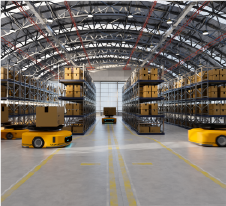


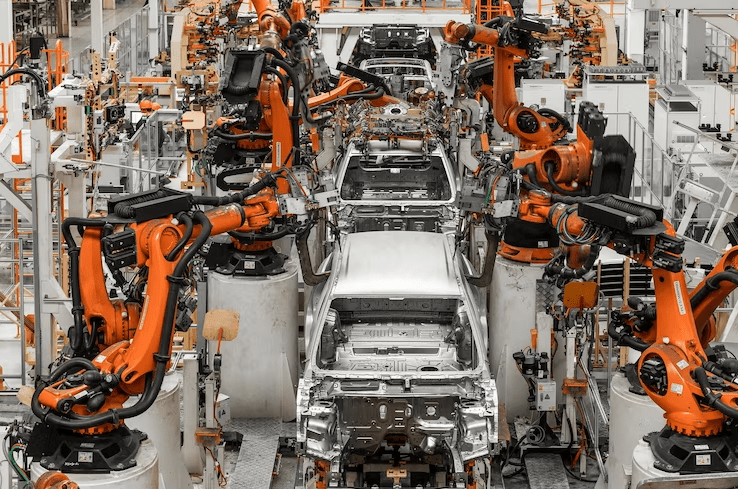
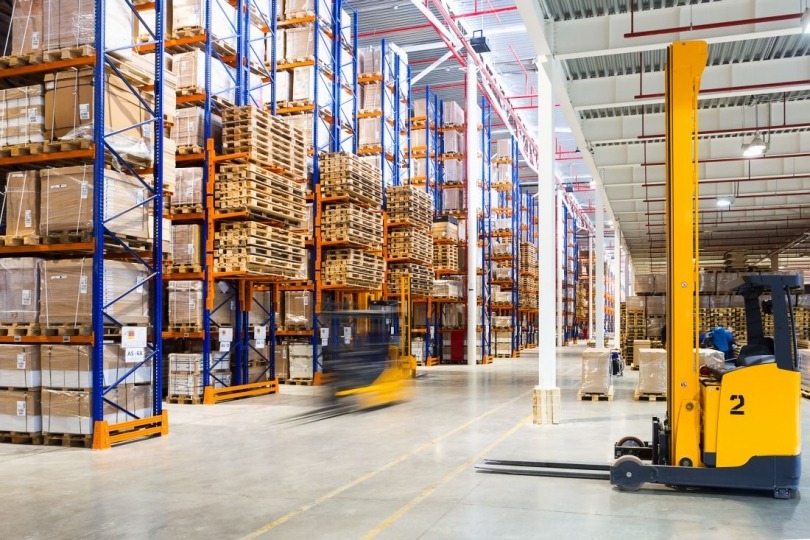
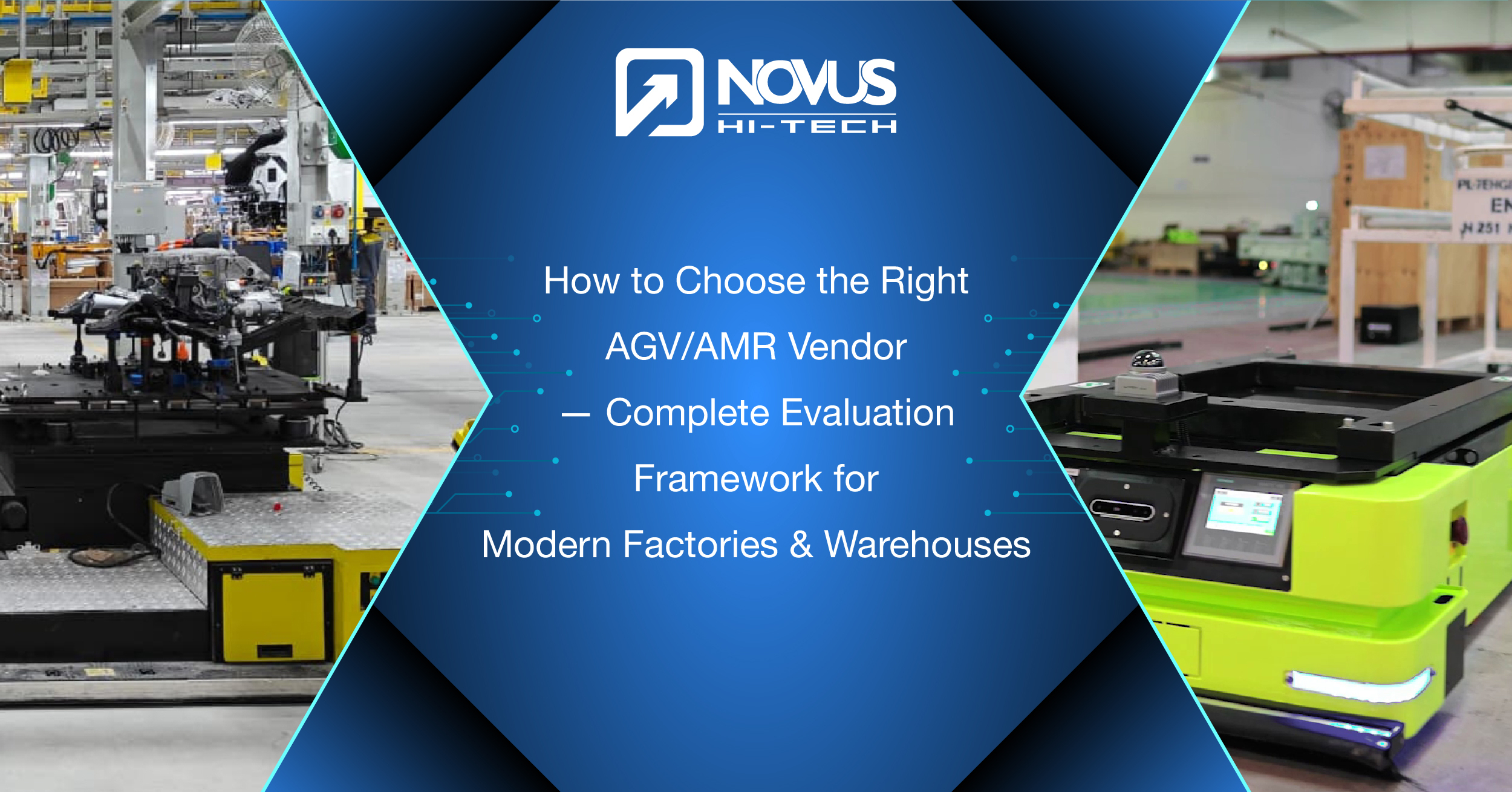
Selecting an AGV (Automated Guided Vehicle) or AMR (Autonomous Mobile Robot) vendor is one of the most important automation decisions a factory or warehouse will make. The right vendor can transform your material flow, safety, and efficiency. The wrong vendor can create operational bottlenecks, hidden costs, downtime, and unsafe environments.
This guide gives you a clear, comprehensive, and practical framework to evaluate AGV/AMR vendors — based on real-world deployments, industry best practices, and technological maturity.
1. What Makes a Reliable AGV/AMR Vendor?
A strong AGV/AMR vendor stands out in three areas:
1. Technology Maturity
Robust navigation, reliable hardware, intelligent software, and safe operations.
2. Intralogistics Expertise
A deep understanding of manufacturing, material flow, warehousing, and the constraints of real production environments.
3. End-to-end Capability
From workflow evaluation → design → integration → commissioning → lifecycle maintenance.
If a vendor lacks strength in any of these three areas, your automation journey becomes risky and unpredictable.
Discover how the right Autonomous Mobile Robot (AMR) solutions drive business efficiency.
Download our free eBook for expert insights and trends!
2. The Complete Vendor Evaluation Checklist
Below is a structured evaluation framework that enterprises use globally before choosing an AGV/AMR solution.
A. Navigation & Technology Maturity
Navigation is the heart of autonomy. A good vendor must demonstrate reliable, safe, and precise navigation across real industrial conditions.
What to evaluate
- SLAM accuracy (2D or 3D LiDAR)
- Obstacle detection and avoidance
- Dynamic rerouting capability
- AI-based perception
- Precision docking (±5–10 mm)
- Map stability in high-traffic zones
Why it matters
Weak navigation leads to slow robots, unnecessary stops, safety risks, and inconsistent cycle times.
How to verify
- Request on-site demo, not PowerPoint
- Test in narrow aisles, turns & high-traffic areas
- Validate logs from actual fleet performance
B. Hardware Reliability & Build Quality
Robots operate 24/7 in demanding environments. Hardware durability directly impacts uptime and maintenance costs.
What to evaluate
- Payload capacity and stability
- Structural rigidity
- Wheel and suspension quality
- Battery type, cycle life & charging strategy
- Safety bumper and emergency stop design
- MTBF (Mean Time Between Failures)
Why it matters
Subpar hardware results in breakdowns, errors in pallet handling, and costly downtime.
How to verify
- Inspect physical robot
- Ask for MTBF documentation
- Review maintenance history from existing deployments
C. Fleet Management Software (FMS)
The fleet manager is the “brain” of AGV/AMR operations — coordinating traffic, tasks, and safety.
What to evaluate
- Multi-robot traffic control
- Task assignment logic
- Congestion management
- Elevator / conveyor / WMS integration
- Analytics & dashboards
- Cybersecurity compliance
Why it matters
Weak fleet management leads to traffic jams, idle time, and unpredictable throughput.
How to verify
- Request live FMS demo
- Review traffic heatmaps & logs
- Check if FMS is scalable from 5 to 50+ robots
D. Safety Architecture
Safety is paramount in environments where robots work alongside people, forklifts, and pallets.
What to evaluate
- Safety-rated LiDAR (SIL2/SIL3)
- 360° protection fields
- Emergency stop system
- Redundant braking
- Predictive collision avoidance
- Compliance with ISO 3691-4
Why it matters
An unsafe robot is a liability — not an asset.
How to verify
- Ask for safety certification documents
- Observe emergency stop response time
- Test robot behavior in dynamic zones
E. Customization & Engineering Capability
Every facility has unique constraints. Custom engineering determines whether automation works smoothly or struggles.
What to evaluate
- Ability to build custom attachments
- Integration with conveyors, racks, lifts
- Top module engineering capability
- Workflow re-engineering experience
- Vision-based pallet detection
Why it matters
A one-size-fits-all approach rarely works in industrial automation.
How to verify
- Request past customization examples
- Review engineering team size & skill depth
F. Integration Expertise
Robots don’t work alone — they must integrate seamlessly with your digital systems.
What to evaluate
- WMS, ERP, MES, SCADA connectivity
- Open APIs (REST, MQTT, OPC-UA)
- Data logging and live monitoring capability
- PLC integration for automated stations
Why it matters
Integration determines whether robots operate independently or become bottlenecks.
How to verify
- Request actual integration case studies
- Test sample API flows
- Check FMS compatibility with existing systems
G. Deployment Process & Timeline
A great vendor has a structured roadmap — not improvisation.
What to evaluate
- Site survey methodology
- Mapping & testing processes
- Safety validation steps
- Operator training modules
- Commissioning documentation
Why it matters
Clear processes ensure predictable deployment and faster time-to-value.
How to verify
- Ask for step-by-step deployment plan
- Review test reports and commissioning templates
H. After-Sales Support & SLAs
Automation success depends on long-term support — not only installation.
What to evaluate
- 24×7 remote monitoring
- On-site service availability
- Spare parts stocking
- Preventive maintenance plan
- Response time & resolution SLA
Why it matters
Downtime is costly. Support is critical for long-term stability.
How to verify
- Request SLA documents
- Validate support center location
- Ask to meet the support team
I. Customer Track Record & References
Real-world proof is the strongest indicator of vendor maturity.
What to evaluate
- Number of deployments
- Diversity of industries served
- Scale of robots deployed
- Customer testimonials
- Multi-year project experience
Why it matters
Vendors with proven, scaled deployments are significantly more reliable.
How to verify
- Ask for reference calls
- Request detailed case studies
- Look for repeat customers
Discover how the right Autonomous Mobile Robot (AMR) solutions drive business efficiency.
Download our free eBook for expert insights and trends!
3. Common Red Flags to Avoid
Be careful if a vendor shows any of the following:
🚩 Only simulation demos, no real robots
🚩 No in-house engineering team
🚩 Overpromising low-cost solutions
🚩 No SLAM or weak navigation capability
🚩 No fleet manager
🚩 Poor documentation or weak SLAs
🚩 Heavy manual intervention required
🚩 Zero integration capability
🚩 No long-term roadmap
🚩 No measurable uptime commitment
Any of these signals risk, downtime, and long-term failure.
4. Conclusion — How to Select the Right AGV/AMR Vendor
A great AGV/AMR vendor should check these boxes:
- Mature technology
- Reliable hardware
- Strong safety compliance
- Scalable fleet management
- Deep intralogistics understanding
- Proven deployments
- Strong SLAs and support
- In-house engineering and R&D
Choosing the right vendor isn’t about choosing the cheapest robot — it’s about selecting a long-term technology partner who can ensure safe, reliable, and scalable intralogistics for years to come.
About Novus Hi-Tech
Novus Hi-Tech is among the few companies globally that design, engineer, and manufacture both AGV and AMR systems entirely in-house. With 150+ patents, 1,200+ mobile robots deployed, 8 million+ km of autonomous travel, and 100+ enterprise customers, we bring unmatched expertise in robotics, AI, and intralogistics.
We support organizations through workflow analysis, vendor evaluation, solution design, integration, and long-term support — ensuring reliable automation from day one.
Looking for the Right AGV/AMR Vendor for Your Facility?
Our automation experts can help you:
- Compare AGV/AMR vendors
- Evaluate navigation quality
- Assess workflow suitability
- Build ROI models
- Plan scalable deployment roadmaps
📩 marketing@novushitech.com
Let’s identify the right vendor — and the right automation strategy — for your factory or warehouse.