

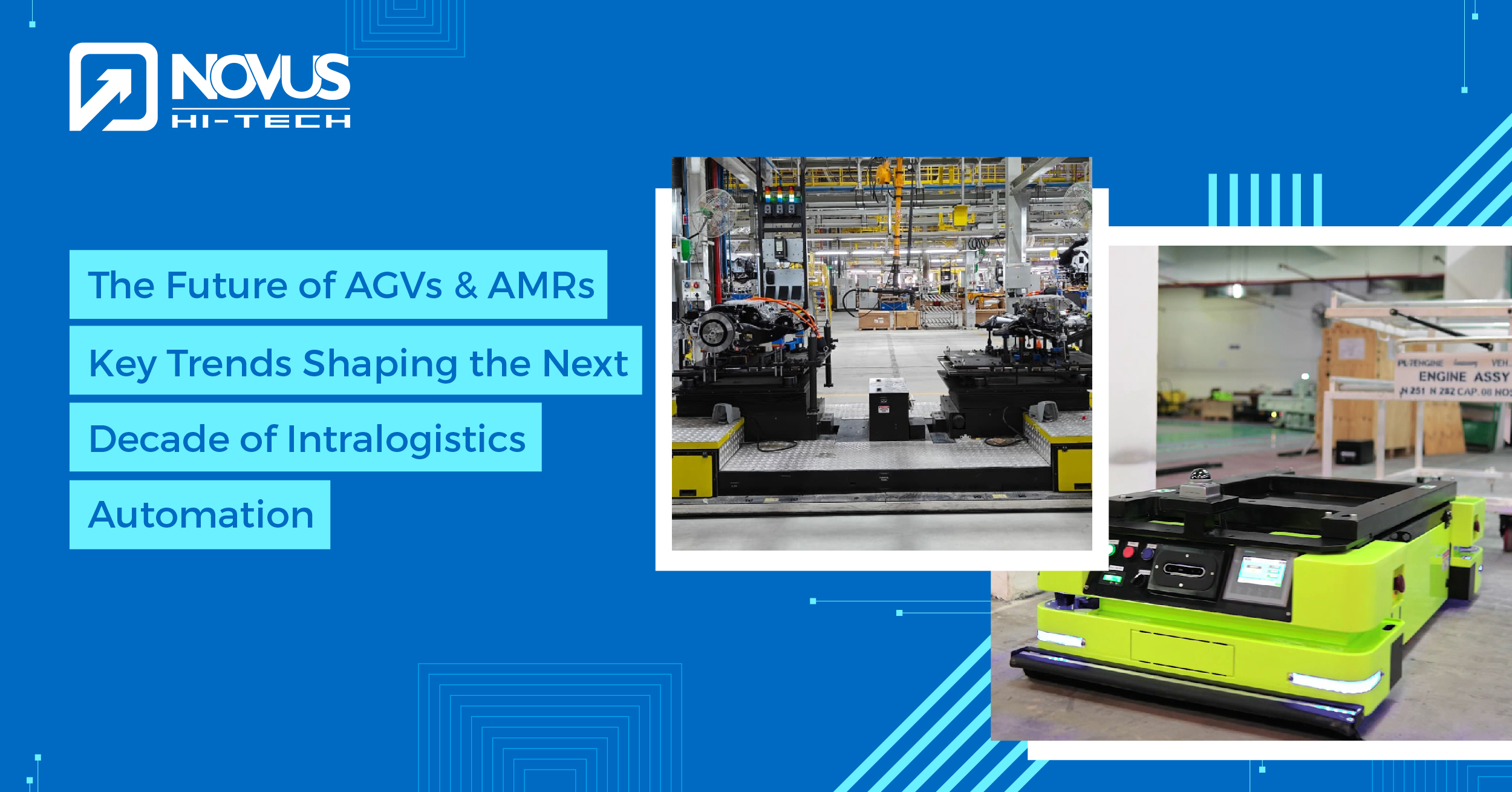
Material handling is undergoing the biggest transformation in decades. As factories and warehouses scale, SKUs multiply, customer expectations tighten, and labor availability becomes unpredictable, industries are moving rapidly toward intelligent autonomous systems.
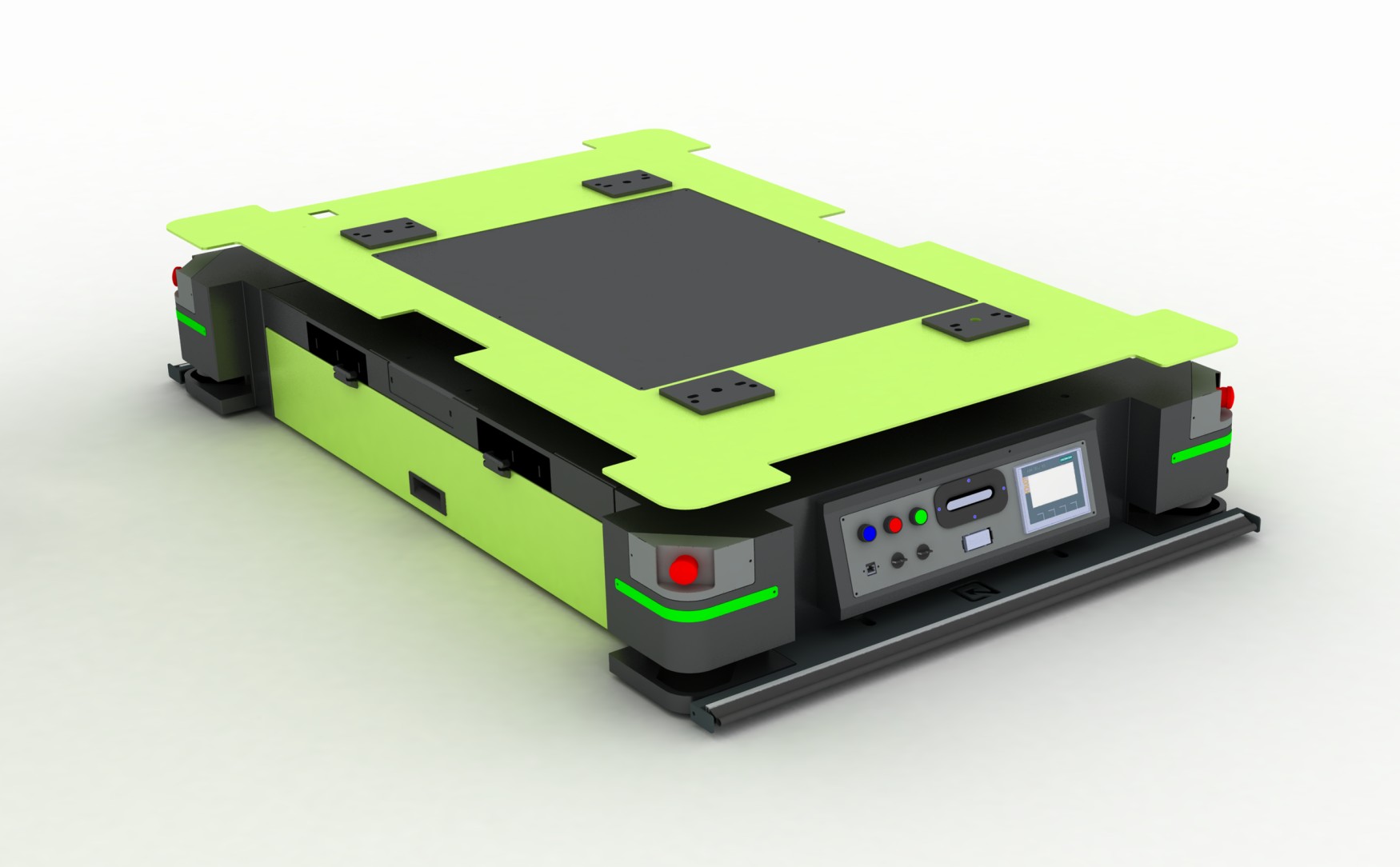
AGVs (Automated Guided Vehicles) and AMRs (Autonomous Mobile Robots) are no longer experimental innovations. They are becoming the backbone of modern intralogistics.
The next 5–10 years will redefine how factories and warehouses operate. This blog explores the most important trends that will shape the future of AGVs, AMRs, and autonomous material movement across industries.
1. AGVs & AMRs Will Converge Into Hybrid Autonomous Fleets
Historically:
- AGVs followed fixed paths
- AMRs navigated dynamically
But modern intralogistics demands both reliability and flexibility.
What’s coming
- AGVs will gain limited dynamic navigation
- AMRs will integrate controlled-guide modes for precision
- One fleet manager will coordinate AGVs + AMRs together
- Robots will share lanes with coordinated traffic intelligence
The future is not AGV vs AMR —
it is AGV + AMR operating together as a unified autonomous ecosystem.
Discover how the right Autonomous Mobile Robot (AMR) solutions drive business efficiency.
Download our free eBook for expert insights and trends!
2. AI Will Transform Robots Into Self-Optimizing Systems
Today’s robots can avoid obstacles and plan routes.
Tomorrow’s robots will predict them.
AI advancements will enable:
- Predictive path planning
- Forecasting congestion before it happens
- Intelligent job scheduling
- Load-based route optimization
- Battery health prediction and charge planning
- Environmental understanding (temperature, floor condition, traffic hotspots)
Automation will shift from reactive → proactive → self-optimizing.
3. Vision-Powered Robots Will Become the New Norm
Current robots heavily depend on LiDAR.
The future belongs to vision + LiDAR + AI fusion.
This will unlock:
- Vision-based pallet detection
- Human pose prediction for safer movement
- Enhanced obstacle classification
- Pure vision docking (no reflectors needed)
- Automated picking and placing applications
Vision gives robots human-like perception, increasing safety and precision.
4. Fleet Managers Will Evolve Into Intelligent Control Towers
Next-gen fleet management platforms will move beyond task assignment.
Capabilities of future fleet control towers:
- Multi-zone orchestration
- Predictive workload distribution
- Smart batching and task grouping
- Real-time performance forecasting
- Integration with planning systems (ERP, APS, WMS, MES)
- Automated exception handling
Fleet coordination becomes a decision-making engine, not just monitoring software.
5. Human–Robot Collaboration Will Become Seamless
The future factory is collaborative, not segregated.
Key developments:
- Shared aisles for people and robots
- Behavioral prediction using AI
- Dynamic speed zones around humans
- Cooperative workflows (picker + AMR, assembler + AMR)
- Robots supporting human teams instead of replacing them
Robots become teammates — enabling safer, more productive operations.
6. Multi-Floor & Multi-Building Automation Will Become Standard
Large facilities will rely on autonomous logistics spanning multiple levels and buildings.
What’s evolving:
- SLAM mapping across multiple floors
- Native elevator integration
- Inter-building navigation
- Outdoor-to-indoor transitions
- Campus-wide robot fleets
This unlocks automation for campuses, multi-building warehouses, ports, and large manufacturing plants.
7. Robots Will Handle Much Heavier Loads Than Today
Traditionally:
- AGVs = heavy loads
- AMRs = medium/light loads
Future direction:
- AMRs will move 2–5 ton loads
- Heavy-duty AMRs will replace forklifts in many environments
- Modular AGV–AMR hybrids will emerge
- Specialized high-capacity robots for coils, dies, engines, and molds
High-load + high-flexibility will define next-gen robots.
Discover how the right Autonomous Mobile Robot (AMR) solutions drive business efficiency.
Download our free eBook for expert insights and trends!
8. Battery Technology Will Advance Significantly
Battery performance drives uptime and fleet size.
Expected improvements:
- LFP and solid-state dominance
- Faster opportunity charging
- 3,000–6,000 cycle lifespans
- Heat-resistant designs for cold storage & hot environments
- Predictive battery analytics
Longer runtime → smaller fleet → higher ROI.
9. Modular, Customizable Robots Will Become the Standard
Future fleets will offer plug-and-play configurability.
Modular advancements:
- Replaceable top modules
- Tugger + pallet + conveyor hybrid robots
- Add-on vision modules
- Inbuilt IoT scanners
- Adjustability for new workflows without redesigning robots
Customizations will become faster and more affordable.
10. Autonomous Decision-Making Will Expand Dramatically
Robots will begin taking situational decisions previously handled by operators.
Examples:
- Dynamic route switching
- Self-adjusted speed control
- Automated downtime prediction
- Reassigning jobs based on priority
- Coordinating with production plans in real time
Robots evolve into intelligent logistics agents, not just carriers.
11. Digital Twins Will Guide Robot Deployment and Optimization
Digital twins will become a standard tool in automation planning.
They will support:
- Real-time simulation of material flow
- Predictive congestion mapping
- Virtual commissioning before deployment
- Fleet productivity forecasting
- Rapid scale-up with minimized risk
Every successful large-scale deployment will rely on digital twin models.
12. Outdoor & Yard Automation Will Accelerate
Autonomous systems will move beyond four walls.
Key innovations:
- GPS + RTK + vision outdoor navigation
- Dock-to-yard transport
- Container movement
- Trailer and pallet tracking
- Autonomous truck/van loading assistance
This will transform ports, 3PL hubs, and industrial campuses.
13. Safety Standards Will Become More Stringent Globally
Expect stronger regulatory frameworks.
What will evolve:
- ISO 3691-4 enhancements
- Better compliance for mixed environments
- Safety-rated perception systems
- Cybersecurity norms for connected robots
- Unified reporting and audit systems
Vendors that cannot meet advanced safety requirements will fall behind.
14. Large Multi-Site Fleets Will Become Common
Deployments will expand from 5–20 robots to hundreds across multiple facilities.
The future fleet:
- 50+ robots in a single warehouse
- 100–200 robots in large factories
- Shared fleet orchestration across sites
- Standardized KPIs and analytics across networks
Automation becomes an enterprise strategy, not a site-level project.
15. Open Standards Like VDA 5050 Will Enable Multi-Vendor Fleets
Today, most fleets run on a single vendor’s robots.
In the future, factories will combine AGVs and AMRs from multiple suppliers.
The enabler of this shift is VDA 5050 — an open communication protocol that allows AGVs/AMRs from different brands to operate under one fleet manager.
VDA 5050 will enable:
- True multi-vendor interoperability
- Single traffic management across mixed fleets
- Freedom to choose the best robot for each workflow
- Reduced vendor lock-in
- Easier scaling across sites and geographies
This is one of the most important future trends in intralogistics automation.
Conclusion — The Next Decade of Autonomous Intralogistics
AGVs and AMRs will define the next generation of smart factories and digital warehouses.
The industry is shifting toward:
- Hybrid autonomous fleets
- AI-driven decision-making
- Vision-powered perception
- Multi-floor and multi-building autonomy
- Heavy-load intelligent robots
- Digital twin planning
- Open standards like VDA 5050
- Human-robot collaboration
- Large-scale, enterprise-wide fleets
Organizations preparing today will lead the next decade of industrial transformation.
About Novus Hi-Tech
Novus Hi-Tech is a global pioneer in AI-driven robotics and indigenously engineered AGV/AMR systems. With 150+ patents, 1,200+ mobile robots deployed, 8 million+ autonomous kilometres traveled, and 100+ enterprise customers, Novus delivers world-class mobile robotics built for safety, scalability, and reliability.
Our R&D, engineering, and integration teams work across industries — automotive, FMCG, electronics, pharma, warehousing, and more — enabling enterprises to build future-ready intralogistics systems.
Looking to Build Your Future Automation Roadmap?
If you’re evaluating AGVs, AMRs, hybrid fleets, or long-term automation strategy, our experts can help you:
- Understand future-ready technologies
- Build multi-year automation plans
- Assess workflows and scale potential
- Model ROI and implementation paths
📩 Connect with us: marketing@novushitech.com
Let’s design the next decade of intelligent intralogistics — together.