
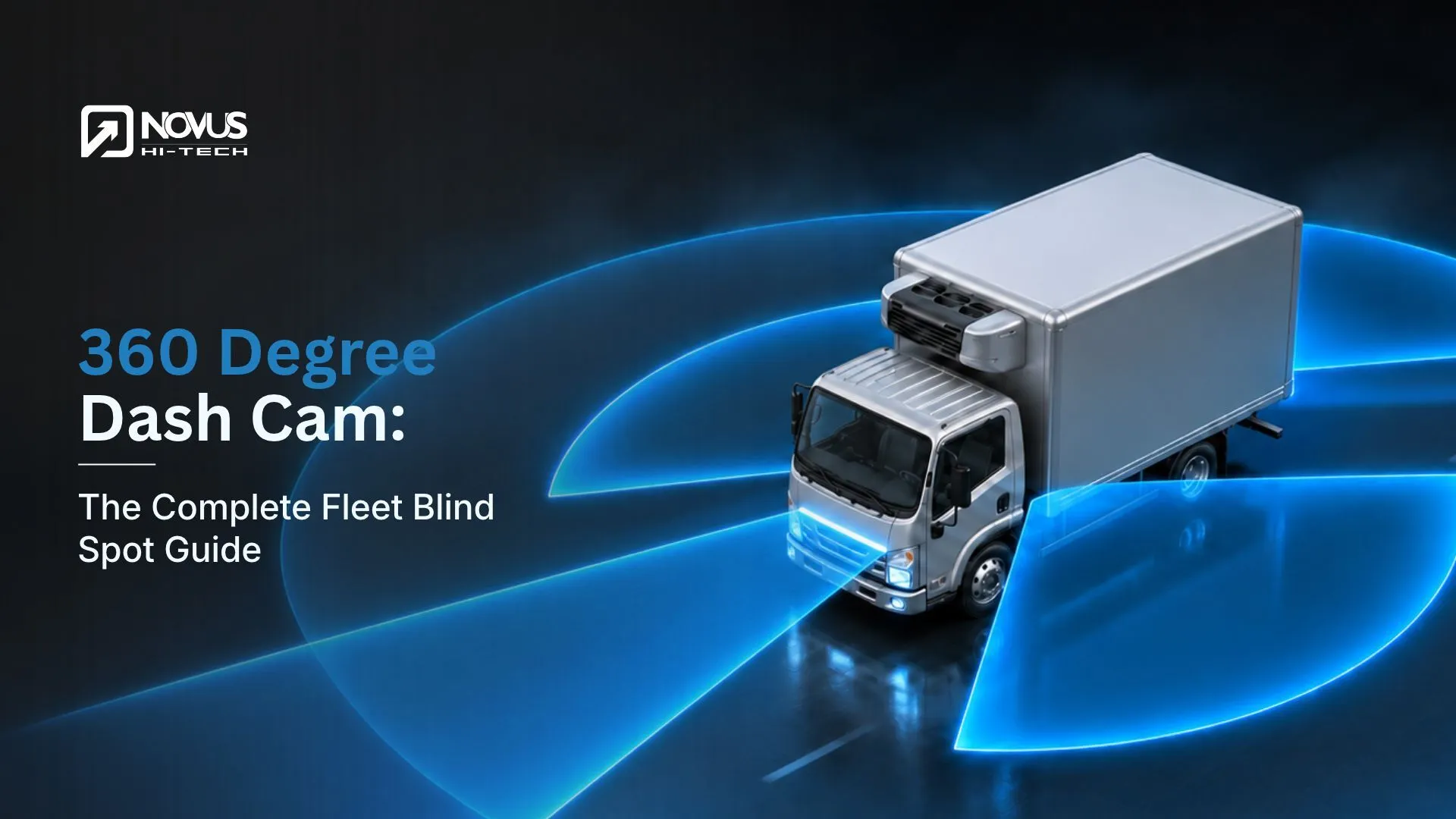
A 360 degree dash cam stitches four wide-angle cameras into one bird’s-eye view around a truck, exposing the zones mirrors cannot show. For Indian fleets, the best system is the one calibrated to your cab height, mirror setup, and body length, with alerts that fire before a pedestrian or two-wheeler enters the danger zone.
Quick Takeaways
- A 360 degree dash cam combines front, rear, left, and right cameras into a single top-down view.
- Blind-spot risk on heavy trucks comes from cab height, short front visibility, and long rear bodies.
- Calibration decides accuracy. An uncalibrated system draws a map that does not match the real truck.
- Left-side and front close-in zones matter most on Indian roads, where two-wheelers filter on the kerb side.
- Pick a system with AI alerts, 24V compatibility, dust and water protection, and fleet-wide reporting.
- Verify every vendor claim against a current spec sheet and a yard test on your own vehicle.
How Does a 360 Degree Dash Cam Eliminate Truck Blind Spots?
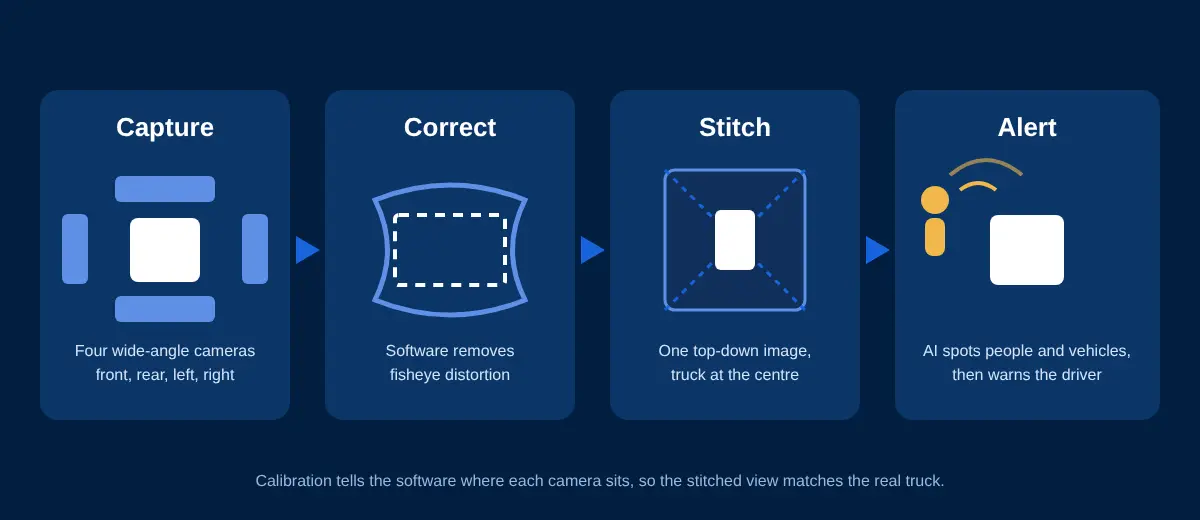
The system works in four steps:
- Capture. Four wide-angle cameras sit on the front, rear, and both sides, each covering roughly 180 degrees.
- Correct. Software removes the fisheye distortion from each feed.
- Stitch. The feeds merge into one top-down image, with the truck drawn at the centre.
- Alert. AI detects people, two-wheelers, and vehicles inside the zones around the truck and warns the driver through the display, a buzzer, or both.
The stitch only works if each camera’s position, height, and angle are known to the software. That is why calibration, covered below, matters more than camera resolution.
The stitch only works if each camera’s position, height, and angle are known to the software. That is why calibration, covered below, matters more than camera resolution.
Where Are the Blind Spots on Indian Trucks?
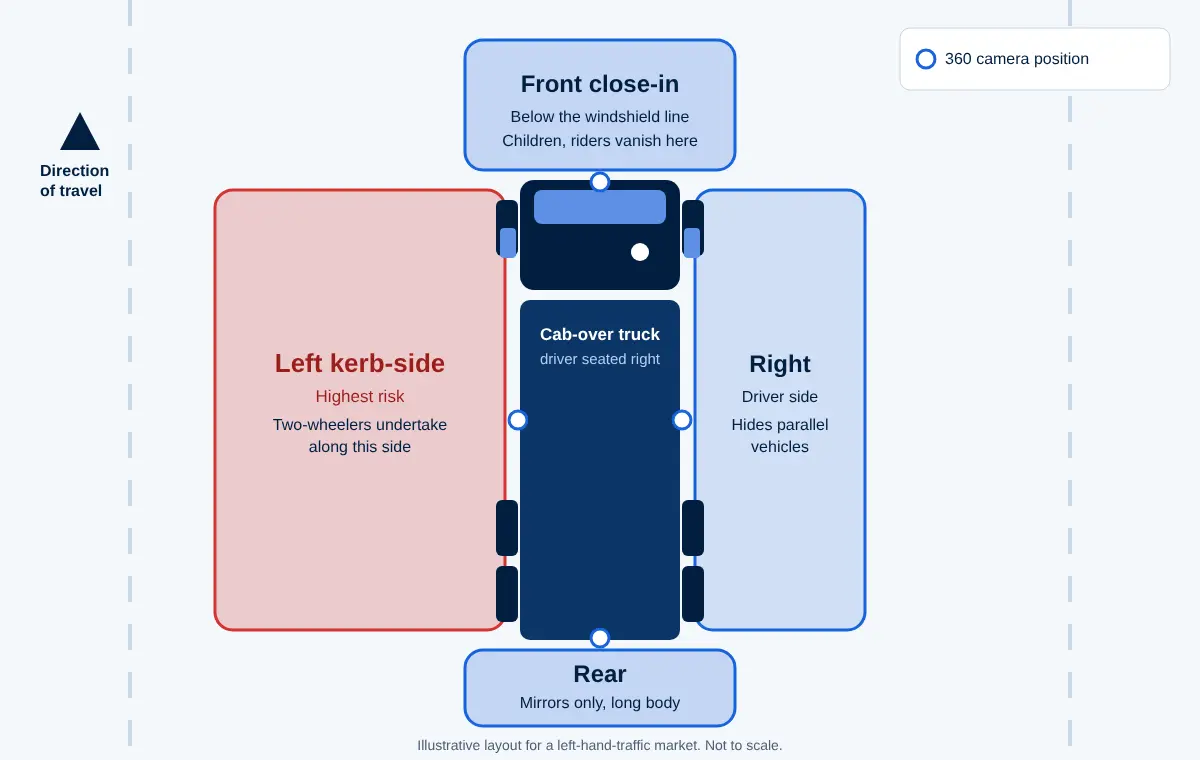
Most heavy trucks in India use a cab-over layout. The driver sits high and close to the front axle, with no hood ahead. Four zones carry the risk:
- Front close-in zone. The area directly ahead of the bumper, below the windshield line. A pedestrian, child, or two-wheeler can disappear here.
- Left (kerb-side) zone. India drives on the left, so riders overtake and undertake along this side. It is the most common zone for two-wheeler conflicts.
- Right (driver-side) zone. Smaller than the left, but it hides vehicles running parallel on multi-lane highways.
- Rear zone. Long bodies and trailers leave the driver with mirrors only. Reversing without a camera is the main risk here.
Road safety data shows why this matters. India recorded 1.77 lakh road deaths in 2024, according to the government’s annual road accident report. The India Status Report on Road Safety 2024 from the TRIP Centre at IIT Delhi found that trucks account for the highest share of impacting vehicles, meaning the vehicle that caused the crash. Blind spots are one cause among several, but they are one of the few that hardware can reduce.
How Do You Map Blind Spots on an Ashok Leyland 3718, Tata Signa, or Eicher Pro 6000?
All three are heavy-duty trucks with high cabs, but the exact blind zone changes with cab variant, seat height, mirror configuration, and the body or trailer fitted. Measure each vehicle instead of trusting a generic chart. Use this method:
- Park the truck on level ground with the driver seated at the normal eye position.
- Place a marker at pedestrian height at 0.5 m intervals along each side.
- Record the distance at which the driver loses sight of the marker, using direct view and mirrors.
- Repeat with a two-wheeler-height marker.
- Overlay the results on the camera coverage to find the gaps.
Log the results for every truck in your fleet:
| Truck | Front close-in (m) | Left, kerb-side (m) | Right, driver-side (m) | Rear (m) |
| Ashok Leyland 3718 | Measure | Measure | Measure | Measure |
| Tata Signa | Measure | Measure | Measure | Measure |
| Eicher Pro 6000 | Measure | Measure | Measure | Measure |
Record pedestrian and two-wheeler distances separately, then use the larger value to set your alert zones.
How Do You Calibrate a 360 Degree Dash Cam on a Heavy Truck?
Follow this sequence on every vehicle:
- Fix the camera positions. Mount all four cameras at the heights and angles in the install guide, and note them.
- Prepare a flat yard. Use level ground with a calibration pattern or floor markers around the truck.
- Run the stitching calibration. Let the software align the four feeds against the pattern.
- Check the seams. Walk a marker along each seam and confirm it passes without distortion or jumps.
- Set the alert zones. Match warning distances to your measured blind-spot map.
- Test with live targets. Use a marker or a trained crew member to confirm alerts fire at the right distance.
- Recalibrate after changes. Repeat after any body change, cab repair, or camera replacement.
How Does a 360 Degree Dash Cam Differ from an AI Fleet Dash Cam?
Fleet video safety splits into two categories. Global leaders such as Netradyne and Samsara lead with AI event detection and driver coaching. A surround-view system focuses on what the driver cannot see around the truck. Most fleets need both functions. Confirm side and rear camera options on each vendor’s current spec sheet.
| Criteria | Surround-view 360 system | AI event-detection dash cam | Novus Safe Pro |
| Main goal | Show the area around the truck | Detect risky driving events | Collision avoidance and driver monitoring |
| Best for | Blind-spot reduction, reversing, yard work | Coaching and event evidence | Fleets that want alerts and driver monitoring on existing trucks |
| Installation | Four exterior cameras, mapped per cab type | Road-facing and driver-facing, generic mounting | Aftermarket retrofit |
Novus Safe Pro is built for aftermarket retrofit. Novus has analysed 7B+ km of driving data across 120,000+ vehicles and 200,000+ drivers in 10+ countries. Explore Novus Hi-Tech’s fleet safety solutions.
What Should You Look for When Buying a 360 Degree Dash Cam?
Use this checklist to evaluate any dash cam:
- Calibration support. The vendor should supply a documented process and tools for your truck models.
- 24V compatibility. Most Indian heavy trucks run 24V systems, so check the input range.
- Ingress protection. Look for dust and water ratings suited to monsoon and construction-site use.
- Night performance. Test low-light output under real yard lighting.
- AI detection. The system should detect people and two-wheelers and warn them before contact.
- Local recording and cloud upload. Evidence should survive network gaps on remote routes.
- Fleet dashboard. Managers need alerts, clips, and driver-level reports in one place.
- Local support. Installation and recalibration need technicians in your region.
Also read our guide on Choosing the Right Dashcam for Business Use.
Does Region Change the Buying Decision in India, SEA, and Global Markets?
Yes, in three ways:
- Driving side. India, Thailand, Malaysia, and Indonesia drive on the left, so the kerb-side blind zone is on the passenger side. Vietnam drives on the right, so the zone flips. Set alert logic to match.
- Road mix. Dense two-wheeler traffic in India and SEA raises the priority of side and front close-in detection.
- Climate. Monsoon, dust, and heat call for strong sealing and thermal ratings.
Check current national requirements before rollout in each market. For India, start with the Ministry of Road Transport and Highways and its Road Accidents in India reports.