
Physical AI cybersecurity comes down to one question: what happens when an attack moves a robot rather than just freezing a screen?
A hacked laptop results in a data leak. A hacked robot can stop a line, drop a load, or put a team at risk.
That risk increases as more factories become connected. Robots are now connecting to sensors, to fleet software, and to enterprise systems (WMS, MES, and ERP). Every connection is another door.
Manufacturers have always prioritized safety and reliability. Cybersecurity is now very much on that same list.
This blog looks at the risks, the data, and the standards around robot cybersecurity so you know what to be asking before connected robots go live.
Quick Overview
- Physical AI cybersecurity protects a robot from attacks that change what it senses, decides, and does.
- A compromised robot affects uptime and safety, not just data. Every IT/OT link, remote connection, and third-party tool adds risk.
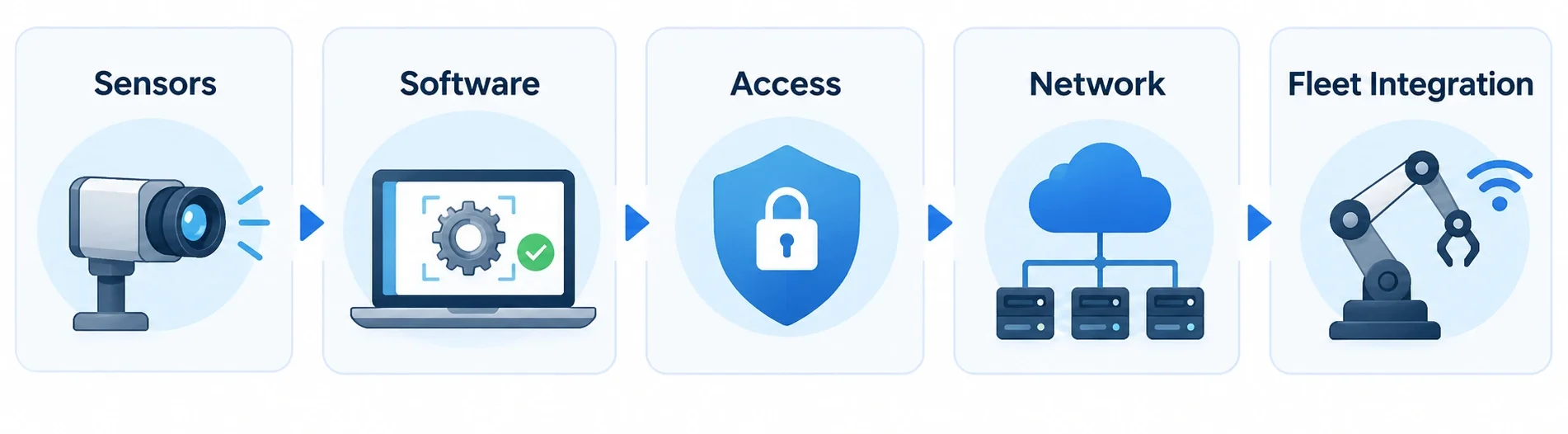
- Five paths matter most: sensors, AI models and software, robot access, networks, and fleet and enterprise integration.
- Manufacturing made up over two-thirds of ransomware victims among industrial organizations, and detection speed drives incident cost.
- IEC 62443, NIST, and CISA guide planning but don’t certify a robot, so build security in from procurement, not at the end of rollout.
What Is Cybersecurity in Physical AI?
Physical AI cybersecurity protects AI machines from attacks that alter what they perceive, what they decide, and what they do.
Physical AI is systems that perceive, decide, and act in the physical world. That’s autonomous mobile robots, forklifts, robotic arms, and self-driving vehicles.
Cybersecurity in this setting guards everything that shapes a robot’s behavior:
- Sensors and perception: cameras, LiDAR, and location data
- AI models and software: the code and models that make decisions
- Networks and access: wireless links, APIs, and user permissions
- Fleet and enterprise systems: fleet software and its links to WMS, MES, and ERP
Three goals guide the work:
- Control: Only authorized people and software can command the robot.
- Trust: Inputs, models, and updates all arrive intact and unaltered.
- Uptime: The robots keep working safely should anything go wrong.
Robot cybersecurity cannot simply replicate an IT playbook because of these goals.
Why Physical AI Cybersecurity Differs From Standard IT Security
IT security is about protecting data. OT cybersecurity is about protecting the machines that actually do the work (move, heat, lift, cut). Physical AI adds a third layer in the form of systems that are capable of sensing and making decisions on their own.
Four shifts widen the attack surface:
- IT and OT convergence: Robots are now talking to the enterprise systems that used to be behind the walls.
- Remote connectivity: Vendor support, cloud dashboards, and remote updates all open up the door.
- Third-party software: vision models, open-source libraries, and fleet software from several suppliers.
- Autonomous decisions: The robot is acting on what it perceives; therefore, bad input can lead to bad movement.
Attackers are already targeting factories. Dragos’ 2026 OT Cybersecurity Year in Review shows 119 ransomware groups targeting industrial organizations in 2025 (up from 80 the year prior). Manufacturing was responsible for over two-thirds of the victims.
Securing the robot in isolation doesn’t solve this. The robot is part of a system (sensors, controller, fleet manager, network, vendor access, and enterprise software). The attacker only needs to get into one of the weakest links.
Many of these exposures arise when a pilot becomes a production fleet. This physical AI deployment guide explains how a factory pilot gets to production.
Five Ways Attackers Can Reach a Physical AI System
Industrial robotics cybersecurity covers five main directions.
Sensor and Perception Manipulation
Robots trust their sensors. The cameras, the LiDAR, and the location data all tell the robot where it is and what’s in front of it.
Misleading or blocked input can change what the robot thinks. It may stop for no reason, take the wrong path, or misjudge a gap.
Small errors matter most when you’re close to people and equipment.
Multiple sensing methods help here. Novus’s autonomous forklifts, for example, pair laser SLAM with vision navigation, so the robot has more than one view of its surroundings.
AI Model and Software Tampering
A different model or modified software will change how the robot behaves. Three entry points stand out:
- A compromised AI model
- Unauthorized software changes
- Firmware updates that nobody verified
A tampered model can appear perfectly normal in day-to-day use. That’s what makes the change so difficult to detect.
Weak authentication, open interfaces, and overly permissive user rights all provide easy points of entry.
SecurityWeek reported a critical flaw (CVSS 9.8) in the control software of a very common collaborative robot in May 2026. An unauthenticated attacker with network access could run commands on the controller. A patch was provided by the vendor.
These networks are often flat, so a first foothold may not be too hard to get, researchers cited in the same report said.
Communication and Network Attacks
Robots depend on wireless networks, APIs, and constant contact with fleet software. Each of those channels can be used to transmit spoofed commands, intercepted data, or replayed messages.
Mobile robots are out on the floor all day. Autonomous robot security is predicated on those links being trustworthy.
Fleet Management and Enterprise Integration
One fleet manager can command dozens of robots. One compromise can reach all of them.
Links to WMS, MES, and ERP systems open paths in both directions. An attack on either side can disrupt the other.
A fleet system supplied with the robots gives teams one integration to map instead of several. Novus’s fleet management system, for example, handles task allocation, routing, and fleet-level control for its autonomous mobile robots, with integration support for the systems around them.
To see how the pieces connect, read this fleet management guide. This AMR guide traces how a WMS task reaches the robot.
What a Cyber Incident Costs a Connected Factory
Numbers prove why this is important. The IBM Cost of a Data Breach Report 2026 puts the global average at $4.99m (a record). Industrial breaches are even more expensive at $5.5m.
Dragos adds the operations view. Their incident response team saw massive operational disruption in every single OT ransomware case they dealt with in 2025.
| Metric | Figure | Why it matters |
| Average breach cost, industrial sector | $5.5M, up from $5.0M | Downtime and lost business drive the bill |
| Ransomware groups targeting industry | 119 in 2025, up from 80 | More attackers means more attempts |
| Industrial organizations hit | About 3,300 | The problem reaches well beyond a few plants |
| OT ransomware dwell time | 42 days on average, 5 days with strong OT visibility | Detection speed decides the impact |
Where Physical AI Security Programs Slip
Even a careful team will miss a few things. Five gaps show up often:
- Robots missing from the asset list. IT has their laptops and servers tracked. Robots don’t generally fall into that IT inventory.
- Vendor defaults left in place. Default credentials and open interfaces can remain active.
- Flat networks. One breach and you’ve got the robots, the controllers, and the business systems all compromised.
- No clear owner. IT, OT, the operations people, and the robot supplier all believe it’s someone else’s responsibility.
- Security was added in after go-live. Safety and throughput are important, and security is the last thing we do.
- Operational data gives teams a baseline for normal behavior, which makes unusual behavior easier to spot. Fleet tools such as Novus Analytics track cycle times, throughput, and system health across a robot fleet.
These gaps won’t be apparent on a spec sheet. They’ll be apparent in the course of an incident.
Physical AI Cybersecurity Standards and Frameworks Manufacturers Should Know
Four references shape most robotics cybersecurity conversations:
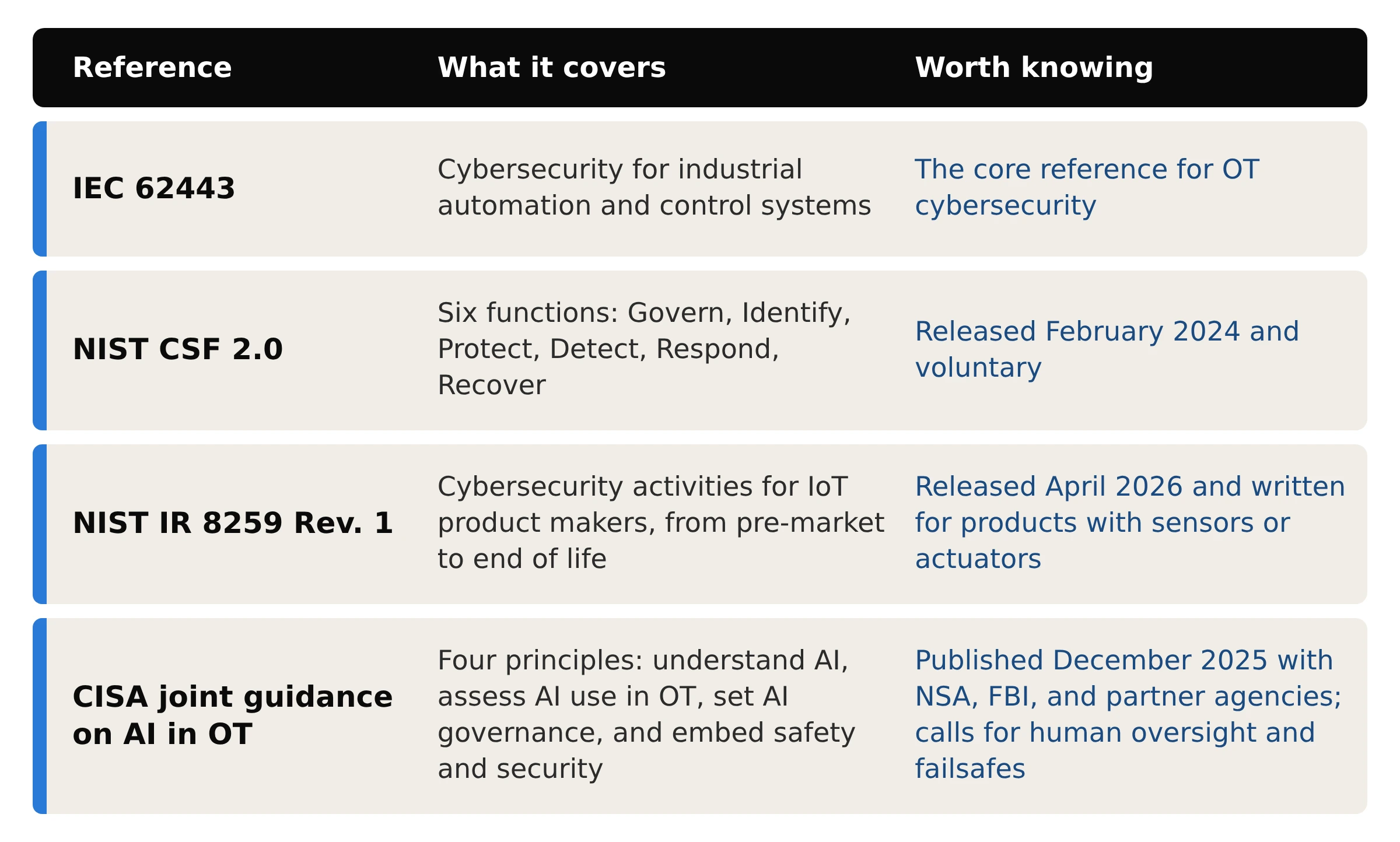
These frameworks are for planning purposes only. They do not certify a robot or a robotics provider.
Expectations for connected robots are ever-increasing. The guide to AGV and AMR trends lists cybersecurity standards as one of the safety standards that are expected to become more stringent.
Physical AI Cybersecurity Starts Before the First Robot Ships
Security can’t wait until the end of a rollout. It belongs in procurement, integration, deployment, and daily operation.
Robots keep gaining sensors, models, and connections. Each one adds value. Each one adds exposure.
Every new robot connection raises a new question. Bring yours to the Novus team.
Physical AI cybersecurity matters at every stage of a robot’s life, from the first quote to the final update.