
ADAS verification and validation answers the question before launch: Will this system be strong on a loaded truck, regardless of the road, weather, and the light?
A collision warning can pass every bench test and still fail on the highway. Glare, dust, a tired driver, and a fully loaded trailer will all affect the outcome.
If you lead a commercial vehicle program, write ADAS test cases, or sign off on safety evidence, this breakdown of ADAS testing is for you.
Key Takeaways
- Verification ensures the system is built right. Validation ensures it works on the real road.
- Commercial vehicles need their own test evidence. You can’t just take the passenger car results and carry them over.
- Good coverage of sensors, decision logic, vehicle integration, driver interaction, and safety requirements.
- Strong test scenarios will incorporate common crashes as well as the odd edge case (glare, dust, blocked sensors, etc.).
- Simulation, test tracks, and public roads all prove different things. None of them proves everything.
- Before you go any further and select a partner, you need to get scenario coverage, false alert data, and full load evidence.
Why Commercial Vehicle ADAS Needs Its Own Test Plan
Trucks and buses don’t behave like cars. Four differences shape every commercial vehicle ADAS program:
- Stopping distance. A heavy load will require a lot more distance to stop.
- Sensor mounting. Cab-mounted cameras and radar are high up and subject to constant vibration.
- Trailers. Articulation changes what the sensors see in a turn and in a lane change.
- Duty cycles. After all that time in the dust, the rain, and the heat, the hardware and the calibration get worn down.
Blind spots also vary from truck to truck. Novus has a 360-degree dash cam guide, which shows you how to map and calibrate them.
The stakes go way beyond the cab. The NHTSA’s 2023 large truck data shows 5,472 deaths in large truck crashes. 70% of those killed were occupants of other vehicles.
Regulators are moving in the same direction. The 2026 federal agenda has a joint NHTSA/FMCSA proposal for AEB on heavy trucks. That proposal includes test procedures for measuring system performance
ADAS Verification vs. ADAS Validation: Two Different Questions
Teams will often use the two terms as if they’re the same. They’re answering two different questions.
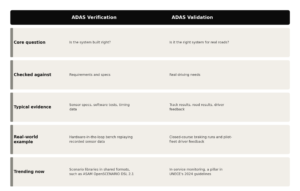
The ADAS verification process checks that each component (sensor, software logic, braking interface, etc.) meets its requirements. The ADAS validation process is the process of checking that the whole system protects people in real traffic. That vehicle level check is ADAS system validation.
Both are in the realm of automotive V&V. ISO 26262 is the one that deals with functional safety. ISO 21448 is the one that deals with risks that can occur even when nothing is actually broken.
AI-based perception adds a further dimension. ISO/PAS 8800 provides guidance on how to demonstrate that the functions of AI (e.g., object detection) do not pose an excessively high risk.
Validation also has a real cost. It appears as a separate line item on the ADAS bill of materials.
What ADAS Verification and Validation Covers on a Commercial Vehicle
Strong programs look at five areas:
- Sensor performance: range, detection accuracy, and calibration drift under vibration, glare, rain, and dust.
- Decision logic. Warning timing, braking triggers, and false alert rates.
- Vehicle integration. Brake response at full load and signal timing throughout the vehicle network.
- Driver interaction. Alerts that a driver can see, understand, and trust.
- Safety requirements. Test evidence that can be linked back to functional safety and the intended function of the product.
Each feature has its own evidence, from forward collision warning through to blind spot monitoring. Novus has its own ADAS features for trucks, which cover the nine features it considers most important for trucks.
False alarms obviously need to be looked at more closely. Drivers will learn to just ignore the constant false alarms or will switch the system off.
ADAS Test Scenarios That Separate Strong Systems From Risky Ones
Standard ADAS test scenarios mix common crashes with ugly edge cases:
- A stopped or slow vehicle ahead at highway speed
- A close cut-in from the next lane
- Pedestrians and cyclists crossing in the dark
- Low sun, wet roads, dust, and tunnel exits
- Curves and lane changes with a trailer attached
- A dirty or partly blocked sensor
Regulators already write the tests that way. The 2024 NHTSA AEB standard for light vehicles requires systems to avoid contact with a lead vehicle in specified tests at speeds up to 62 mph. It also establishes pedestrian detection and braking tests under daylight and darkness conditions. The heavy vehicle teams can take those as a floor and then add on the loaded truck cases.
Dark conditions are why this is so important. In AAA’s 2025 closed course tests of four passenger cars, it was found that pedestrian emergency braking avoided impact in 60% of the nighttime runs (that’s up from 0% in 2019). The AAA study evaluated four passenger vehicles in controlled nighttime testing.
Results still ran the range from clean avoidance all the way to total loss of detection. A loaded truck takes more distance to stop, so the margin is reduced. Novus covers how fleets assess pedestrian and cyclist detection in its Pedestrian Detection ADAS guide.
Not all scenarios are equal. ISO 34505:2025 rates them on frequency, criticality, and complexity. It’s specifically for Level 3 and above in automated driving, but ADAS teams can certainly use the same approach to prioritize their test cases.
Real-World ADAS Testing: What Each Test Environment Proves
No one environment proves the system. Each one answers part of the question:
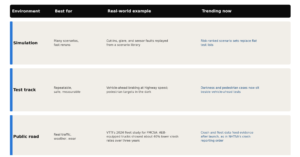
Simulation is all down to the quality of the models. Track tests are the repetition of scripted cases. Road tests provide the unscripted scenarios (which are of course much harder to repeat).
Strong ADAS verification and validation programs incorporate all three.
Where ADAS Verification and Validation Programs Slip
Even the strongest teams will miss a few things. Five gaps catch them off guard:
- Tested at curb weight. A truck that brakes perfectly when it’s empty can do quite a different thing when it’s fully loaded.
- Treating calibration as a one-off job. Vibration and repairs will all tend to shift the sensor alignment over time.
- Tuning only for fewer false alerts. Quieter systems build driver trust, of course, but aggressive filtering can, in fact, hide the real threats.
- Skip the ugly weather cases. Rain, dust, and low sun will all cut what the camera and radar see.
- Let software updates go straight through review. A tiny bit of code can change the warning and braking behavior.
A spec sheet will show none of these gaps. You’ll find them in the road test.
From Test Plan to Production: Where Novus Fits
Novus Hi-Tech provides end-to-end OEM ADAS development in the areas of external perception, in-cabin driver monitoring, sensor fusion, and software engineering.
Explore Novus ADAS for OEMs or get in touch with the Novus team about your program.
Strong ADAS verification and validation starts long before the prototype reaches the road