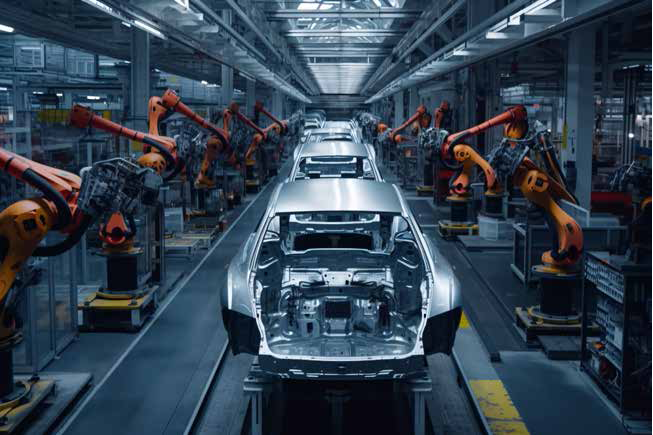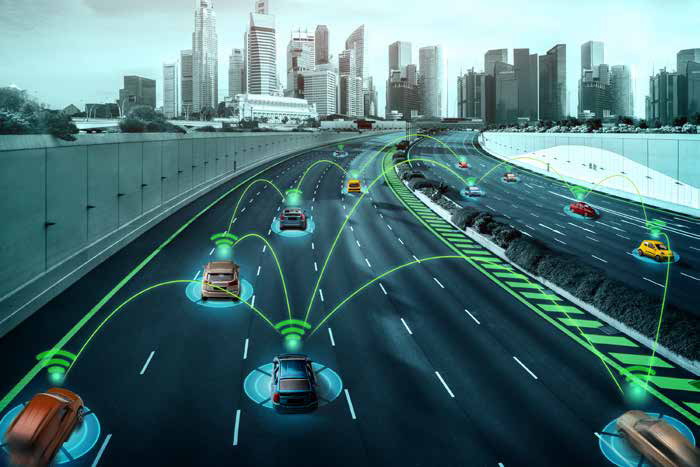

Your optimal automation cell operates seamlessly until a product change occurs. At that point, production halts, engineers gather at the control panel, and output stops as a machine designed for a specific task must adapt to a new one.
Physical AI in manufacturing bridges that gap. Robots that can perceive, reason, and act are already running Foxconn’s assembly lines and Amazon’s fulfillment centers, handling the variation that fixed-program automation never could.
This guide covers where physical AI applications in manufacturing work today, what two established enterprise deployments achieved, and how to use their results as a benchmark, not a promise, for your own plant. It also shows which autonomous systems carry that shift onto your shop floor.
What Physical AI Means in an Actual Production Environment
Physical AI helps machines to perceive their surroundings, interpret information, and adapt their actions to changing conditions. Unlike traditional automation, it goes beyond fixed instructions to handle more complex and variable tasks.
A World Economic Forum white paper, developed with BCG, sorts industrial robots into three types:
- Rule-based: designed for repetitive and high-volume work.
- Training-based: learn from simulated or real-world experience so they can cope with some variation.
- Context-based: use foundation models to read the situation and then work out their own response.
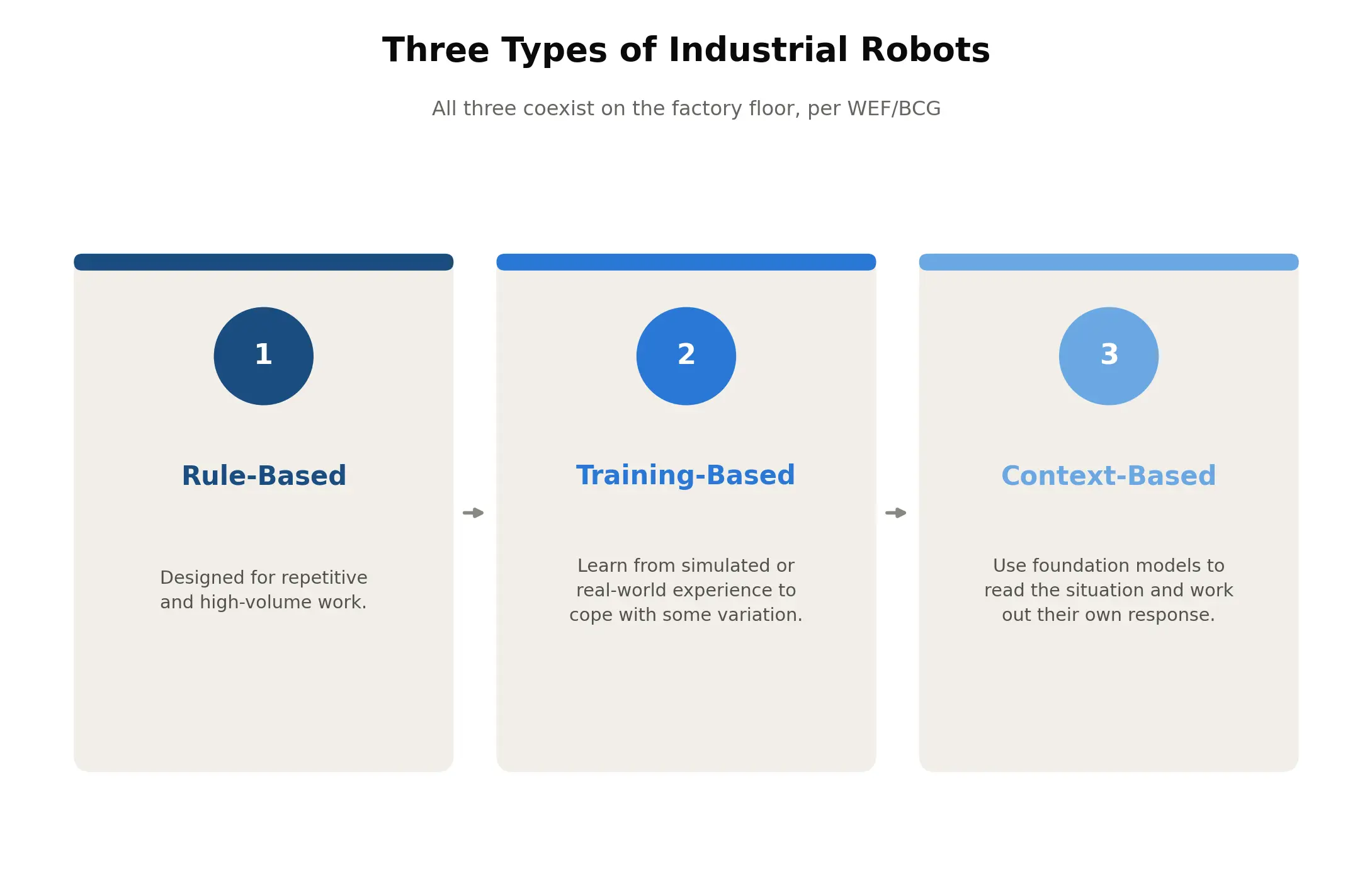
All three will coexist. Fixed-program cells stay on your highest-volume lines. Industrial physical AI covers the variable work around them.
For a wider picture, read how physical AI is used in warehouses and factories, and see which of the top physical AI companies are shaping the field.
Why Manufacturing Leaders Are Adopting Physical AI
The installed base is already huge. Factories added 542,000 industrial robots in 2024, and 4.66 million now operate worldwide, up 9% in a year, according to the International Federation of Robotics.
Most of those robots follow fixed instructions. That is the limit physical AI overcomes.
Adoption is still quite early. A Manufacturing Leadership Council survey, cited in Deloitte’s 2026 outlook, found that 9% of manufacturers deploy physical AI today. Another 22% plan to be within two years.
The challenges come from three key areas:
- Labor shortages that limit how many shifts you can staff.
- Product variety that forces more changeovers.
- Wages are rising, and energy costs are increasing, thereby narrowing the margins.
When companies are considering whether to adopt AI for automation in the manufacturing sector in view of their increasingly tight cost positions, it is generally the three pressures mentioned that influence the decision, not the fact that the technology is new.
Physical AI Applications in Manufacturing That Work Today
Before looking at specific applications, it helps to understand how physical AI differs from traditional automation.
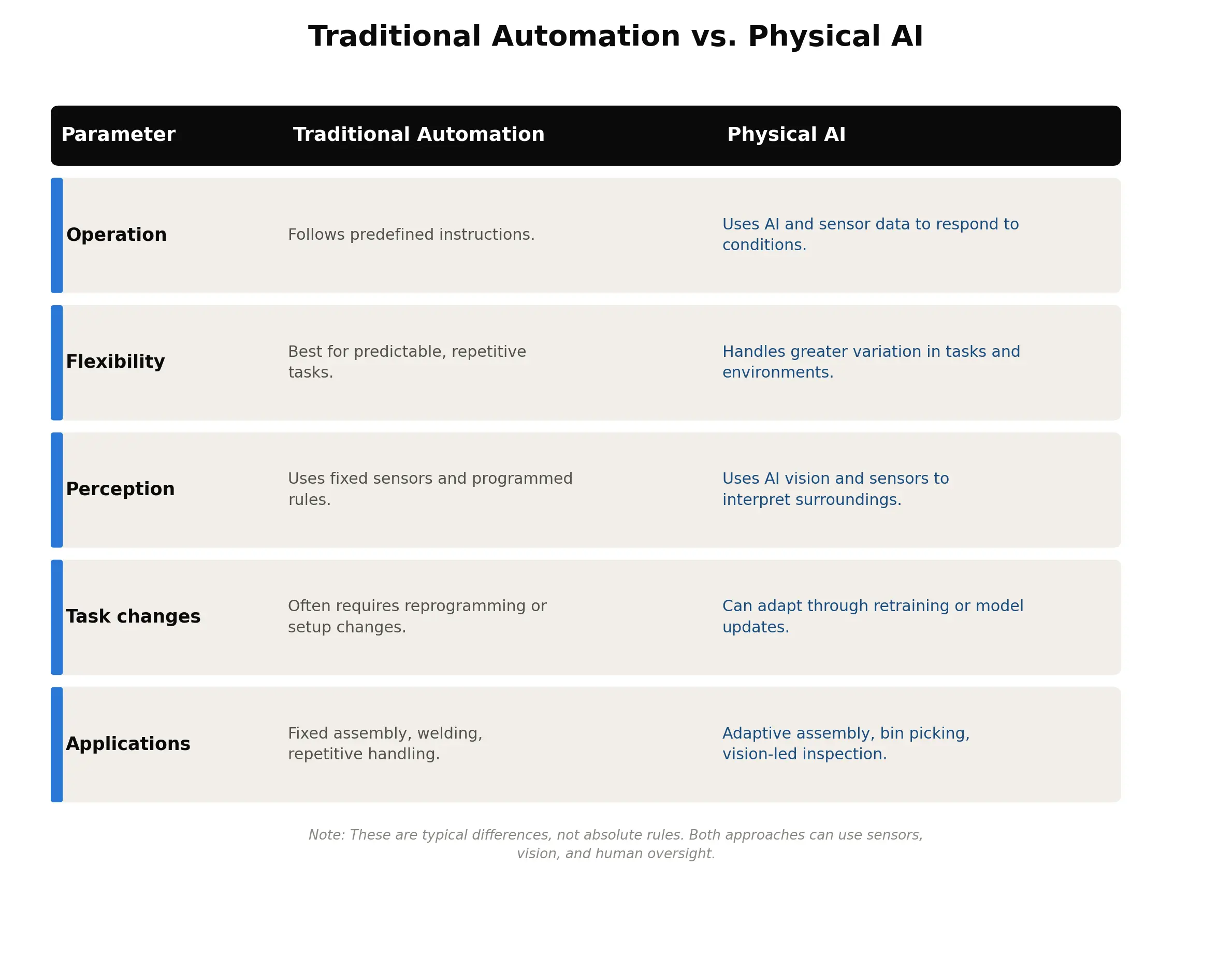
Not every use case is ready. These four are already running on factory floors:
- Adaptive assembly. A BCG pilot on a brownfield circuit board line trained robots in simulation to place irregular components. One operator had been managing up to nine of them by hand.
- Vision-led inspection. Vision models spot defects on parts that vary in shape and finish, without fixed fixtures.
- Autonomous material handling. Mobile robots move pallets through changing layouts using SLAM and vision-based navigation, without relying on fixed floor markers. The Novus Carry series, for example, swaps fixed conveyors for modular lifter, tugger, and conveyor robots that reroute through a software update.
- Faster changeovers. The same hardware takes on a new task with a retrained “brain” instead of a new line design.
Material handling is a practical starting point for factory automation. Novus offers several systems for moving materials across production environments:
- Novus CARRY AMRs support line-side delivery and movement between workstations. Their modular configurations include lifter, tugger, and conveyor attachments for different material-handling tasks.
- Novus AGVs and autonomous pallet trucks support pallet and material movement across production areas. For coordinating these systems, Novus Flow provides fleet management features such as task allocation, traffic management, and mixed-fleet coordination.
The choice depends on route stability and material-handling requirements. AGVs suit predictable routes, while AMRs offer greater flexibility when layouts change. Many facilities use a combination of both. See the AMR vs AGV vs forklift comparison for a closer look at the differences.
What the Early Results Show
The WEF/BCG research names two companies already running physical AI at scale, and the results look different depending on what each one is solving for.
Foxconn, the electronics contract manufacturer, is building what it calls a “scalable AI-powered robotic workforce” in response to rising labor costs. It pairs AI with digital twin simulation to automate precision tasks that traditional rule-based robots couldn’t handle, screw tightening and cable insertion among them. The reported results:
- 40% shorter deployment time for new systems
- 20% to 30% better cycle times
- 25% lower error rates
- 15% lower operating expenses
WEF also reports that in complex assembly tasks, Foxconn’s AI-driven robots now outperform human workers on success rate, not just speed.
Amazon tells a different story. It runs more than a million robots across roughly 300 fulfillment centers, working alongside human employees on sorting, lifting, and package transport. In pilot deployments, Amazon reported a 25% boost in operational efficiency and faster delivery times. Across its full fleet of on-site mobile robots, orchestration alone and better coordination of robots already on the floor added a 10% gain in travel efficiency.
BCG adds a second angle on speed: physical AI systems can train overnight in simulation, where human workers often need weeks on the floor to reach the same proficiency. That matters most when you’re standing up a new site, where efficiency losses during ramp-up typically run 4% to 15%.
Keep the context in mind. These are two companies’ results from early deployments, not an industry average. Read them as direction, not a promise for your line.
The Hurdles Between You and Autonomous Manufacturing
Autonomous manufacturing doesn’t arrive in one step. Plants still work through:
- Legacy integration. Older equipment and software rarely talk to new systems cleanly.
- Safety certification. Machines that adapt need proof that they stay safe.
- Edge-case reliability. AI must perform when conditions drift from its training.
- Skills. Operators become robot technicians, and logistics teams start coordinating fleets.
Two of these have practical answers on the floor. Links into WMS, ERP, and MES systems, plus standards such as VDA 5050, ease legacy integration. Certifications such as UL and CE speak to safety, and Novus AMRs and AGVs carry both.
BCG also warns against small, safe pilots that never touch the core business. Its advice: aim for physical AI at work where the impact can scale.
Where This Leaves Your Plant
Rule-based cells stay on your highest-volume lines. Physical AI takes on what surrounds them: changeovers, inspection, and material flow.
Material flow is the practical place to start. See how Novus Hi-Tech’s autonomous mobile robots can streamline movement across your plant, then talk to the Novus team to find where automation fits.
Physical AI in manufacturing won’t replace your plant’s judgment. It gives that judgment to machines that can keep up.