
PFor most of the last century, automation meant predictability.
Machines followed instructions. Systems ran pre-planned routes. Factories built processes designed to never deviate. And for a long time, that was enough.
Then the world started moving faster than the systems could adjust.
Visit a warehouse or factory floor today and the shift is immediately obvious. The machines aren’t waiting for instructions anymore — they’re interpreting situations, adjusting to what’s in front of them, and acting in real time. Less mechanical. More responsive.
That’s Physical AI at work.
What Is Physical AI?
Physical AI is any AI system with a physical interface — robots, autonomous vehicles, industrial machines — that can operate in dynamic environments without constant human intervention.
But that definition undersells it.
What makes Physical AI genuinely different from software AI isn’t just that it controls hardware. It’s that these systems can function in conditions that weren’t pre-programmed, continuously learn from experience, and adapt their behaviour as environments change. Researchers often call this “embodied AI” — the idea that intelligence isn’t separate from action. It learns by doing, in the real world, in real time.
This is why the term matters. Physical AI isn’t automation with a software upgrade. It’s a different category of capability entirely.
This difference in how we think about intelligence and actions is a major driver of the rapid growth of AI technologies being used in manufacturing, robotics, and intelligent automation systems within many industries.
Why Physical AI Is Accelerating Right Now
The rise of Physical AI didn’t happen overnight. It’s the convergence of several technologies that, individually, were promising — but together, are transformative.
Computer vision has matured to the point where machines can identify objects, read context, and detect anomalies with accuracy that matches or exceeds human inspection. Edge computing now puts enough processing power directly on the machine to make real-time decisions without a round-trip to the cloud. Sensor fusion, combining LIDAR, cameras, ultrasonic, and weight data — gives machines a richer picture of their environment than any single input could provide.
But the deeper driver is a shift in what companies actually need from automation.
The old requirement was simple: automate tasks that work reliably under ideal conditions. The new requirement is harder: build systems that handle change — layout shifts, demand spikes, unpredictable human behaviour, exceptions that no one anticipated when the original process was designed.
Traditional automation wasn’t built for that. Physical AI was.
Warehouses and factories are adopting it first because they experience this complexity most acutely. But the expectation is spreading: adaptability is no longer a competitive advantage. It’s becoming the baseline.
How Physical AI Is Transforming Warehouses
Warehouses have always been about movement — of goods, information, and time. What Physical AI changes is how intelligently that movement happens.
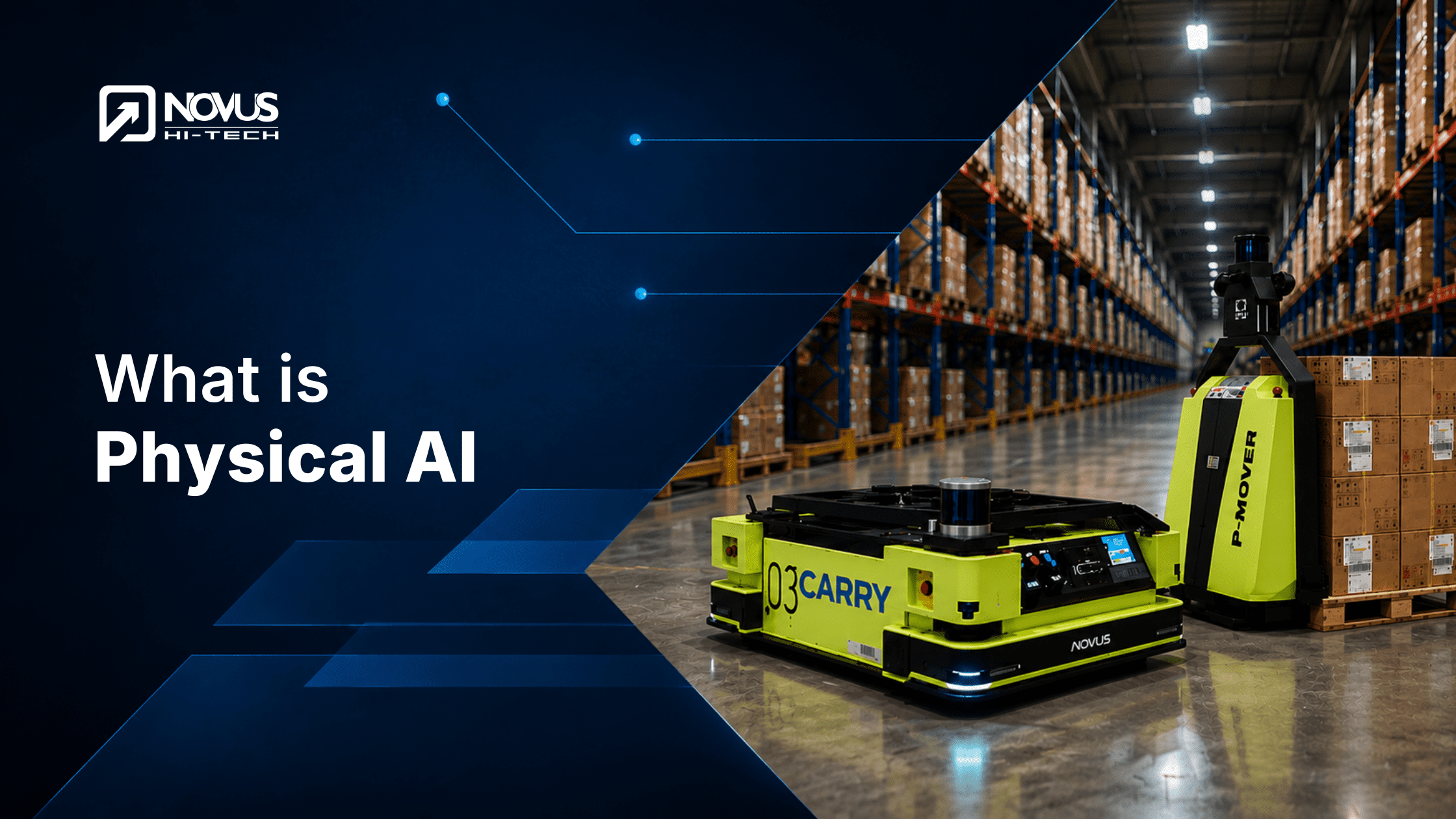
AI-powered robotic systems no longer follow fixed paths or wait for central coordination. They navigate dynamically, rerouting around obstacles, reprioritising tasks based on urgency, and communicating with other machines without a human issuing each instruction. The result isn’t just efficiency. It’s operational flow.
What’s interesting is how invisible this intelligence becomes once it’s working. Delays reduce. Decisions happen faster. Throughput increases — but without the friction of constant oversight.
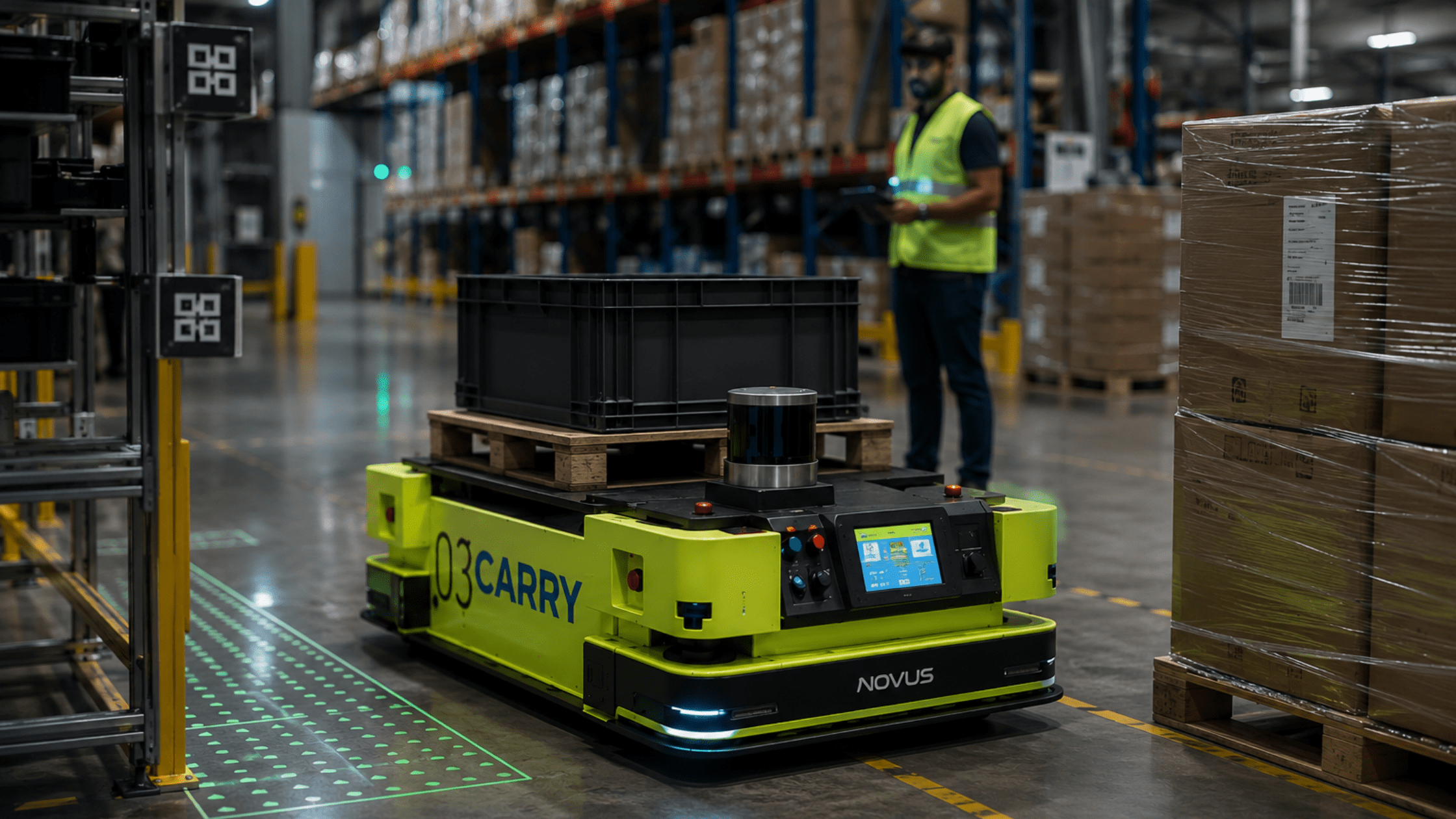
The outcomes are measurable: Facilities deploying autonomous mobile robots (AMRs) alongside Physical AI platforms report 30–50% reductions in pick-and-pack cycle times and inventory accuracy improvements from approximately 70% to above 99%.
Curious how intelligent movement translates into real operational gains?
→ Explore Novus AMR Solutions
How Physical AI Is Reshaping Manufacturing
Manufacturing has always been defined by precision and control. But as product complexity increases and customisation becomes the norm, rigidity stops being a strength and starts being a constraint.
Physical AI takes a different approach.
Rather than designing processes that machines must follow, manufacturers are deploying systems that adapt to the process as it changes. Materials move autonomously across the factory floor. Production lines adjust to shifting requirements. Machines collaborate with human operators in ways that feel intuitive rather than mechanical.
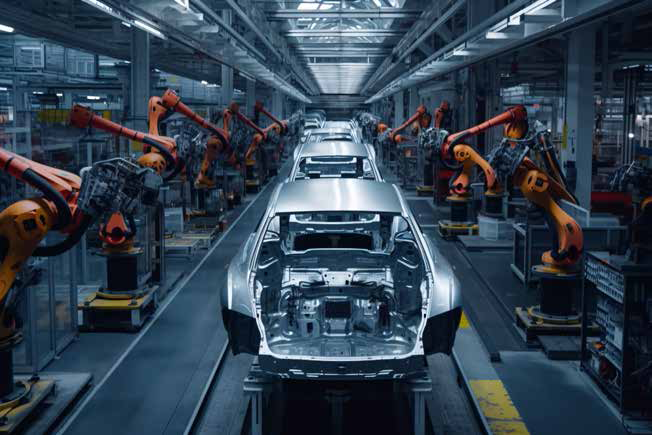
In quality control, AI vision systems now detect defects that rule-based cameras can’t — micro-cracks in welds, subtle surface anomalies, misaligned components. Automotive manufacturers using these systems report defect escape rate reductions of up to 90%.
In assembly, collaborative robots (cobots) equipped with Physical AI sense human proximity and adjust speed, force, and trajectory in real time, enabling human-robot teams that are safer and faster than either working alone.
In material flow, autonomous systems coordinate production schedules with internal transport — forklifts, AGVs, yard vehicles, reducing idle time and cutting unnecessary movement across the facility. ⁵
There’s also a learning layer that didn’t exist before. These systems don’t just execute — they observe outcomes, identify inefficiencies, and refine their behaviour over time. That continuous improvement is what turns a factory from a production unit into what you might call a living system.
See how adaptive manufacturing actually works in real environments.
From Automation to Autonomy
One of the most important distinctions to understand is that Physical AI is not just an upgrade to automation—it’s a shift toward autonomy.
Traditional automation depends on predefined rules. If something changes outside those rules, the system either stops or requires human intervention. Physical AI systems, however, are designed to handle change as part of their normal operation.
They don’t just follow instructions. They interpret situations.
This is what allows them to function in environments that are constantly evolving. And as industries become more complex, this ability will define which operations scale efficiently—and which ones struggle to keep up.
Physical AI vs Traditional Automation: Side-by-Side
| Feature | Traditional Automation | Physical AI |
|---|---|---|
| Decision-making | Rule-based, pre-programmed | Adaptive, learned from real-world data |
| Handles exceptions | Stops or requires human input | Adapts in real time |
| Setup time | Months of programming | Weeks with pre-trained models |
| Maintenance approach | Scheduled or reactive | Predictive, AI-driven |
| Scalability | Linear — add more machines | Exponential — retrain and redeploy |
| Human collaboration | Isolated behind safety barriers | Cobot-friendly, collaborative |
| Continuous learning | None | Ongoing, improves with use |
| Upfront cost | Lower | Higher (ROI typically 18–36 months) |
| Error handling | Manual correction | Autonomous detection and correction |
| Best suited for | Repetitive, stable tasks | Variable, complex, dynamic environments |
The Role of Novus Hi-Tech in Physical AI
At Novus Hi-Tech, this shift toward Physical AI is not treated as a future concept—it’s already embedded into how solutions are designed and deployed.
Whether it’s autonomous mobile robots navigating warehouse floors or intelligent systems optimising material flow, the focus remains the same: building technologies that work in real-world conditions, not controlled environments.
What sets these systems apart is their ability to adapt. They are not locked into fixed infrastructure or static workflows. Instead, they evolve with the operation, making them inherently scalable and far more resilient to change.
In many ways, this is what defines premium automation today—not just performance, but flexibility.
Access the Novus AMR Brochure
Understand how Physical AI delivers measurable ROI, efficiency, and safety in real deployments.
→ Get the Complete Product Guide
Looking Ahead
If the last decade was about digitisation, the next will be about embodiment.
Intelligence is no longer confined to software systems. It is moving into machines, into infrastructure, and into the physical spaces where work actually happens. As this transition accelerates, the line between digital intelligence and physical execution will continue to blur.
Factories will not just produce. They will respond.
Warehouses will not just store. They will think.
And the organisations that understand this shift early will be the ones that define what efficiency looks like in the years ahead.