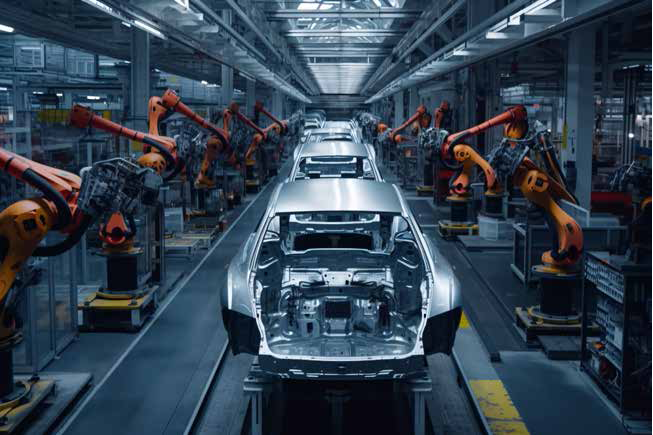

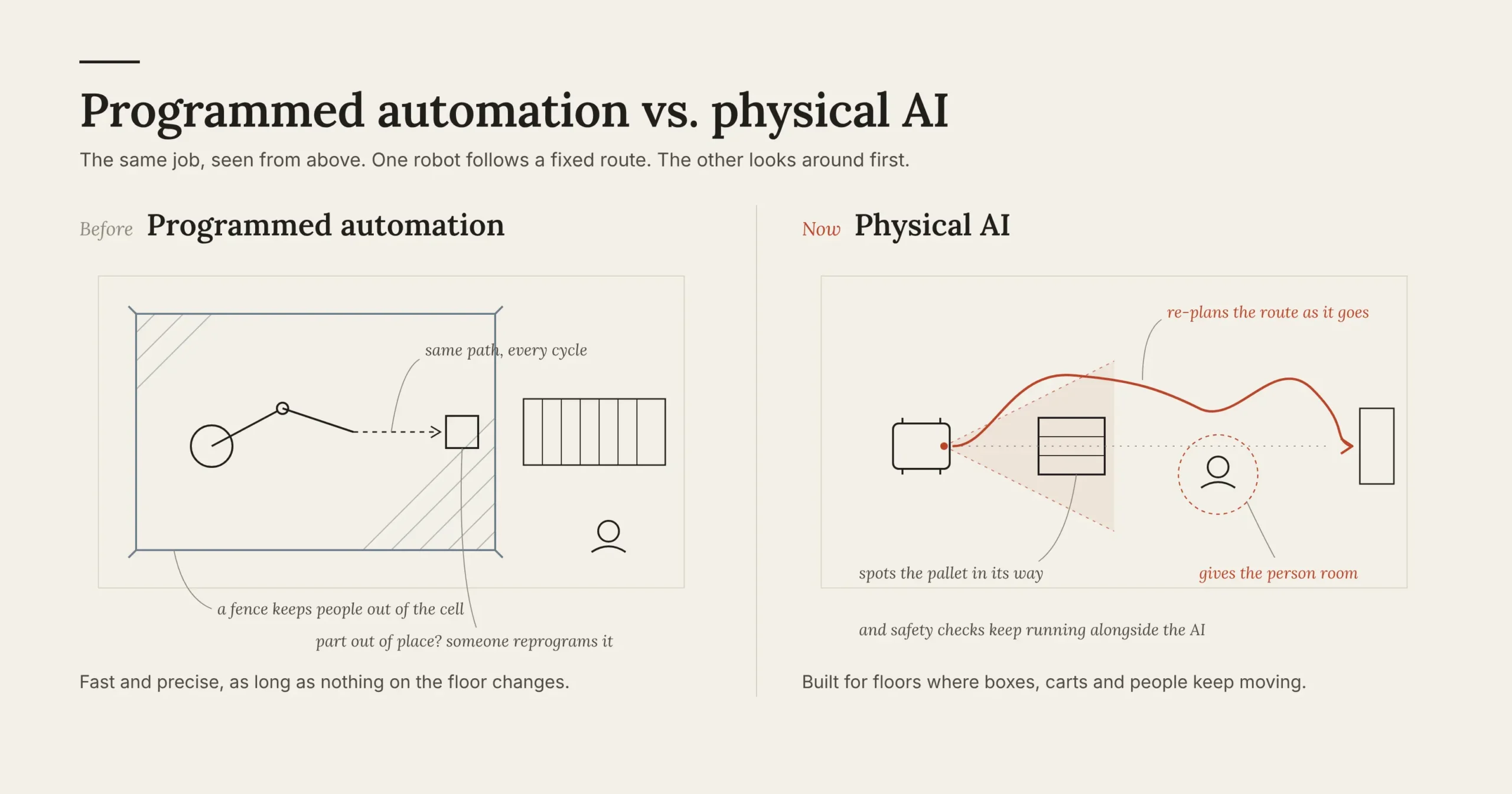
Most industrial robots on factory floors today are fast and precise but work almost blind. They sit behind safety fences, repeat one taught path every shift, and need an engineer to reprogram them when a part arrives a few millimeters out of place.
Physical AI companies are replacing that setup. Their robots carry cameras and sensors, and trained models work out what’s in front of them and replan when the scene changes. During 2026, enterprise buyers moved many of these systems out of pilots and into paid production work. In October 2026, at GTC Berlin, NVIDIA released its open-source GR00T N1.7 robot model and Isaac Lab 3.0, its framework for training robots in simulation.
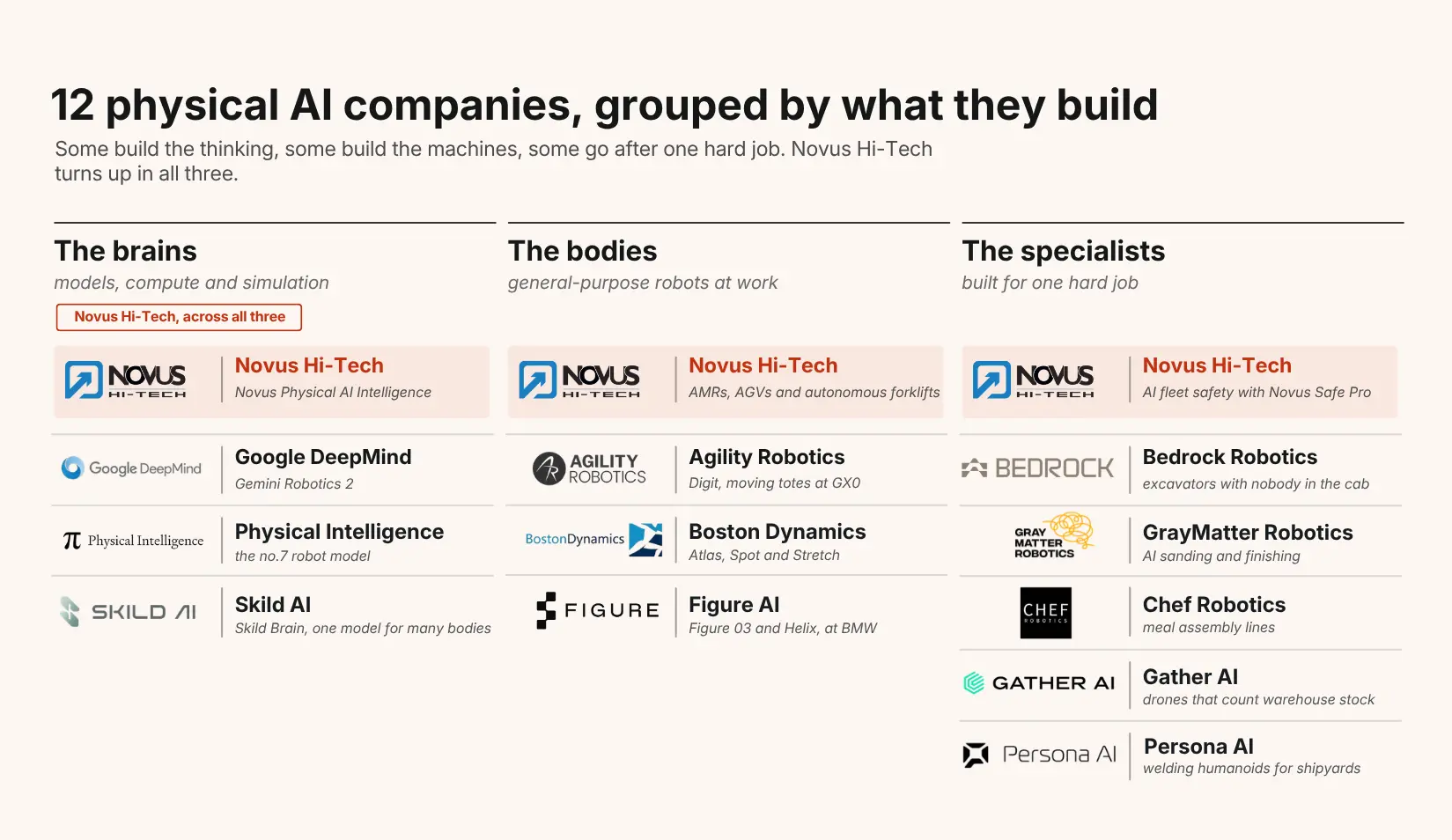
These are the top physical AI companies for enterprise buyers to watch in 2027, listed in no particular order. We’ve grouped them by what they build, from models and computing to robot bodies to single-job machines.
How we Chose These Physical AI Companies
We built this list for enterprise buyers in manufacturing, logistics, construction and food production, and every company had to pass three tests. First, it sells to enterprises or runs paid deployments, so lab-only projects are out. Second, it has a public, dated proof point from 2025 or 2026, such as a customer contract, a production milestone or a funding round tied to deployment. Third, it fills one of three roles a buyer needs to understand: the models that act as a robot’s brain, general-purpose robot bodies, or specialists built for one job. The numbering follows those groups and is not a ranking. Novus Hi-Tech publishes this guide and was held to the same tests.
Physical AI Companies Compared at a Glance
| Company | What it builds | Dated proof point | Best fit for enterprise buyers |
| Novus Hi-Tech | AMRs, AGVs, P-Mover pallet trucks and fleet software | 1,400+ robots deployed and 150+ patents (2026) | Factories and warehouses running mixed robot fleets |
| Google DeepMind | Gemini Robotics vision-language-action models | Gemini Robotics 2 launched July 30, 2026 | Teams choosing the model behind their robots |
| Physical Intelligence | General-purpose robot models | π0.7 released April 2026 | Programs that want one model across many robots |
| Skild AI | Skild Brain, one model for many robot bodies | In production with Foxconn by March 2026 | Electronics assembly and mixed robot types |
| Agility Robotics | Digit bipedal humanoid | 100,000+ totes moved at GXO by November 2025 | Warehouse tote handling |
| Boston Dynamics | Spot, Stretch and Atlas | DHL deal for 1,000+ Stretch units, May 2025 | Truck unloading and site inspection |
| Figure AI | Humanoids running the Helix model | Helped build 30,000 cars at BMW Spartanburg in 2025 | Automotive assembly lines |
| Bedrock Robotics | Autonomy retrofit for excavators | $600 million raised at a $4.1 billion valuation, Oct. 26, 2026 | Earthmoving and civil contractors |
| GrayMatter Robotics | AI sanding, polishing and spraying cells | U.S. Air Force AFWERX Phase II contract, January 2026 | High-mix finishing in aerospace and marine |
| Chef Robotics | Robot arms and ChefOS for meal assembly | 100 million+ servings by 2026 | Food producers and institutional kitchens |
| Gather AI | Drone and forklift-camera inventory scanning | $40 million Series B, February 2026 | 3PLs and distribution centers |
| Persona AI | Rugged welding humanoids | HD Hyundai partnership, March 2025 | Shipyards and heavy fabrication |
The brains: embodied AI companies building models and simulation
1. Novus Hi-Tech
Novus Hi-Tech builds the AI that lets industrial machines read a factory floor, plan a route and act without a driver, and it has shipped that autonomy in its own robots since 2006. Its autonomous mobile robots, AGVs and P-Mover autonomous pallet trucks map a site with 3D LiDAR SLAM, route around people and pallets, and take new paths when a layout changes, while Novus physical AI software coordinates mixed fleets of robots and forklifts from one system. Novus Safe Pro applies the same vision AI to road fleets. As of 2026, Novus has more than 1,400 robots deployed, over 150 patents and 100+ enterprise customers, including Volvo Eicher, Asian Paints and Nestlé. For enterprise buyers, one vendor owns the full stack, from chassis to fleet software.
2. Google DeepMind
Google DeepMind builds vision-language-action models that turn camera input and plain-language instructions into robot movement. Its current release is Gemini Robotics 2, launched on July 30, 2026. On a robot hand with 22 degrees of freedom, it handles fine manipulation such as tying a knot. Its companion model, Gemini Robotics ER 2, plans multi-step tasks across a job, and Gemini Robotics also runs on Boston Dynamics’ Atlas humanoid. For enterprise buyers, DeepMind is a model supplier: robots from other vendors may run on its models, so ask each vendor which foundation model sits underneath and who controls its updates.
3. Physical Intelligence
Physical Intelligence builds general-purpose robot models and leaves the hardware to others. It tests those models on everyday tasks, such as folding laundry, across many different robots. Researchers including Sergey Levine and Chelsea Finn founded the company in 2024. In April 2026, it released the π0.7 model, which helps robots complete tasks they haven’t been specifically trained for. A 2025 funding round led by CapitalG valued Physical Intelligence at $5.6 billion. For enterprise buyers, the value is reuse: a model that adapts across robot types can lower the cost of every new automation project.
4. Skild AI
Skild AI builds Skild Brain, a single robot model designed to control many different robot bodies. Skild Brain is “omni-bodied” because it can control a robot without being built for that specific body, whether it’s a quadruped, humanoid, or a tabletop arm. It’s trained on human video and physics simulation data. As of January 2026, Skild raised about $1.4 billion at a valuation above $14 billion, and by March 2026 its model was running in production, including precision assembly of NVIDIA Blackwell systems with Foxconn. For enterprise buyers, one model across many robot types means fewer software stacks to integrate and maintain.
The bodies: enterprise robotics companies building general-purpose robots
5. Agility Robotics
Agility Robotics builds Digit, a bipedal humanoid that moves totes in warehouses. At GXO’s warehouse in Flowery Branch, Georgia, Digit moves totes between mobile robots and conveyors, and it had handled more than 100,000 totes by November 2025. GXO has two more sites planned for early 2027. Agility was also the first company to build parts of NVIDIA’s Halos for Robotics into Digit’s person-detection safety system. For enterprise buyers, that safety work matters as much as the robot, because a humanoid only earns a place on a shared floor once it passes a site safety review.
6. Boston Dynamics
Boston Dynamics builds three working robots: Spot for inspection rounds, Stretch for unloading trucks at up to 700 cases an hour, and the Atlas humanoid. Stretch has the clearest commercial record: DHL signed for over 1000 units in May 2025. For Atlas, all 2026 deployments of the production model unveiled at CES 2026 are already committed to Hyundai and Google DeepMind, and that model lifts 50 kg and swaps its own batteries. For enterprise buyers, Stretch is the system to evaluate now, while Atlas is a 2027 conversation at the earliest.
7. Figure AI
Figure AI builds general-purpose humanoids and Helix, its own vision-language-action model, whose second version controls the full body. Figure ended its OpenAI partnership in early 2025 to develop that model in-house. BMW’s plant in Spartanburg, South Carolina, is the main proving ground. Figure 02 robots helped build 30,000 cars there in 2025, and since late June 2026, Figure 03 has been undertaking sequencing work in Hall 52. For enterprise buyers, BMW is a reference site worth asking about: it shows a humanoid holding a takt-time job on a live automotive line.
The specialists: industrial physical AI companies built for one tough job
8. Bedrock Robotics
Bedrock Robotics builds an autonomy system that retrofits the excavators contractors already own. Former Waymo engineers founded the company in 2024, and in 2026 its machines began taking paid work in mid-August with no one on board, including a 1.2 million cubic yard sitework contract with Zachry Construction. For enterprise buyers in construction, a retrofit adds autonomy to machines they already own and avoids a fleet replacement. Since 2025, Bedrock’s customer base has more than doubled, and on Oct. 26, 2026, it raised $600 million at a $4.1 billion valuation.
9. GrayMatter Robotics
GrayMatter Robotics builds AI-driven robotic cells for sanding, polishing and spraying, finishing work that high-mix plants still do mostly by hand. The company’s physics-informed software plans each pass from a scan of the part, so a cell can finish one-off parts without a new robot program. GrayMatter Robotics’ cells already run in aerospace, defense and marine plants. In January 2026, the U.S. Air Force’s AFWERX awarded it a Phase II contract to build a system that sands aircraft canopies, finds scratches and corrects them automatically. For enterprise buyers with high-mix lines, this is a way to automate finishing without writing a robot program for every part number.
10. Chef Robotics
Chef Robotics builds robot arms with cameras and scales that drop into existing meal assembly lines, plus ChefOS, the software that learns how each ingredient behaves. Food is hard to automate because no two scoops are the same. “Onions is not onions is not onions”, CEO Rajat Bhageria told The Spoon. By 2026, Chef Robotics had plated more than 100 million servings for customers that include major U.S. food companies, school lunch programs, airlines and hospitals. For enterprise food producers, the retrofit approach automates portioning on lines they already run, without rebuilding the production floor.
11. Gather AI
Gather AI builds inventory-scanning software that runs on off-the-shelf drones flown down warehouse aisles and on cameras mounted to forklifts already working in the building. It replaces manual cycle counts done from lifts. The software reads barcodes, lot codes, expiry dates and case counts, and flags damage and empty slots, including in freezers. Third-party logistics providers GEODIS and NFI use it, and in February 2026 Gather AI raised a $40 million Series B and reports inventory accuracy of 99% or higher. For enterprise warehouse operators, that accuracy matters most at peak season, when one miscounted slot becomes a missed shipment.
12. Persona AI
Persona AI builds rugged humanoids for shipyards and heavy industry. Former NASA and Figure engineers founded the company, and they’re starting with welding, one of the hardest shipyard trades to staff. HD Hyundai teamed up with Persona in March 2025 to develop welding humanoids for an industry where attrition in skilled trades can reach 30% or more. A prototype is due in late 2026, with field testing and a commercial launch planned for 2027. According to a September 2026 SEC filing, Persona has raised $65.4 million of a planned $142 million round. For enterprise buyers in shipbuilding and heavy fabrication, Persona is a candidate for 2027 pilots.
3 trends that will define enterprise robots in 2027
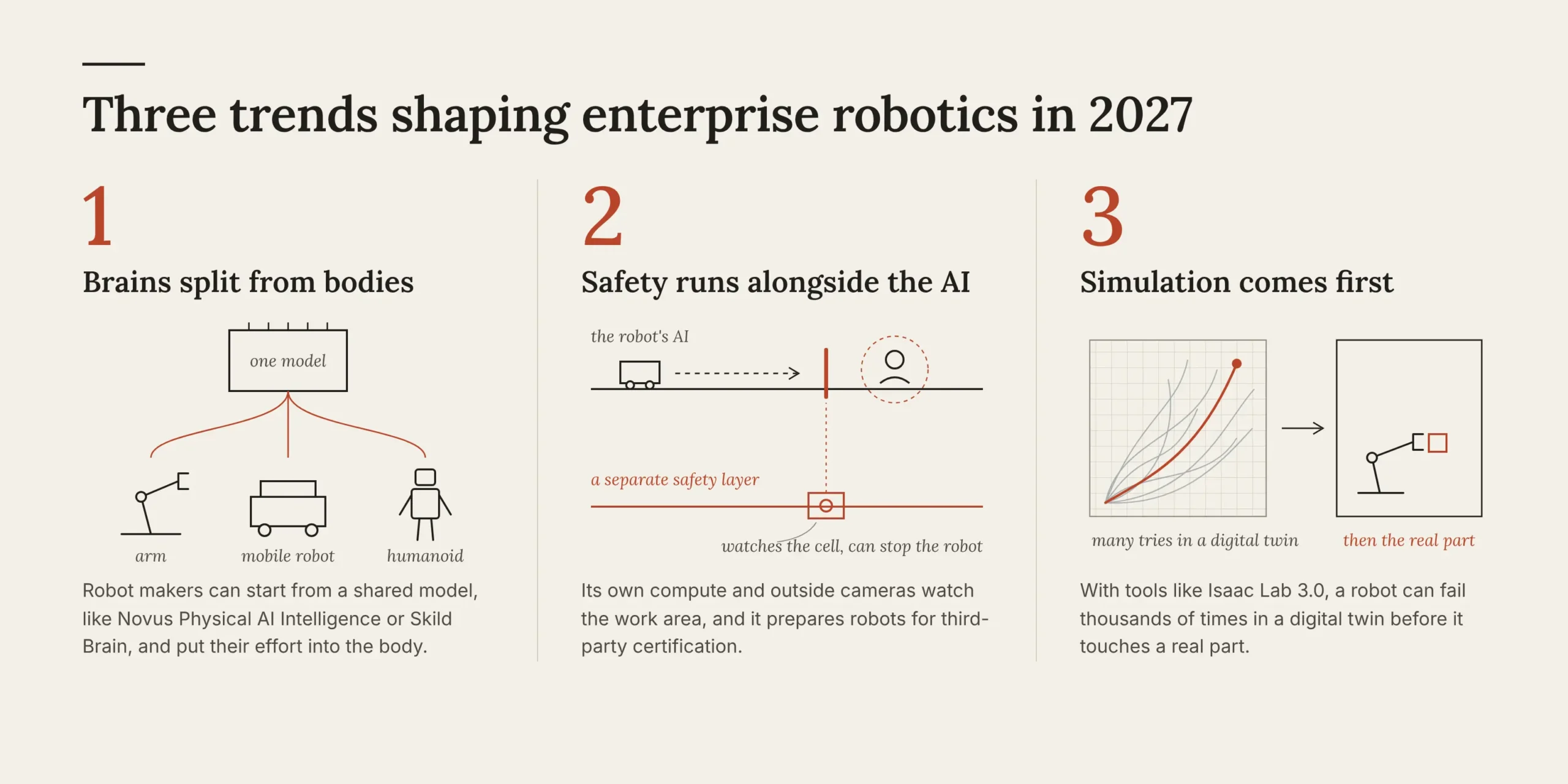
Look at the leading physical AI businesses, and you’ll find three shifts.
First, the brain is splitting from the body. Robot builders don’t have to build a robot brain from scratch anymore. They can start with a model such as NVIDIA’s GR00T N1.7 or Skild Brain.
Second, safety now runs alongside the AI. NVIDIA Halos for Robotics, for example, pairs external cameras that watch the work cell with dedicated safety computing and an inspection lab that helps robots reach third-party certification. Certification is usually the first thing a plant’s safety team asks for.
Third, robots now train in simulation first. With tools like Isaac Lab 3.0, a robot can fail thousands of times in a digital twin before it touches a real part, which shortens commissioning on the plant floor.
What this means for enterprise buyers in 2027
The takeaway: demos won’t decide 2027. Buyers will pick robots that pay for themselves on one job and come with a safety case an auditor will sign. Before you commit, ask for a pilot on your own floor. For most plants, that points to a specialist before a general-purpose humanoid.
Put physical AI to work on your floor
Novus Hi-Tech has been building autonomous robots for factories and warehouses since 2006. More than 1,400 of our robots already work on customer sites, from AMRs and autonomous forklifts to Novus Safe Pro fleet safety, backed by over 150 patents. We’ll help you choose one high-cost job, run a pilot on your site, and scale from there.
[Book a site assessment] [Talk to our team]
FAQs about physical AI companies