
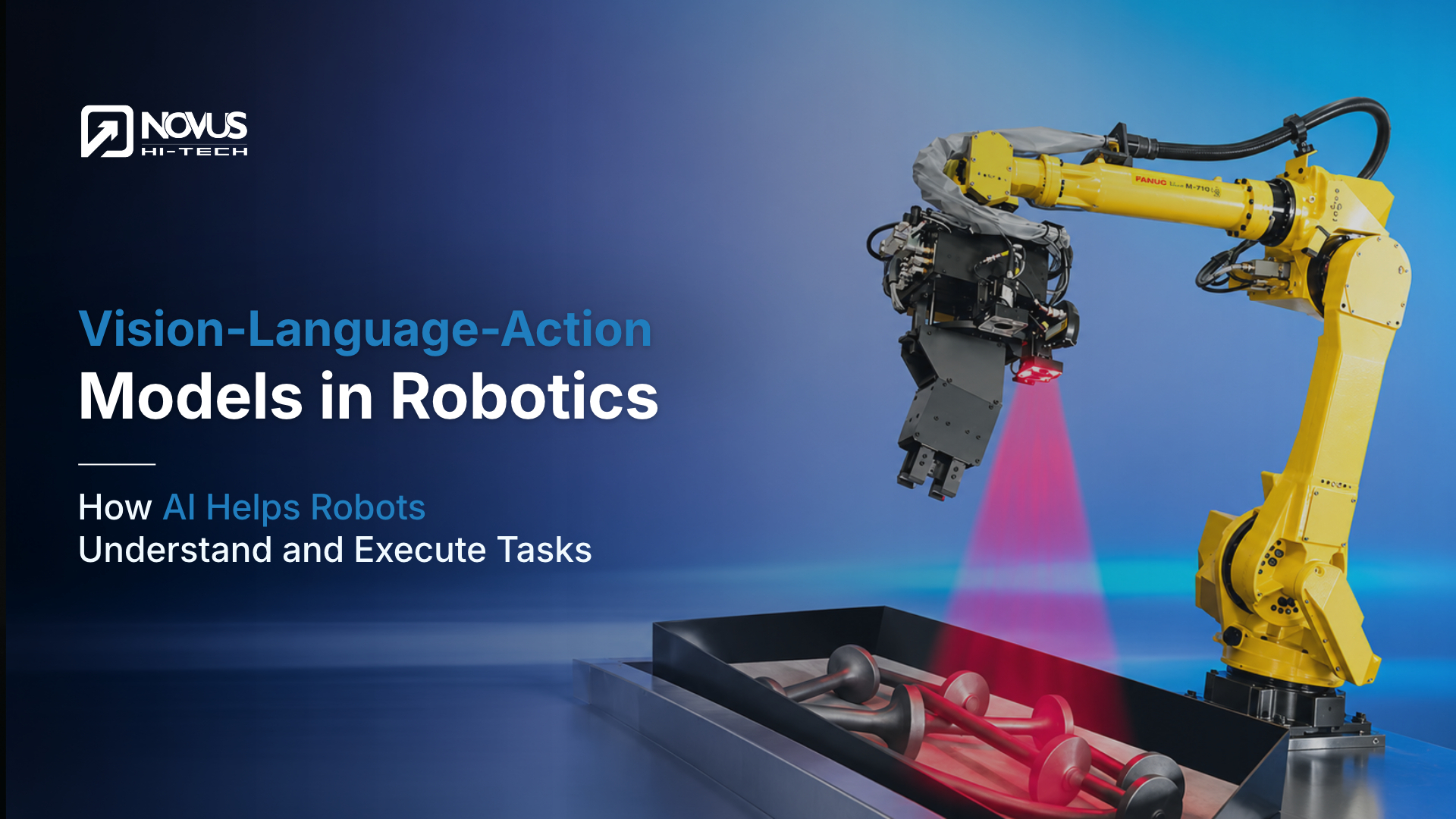
Vision-language-action models can read “put the blue bracket in tray three” and then do it, even on a part the robot hasn’t seen before.
If you’ve ever seen a team reprogramming a robot arm because one part changed, that sounds like science fiction. It’s now one of the hottest areas in robotics, and investments are flooding in.
But a robot that works in a demo is not a robot that works on your line.
This guide separates the two. You get the fundamentals, six trends with real numbers, and a reality check on factory readiness.
Vision-Language-Action Models, Explained
The title reveals the formula:
- Vision. Cameras and sensors show the model the scene.
- Language. A written instruction tells the model what to do.
- Action. The model outputs robot movement.
Short answer: Vision-language-action (VLA) models are AI systems that take camera images and written instructions and then output robot actions. They add movement to the vision-language models behind modern AI. Most work today sits in research labs and early factory trials.
This idea fits inside two bigger ones:
- Robotics foundation models: large models trained on broad data, then adapted to many robots and tasks.
- Embodied AI: AI that lives in a machine, senses the world, and acts in it. This guide to the embodied intelligence stack breaks down the software layers behind autonomous robots.
Together, they point toward AI-powered robotics that reads a situation instead of replaying a script.
Why Vision-Language-Action Models Are Suddenly Everywhere
Start with the money. Venture funding for robotics startups hit $9.9 billion in Q3 2026, more than double the $4.3 billion from Q3 2025, according to Crunchbase.
Zoom out and the picture gets bigger. The wider physical AI category, which includes robots and autonomous vehicles, raised $47.4 billion in the first half of 2026, per Crunchbase’s half-year data. One self-driving round made up nearly a third of that total, so read the headline number with that in mind.
Why the rush? VLA models promise something factories want: robots that adapt to change without a new program for every tweak.
Funding measures belief. It does not measure deployment. The rest of this guide shows the gap.
Vision-Language-Action Models vs. VLMs vs. LLMs
The three terms get mixed up often. The difference comes down to what each model reads and what it produces.
| Model | What it reads | What it produces | Example |
| LLM (large language model) | Text | Text | Summarizing a maintenance report |
| VLM (vision-language model) | Images and text | Text | Describing what a camera sees |
| VLA (vision-language-action model) | Images and text | Robot actions | “Put the blue bracket in tray three” |
The three build on each other. A VLM typically adds vision to a language model. A VLA adds movement to a VLM.
Six Trends Shaping VLA Models in Robotics Right Now
These trends come from the latest papers, model releases, and funding data. Each one changes what a factory can expect.
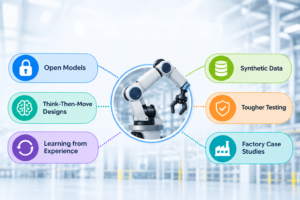
1. Open and Compact Models Move Closer to the Robot
Early VLAs were huge and closed. That is changing.
OpenVLA (June 2024) has 7 billion parameters and was trained on 970,000 robot episodes. It beat a 55-billion-parameter model by 16.5 points in task success across 29 tasks.
SmolVLA (June 2025) goes smaller: 450 million parameters, open source, and able to run on consumer hardware. Its team reports that asynchronous inference gave 30% faster responses and 2x task throughput.
Why it matters: Open code and cheaper hardware mean more teams can test these models without a big budget.
2. Models Learn to Think, Then Move
New designs split slow planning from fast motion.
In one open humanoid model’s paper, a reasoning module runs at 10 Hz on a data-center GPU. A separate module handles the movement.
One leading AI lab’s robotics model takes a related path. It interleaves actions with reasoning written in natural language.
Why it matters: Separating thinking from moving helps meet real-time limits, and written reasoning may make decisions easier to inspect.
3. Robots Start Learning From Experience, Not Just Demos
Imitation only goes as far as the demonstrations. Reinforcement learning breaks that ceiling.
A robotics research lab’s RECAP method trains a VLA on its own deployment experience. According to the paper, on some of the hardest tasks, it more than doubled throughput and roughly halved failures. One robot ran continuously for 13 hours making espresso, and another assembled boxes in a factory.
Why it matters: Systems that improve with use could close the gap between demo and production.
4. Synthetic Data Fills the Data Gap
Real robot data is slow and costly to collect.
One open humanoid model reported a 40% performance gain when it trained on synthetic data plus real data, compared with real data alone, in its launch announcement.
Why it matters: Simulation could shorten the data work for each new task.
5. Testing Gets Tougher
Benchmark scores look great. Stress tests tell a different story.
The LIBERO-Plus study tested models in simulation. It found models scoring around 95% fell below 30% after modest changes to camera viewpoint or robot starting position. Many models also ignored the language instruction.
Safety rules matter too. ISO revised its industrial robot standards in February 2025 with ISO 10218-1 and ISO 10218-2. Any learned model still has to work within them.
Why it matters: High scores overstate readiness. Expect hard testing before deployment.
6. First Factory Case Studies Arrive With Honest Failure Reports
Researchers now publish what happens on a real line. A May 2026 factory-floor study adapted a pretrained model to one packaging task. It needed 2,535 on-site episodes, about 10 hours of data, across repeated rounds of data collection, fine-tuning, and recovery training.
Why it matters: One task took real effort. Plant-wide use will take more.
VLA Models vs. Hand-Coded Robot Programs
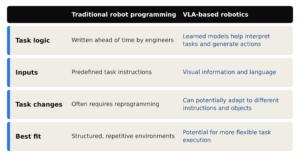
VLA models do not replace conventional programming, motion planning, or safety controls. They add a flexible layer for interpreting tasks, and the rest of the stack stays.
How VLA Models Work With Existing Robot Control Systems
A VLA model rarely drives a robot’s motors on its own. It sits on top of the control stack a plant already runs. Here is how the layers divide the work:
- The VLA model. It reads the camera feed and the instruction, then outputs a short chunk of target motions, such as where the gripper should move next.
- Motion planning and controllers. These turn those targets into smooth, collision-checked movement and run the fast loops that keep each joint on track.
- The safety layer. Speed limits, force limits, and protective stops stay in the robot’s safety controls, outside the model.
- Plant systems. The instruction itself can come from the systems that already assign work on the floor.
Timing is the tricky part. A large model thinks more slowly than a controller moves. That is why designs split slow planning from fast motion, as in trend 2 above. SmolVLA’s team takes another route: its asynchronous inference lets the robot carry out one chunk of actions while the model predicts the next.
The result is a layered setup. The model interprets the task. The proven control stack executes it. Any generated action still has to stay within the limits set by standards like ISO 10218.
Proven, Promising, or Still Open? A Reality Check on VLA Models
Think of VLA maturity as a ladder:
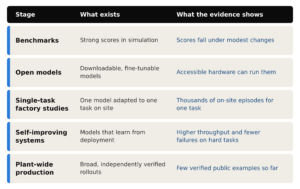
Five hurdles sit between a demo and a deployment:
- Training data: Models need diverse, relevant examples for each new task.
- Reliability: Performance must hold when objects, lighting, and layouts change.
- Real-time processing: Actions must arrive inside the machine’s response window.
- Hardware: The factory study ran on an industrial PC with a high-end GPU. Compression helps, but compute still shapes the design.
- Safety and validation: Generated actions must stay inside robot safety limits and operating procedures.
Moving from pilot to production is the hardest step. This physical AI deployment guide explains how factory pilots reach production.
Where Vision-Language-Action Models Go Next
The signals are clear. Models are getting smaller, smarter, and better at learning from experience. Investors are paying attention.
The factory floor still asks for proof: reliability, integration, and safety.
Want to track where physical AI is heading for your plant? Talk to the Novus team.
Vision-language-action models will earn their place on the factory floor the way every automation tool does: through proven reliability, clean integration, and safety.