
A robot with a faster motor and a sharper lidar is not automatically a smarter robot. Two AMRs can run identical hardware bills of materials and still perform on completely different levels on the same warehouse floor, because the gap between them is not steel or silicon. It is software.
This is the argument behind the Embodied Intelligence Stack: a layered software architecture that turns sensors and actuators into a system capable of perceiving, deciding, and acting in unstructured physical environments. Hardware gives a robot the ability to move. The stack gives it the ability to know where it is, what is around it, what to do next, and how to coordinate with every other machine on the floor. For engineering leaders evaluating a fleet purchase in 2026, understanding this stack matters more than comparing payload specs.
This guide breaks the Embodied Intelligence Stack into its functional layers, explains why software-defined robotics is displacing fixed-function automation, and shows engineering and operations leaders what to look for before signing a deployment contract.
What Is the Embodied Intelligence Stack?
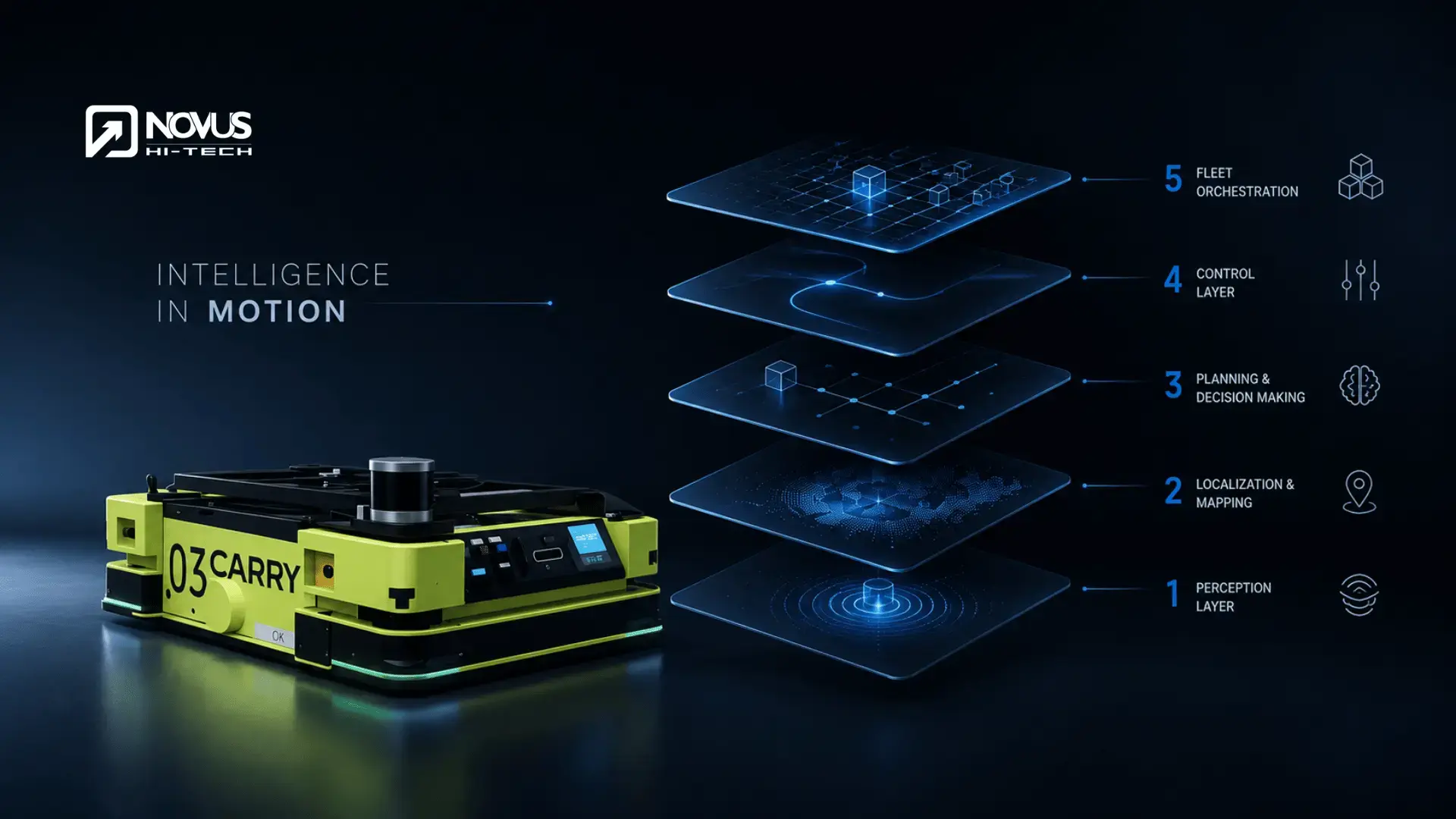
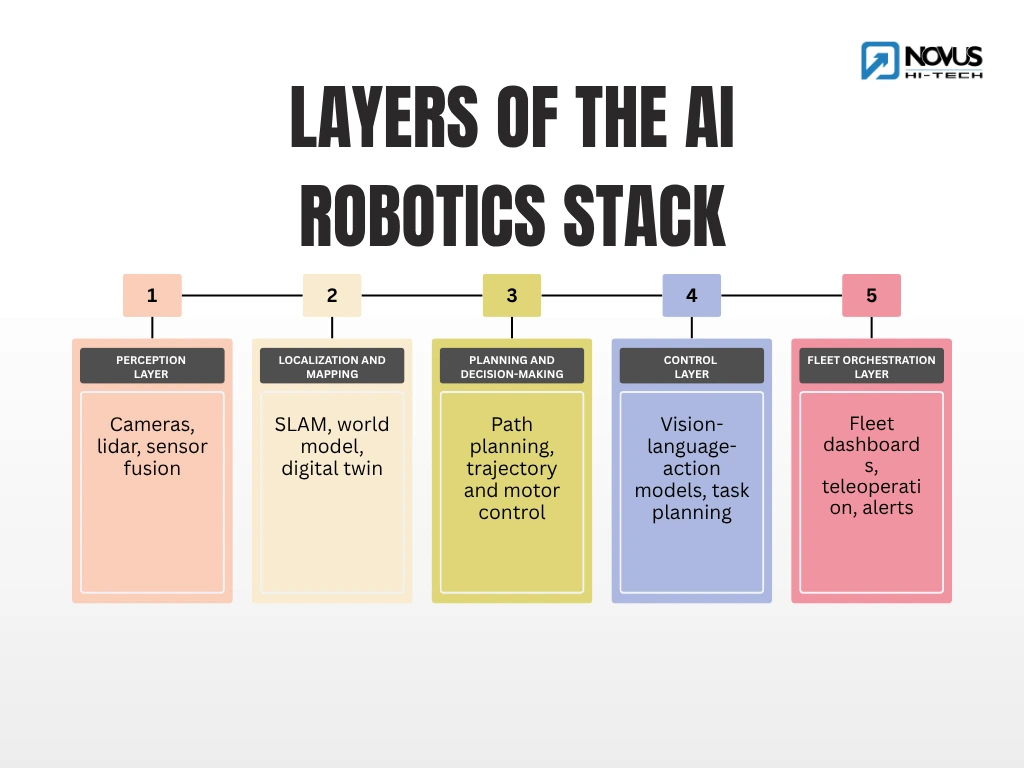
The Embodied Intelligence Stack is the layered software architecture that connects a robot’s sensors and actuators to its decision-making logic, and connects individual robots to each other and to enterprise systems. It typically spans five layers: perception, localization and mapping, planning and decision-making, control, and fleet orchestration.
The term “embodied” matters here. Unlike a language model that reasons over text, an embodied system has to close the loop with the physical world in real time. A misread frame, a stale map, or a planning delay of a few hundred milliseconds is not an inconvenience. It is a stalled robot, a missed pick, or a safety incident. This is why the stack, not any single sensor or motor, is the real product being sold in industrial robotics today.
Why Software-Defined Robotics Is the Real Differentiator
Fixed-function automation, think reflector-guided AGVs following painted lines, was built for stable, unchanging environments. Once a facility’s layout, SKU mix, or throughput target changes, that hardware-first approach requires re-engineering the physical environment itself.
Software-defined robotics inverts this. The floor plan, obstacle rules, task priorities, and traffic logic all live in configurable software layers rather than in fixed infrastructure. That means:
- A layout change is a map update, not a construction project
- New robot types can join a fleet without replacing the orchestration layer
- Behavior improves over time through software updates, not hardware swaps
This is also why fleet economics are shifting toward Robotics as a Service models, where the software layer, not the robot chassis, is what customers are really paying to access and improve. Novus Hi-Tech’s own Robotics as a Service framework reflects this shift directly: customers subscribe to an outcome, and the intelligence stack behind it is what makes that outcome consistent.
The Five Layers of the AI Robotics Stack
1. Perception Layer
The perception layer fuses data from lidar, depth cameras, IMUs, and ultrasonic sensors into a coherent read of the environment. In dynamic industrial settings, this layer has to distinguish a stationary pallet from a moving forklift and a false positive from a genuine obstacle, all within milliseconds. This is where most autonomous systems software actually breaks in production, not in the lab.
2. Localization and Mapping
Simultaneous Localization and Mapping (SLAM) lets a robot answer two questions at once: where am I, and what does the space around me look like right now. Modern deployments increasingly pair SLAM with a live digital twin of the facility, so the map a robot navigates by stays synchronized with the physical floor as racking, staging areas, and traffic patterns change.
3. Planning and Decision-Making Layer
This is the reasoning core of the stack. It converts a goal (“move this pallet to dock 4”) into a safe, efficient path, while continuously re-planning around dynamic obstacles. This layer increasingly borrows from reinforcement learning and imitation learning techniques, trained in simulation and validated through sim-to-real transfer before touching a live floor.
4. Control Layer
The control layer translates a planned trajectory into precise motor commands, managing acceleration curves, fork insertion depth, and load stability in real time. It is the layer with the least room for error, since control failures show up immediately as physical incidents rather than logged exceptions.
5. Fleet Orchestration Layer
At scale, individual robot intelligence is not enough. A Fleet Management System (FMS) coordinates task allocation, traffic management, charging schedules, and multi-vendor interoperability across the entire fleet. Open standards like VDA 5050 increasingly let AMRs and AGVs from different manufacturers operate under one orchestration layer, which is a prerequisite for any facility running a mixed fleet at scale.
Robotics Middleware: The Connective Tissue Engineers Actually Work With
Underneath these five layers sits the middleware that lets modules communicate without engineers having to hand-write every interface. ROS 2 remains the dominant open-source middleware for message passing, sensor abstraction, and simulation integration in industrial robotics. Model formats like ONNX let perception and planning models move between training frameworks and edge inference hardware without a full rewrite.
Senior engineers evaluating a robotics middleware stack should look past the demo and check for:
- Deterministic message timing under real network load, not just lab conditions
- Native support for multi-robot namespace isolation
- A clean separation between simulation and production code paths
- Documented failure modes for sensor dropout and network partition
Choosing an NVIDIA Isaac Alternative: What Actually Matters
NVIDIA Isaac has become a reference platform for simulation and perception pipelines in robotics, and it deserves credit for pushing sim-to-real workflows into the mainstream. But platform choice should be driven by deployment reality, not brand recognition. Engineering teams evaluating an NVIDIA Isaac alternative should weigh:
- Edge hardware flexibility: can the stack run on the compute already budgeted for the fleet, or does it lock you into a specific silicon vendor
- Field data volume: platforms trained and validated against millions of kilometers of real, not purely simulated, autonomous navigation carry fewer surprises at deployment
- Integration depth with WMS/ERP: a robotics stack that plugs cleanly into existing warehouse and enterprise systems avoids a second integration project
- Local support and iteration speed: how fast can the vendor push a fix when a floor-specific edge case appears
Novus Hi-Tech has built its stack around this second criterion directly, with intelligence layers validated across autonomous mobile robot deployments that have logged over 10 million kilometers of real-world autonomous navigation, backed by 150+ patents and more than 1,400 robots deployed across manufacturing and logistics environments.
Not sure which layer of your current robotics stack is limiting your fleet’s ROI? Talk to a Novus Hi-Tech automation engineer for a stack-level audit of your deployment.
Why This Stack Decides the Next Decade of Industrial Automation
Manufacturing floors are converging around what the World Economic Forum’s Global Lighthouse Network calls integrated, adaptive production systems, where robots, AGVs, vision systems, and MES platforms coordinate as one system rather than operating as isolated islands. This is the practical meaning of Physical AI in India’s manufacturing sector: the intelligence layer sitting above existing infrastructure, not a replacement for it.
The facilities that scale automation successfully over the next decade will not be the ones with the newest robot chassis. They will be the ones whose Physical AI foundation was built as a software-defined stack from the start, capable of absorbing new robot types, new floor layouts, and new task complexity without a hardware rebuild every time the business changes.
Key Takeaway
The Embodied Intelligence Stack, not the robot chassis, is what determines whether a fleet scales from pilot to plant-wide deployment. Perception, localization, planning, control, and fleet orchestration each carry distinct failure modes, and evaluating a robotics platform means testing every layer, not just the demo video. Software-defined robotics wins the next decade because it is the only architecture that adapts as fast as the factory floor around it changes.
Ready to evaluate whether your fleet’s software stack can scale past pilot? Request a Novus Hi-Tech stack assessment and see exactly where your current architecture stands against the five-layer benchmark.