
In today’s fast-paced industrial world, industrial robot components play a critical role in improving efficiency, minimizing human error, and increasing productivity. From mobile robot components to advanced control systems, every part contributes to seamless automation.
Industrial robot components are the seven physical and software systems that give a robot its ability to sense, move, decide, and communicate. Every industrial robot, from a fixed robotic arm on an assembly line to an autonomous mobile robot navigating a warehouse floor, is built from the same seven core parts:
- Sensors for perception
- Actuators for movement
- Power supply for energy
- Control system for decision-making
- Navigation and mapping for autonomous motion
- Communication systems for coordination
- Structural framework for durability
This guide breaks down each component: what it does, how it works in practice, and how to choose the right configuration for your application. According to the International Federation of Robotics, global demand for industrial robots continues to grow as manufacturers accelerate automation adoption.
What Are Industrial Robot Components?
Industrial robot components are the physical and software systems that work together to give a robot its ability to sense, move, decide, and communicate. Every industrial robot, from a fixed robotic arm on an assembly line to an autonomous mobile robot (AMR) navigating a warehouse floor is built from the same seven core components: sensors, actuators, a power supply, a control system, navigation and mapping technology, communication systems, and a structural framework.
According to the The Robot Report, the global industrial robot market to grow 5-7% out to 2027. Understanding what goes into these machines is the first step toward choosing, deploying, and getting maximum ROI from them.
This guide breaks down each component; what it does, how it works in practice, and why it matters for industrial efficiency.
The 7 Core Industrial Robot Components
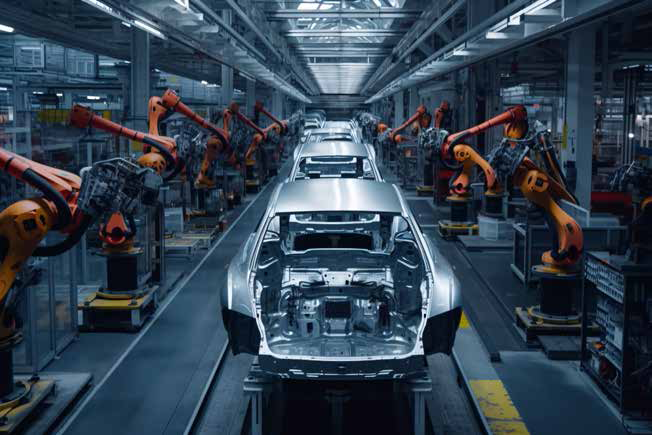
Robot parts essentially constitute the very core of any industrial robot, from basic components of robotic arms and arms of various types to advanced mobile/industrial robots. Sensors, actuators, power supplies, control systems, navigation technologies, communication systems, and structural frameworks are all part of this. Each and every one of these plays a vital role in guaranteeing that the robot gets to work correctly and efficiently in the conduction of complex tasks. Let’s proceed to see how these basic components of robot
Robotic arm components & components of industrial robots play such an important role in general industrial efficiency.
The mobile robots can move about anywhere in their workspace, meaning they can accomplish a lot of work entirely on their own without human intervention. Their complexity and design are enhanced by the combination of abilities needed for navigation, avoidance of obstacles, and communication with personnel on shop floors. The main parts of a robotic arm are described below, followed by those of mobile robots that enable them to be useful in industries.
The core robot parts and functions include:
- Sensors
- Actuators
- Power supply systems
- Control systems
- Navigation technologies
- Communication systems
- Structural frameworks
Each of these robotic components in industrial automation ensures accuracy, efficiency, and scalability across manufacturing and logistics operations.
1. Sensors:The Robot’s Perception System
Sensors are how a robot understands its environment. They are also known as the eyes and ears of a robot.
These components allow the robot to look about, notice changes in the environment, and react based on the noticed changes.
Industrial robots use several types of sensors depending on their application:
- Vision sensors (cameras and 2D/3D imaging): Used for object recognition, barcode reading, defect detection, and pick-and-place guidance. Vision sensors are the foundation of quality inspection systems in electronics and automotive manufacturing.
- Proximity sensors: Detect objects within 0.5–2 metres without physical contact. Critical for collision avoidance in environments where humans and robots work alongside each other.
- Force/torque sensors: Measure the pressure a robot’s end effector applies during assembly, enabling tasks that require human-like sensitivity, such as inserting a connector or tightening a fastener to exact specification.
- Temperature and pressure sensors: Monitor operational conditions in process industries like food production and pharmaceutical manufacturing, triggering automatic adjustments when parameters drift.
Such sensors play an important role in mobile robots because they enable them to run over complex terrain, scan out obstacles, and alter the course based on the discovery of any of the above.
The performance of robot components, such as sensors, is directly correlated with real-time efficiency of a robot’s functioning and guarantees optimum performance.
2. Actuators: The Robot’s Muscle Power
Actuators are the components responsible for the movement and interaction of robots. These ‘muscles’ convert electrical energy into mechanical movement, allowing robots to manipulate objects or move through space.
The three main types used in industrial robots:
- Electric servo motors are the most common, offering precise position control and repeatability within ±0.02 mm on high-end systems. They dominate in robotic arms used for assembly, welding, and packaging.
- Hydraulic actuators generate exceptional force — suitable for robots handling payloads exceeding 500 kg in automotive stamping or heavy fabrication environments. The trade-off is higher maintenance complexity and energy consumption.
- Pneumatic actuators are ideal for high-speed, repetitive, cyclical tasks (such as pick-and-place on a fast-moving conveyor) where the exact force applied is less critical than speed.
The actuators are of the essence in robots because, without them, robots would not be able to interact with their environment, thereby making tasks impossible, including activities like material handling, welding, and an assembly line operation. The global market for force and torque sensors, a class of smart actuator feedback components is projected to grow fastest in collaborative robot applications, rising from 35% of sales in 2022 to 54% by 2027 (Interact Analysis, 2023).
3. Power Supply:The Energy Backbone
The power supply system of a robot can have a very wide impact on the number of times such a robot will work at rated uptime, affecting productivity generally. For industrial robots, power supplies typically involve:
- For stationary robots (robotic arms, gantry systems): hardwired AC power supplies provide uninterrupted energy with no downtime for charging. Power conditioning systems protect sensitive electronics from line voltage fluctuations.
- For mobile robots (AMRs, AGVs): lithium-ion battery packs dominate. Modern industrial AMR batteries support 8–12 hours of continuous operation with fast charge times of 1–2 hours, or opportunity charging during natural workflow pauses (loading/unloading docks). Swappable battery designs eliminate downtime entirely.
The efficiency of a robot’s power supply system can significantly affect its operational uptime and overall productivity. In the high-demand industrial settings, robots must operate for extended periods without failure, making powers fully a critical component.
4. Control System: The Robot’s Brain
The brain of the robot is the control system that lies at the heart of every robot. This is the component responsible for processing inputs received through sensors and executing commands via actuators. Control systems are often integrated with sophisticated software software and algorithms, allowing robots to:
- Make real-time decisions based on sensor data.
- Adapt to changing environments or tasks.
- Coordinate movements for multiple robotic arms or mobile units.
PLC (Programmable Logic Controller) is a specialized digital computer used in industrial automation and control systems. It continuously monitors inputs from sensors, processes the data, and then triggers outputs to control machinery or processes in real-time. PLCs are highly reliable and designed to withstand harsh industrial environments, making them a standard in robotics and automation. This is where Physical AI in warehouses becomes tangible, the robots that don’t just follow instructions but learn from operational patterns to optimise routes, predict failures, and adapt to demand shifts.
Robotic performance in industrial settings is directly dependent on the control system. Accuracy, rapidity, and flexibility are observed to directly proportion with a good control system in an industrial setting. A high-performance control system has been proven to enable robots to work unaided, thereby increasing productivity and operational efficiency.
For Mobile robots, navigation and mapping technologies are essential for autonomous movement. These technologies, often referred to as the robots’ GPS, help robots understand their environment and navigate safely.
Two technologies underpin modern autonomous navigation:
- LiDAR (Light Detection and Ranging): Emits laser pulses and measures return times to build high-resolution 2D or 3D maps of the robot’s surroundings in real time. Accuracy to within ±2 cm allows robots to navigate tight aisles and dynamic environments safely.
- SLAM (Simultaneous Localisation and Mapping): An algorithm that allows a robot to build a map of an unknown environment while simultaneously tracking its own position within that map. SLAM-enabled robots do not require pre-mapped facilities — they learn layouts on deployment and update them dynamically as conditions change.
With the help of such technologies, mobile robots can move around an industrial environment freely, without collisions and reaching destinations without human interference. Such capability significantly improves operational efficiency since workflows happen in a continuous manner, and the machines work independently.
6. Communication Systems: How Robots Talk to the World
Industrial robots don’t operate in isolation. They exchange data with other machines, central control systems, human operators, and increasingly with cloud-based analytics platforms.
Communication infrastructure in a modern robotics deployment typically includes:
- Wi-Fi 6 and 5G private networks: Provide high-bandwidth, low-latency wireless connectivity that allows AMRs to receive task updates and return telemetry data without cables.
- Machine-to-Machine (M2M) communication: Enables a fleet of robots to coordinate dynamically — for example, robots in a warehouse automatically negotiating right-of-way at intersections or redistributing tasks when one unit goes offline for charging.
- OPC-UA and MQTT protocols: Open industrial standards that allow robots from different manufacturers to communicate with PLCs, SCADA systems, and cloud platforms using a common language.
Other than that, good communication systems will be very important in the running of it since there are several robots or human workers who must convey or receive information from one another in such places.
7. Chassis and Structural Framework: The Physical Foundation
The chassis and structural components provide stability and support for the robot’s operational parts. These components form the foundation of the robot, ensuring durability and strength, especially in demanding industrial environments.
Key design considerations include:
- Payload rating: How much weight the robot can carry at full extension. Robotic arms range from sub-1 kg (collaborative robots for electronics assembly) to 1,350 kg (heavy automotive robots).
- Degrees of freedom (DOF): More joints mean more flexibility of movement. A 6-DOF robotic arm can position its end effector at virtually any angle in its working envelope, mimicking the human arm.
- Materials: Aerospace-grade aluminium alloys and carbon fibre composites are increasingly used in collaborative robot arms to reduce weight without sacrificing rigidity, enabling faster motion and higher energy efficiency.
- IP rating: Robots in food processing, pharmaceutical, or outdoor environments require sealed enclosures (typically IP54 or IP67) to resist dust, moisture, and cleaning chemicals.
Discover how Robot Components enhance industrial productivity and performance.
Download our free eBook for expert insights and trends!
Key Components of a Robotic Arm (Quick Reference)
| Component | Function | Common Technology |
|---|---|---|
| Base | Anchors and stabilises the arm | Steel/aluminium frame |
| Joints / Actuators | Provide degrees of freedom | Servo motors + gearboxes |
| Links | Rigid segments between joints | Aluminium / carbon fibre |
| End Effector | Interacts with workpiece | Gripper, welding torch, suction cup |
| Controller | Processes inputs, commands motion | PLC / robot controller |
| Sensors | Position, force, and vision feedback | Encoders, cameras, force/torque |
| Power Supply | Energises motors and electronics | AC mains / battery |
Benefits of Industrial Robot Components in Automation

When these components work together in a well-integrated system, the operational gains are measurable:
- Increased Productivity:
Robots can perform work 24×7 without getting exhausted and, therefore, increase productivity several times. A single AMR performing warehouse put-away tasks can process 300–600 picks per hour, roughly 3–4× the rate of manual picking. - Reduced Error:
Industrial robots with precision servo actuators and encoder feedback consistently achieve positioning repeatability of ±0.02–0.1 mm, far exceeding human capability for tasks like micro-electronics assembly or precision welding.
- Economically cost effective:
While upfront investment is significant, the typical ROI period for an industrial robot deployment is 2–5 years (IQS Directory, 2024), after which the cost savings from labour, scrap reduction, and energy optimisation compound significantly.
- Increased Safety:
Robots handle the dangerous, dirty, and ergonomically harmful tasks — heavy lifting, chemical exposure, repetitive strain that are the leading causes of workplace injury. Facilities deploying collaborative robots have reported injury rate reductions of 50–70% in high-risk assembly cells. - Scalability: Robots can be very easily scaled up to meet increased production demands.
These advantages highlight why more industries are adopting robotic solutions to stay competitive and maintain high levels of efficiency. The rapid growth of the robotics market is driven by increased demand for automation, efficiency, and scalable industrial solutions.
Choosing the Right Robot Components for Your Application
Not all industrial robots need the same component configuration. Matching components to application requirements prevents over-engineering (and overspending) while ensuring the system can handle real production demands.
| Application | Critical Components | Recommended Robot Type |
|---|---|---|
| Assembly line (precision) | Force/torque sensors, servo actuators, vision | 6-DOF articulated arm or cobot |
| Warehouse material movement | SLAM navigation, LiDAR, fleet comms | AMR / AGV |
| Heavy part handling | Hydraulic actuators, rigid chassis, high-payload frame | Heavy-payload articulated robot |
| Quality inspection | High-resolution vision sensors, AI controller | Gantry robot or inspection cobot |
| Welding | Arc sensors, precise servo joints, teach pendant | Welding-specific articulated arm |
How Novus Hi-Tech Integrates These Components
At Novus Hi-Tech, our cutting-edge AGVs and AMRs are engineered with each of these seven components selected and tuned for Indian industrial environments, from automotive tier-1 suppliers to large-format warehouses and FMCG distribution centres.
Our AMRs combine:
- Multi-sensor perception (LiDAR + cameras + ultrasonic fusion) for safe navigation in mixed human-robot environments
- SLAM-based autonomous mapping, no facility pre-mapping or infrastructure changes required on deployment
- Fleet communication systems supporting up to 50+ simultaneous AMR units coordinated through a central Fleet Management System (FMS)
- Lithium-ion battery systems with opportunity charging, achieving 20+ hours of operational uptime per day
The result is measurable: clients have reported 30–40% reductions in intralogistics cycle times and significant improvements in order accuracy within 90 days of deployment.
Conclusion
The components of industrial robots, from sensors to control systems, play a pivotal role in boosting industrial efficiency. By understanding and utilizing these advanced components, industries can significantly enhance productivity, lower operating costs, and elevate safety standards. Whether its manufacturing, logistics, or material handling, robots equipped with cutting edge technologies are driving smarter and more efficient operations. If you’re ready to upgrade your industrial setup with advanced robotic solutions, contact Novus Hitech today.
Our team can help you implement the right robotics solutions to transform your operations and maximize profitability.