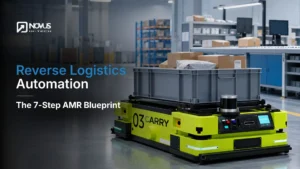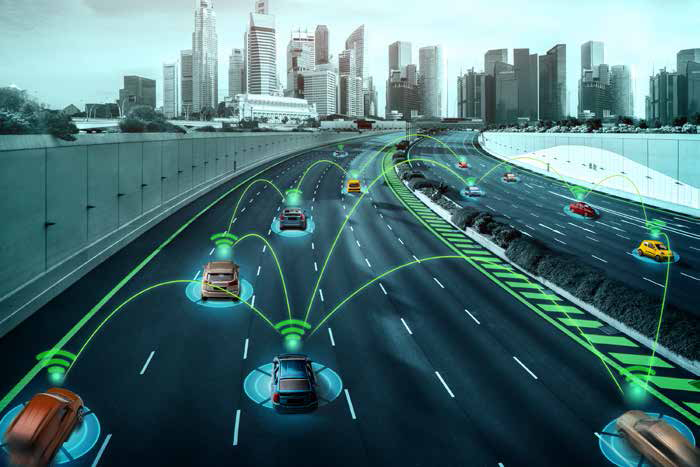

Autonomous Mobile Robots (AMRs) are autonomous robots that can navigate through dynamic uncontrolled environments without the use of tracks or guides. AMRs utilize their own sensing and computing capabilities, continuously sensing the surrounding area while independently making decisions regarding what action to take next, without waiting for directions.
In contrast, AGVs based on traditional automated technology work on a pre-defined route (normally marked with magnetic tape, embedded wires or another unique identification system). AGVs are a suitable solution for carrying out tasks that are repetitive and in an unchanging environment. But put an unexpected obstacle in their path and they just… stop. They can’t think about a problem. AMRs can. That’s not a small difference in practice — it’s the difference between automation that works in a real-world facility and automation that only works when everything goes perfectly.
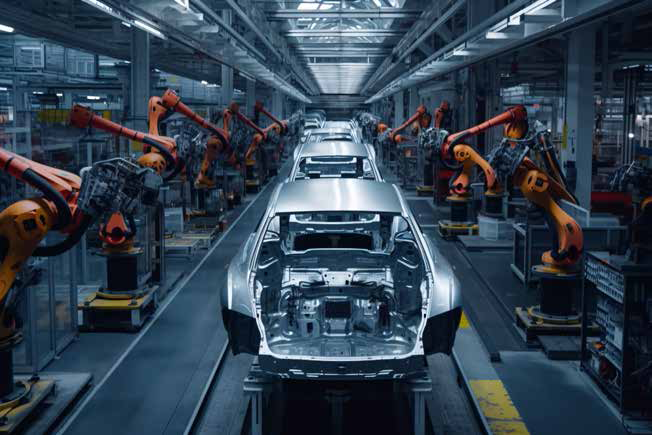
Robotics has stopped being a future conversation and started being a present reality. Walk through a large warehouse today, visit a modern hospital, or tour an automotive plant — you’ll see robots doing work that used to take a lot of human hours. And in most cases, they’re not doing it to replace people. They’re doing the jobs that wore people out, slowed things down, or were genuinely dangerous to do manually.
Manufacturing lines run faster and more consistently when robots handle the welding, painting, and assembly. Hospital staff spend less time pushing medication carts when robots handle the deliveries. Logistics companies fulfill more orders per shift when robots take over the picking and packing. None of this happened overnight, but it’s happening — and businesses that ignore it are increasingly the exception.
Discover how Autonomous Mobile Robots (AMRs) transform workplace productivity.
Download our free brochure for expert insights and trends!
Key Characteristics of AMRs
Mobility and Autonomy:Independence and Mobility: An Automated Mobile Robot (AMR) determines its own path and navigates without human assistance by constantly creating a mental image of its surroundings using (1) LiDAR, (2) vision, and (3) ultrasonic sensor technology. In the event of an obstacle (example: a pallet blocking the aisle or a fork lift truck crossing its path) being introduced into the AMR’s path, the AMR will “see” it and make an immediate adjustment to its navigation plan to continue along its predetermined route. While this type of rapid-response decision capability may be perceived by others to be simple, it is quite challenging from an engineering standpoint to develop, thus making AMRs a much more viable solution to warehouse automation than past iterations of warehouse automation technology.
Flexibility and Adaptability: Most automation equipment is basically furniture — once it’s in place, moving it is a project. AMRs aren’t like that. You can send them somewhere new, change what task they’re doing, or restructure your whole facility layout without rebuilding anything. For any business dealing with seasonal volume swings, product changes, or warehouse reorganizations — which is most businesses — that flexibility is worth a lot.
Human-Robot Collaboration: People were reasonably skeptical when robots started showing up on warehouse floors alongside workers. The safety concerns were legitimate. But AMRs are built specifically for shared spaces — they have layered safety systems, defined zones where they slow or stop automatically, and collision detection that reacts faster than any person could. In practice, workers tend to get comfortable with them pretty quickly once they see how consistently the robots behave.
Types of AMRs based on function and payload capacity

Goods-to-Person Picking Robots: Warehouse picking has always meant a lot of walking — workers covering kilometers every shift just tracking down items. These AMRs take over that travel. They go get the items and bring them back to the person doing the packing. Less walking, faster picks, fewer errors. It’s one of the clearest and most immediate productivity wins when facilities deploy AMRs.
Delivery Robots: These handle the final leg of a delivery — moving something from a central point to wherever it actually needs to go. You’ve probably seen them on university campuses or city streets, carrying food orders or packages. They don’t need a driver, they don’t need fuel, and they don’t get stuck in traffic. For last-mile delivery in the right environments, they’re genuinely hard to beat on cost.
Palletizing Robots: Stacking pallets manually is the kind of work that breaks bodies over time — heavy, repetitive, awkward angles, hour after hour. AMRs built for palletizing do this job without fatigue, without injury risk, and with better consistency than most human operators can maintain across a full shift. They’re also faster, which matters when you’re trying to keep up with shipping schedules.
Cleaning Robots: Big facilities have enormous amounts of floor space that needs regular maintenance. Cleaning AMRs handle the straightforward sweeping, mopping, and scrubbing — usually during quieter periods when the facility isn’t fully operational. It’s not glamorous work, but it’s time-consuming, and having robots do it consistently frees up cleaning staff for the areas and situations that actually need human judgment.
Inspection Robots: Some places simply aren’t safe or practical for regular human inspection — heights, confined spaces, areas with chemical or electrical hazards. Inspection AMRs go into those environments with cameras and sensors, document what they find, and flag anything that needs attention. It’s faster, it’s safer, and it produces consistent records rather than relying on whatever a tired inspector happened to notice on a given day.
How Autonomous Mobile Robots Work?
Navigation Systems: Navigation Systems: An AMR sensor system will run numerous tasks at the same time and LiDAR will continuously send out laser light pulses to produce a highly detailed 3-dimensional map of the area it is in by measuring the time taken for these laser pulses to be sent out and returned back to it. This is how an AMR knows where walls, shelves and other obstacles are located within its operating environment. The robot’s camera system captures and provides additional visual information that is unable to be captured by LiDAR, such as labels attached to specific items and people moving throughout the area. Ultrasonic sensors provide information about what is happening in very close proximity to the AMR by detecting anything that is in very close proximity to it before it becomes an issue for the robot to avoid contacting with. Furthermore, wheel encoders track the movement of the robot by determining exactly how far the robot has travelled and in what direction. All available sources of navigation information contribute to a real-time navigation picture that is updated each time the robot moves from one location within its operating environment to another.
Software and Control Systems: Raw sensor data is useless without software to make sense of it. SLAM — Simultaneous Localization and Mapping — is the core algorithm that handles the genuinely tricky problem of building a map of an environment while also tracking the robot’s own position within that map, simultaneously, without stopping to do either task in isolation. Path planning sits on top of that, working out the best route from where the robot is to where it needs to be. Motion control then translates that planned route into the actual physical movements of the robot. These three layers working together are what make smooth, autonomous navigation possible.
Safety Features: Safety in AMRs isn’t a single feature — it’s a stack of overlapping systems. Obstacle detection runs continuously and will stop or reroute the robot automatically if anything unexpected appears in its path. Physical emergency stop controls are always accessible to any nearby worker. Software-defined safety zones create distance buffers that trigger automatic responses when people enter them. The reason there are multiple layers is straightforward — in a real facility, you can’t afford to have safety depend entirely on any one system working perfectly every single time.
Benefits of Implementing Autonomous Mobile Robots

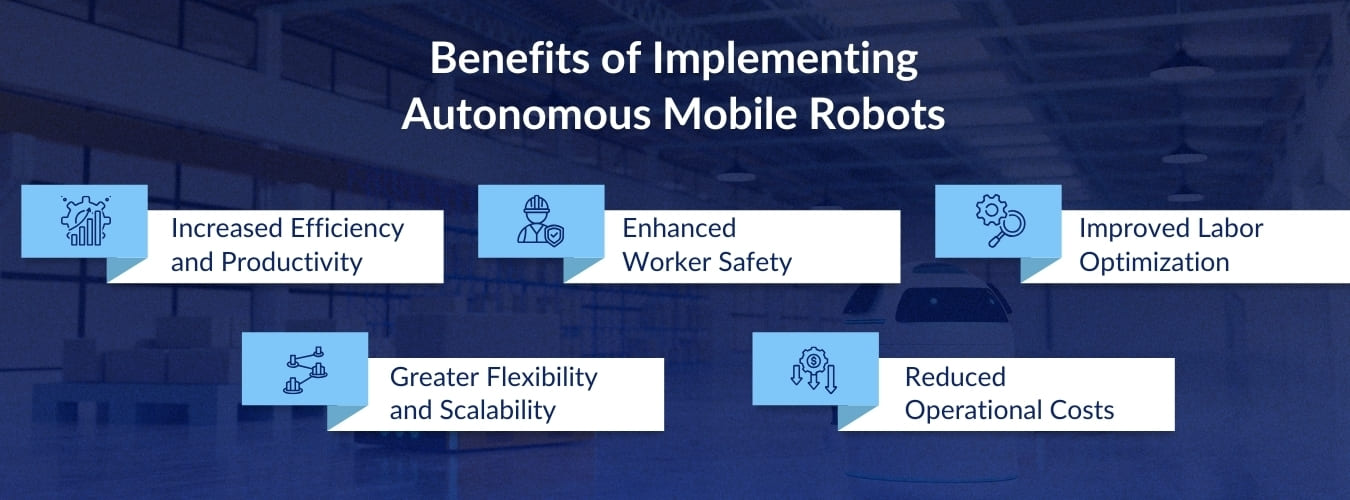
Increased Efficiency and Productivity: Tasks that previously depended on how many people showed up, how rested they were, or how late in the shift it was now run on a predictable, consistent schedule. Material moves when it needs to move. Throughput becomes something you can actually plan around rather than estimate and hope for.
Enhanced Worker Safety: The injury risk in warehouses and manufacturing facilities is real — heavy lifting, repetitive strain, working near moving vehicles. These aren’t rare events, they’re regular causes of time off and long-term health problems. When AMRs take over the tasks that create that exposure, the injury numbers drop. That matters for workers obviously, but it also matters significantly for the business carrying those costs.
Improved Labor Optimization: There’s a difference between keeping people busy and actually using them well. Workers who spend their day walking inventory across a facility aren’t doing work that needs their judgment or experience. Give that job to an AMR and suddenly those same workers can focus on quality control, exception handling, customer-facing work — things where human thinking actually adds value.
Greater Flexibility and Scalability: Peak season hits and you need to process twice the volume. A new product line launches and your workflow needs to change. Your lease is up and you’re moving to a different layout. AMRs handle all of these transitions with software changes rather than infrastructure overhauls. That adaptability has real financial value that’s easy to underestimate when you’re first looking at the upfront cost.
Reduced Operational Costs: The cost savings from AMRs don’t usually come from one dramatic line item — they accumulate across several smaller ones. Fewer labor hours on repetitive tasks, better space utilization, reduced product damage from handling errors, lower injury-related costs. The specific mix varies by operation, which is why the cost-benefit analysis matters, but the underlying case is solid for most high-volume facilities.
Considerations for Deploying AMRs?
Identifying Needs and Applications: Start with the problems you actually have rather than the technology you want to use. Where are you consistently losing time? Where do errors keep happening? Where are your workers spending hours on work that doesn’t really need a human? Those are the places AMRs tend to deliver. Don’t deploy them because it sounds impressive — deploy them because there’s a real problem they’ll solve.
Warehouse Infrastructure: AMRs can handle a lot, but they’re not going to navigate a facility with broken floors, inconsistent aisle widths, or shelving that wasn’t designed with robot dimensions in mind. Before committing to a deployment, physically walk your facility against the specific requirements of the AMR you’re considering. Be honest about what would need to change — and factor that cost into your planning.
Integration with Existing Systems: An AMR fleet that operates in isolation from your Warehouse Management System is delivering maybe half the value it could. The real efficiency gains happen when task assignment, location tracking, and inventory updates are all flowing automatically between systems. This integration takes real planning to get right, and shortcuts taken here tend to cause ongoing headaches. Do it properly from the start.
Cost-Benefit Analysis: The upfront investment in AMRs is significant enough to deserve genuinely rigorous analysis — not optimistic projections designed to justify a decision you’ve already made. Model the realistic savings conservatively, account for implementation costs, training, and ongoing maintenance, and make sure the numbers actually hold up before committing. A good deployment should have a clear, credible ROI case.
Safety Training and Risk Assessment: Handing workers a quick briefing about new robots and calling it done isn’t enough. People who share a floor with AMRs every day need real familiarity — how the robots move, where they’re likely to be, what the warning signs of a problem look like, and exactly what to do when something goes wrong. The risk assessment before deployment should be thorough enough to surface scenarios you hadn’t thought of, not just confirm that everything looks fine.
The Future of Autonomous Mobile Robots
Advancements in Artificial Intelligence (AI): Today’s AMRs are good at structured, repeatable tasks in environments they’ve been trained on. Tomorrow’s will be considerably better at handling genuinely novel situations — things they haven’t seen before — because the AI driving their decisions will be more capable of reasoning rather than just pattern-matching. That gap between what robots can handle and what still needs a human will keep shrinking.
Enhanced Human-Robot Collaboration: Current safety systems mostly work by keeping robots and people separated — the robot stops when someone gets too close. That’s safe but it’s also inefficient. The next generation of human-robot collaboration will be less about creating distance and more about genuine coordination — robots and workers moving fluidly in the same space, each aware of what the other is doing.
The Rise of Cobots: Collaborative robots (cobots) and AMRs are increasingly being deployed together, and it’s a natural pairing. AMRs are excellent at moving things through a facility. Cobots are better at the precise, dexterous manipulation work that requires something closer to human hand movements. Together they cover ground that neither can cover well alone.
Cloud-based Robotics: Managing ten AMRs in one facility is manageable. Managing hundreds across multiple sites is a different challenge entirely. Cloud-based management platforms bring everything together — real-time fleet visibility, remote diagnostics, performance data, coordinated scheduling. The operational insight that comes from that kind of oversight is what allows large deployments to run efficiently rather than just technically.
Autonomous Mobile Robots (AMRs) are revolutionizing industries by offering increased efficiency, enhanced safety, and improved flexibility. They navigate using sensors and software without fixed tracks, adapt to changing environments, and collaborate safely with humans. AMRs come in various types, such as goods-to-person picking robots, delivery robots, palletizing robots, cleaning robots, and inspection robots, each serving specific functions with different payload capacities.
To deploy AMRs successfully, businesses must identify suitable tasks, assess warehouse infrastructure, integrate with existing systems, conduct cost-benefit analyses, and ensure safety training. The future of AMRs looks promising, with advancements in AI enabling complex decision-making and task learning, enhanced human-robot collaboration for seamless interaction, potential integration with collaborative robots (cobots), and the adoption of cloud-based management for optimized performance. These trends indicate a future where
AMRs play a vital role in increasing productivity and driving innovation across industries.
Conclusion
Autonomous Mobile Robots (AMRs) are redefining the future of industrial automation by enhancing efficiency, flexibility, and safety across sectors. Their ability to navigate dynamic environments, collaborate with human workers, and adapt to changing operational needs makes them invaluable assets in industries like manufacturing, logistics, healthcare, and beyond. By integrating AMRs, businesses can unlock new levels of productivity, streamline operations, and ensure a safer working environment.
At Novus Hi-tech, we are at the forefront of this robotic revolution, providing cutting-edge AMR solutions tailored to meet the unique needs of businesses across industries. Whether you are looking to automate warehouse operations, improve material handling, or enhance overall productivity, Novus Hitech is here to guide you through every step of the process.
Ready to embrace this transformative technology?
Reach out to Novus Hitech today and embark on your journey towards a human-centric, safe, intelligent, and more efficient manufacturing future!