
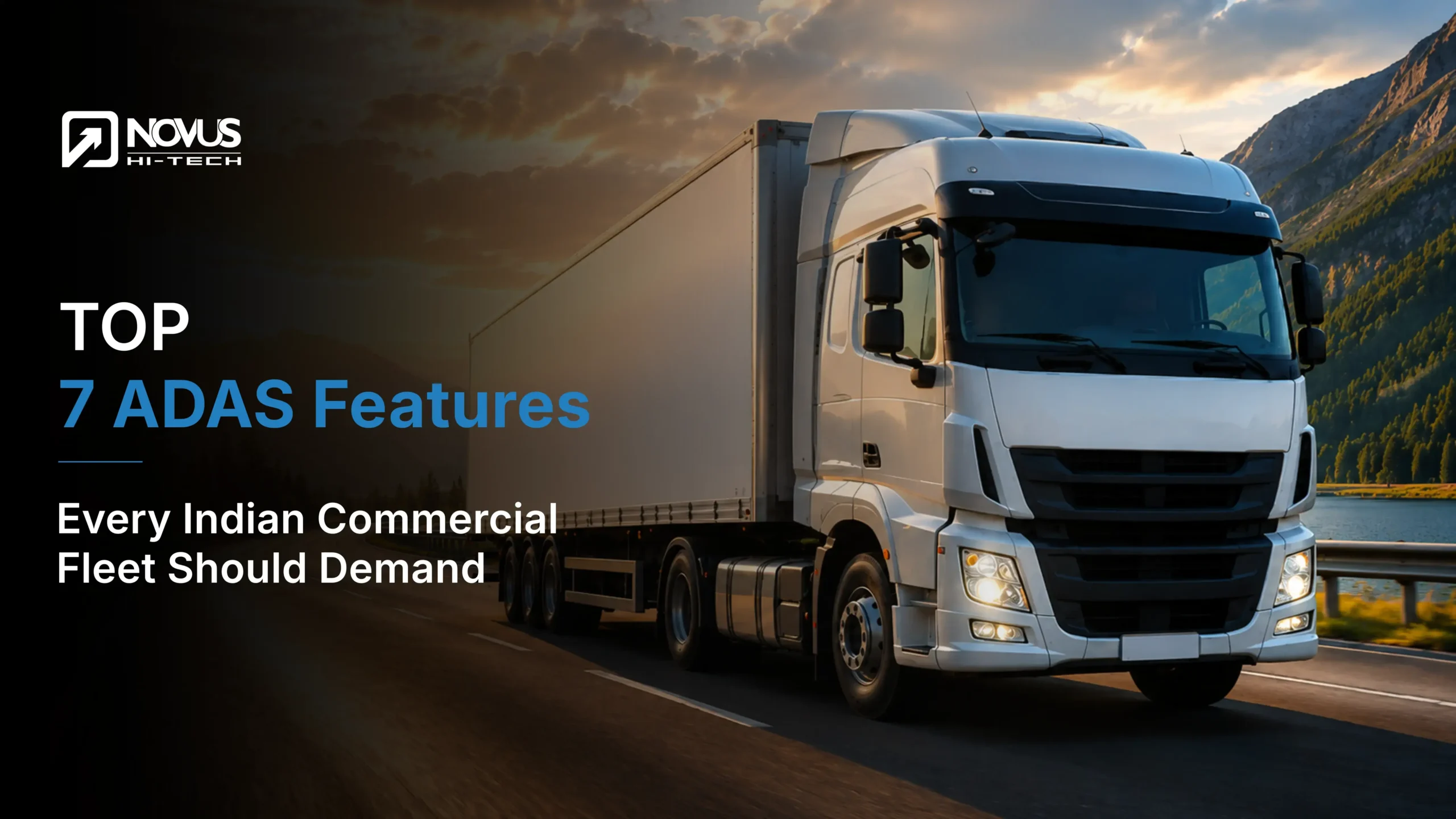
India currently leads the world in road fatalities, with over 1.70 lakh deaths recorded in 2024 alone. According to road safety data cited by Tata Motors Trucks from national road safety reports, nearly 70% of fatal crashes in rural and urban areas involve trucks and buses. To combat this, the industry is shifting toward proactive prevention through advanced ADAS features.
This article explores how integrating these features like collision avoidance and fatigue monitoring, is no longer a luxury, but a regulatory necessity for Indian fleet operators facing the MoRTH April 2026 mandates.
The Regulatory Shift: Compliance is No Longer Optional
The regulatory window for Indian fleet owners is rapidly closing. Under the Motor Vehicles (Amendment) Act, 2019, fleet owners are now held directly liable for recorded driver negligence. Furthermore, the Ministry of Road Transport and Highways (MoRTH) has proposed mandatory AEBS, DDAWS, and LDWS for commercial vehicles carrying more than eight passengers starting April 2026. Coupled with AIS-140 Phase II standards mandating real-time video telematics, the shift toward ADAS has moved from a “future trend” to an immediate legal and operational necessity.
Why ADAS Features Give Indian Fleets a Competitive Edge
Beyond compliance, smart fleet safety solutions in India offer a massive ROI.
- Commercial insurers are increasingly offering premium incentives for fleets using ADAS, AI dash cams, and telematics systems, with industry case studies reporting discounts ranging from 5% to 20%, and some fleets achieving up to 30% lower premiums over time.
- Studies from fleet telematics providers and the U.S. Department of Energy show that reducing harsh braking, overspeeding, rapid acceleration, and unnecessary idling can improve fleet fuel efficiency by roughly 8–12%, while aggressive driving alone can reduce fuel economy by up to 30%.
- AI dash cams and ADAS systems increasingly function as a ‘digital witness,’ providing video and telematics evidence that helps fleets defend against false liability claims and accelerate dispute resolution.
This guide covers everything Indian fleet operators need to know in 2026: the top 7 ADAS Features List for commercial vehicles.
What Is an ADAS System for Commercial Vehicles?
ADAS is a suite of AI-powered technologies that monitor the vehicle, the road, and the driver simultaneously. Cameras, radar, GPS, and sensors work together to detect hazards, alert the driver, and in some cases intervene automatically before a crash occurs.
Standard global ADAS platforms, however, are not calibrated for Indian conditions: dense mixed traffic, two-wheeler proximity, unmarked rural highways, and low-light night environments. Fleet safety technology in India needs to be built and tested for these specific conditions to perform reliably.
Top 7 ADAS Features in 2026 for Indian Commercial Fleets
1. Forward Collision Warning + Autonomous Emergency Braking (FCW + AEB)
To prevent or mitigate the severity of front-end collisions, this system serves as a proactive safety layer. FCW uses forward-facing radar or camera to continuously monitor the closing distance to the vehicle ahead – triggering escalating audio-visual alerts the moment a collision risk is detected. If the driver does not respond, AEB fires the brakes autonomously in under 150ms. On India’s high-density freight corridors, this combination reduces rear-end crashes by up to 50% and is proven to save the most lives per rupee of fleet investment.
2. Lane Departure Warning + Lane Keeping Assist (LDW + LKA) – Critical for Long-Haul Routes
Specifically designed for long-haul routes, this steering-support system prevents unintentional drifting, which is a leading cause of head-on collisions. LDW uses a forward camera to detect lane boundaries in real time. The moment a vehicle begins drifting without the turn indicator active, the driver receives an immediate audio-haptic alert – no delay, no guesswork. LKA goes further: it applies calibrated steering torque to actively guide the vehicle back into its lane.
3. Driver Monitoring System for Fleet Vehicles (DMS)
Addressing the human element, DMS for fleet vehicles is an interior sensing technology focused on the driver’s physiological state and attention levels. An IR cabin-facing camera continuously tracks eye closure rate, head-nod patterns, gaze deviation, and yawn frequency – the four primary biomarkers of dangerous fatigue. This is the fatigue detection system for drivers that intervenes before a microsleep event, not after.
Real-world proof from India: Nayara Energy, operating a multi-thousand dangerous-goods tanker fleet under high-risk, night-heavy duty cycles, deployed a three-layer behavioral safety system combining in-cab AI sensors, live dashboards, and data-driven driver coaching. Validated results over 18 months:
- 46% reduction in road-behaviour violations across the full fleet over 18 months
- 55% reduction in drowsiness alerts per 1,000 km
- 55-60% reduction in distraction events per 1,000 km
- Risk response time compressed from 24 hours to under 4 seconds
Results independently validated in Nayara Energy Annual Report FY 2023-24.
4. Blind Spot Detection + Rear Cross-Traffic Alert (BSD + RCTA)
This sensor-based system monitors areas alongside and behind the 40-tonne chassis that are typically invisible to the driver. BSD uses short-range radar to monitor these zones continuously and alerts the driver – via mirror-mounted visual indicators and audible warnings – the moment a vehicle enters the danger zone during a lane change. This is vital for protecting vulnerable road users, such as two-wheelers and pedestrians, in congested urban delivery points and loading bays where visibility is naturally limited.
5. Intelligent Speed Assistance + Traffic Sign Recognition (ISA + TSR)
ISA reads posted speed limit signs using a forward camera and cross-references live GPS geofencing data to enforce state-specific, road-type-specific speed limits dynamically. Speed violations are pushed to fleet telematics dashboards in real time – giving operations managers instant visibility across the entire fleet. ISA also handles school zone reductions, toll plaza approach speeds, and restricted zones automatically. Insurance providers offering premium reductions for documented ISA compliance make this a direct revenue-generating feature, not just a safety measure.
6. Electronic Stability Control + Rollover Stability Control (ESC + RSC)
ESC monitors yaw rate, lateral acceleration, and steering input simultaneously – applying individual wheel braking to correct skids, oversteer, and understeer before the driver can react. RSC specifically addresses rollover risk for tankers, high-CG flatbeds, and double-decker buses navigating India’s mountain ghats, hill station routes, and sharp highway curves. ESC is proven to reduce fatal single-vehicle crashes by up to 49%. For any fleet operating on logistics safety technology standards, this is baseline.
7. 360° Surround View + AI Dashcam with Event Recording
A four-camera surround system stitches a real-time bird’s-eye view of the vehicle – eliminating all remaining blind spots during low-speed manoeuvres in docks, lanes, and congested delivery zones. The AI dashcam layer uses G-force sensors to automatically record and tag critical events: hard braking, sharp swerves, impact. Footage is timestamped and uploaded to the commercial fleet automation platform for review. This resolves insurance disputes with direct evidence – saving INR 2–10 lakh per claim.
Running a fleet without AIS-184-compliant ADAS creates documented compliance exposure, insurance liability, and safety risk that compounds with every month of delay. Novus Hi-Tech’s fleet safety assessment identifies exactly where your current setup stands against the mandate requirements.
Commercial ADAS Comparison: Without vs. With — ROI for a 100-Vehicle Fleet
Safety technology is not a cost centre. The table below shows the direct financial impact of full ADAS deployment across five cost categories for a 100-vehicle Indian commercial fleet.
| Cost Area | Without ADAS | With ADAS (Novus Hi-Tech) | Annual Savings |
| Accident Cost (100-vehicle fleet) | INR 24–250 lakh/yr | ↓ 40–60% reduction | INR 10–150 lakh |
| Insurance Premium (per vehicle) | INR 80K–2 lakh/yr | ↓ 15–30% discount | INR 16–40 lakh (fleet) |
| Fuel Consumption | Baseline spend | ↓ 8–15% smoother driving | INR 5–18 lakh (fleet) |
| Driver Replacement Cost | INR 50K–1.5 lakh/driver | ↓ Reduced turnover | INR 5–15 lakh |
| Insurance Dispute Losses | INR 2–10 lakh/claim | ↓ Dashcam evidence resolves fast | INR 2–10 lakh/claim |
| Cargo Damage | Frequent harsh-braking losses | ↓ Smoother ADAS-assisted driving | 3–8% cargo savings |
Source:
Premium Discounts & Risk Mitigation Regulations
Commercial Vehicle Insurance Statutory Pricing
ROI ranges are indicative. Actual figures vary by fleet size, route profile, incident history, and insurer. Novus Hi-Tech deployment data and publicly available insurance market benchmarks used as reference inputs.
For a 100-vehicle fleet, comprehensive ADAS deployment – covering all 7 features – typically achieves full ROI within 18–24 months through accident cost savings and insurance premium reduction alone. Fuel and driver retention savings are additional upside.
ADAS Buying Checklist: What to Demand from Any Vendor in 2026
Before signing any ADAS procurement contract, verify these non-negotiables:
Technical Requirements
- Sensor fusion: Radar + camera combined (single-sensor systems are insufficient for Indian roads)
- India-calibrated: Two-wheeler detection, unmarked lane performance, low-light IR capability
- AEB response time under 150ms – the industry benchmark for effective emergency intervention
- False alert rate below 2% – high false positives cause driver disengagement and system switch-off
Compliance & Integration
- AIS-140 Phase II certified hardware – mandatory for all commercial transport
- Fleet telematics platform integration via open API
- GPS geofencing for state-wise, road-type speed compliance
- Exportable driver behaviour logs for insurance documentation
Commercial & Support
- Pan-India hardware service coverage across your fleet’s operating corridors
- Retrofit availability – no full vehicle downtime required for installation
- Total cost of ownership transparency over 3–5 years
Future Trends of ADAS for Commercial Vehicles in India (2030)
The APAC commercial vehicle ADAS market is projected to grow at 32%, and the fleet safety technology stack established in 2026 directly enables what comes next. Two near-term developments are already being piloted: truck platooning on Dedicated Freight Corridors, and V2X (Vehicle-to-Everything) communication that allows trucks to interact with smart highway infrastructure in real time. Both require the sensor fusion and telematics integration that today’s ADAS deployment puts in place. Early adopters will not need to retrofit for these capabilities — they will already be ready.
Conclusion
India’s commercial road transport sector is at a defining crossroads. With 1.70 lakh road deaths in 2024 (MoRTH), a regulatory framework that is tightening by the quarter, and an ADAS market growing at 18.12% CAGR through 2031, the question for Indian fleet operators is no longer whether to invest in ADAS features but how quickly.
The 7 features in this guide are the minimum viable safety stack for any Indian commercial fleet operating in 2026. The business case is equally clear: a 100-vehicle fleet achieves ROI within 18 to 24 months through accident cost reduction, fuel savings of 8 to 15%, and reduced insurance exposure.
The fleets that act before April 2026 will not just be compliant. They will be safer, leaner, and better positioned for every regulatory and commercial shift that follows.