
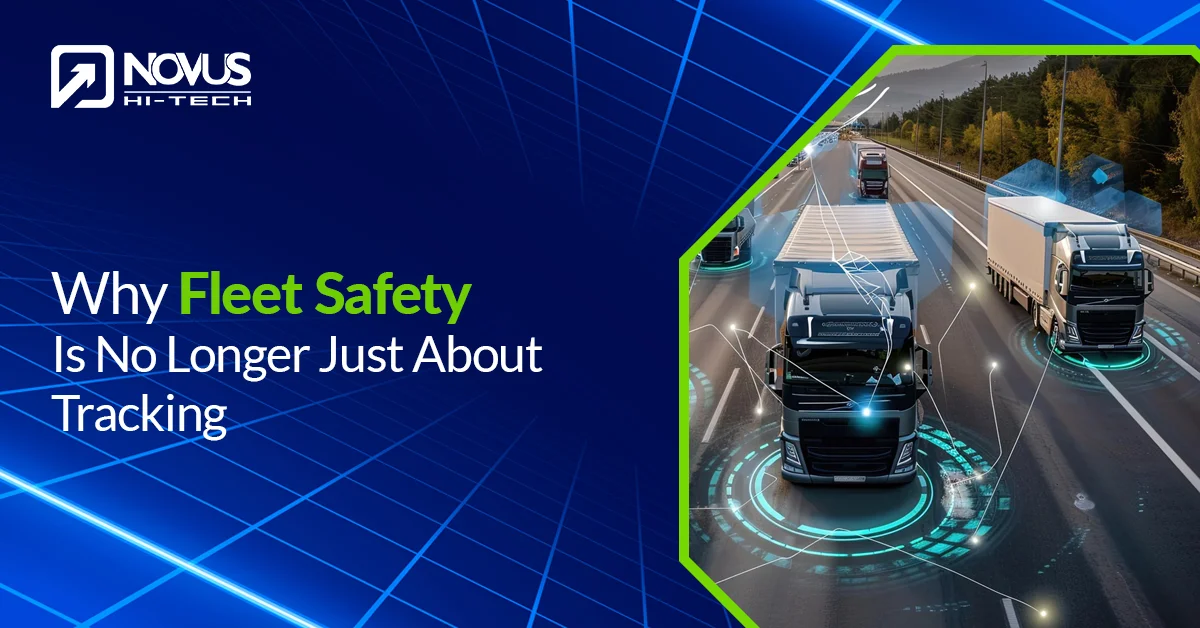
Why Fleet Safety Is No Longer Just About Tracking
For a long time, fleet safety was built on a simple assumption — that visibility equals control. If you could track where your vehicles were, monitor their speed, and ensure routes were being followed, you were doing enough. On dashboards, everything looked organised and predictable. But out on the road, things rarely behave that way.
Incidents don’t happen because data is missing. They happen because something small goes unnoticed in the moment. A driver looks away briefly. A vehicle ahead brakes harder than expected. A blind spot hides what shouldn’t be hidden. These are not failures of systems, but gaps between perception and reaction. And traditional fleet safety systems, while useful, were never designed to close that gap.
They tell you what happened. But they don’t explain why it happened. And more importantly, they don’t actively prevent it from happening again.
That’s where the shift begins — from tracking to intelligence. And at the center of this shift are two technologies that are reshaping how fleets operate: advanced driver assistance systems (ADAS) and video telematics.
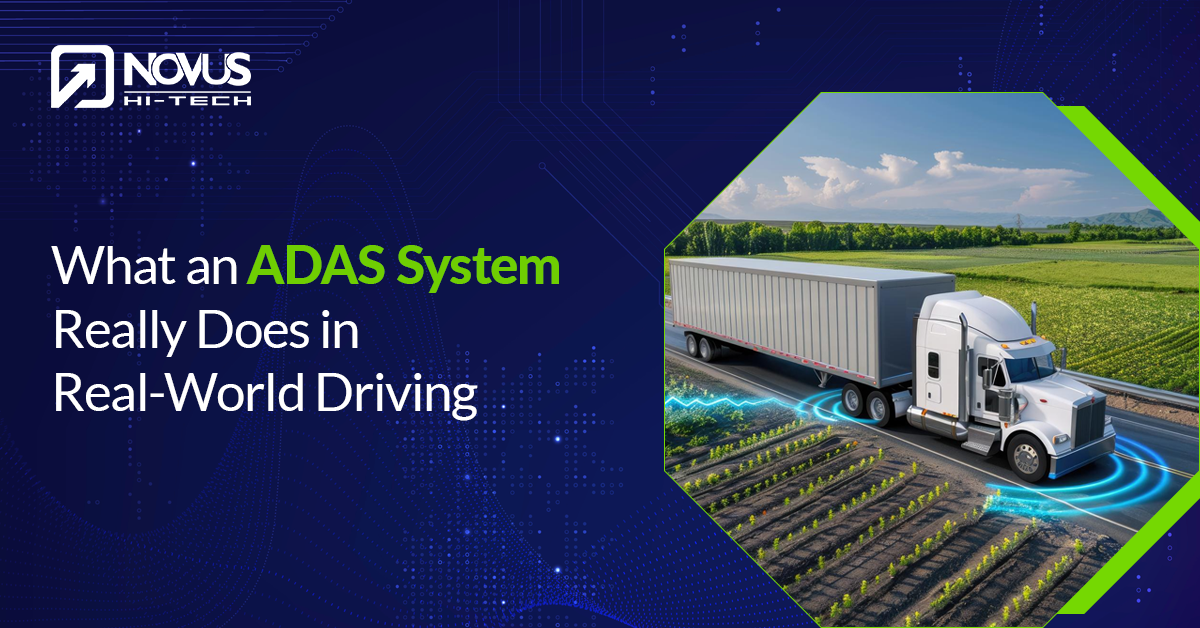
What an ADAS System Really Does in Real-World Driving
The ADAS System is more than a level of supervision; at its core, the ADAS is an advanced technological system for identifying potential risks through continuous monitoring of lane markings, other vehicles, rapidly moving traffic elements, and peripheral obstructions to the vehicles’ immediate area through the application of multiple integrated components, such as cameras, sensors, and Artificial Intelligence in constant configuration with one another for environmental data processing.
The distinguishing factor regarding ADAS is not solely the environmental data being processed, but also the quickness that it can react to that information.
When an impending accident is detected, the ADAS does not delay notifications to a vehicle operator; the ADAS immediately activates visual and audible alert systems to inform the operator that an accident is about to occur. In more advanced systems, an ADAS can not only notify an operator of an impending accident, but also implement emergency safety measures, including electronically activating the vehicle’s diagonal braking systems, transferring steering input back into the vehicle, and/or providing the operator with stabilising input into the vehicle’s steering systems. The speed with which an ADAS reacts to an impending collision warning provides considerable advantages over humans as it relates to providing the potential for reducing the number of fatalities associated with motor vehicles.
The benefit of an ADAS to the vehicle operator is the perception of the presence of additional safety; additional safety that is created by an electronic safety system that cannot be distracted, fatigued, or impaired. For the fleet operator, this translates into less vehicle operational downtime due to an accident than if an ADAS was not installed in a vehicle.
Nonetheless, due to its overall effectiveness, an ADAS is designed to operate solely in the present time; an ADAS is required to focus on and react to what is occurring at the moment of an accident. After that point, an ADAS has fulfilled its intended purpose.
The Missing Layer — Understanding What Happens Over Time
This is where most fleets start noticing a gap.
Even with ADAS in place, patterns still emerge. Certain drivers tend to brake harder. Certain routes consistently show higher risk. Some vehicles appear in more incidents than others. These patterns don’t show up in real-time alerts. They only become visible over time.
And that’s exactly what video telematics is built to capture.
Unlike ADAS, which reacts instantly, video telematics observes continuously. It combines AI-powered cameras with telematics data like speed, location, and driver inputs to create a much richer view of fleet operations.
When an event occurs, it doesn’t just log a number. It shows the full context. What the driver saw. How they reacted. What led to that moment. This shift — from data points to visual evidence — is what makes video telematics fundamentally different.
Why Video Telematics Changes Behaviour, Not Just Reporting
There’s a subtle but important difference between knowing something happened and seeing it happen.
When drivers receive abstract feedback — “harsh braking,” “over-speeding,” “sudden turn” — it often feels generic. But when they see actual footage of their actions, the response is very different. It becomes personal. Immediate. Real.
This is why video telematics has such a strong impact on driver behaviour.
It turns every incident into a learning opportunity. Coaching becomes specific instead of broad. Feedback becomes visual instead of verbal. Over time, this leads to noticeable improvements in how vehicles are driven — not because rules are stricter, but because awareness is higher.
For fleet operators, this creates something far more valuable than reports. It creates clarity. And with clarity comes better decision-making.
ADAS vs Video Telematics — Understanding the Real Difference
When people compare ADAS systems and video telematics, the conversation often turns into a question of choice. Which one is better? Which one should come first?
But the truth is, they were never designed to replace each other.
ADAS is built for prevention. It reduces risk in real time by detecting and reacting to immediate threats.
Video telematics is built for understanding. It reduces long-term risk by analysing behaviour and identifying patterns.
One works in the moment.
The other works across time.
ADAS protects the vehicle when something goes wrong.
Video telematics ensures that the same thing is less likely to go wrong again.
Why the Most Advanced Fleets Use Both Together
The real transformation happens when these two systems are combined.
Instead of isolated tools, they become part of a continuous loop. A potential risk appears, ADAS detects it instantly and alerts the driver. The event is captured by video telematics, providing context and insight. That insight is then used to coach drivers, refine operations, and reduce future risk.
Over time, this loop creates a system that improves on its own.
Incidents don’t just decrease randomly — they decrease predictably. Driver performance doesn’t fluctuate — it stabilises and improves. And fleet operations become more consistent, more efficient, and easier to manage.
This is the shift from managing vehicles to managing intelligence.
The Bigger Shift — From Monitoring Fleets to Understanding Them
What we’re seeing today is not just an upgrade in tools. It’s a change in how fleets think.
Instead of asking, “Where are my vehicles?”
Operators are asking, “How are my vehicles being driven?”
Instead of reacting to incidents after they happen, they are starting to predict where risks are likely to emerge.
This shift is powered by systems that don’t just collect data, but interpret it. Systems that connect real-time alerts with long-term insights. Systems that allow fleets to move from reactive operations to proactive strategy.
ADAS and video telematics sit at the core of this transformation.
How Novus Hi-Tech Is Building Smarter Fleet Safety Systems
This is exactly where Novus Hi-Tech positions itself.
Rather than offering standalone tools, Novus focuses on building integrated fleet safety systems that combine advanced driver assistance systems, AI-powered video telematics, and driver monitoring technologies into one cohesive platform.
The approach is not just about reducing accidents. It’s about creating fleets that learn from every journey. Fleets where data is not just collected, but used. Fleets where safety improves continuously, not occasionally.
This shift — from monitoring to intelligence — is what defines the next generation of fleet operations.
Watch how Novus SafePro combines ADAS & video telematics to prevent fleet accidents
Move Beyond Tracking. Build True Fleet Intelligence
If your current system only shows you where your vehicles are, you’re only seeing part of the story.
The real advantage lies in understanding how your fleet behaves, where risks originate, and how those risks evolve over time.
Explore how ADAS systems and video telematics work together
Because the future of fleet safety isn’t just about reacting faster.
It’s about learning smarter.