
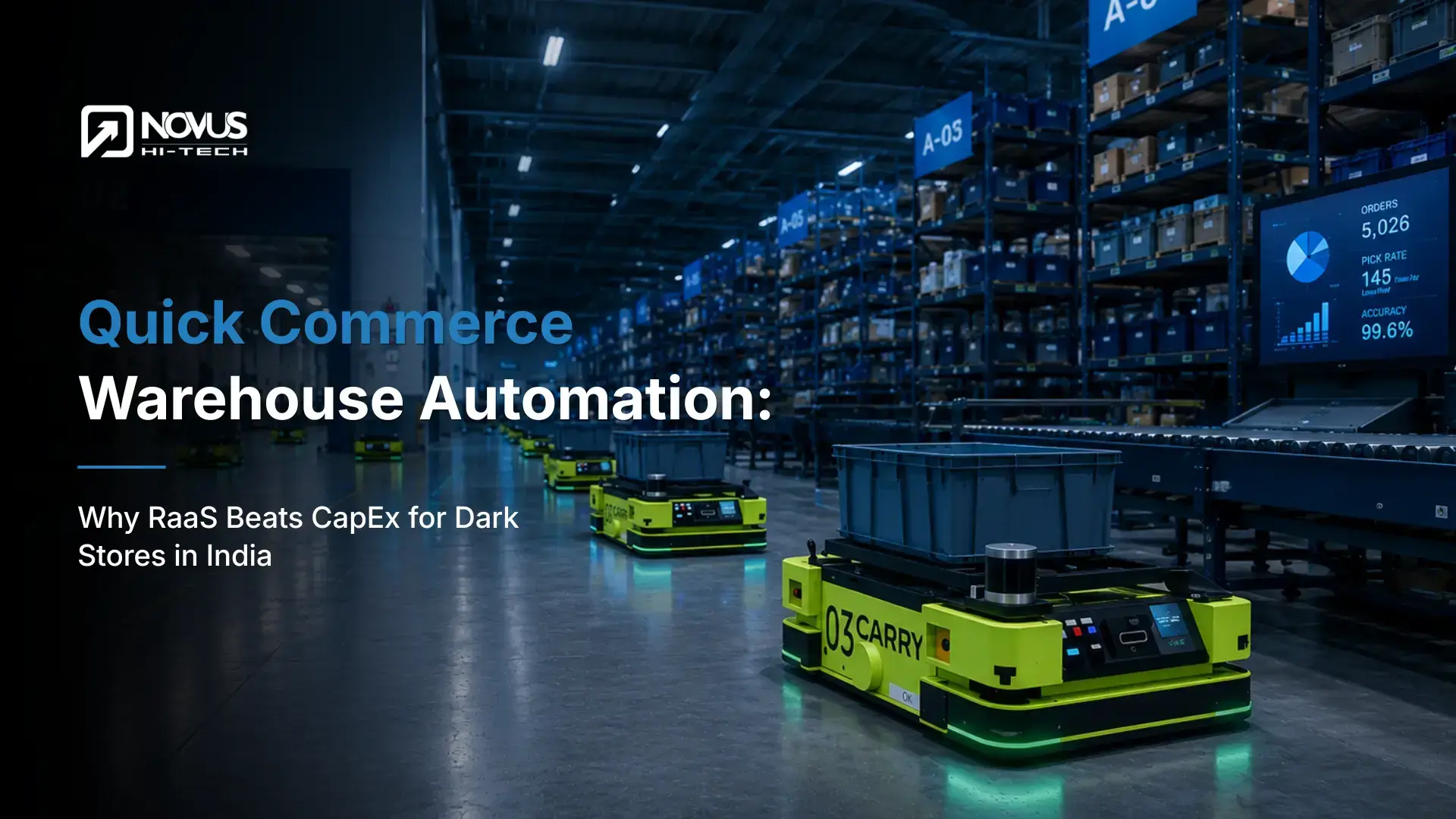
Quick commerce warehouse automation has become the quiet battleground behind India’s 10-minute delivery promise. Every rapid order is fulfilled from a dark store, a compact hub closed to walk-in shoppers that stocks fast-moving essentials and turns orders around in minutes. These hubs are multiplying fast: the combined dark store networks of Blinkit, Swiggy Instamart, and Zepto reached 5,026 locations in May 2026, up from 3,405 a year earlier, a near 48% expansion in twelve months.
The economics point the same way. India’s quick commerce segment is projected to touch roughly ₹1.08 lakh crore in 2026, growing around 40% year on year, more than twice the pace of overall digital commerce. As volumes climb and categories widen beyond groceries, every dark store faces one demand: pick faster, pick more accurately, and cut the cost per order.
That is the case for automation. The harder question is how to fund it. Buying robots outright locks up capital in a format where stores move, resize, and reopen constantly. This is where Robotics-as-a-Service (RaaS) reshapes the decision for dark store operators, and why it often beats the traditional capital expenditure (CapEx) route.
Why Dark Stores Need Automation More Than Traditional Warehouses
Unlike conventional warehouses that process bulk shipments, dark stores are optimized for thousands of small, time-sensitive orders, and every second counts. A picker walking an extra 20 meters or hunting for an item can delay several deliveries at once and drag down overall throughput.
Modern dark store automation targets exactly those inefficiencies through autonomous mobile robots (AMRs), smart inventory movement, automated replenishment, intelligent order routing, and real-time warehouse analytics. Instead of associates spending most of a shift walking between shelves, robots transport inventory while people focus on picking and packing. The payoff shows up across the operation:
- Faster order fulfillment
- Higher picking accuracy
- Reduced labor fatigue
- Better space utilization
- Consistent performance during peak demand
What Quick Commerce Warehouse Automation Actually Looks Like
Quick commerce warehouse automation covers the systems that move, store, pick, and sort inventory inside a dark store or micro-fulfillment center with minimal manual handling. Inside an automated dark store, the common building blocks are:
- Autonomous Mobile Robots (AMRs) that carry totes or shelves to a stationary picker, cutting walking time in goods-to-person workflows.
- Put-to-light and pick-to-light stations that guide accurate, high-speed order assembly.
- Linear sorters and automated weighing and packaging that shorten dispatch time.
- A warehouse management system (WMS) and fleet software that coordinate every robot and every order in real time.
India’s Quick Commerce Boom Is Driving Robotics Adoption
The rapid expansion of Blinkit, Zepto, Swiggy Instamart, and BigBasket Now has turned competition around fulfillment speed into a warehouse problem, not just a delivery one. Consumers only ever see the rider at the door, but the real competitive advantage is built inside the store, and that is where quick commerce robotics is starting to reshape operations.
India’s leaders are already investing here. In its updated IPO filing, Zepto described put-to-light sorting stations, linear sorters, and automated weighing and packaging, alongside machine-learning demand forecasting, and said it is developing AI-powered warehouse picking and robotics for product movement and replenishment. For Zepto, warehouse automation is moving from pilot to backbone.
Blinkit, now the market leader and EBITDA positive, uses semi-automation and robotics for picking, packing, and cold storage, and has publicly showcased a highly automated warehouse. The signal is consistent across the sector: quick commerce intralogistics is becoming robot-assisted, and manual-only dark stores will struggle to keep pace.
RaaS vs CapEx: The Math for Q-commerce Operators
The CapEx problem
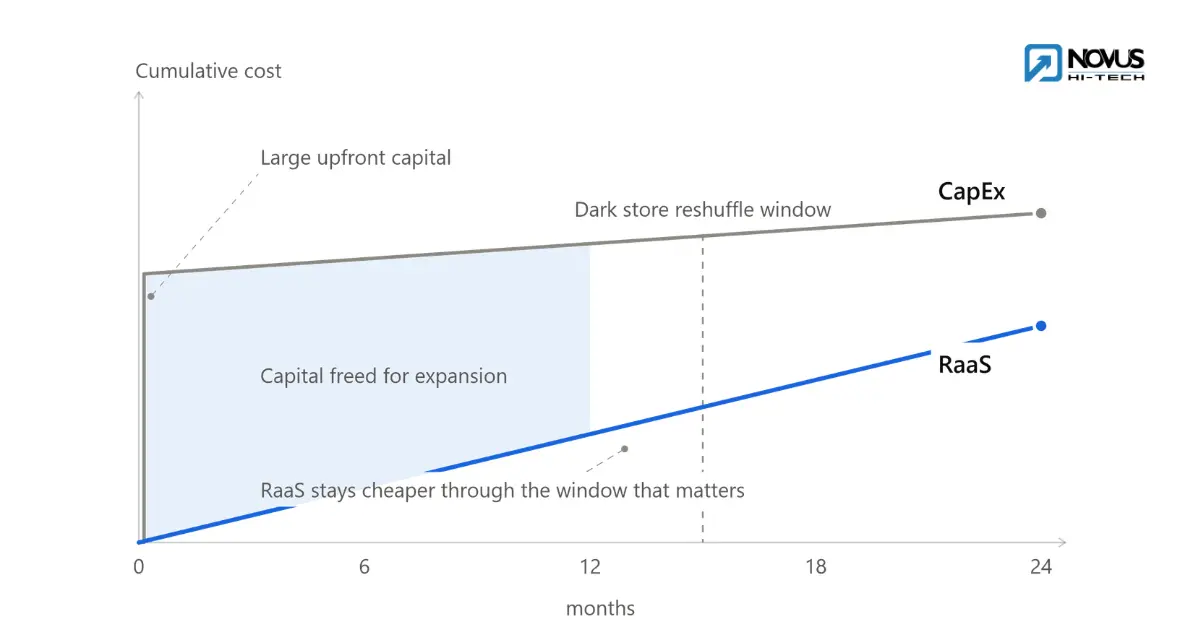
Buying automation outright is a heavy commitment. A single AMR can run into tens of thousands of dollars, and a full automation system can reach seven figures depending on scale. For a dark store operator, that means large upfront capital, a long approval cycle, and the risk that hardware is outgrown or outdated before it pays back.
In a format that reconfigures stores often and opens new ones weekly, sinking fixed capital into every site is hard to justify. The store you kit out today may move, expand, or change its product mix within a year.
How RaaS changes the equation
Robotics-as-a-Service turns that purchase into a subscription. Instead of owning robots, operators pay a predictable recurring fee that bundles hardware, software, deployment, and maintenance. The financial effect is a shift from CapEx to operational expenditure (OpEx), and it maps neatly onto how dark stores actually run.
Key advantages for Q-commerce operators:
- Lower upfront cost. Capital stays free for store expansion and inventory instead of being locked into fixed assets.
- Faster payback. With no large outlay to recover, savings can show in months rather than years.
- Built-in maintenance and upgrades. The provider handles servicing and keeps the fleet current, so a store never runs obsolete hardware.
- Elastic scaling. Fleets flex up for festive peaks and down afterward, matching the demand spikes that define quick commerce.
Not sure whether RaaS or CapEx fits your store economics?
The Novus Hi-Tech team can model both against your throughput and rollout plan. Explore our warehouse automation solutions to see how a subscription fleet scales with a growing dark store network.
Why RaaS Is Becoming the Preferred Model
Dark stores are a moving target. Leases are short, layouts change, and networks expand into new cities constantly. RaaS suits that volatility because it treats automation as a service that scales with the store, not a permanent installation bolted to one address.
When a platform opens 2,000 stores in a year, standardising on a subscription model lets it roll out consistent quick commerce robotics across sites without re-approving capital every time. It also lowers the barrier for smaller and regional operators who cannot match a market leader’s balance sheet but still need competitive fulfilment speed.
There is a strategic point too. Blinkit’s partner-operated model already pushes store-level costs onto franchise partners while the platform supplies the technology. RaaS extends the same logic to robotics: pay for productivity, not for owning machines.
What To Look For in a RaaS Partner
Not every RaaS contract is equal. Operators evaluating quick commerce warehouse automation should check:
- Clear SLAs on uptime, response time, and throughput.
- Integration with existing WMS and order management systems.
- A proven fleet management platform for traffic control, monitoring, and analytics.
- A real deployment track record at scale, not a demo reel.
Depth of field experience matters most. Novus Hi-Tech, for example, brings 1,400+ robots deployed, 150+ patents, and more than 10 million km of autonomous navigation across factory and warehouse floors, the kind of operating history that de-risks a first automation project.
Choosing Between CapEx and RaaS
CapEx vs RaaS for dark store automation
| Factor | CapEx | RaaS |
| Upfront investment | High | Low |
| Monthly costs | Lower after purchase | Subscription-based |
| Deployment speed | Moderate | Faster |
| Scalability | Slower | Highly flexible |
| Technology upgrades | Additional investment | Typically included |
| Maintenance | Internal responsibility | Usually managed by provider |
| Best suited for | Stable, mature operations | Growing and expanding businesses |
For organizations with stable, predictable warehouse operations and long planning horizons, CapEx can still make financial sense. However, for India’s fast-moving quick commerce sector—where expansion, demand, and customer expectations evolve constantly—the flexibility of RaaS often outweighs outright ownership.
The Takeaway For India’s Dark Stores
Quick commerce in India is scaling faster than manual fulfilment can comfortably keep up. Automation is becoming a requirement, not an option, and the operators who win will be the ones who deploy it without locking up capital or betting on hardware that ages out.
For most dark store networks, RaaS delivers the speed and accuracy of robotics with the flexibility the format demands. That is why, for Q-commerce intralogistics in India, RaaS increasingly beats CapEx.
Planning automation for your dark store or micro-fulfilment network? Talk to the Novus Hi-Tech team about a RaaS deployment sized to your throughput, or explore our warehouse automation solutions to see what a subscription-based fleet could do for your fulfilment speed.