
Your customer taps “order” and starts a countdown. You’ve got ten minutes, maybe less, to find the item, pack it, and get it out the door.
That’s the entire premise behind a micro fulfillment center. Not a bigger warehouse. Not more staff. A small, efficient footprint positioned near your customer, reducing distance as an issue.
Most retailers still think fulfillment speed is a delivery rider problem. It’s not. It’s a floor-layout problem, a stock-visibility problem, and increasingly, a robotics problem. Get the inside of the building right, and the last mile takes care of itself.
This playbook breaks down what a micro fulfillment center actually needs to work, where dark store automation fits, where it doesn’t, and what the real numbers say about where this is all headed.
Defining a Micro Fulfillment Center
A micro fulfillment center, or MFC, is a small, local facility designed to store inventory and prepare online orders on the premises. Not hundreds of thousands of square feet, but several thousand square feet.
It can be a stand-alone unit inside a retail store or simply a single line in a larger local network.
A traditional distribution center plans for scale. An MFC plans for speed.
Here’s what a well-run MFC gets you:
- Inventory that exists where demand is. No shipping a product across the country to fill a same-day order.
- Shorter paths for selection. Staff are not navigating an expansive warehouse.
- Enhanced stock accuracy. Smaller footprint with fewer places for inventory to disappear.
- Faster dispatch. Orders move from pickup to door with less handoffs.
An MFC shouldn’t be considered a dark store automatically. A dark store is a retail space repurposed to only handle online orders. An MFC describes the fulfillment model itself. You can run an MFC inside a dark store, inside an active retail location, or inside a dedicated micro-warehouse. They’re not the same thing.
Why Dark Store Automation Is the Real Competitive Edge
Here’s the truth for a lot of operators: your floor is somehow your real roadblock.
A dark store involves certain activities like picking, replenishment, packing, and staging into an available floor space that might be under 500 square feet. Every one of those activities competes for the same aisle, shelf, and minute.
Sometimes the solution is simpler and more cost-effective:
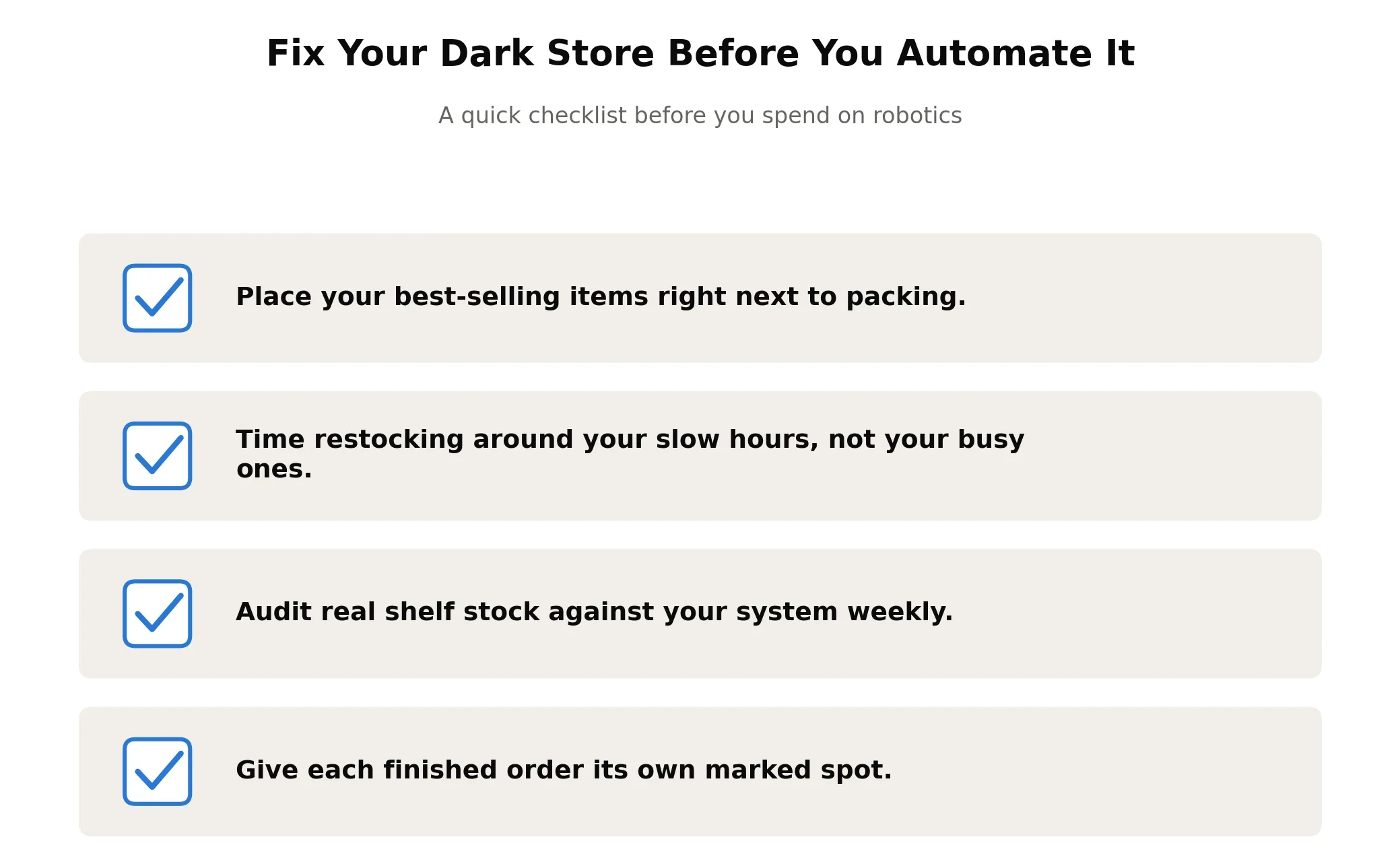
- Relocate your top-selling SKUs nearer to the packing station. Sounds straight to the point. Yet, many retailers overlook it.
- Schedule stock replenishment to avoid peak order times. Replenishment during a rush creates many problems at once.
- Run a live stock check against your system records weekly. A ghost SKU listed as “in stock” leads to canceled orders and negative feedback.
- Assign a designated labeled slot for each packed order. Your delivery partner shouldn’t be hunting through a stack of bags.
Novus Hi-Tech’s breakdown on quick commerce warehouse automation digs into this exact situation, where robots-as-a-service beats a big upfront capital spend for operators scaling a dark store network fast. A good read if you’re choosing between leasing automation and buying it outright.
Building 10 Minute Delivery Infrastructure Without Breaking Your Budget
Here’s where most operators get the numbers wrong. They assume 10-minute delivery infrastructure means wall-to-wall robotics from day one.
It doesn’t.
You don’t get a delivery promise under ten minutes to the curb. It’s won in the thirty seconds before. An order even gets assigned to a picker. That means:
- Real-time inventory accuracy, down to the shelf
- A pick path that’s been accurately calculated and optimized
- A packing station that serves solely for packing, not for storage overflow
Deloitte’s 2025 US Retail Industry Outlook found that 64% of surveyed retail executives expect the number of automated micro-fulfillment centers to grow significantly over the next five years.
That’s not speculation; instead, retail leadership is indicating the direction of future capital investments.
Where Micro Warehouse Robotics Pays Off
Micro warehouse robotics proves important when your primary time drain isn’t picking; it’s the movement of staff transporting totes across the floor. Walking back and forth between storage and packing. Repetitive trips that burn labor hours on zero value-add work.
For that reason, autonomous mobile robots, or AMRs, are built to fix:
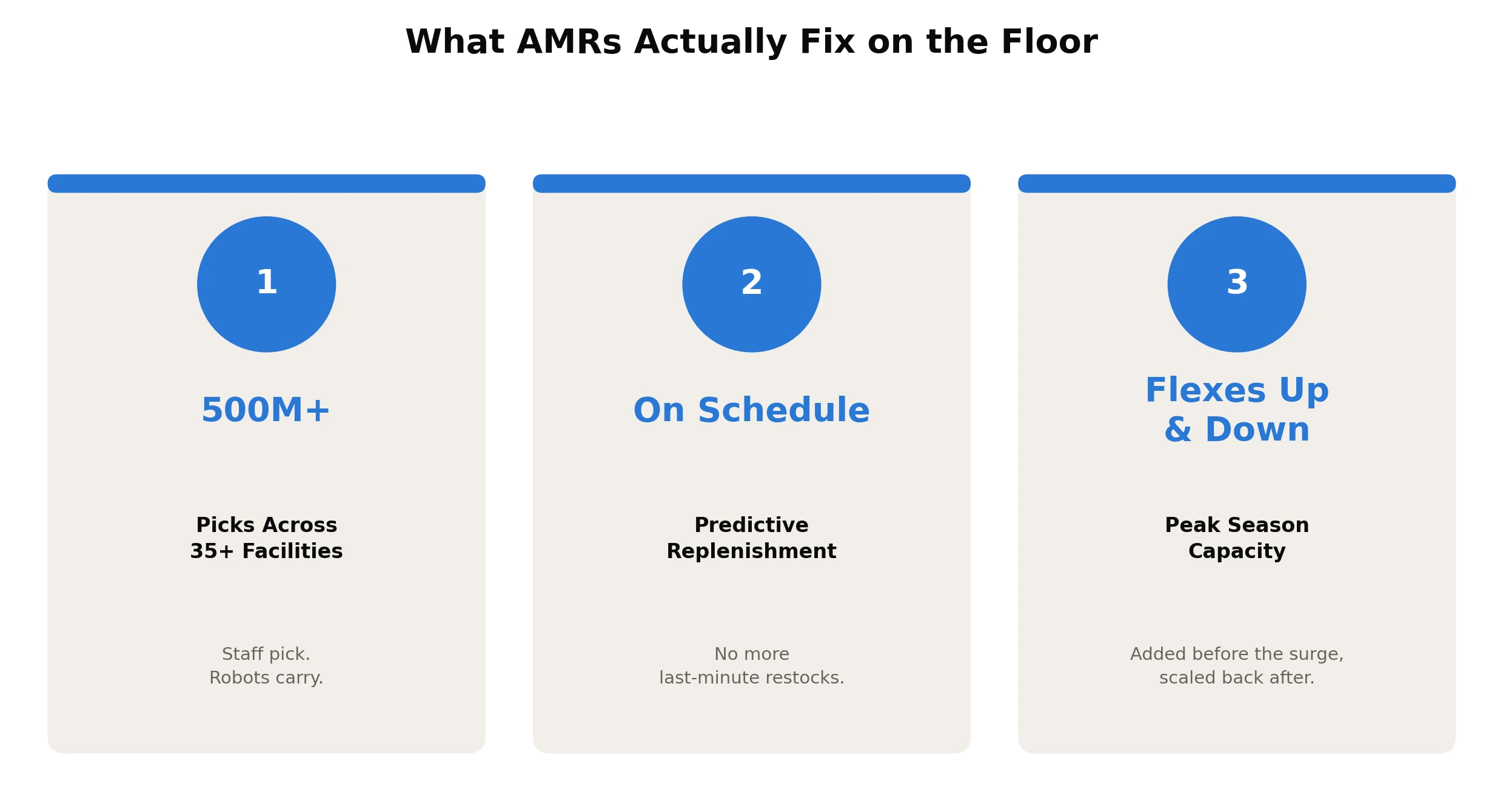
- They carry the tote so that staff can pick. It was reported that AMR deployments in global logistics crossed 500 million robot-assisted picks over more than 35 facilities, with leadership crediting the gains to pickers staying focused on picking instead of walking.
- They run replenishment routes on a schedule without delay. AMRs delivered their most reliable gains in replenishment, especially when paired with predictive scheduling, cutting down on the last-minute restocking that interrupts active picking.
- They hold their pace during a demand spike. Large logistics operators now plan peak season around flexible robotics instead of fixed conveyors, adding robotic capacity ahead of a seasonal surge and scaling it back down once volume drops, so capacity flexes with demand instead of sitting idle most of the year.
A recent study on Optimizing Warehouse Operations with Autonomous Mobile Robots emphasizes how human pickers and AMRs perform together, scheduling, routing, and the coordination between the two.
The core finding: making sure robots and people work as one coordinated system beats treating them as two separate workflows bolted together.
Novus Hi-Tech’s guide on how autonomous mobile robots work covers the mechanics for a deeper technical view.
The Global Picture: Where Quick Commerce Is Headed
Fast delivery is playing out differently across the globe depending on where you look.
India has become a major quick-commerce market globally.
A Reuters report from March 2025, citing Bain and Flipkart research, found that quick commerce made up more than two-thirds of all online grocery orders in India in 2024. That’s the dominant model.
The Gulf is right behind it. Dense cities, high smartphone penetration, and serious capital flowing into hyperlocal delivery networks. Mordor Intelligence pegs the GCC quick commerce market at $4.59 billion in 2026, growing at a 22% compound annual rate to hit $12.43 billion by 2031. Saudi Arabia accounted for an estimated 54.76% of the GCC market in 2025
Southeast Asia is a different kind of signal. The e-Conomy SEA 2025 report, from Google, Temasek, and Bain & Company, projected the region’s digital economy would clear $300 billion in gross merchandise value in 2025, with e-commerce alone hitting $185 billion. That’s regional purchasing power, not directly indicating MFC demand, but it shows you where fulfillment infrastructure investment is headed next in upcoming years.
North America and Europe operate on a different cost curve entirely. So the calculations for a compact fulfillment node must be more precise before they are viable. Order density per square mile decides whether an MFC makes sense here.
How to Know If Your MFC Automation Is Working
Speed alone doesn’t tell you if an MFC is healthy. Track these five numbers before and after any change you make:
- Order processing time. Receipt to dispatch, measured in minutes, not vibes.
- Picking accuracy. What percentage of orders come out correct the first time?
- Inventory accuracy. Does your system match what’s actually on the shelf?
- Orders per labor hour. Your real productivity number, not a guess.
- Cost per order. Pick, pack, and prep, all in.
If running robotics, then add robot utilization rate and material transfer time to that list.
Here’s the part that often gets skipped: measure before you change anything. If you can’t say what picking accuracy looked like last month, you can’t prove automation moved the needle this month.
The Real Takeaway on Micro Fulfillment
A micro fulfillment center only works when every piece, layout, stock visibility, staffing, and automation all move in the same direction. Speed is no panacea. It’s the sum of a lot of small decisions made right.
If you’re thinking about where robotics could realistically fit into your dark store or MFC, the Novus Hi-Tech team can help you assess your layout and order volume and where the real challenge is sitting to help find out the best solutions that fit into your operations workflows.