
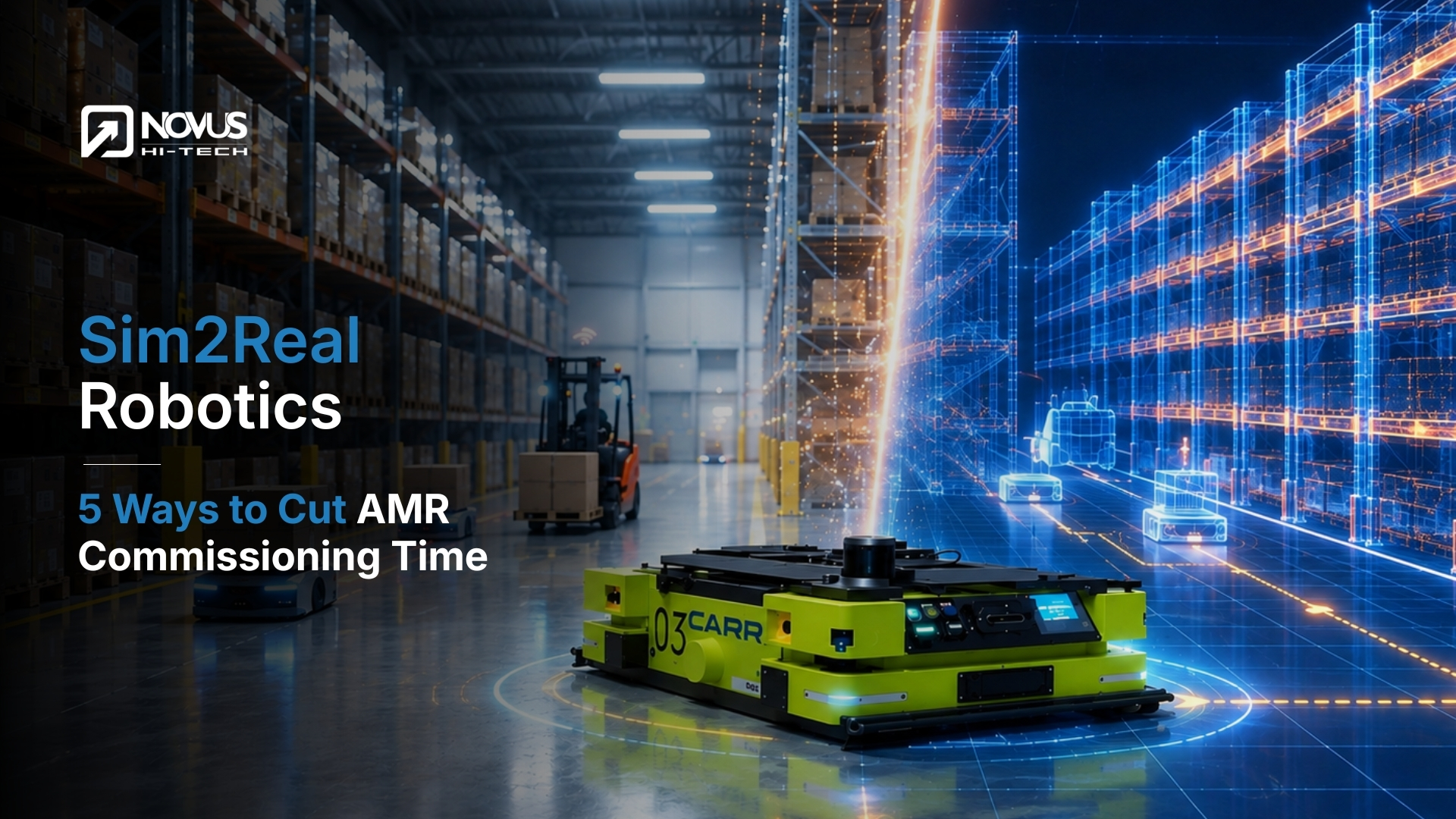
Your AMR passed every test in the simulator. Clean routes, solid obstacle avoidance, and timing right where you wanted it.
Then it came to the physical warehouse floor, and the numbers didn’t completely fit. That’s the gap Sim2real work exists to overcome. A simulation can validate a lot of what an AMR is supposed to do, but a live site always turns up a few conditions nobody built into the model.
This one’s for developers and systems integrators tired of watching a clean simulation turn into a pile of extra work on-site. The point isn’t to skip physical testing. It’s to walk into that testing already knowing what to look for.
Sim2Real, Explained for AMR Teams
Sim2Real stands for simulation to reality: the process of taking a robot’s perception, navigation, or control behavior out of a simulated environment and putting it to work in the real environment.
That exchange does not go as easily as the simulation indicated it would. The issue is divided into two parts in a 2026 survey in the Annual Review of Control, Robotics, and Autonomous Systems: the reality gap itself and the performance gap it causes when a robot transitions from simulation to real-world operation.
The reality gap robotics teams run into is the mismatch between what the simulation modeled and what the physical site looks like in real life: differences in sensor data, physics, system dynamics, and plenty of smaller conditions nobody thinks to simulate until they’re standing in front of them. The review names closing this gap as one of robotics’ more stubborn, ongoing challenges.
Why does that look different in a physical environment? No simulation could promise the same performance as in the real physical world. Though, it does give teams a controlled space to detect problems before commissioning day, ensuring there are fewer surprises waiting on the physical floor.
Digital Twin Robotics: Test it on the floor you build
Digital twin robotics starts with a virtual stand-in for your facility: the same layout, racking, dock positions, and traffic patterns your team works with every shift.
Instead of assuming how 10 AMRs will behave sharing one aisle, you can run that scenario virtually first and watch what happens before a robot reaches the floor.
A 2024 McKinsey’s research, derived from a 2022 survey of senior industrial executives, found that 86% said digital twins applied to their organization, and 44% had already put one to work. In one factory case, a digital twin surfaced hidden challenges and cut total processing time by around 4% by improving sequencing.
This is also baked into how Novus approaches AMR deployment. Simulation and digital-twin validation sit at Step 6 of Novus’s AGV and AMR Systems Guide, running before integration and on-site commissioning even start.
Used well, the virtual environment can flag route conflicts, any barriers, fleet behavior quirks, and charging requirements long before any of that becomes a problem engineers and teams have to solve.
Isaac Sim AMR: What the Platform Does
NVIDIA’s Isaac Sim is one example of a robotics simulation platform built to model robots, sensors, environments, and fleet scenarios before anything physical gets deployed. Teams running Isaac Sim AMR workflows use it as a dedicated environment for robotics simulation training before any hardware leaves the lab.
It allows realistic virtual robotic environments and simulates sensor data using technologies such as RGB-D, LiDAR, and IMU. The document covers guidance on synthetic data creation, domain randomization, and AMR navigation in different warehouse environments.
For AMR developers, that translates into building virtual warehouse environments, testing navigation behavior, generating synthetic sensor data, and running through different scenarios before repeating any of it on real hardware.
For a Novus deployment, simulation represents an initial phase in a comprehensive engineering process. The integration of physical AMRs, fleet coordination, warehouse systems, and on-site commissioning must ultimately converge and validate their effectiveness in the real-world operational setting.
5 Ways Sim2Real Can Reduce AMR Commissioning Time
1. Create a More Realistic Digital Environment
A useful simulation starts with a useful representation of the real environment.
For an AMR, that can include:
- Aisle dimensions
- Rack positions
- Loading and unloading areas
- Robot dimensions
- Payload characteristics
- Static and dynamic obstacles
- Sensor placement
- Traffic patterns
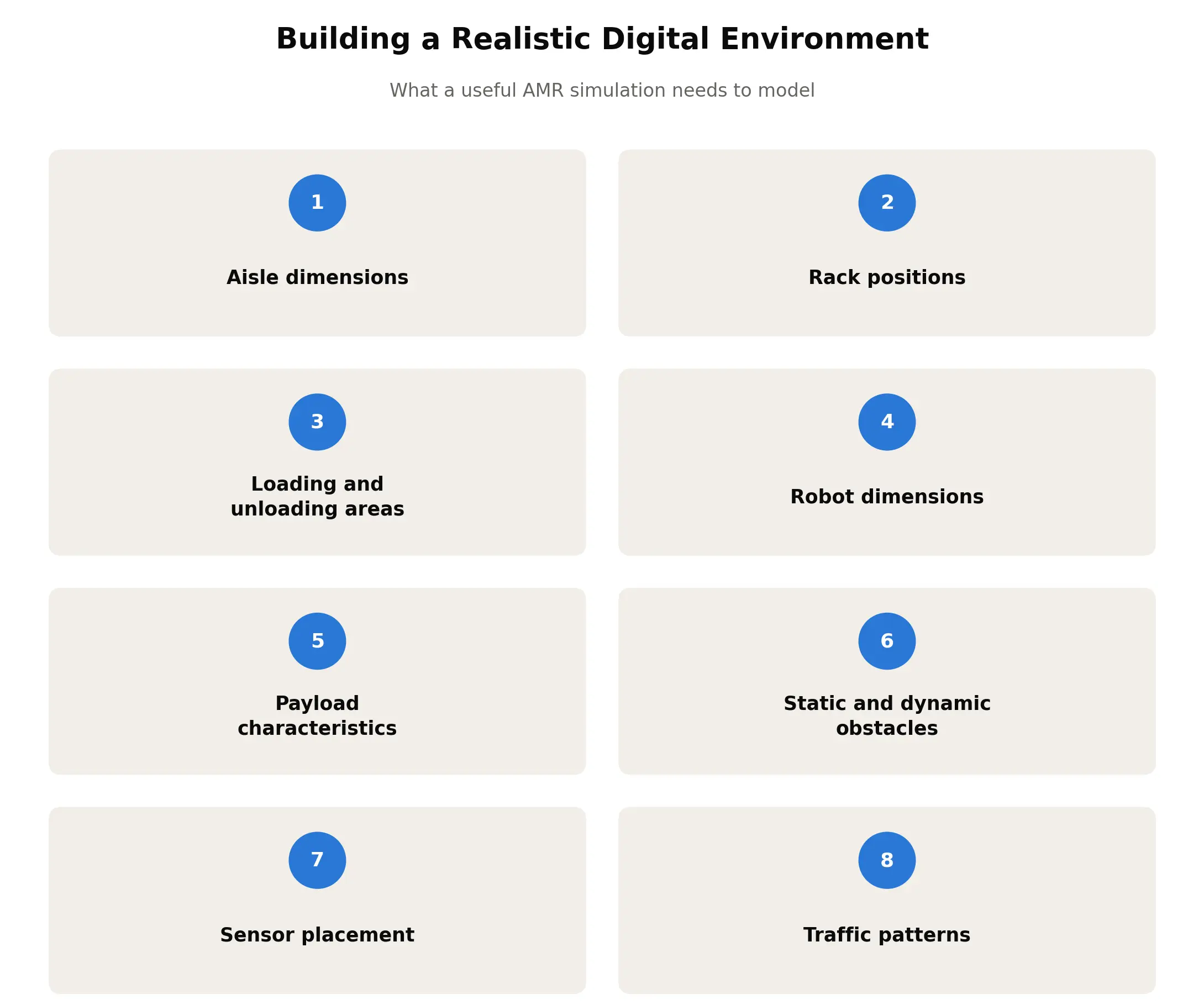
The closer the virtual environment is to the actual facility, the more useful the simulation results become.
This is where digital twin robotics can add value.
A digital twin can bring together physical-world data and virtual models to create a more representative environment for testing.
McKinsey’s research found that factory digital twins can model complex physical systems and run different scenarios before changes are made to the physical operation.
The goal is not to create a visually impressive virtual warehouse.
It is to create a model that represents the conditions the AMR needs to handle.
2. Test Scenarios Before the Robot Reaches the Floor
Physical testing has its own limits.
Teams cannot easily recreate hundreds of variations of:
- A blocked aisle
- A person crossing at the wrong moment
- Two AMRs approaching an intersection
- A pallet being slightly misaligned
- A temporary obstruction
- Different lighting conditions
- Changes in traffic density
Simulation makes it easier to repeat these scenarios.
That makes robotics simulation training useful for exploring edge cases before they become commissioning issues.
NVIDIA’s Isaac Sim platform supports synthetic data generation and simulation workflows for robotics development. Its documentation also includes AMR-focused workflows for navigation and perception testing.
The value is not simply running more simulations.
It is exposing the robot’s perception, planning, and control systems to a wider range of conditions before deployment.
3. Reduce Physical Testing Cycles
Every physical test takes time.
The robot needs to be available. The test area needs to be prepared. Engineering and safety teams may need to be involved. If an issue appears, the system needs to be changed and tested again.
Simulation can move some of that iteration earlier.
Deloitte’s research on software-defined manufacturing highlights the role of simulation in testing designs and processes digitally before relying on physical iterations.
The model becomes:
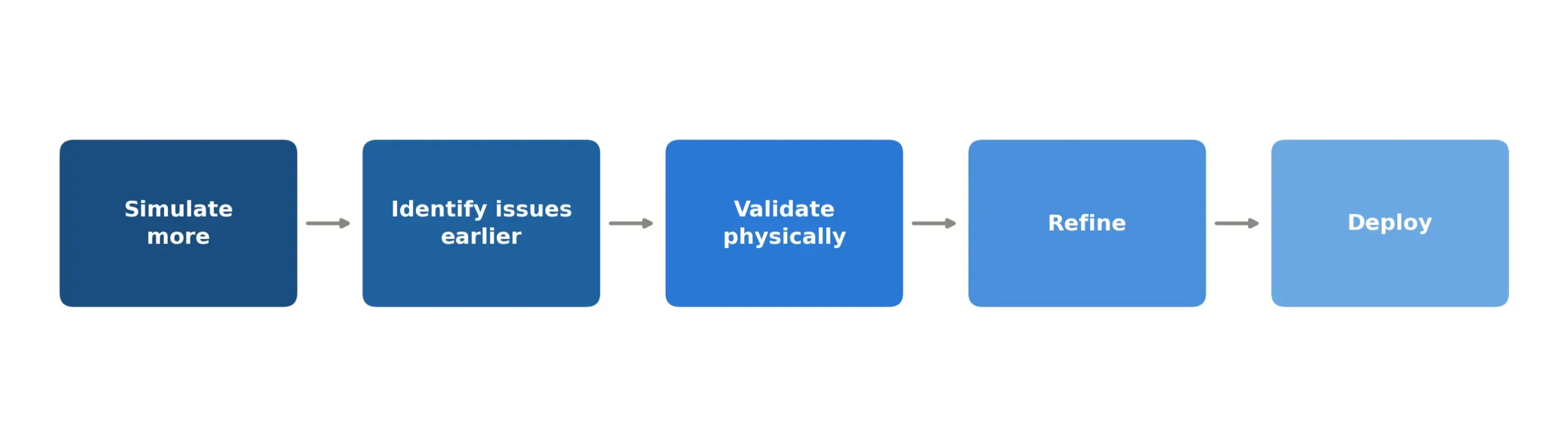
That does not remove physical validation.
It makes physical testing more focused.
4. Use Isaac Sim to Explore AMR Behavior
Isaac Sim AMR workflows show how robotics simulation is moving beyond simple virtual navigation.
NVIDIA describes Isaac Sim as a framework for robotics simulation, testing, and synthetic data generation in physically based virtual environments. It can also support software-in-the-loop and hardware-in-the-loop testing.
For AMR development, this can support testing around:
- Navigation
- Sensor behavior
- Obstacle detection
- Perception
- Robot control
- Synthetic data
- Mobility systems
The question worth asking:
Can the robot reach the destination reliably across different conditions?
The question is somehow closer to what happens on a real warehouse floor.
5. Simulate the Full AMR Workflow
Navigation is only one part of an AMR deployment.
The robot also needs to interact with people, payloads, workstations, charging areas, other robots, and the broader material-flow environment.
A simulation that only tests point A to point B movement can overlook problems that show up later in the workflow.
For example, an AMR may navigate perfectly but yet face difficulty when:
- A pickup point is partially blocked
- A payload changes robot behavior
- Multiple robots compete for the same space
- A task depends on another machine finishing first
- Charging availability affects fleet behavior
This is where Sim2Real robotics connects with the broader Physical AI stack.
The objective is not to simulate movement. It is to understand how the robot perceives, decides, and acts within a changing physical environment.
The World Economic Forum’s 2025 Physical AI report describes this broader shift toward robotic systems that combine hardware, AI, vision, perception, reasoning, and autonomous action.
Novus explores a similar direction in its article on physical AI in India and intelligent factory coordination, where robotics, AI, and physical systems come together to coordinate more complex factory operations.
Wrapping Up Sim2Real
Simulation won’t make commissioning instant. What it does is make the slow, unpredictable parts of the process more predictable, instead of leaving every problem to surface for the first time on deployment day.
What’s left over is the one thing no simulation replaces: a team on the actual floor, watching how the AMRs perform under real operating conditions.
That’s the true benefit of sim2real. It doesn’t bypass physical testing; in fact, it provides a more concise and intelligent checklist of what that testing should address.
Planning an AMR deployment? Our team will walk you through and can help to assist you in understanding the automation needs, covering everything from solution design and simulation to integration and commissioning.