
Physical AI deployment works at scale when you start with one expensive, repeatable job, prove it on your real floor against numbers you set in advance, and plan the second site before the first pilot ends.
Most pilots don’t fail because the robot can’t drive. They fail because nobody planned the integration or decided who owns the fleet once the vendor’s engineers go home.
Very few pilots ever make it into daily operations.
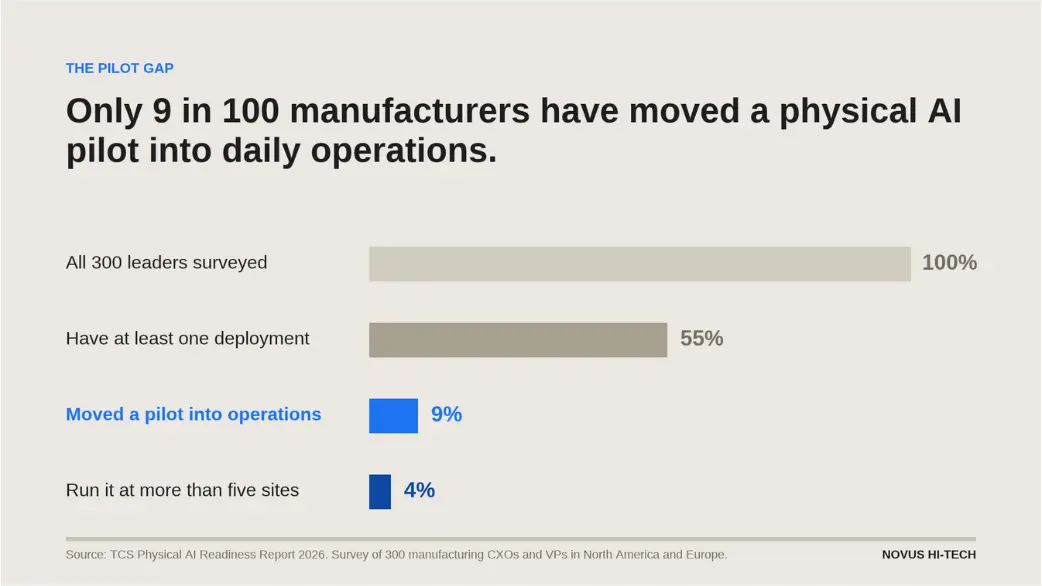
According to TCS’s Physical AI Readiness Report 2026, which surveyed 300 manufacturing CXOs and VPs in North America and Europe, 45% had no active physical AI deployments at all. Only 9% had moved a pilot into operations, and 4% ran deployments across more than five sites.
What physical AI looks like on a factory floor
Physical AI is AI built into machines that see, decide, and move real things in a real plant.
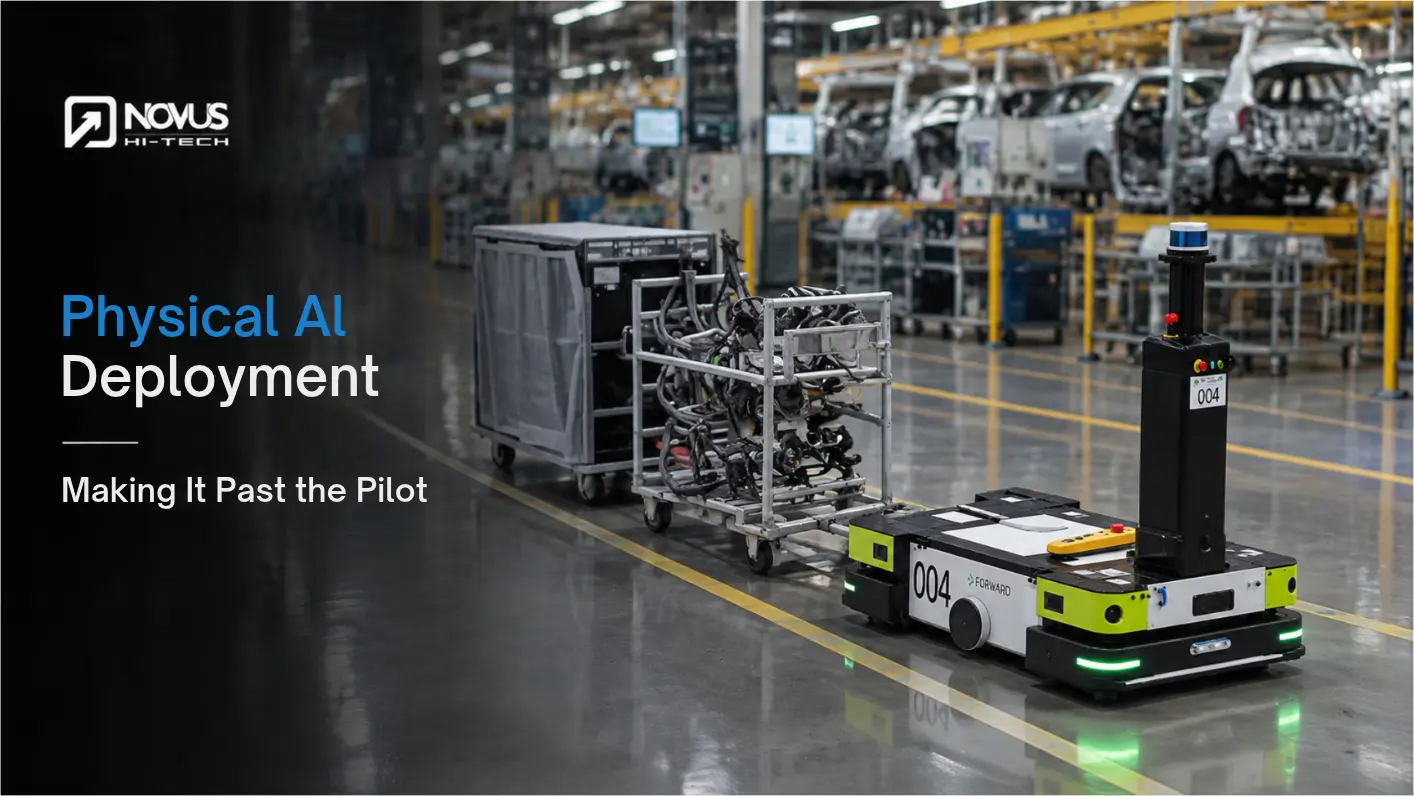
An autonomous mobile robot (AMR) towing a trolley to the line. An autonomous pallet truck picks a pallet off a dock. A camera in a truck cab that warns a tired driver. A chatbot that gets an answer wrong wastes a minute. A robot carrying 1,500 kg that misjudges a pallet stops a line.
Novus Hi-Tech has built autonomous robots since 2006, and more than 1,400 of them now work for over 100 enterprise customers.
Why most physical AI pilots stall
Pilots stall on integration and ownership, not on the robot. TCS found legacy integration was the biggest barrier to scaling physical AI, and 69% of respondents called their data environments limited, moderate, or fragmented.
Most pilots are built to impress.
The route is clean. The demo runs at 3 pm on a Tuesday with the plant head watching. Then the real floor shows up. A manual forklift parks in the robot’s lane at shift change. Wi-Fi drops near the loading dock. Someone stacks cartons past the floor marking because that’s how it’s always been done. The robot stops and raises an alarm nobody is assigned to answer.
If a route has cracked concrete or steep ramps, fix it first or pick a different job. We’d rather talk a customer out of a pilot than run one we expect to fail.
A physical AI deployment playbook, from pilot to production
Run your pilot under live production conditions from week one.
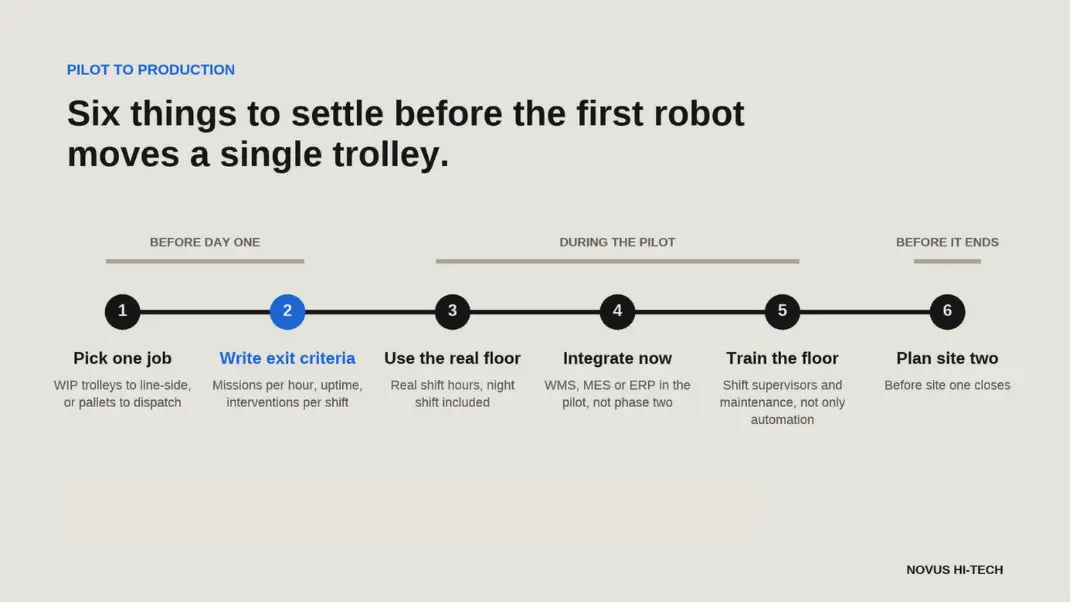
Here’s the sequence we recommend:
- Pick one high-cost job, like WIP trolleys to line-side storage or pallets to the dispatch bay. Our AMR deployments in India typically pay back in 18 to 24 months, so pick a job big enough to carry that.
- Write exit criteria before day one: missions per hour, uptime, and interventions per shift. If you can’t name the number, you’re running a demo, not a pilot.
- Run on the real floor during real shift hours, including night shifts.
- Connect to your WMS, MES, or ERP during the pilot. Integration pushed to “phase two” usually never happens.
- Train shift supervisors and maintenance technicians alongside your automation team.
- Plan site two before site one closes.
A fast-growing EV maker in Southeast Asia replaced a fixed conveyor in its axle-to-body marriage process with our omni-directional AGVs. It copied the line into three countries, and each facility reached full production in 6 to 8 weeks with no safety incidents recorded (Read our automotive AGV axle-to-body case study).
| Stage | Pilot | Production |
| Routes | One clean route. | Every route the job needs. |
| Traffic | The robot works alone. | Robots share aisles with people and forklifts. |
| Ownership | Vendor engineers on site. | A named plant owner plus a support SLA. |
| Success metric | “It worked.” | Uptime, cost per move, and interventions per shift. |
What changes when you start scaling physical AI
Scaling physical AI is mostly a fleet management problem. One robot needs a route. Twenty needs traffic rules, charging schedules, and software that decides who goes first at a crossing.
Our Fleet Management System dispatches tasks, manages traffic, and schedules charging across AMRs, AGVs, and forklifts.
Scale also leaves the gate. A global food company runs our Novus Safe Pro dual dashcam on 1,092 vehicles across Central West Africa, 965 of them contracted trucks it doesn’t own.
The International Federation of Robotics’ World Robotics 2026 report says India installed almost 10,500 industrial robots in 2025, up 15%, sixth in the world. Our bet is that the next wave of physical AI in manufacturing will be mobile: the trolleys and pallets moving between those robots.
How to judge physical AI companies before you sign
Skip the demo videos and ask for production references. A list of top physical AI companies won’t tell you who fixes a stalled robot at 3 am.
Ask every vendor, including us, how many robots run past their first year on a customer site, and call two of those customers. “We consistently engage with Hi-Tech for our ongoing RFQs/RFPs in intra-logistics automation requirements,” says the Plant Head at John Deere. Ask how fast spares reach your country and which safety standards the robots are tested against (such as ISO 3691-4 for driverless industrial trucks).
If your pilot has no named owner and no exit number on paper, stop it and restart.
A robot that runs for six weeks and then gets parked costs more than never buying one. You’ve spent the money and taught your floor that automation doesn’t stick.
Scope your first pilot with Novus
Novus Hi-Tech has been building autonomous robots for factories and warehouses since 2006. More than 1,400 of our robots already work on customer sites, from AMRs and autonomous forklifts to Novus Safe Pro fleet safety, backed by over 150 patents. We’ll help you choose one high-cost job, run a pilot on your site, and scale from there.
Talk to an Expert | Download Case Study