
The Problem Every Tier-1 Supplier Faces Right Now
Your team nailed the ADAS quote eight months ago. Everyone signed off. Sensors. Compute. Timeline. Done.
Then the email arrives.
The OEM has a smaller compute budget. The safety validation window just tightened. And now they want OTA support, even though nobody scoped it at the start.
If you run ADAS integration programmes, you’ve probably seen this before.
The challenge for tier-1 suppliers in 2026 is major – delivering premium safety at mainstream vehicle costs, within tighter timelines, while accommodating changing OEM requirements throughout development.
That is the reality shaping OEM ADAS programmes presently.
What OEMs Expect from Tier-1 Suppliers in 2026
ADAS has moved far beyond being a premium feature.
OEM automotive suppliers are now integrating automotive ADAS into mainstream vehicle platforms, which means suppliers are expected to deliver solutions that are scalable, software-defined, and ready for long-term product evolution, not for the first vehicle launch.
At present, OEMs expect their technology partners to:
- Deliver L2 and L2+ capabilities within tighter cost targets
- Support OTA software updates from the beginning
- Build modular software that can scale across vehicle platforms
- Meet increasingly demanding functional safety requirements
- Reduce integration risk and shorten validation cycles
Meeting these expectations requires much more than supplying hardware. It requires a system-level engineering approach built around ADAS for OEMs, where software, sensing, compute, and functional safety are engineered as a unified platform.
Why These Expectations Are Rising
As is evident, the ADAS market continues to grow. The global ADAS market size is projected to grow from USD 37.71 billion in 2026 to USD 67.38 billion in 2031, at a CAGR of 12.31% during the forecast period.
In parallel to this, driver assistance features are becoming standard across more vehicle segments rather than being exclusive to premium models.
For Tier-1 suppliers, that creates three major pressures.
Regulations Continuing to Adapt
Safety frameworks, including Euro NCAP, Global NCAP, and the EU General Safety Regulation (GSR), continue to impose growing requirements around automatic emergency braking, driver monitoring systems, and other active safety technologies.
For OEMs, achieving strong safety ratings is now a top competitive priority; making compliance a core part of every ADAS integration programme is what is essential.
Compute Budgets Remain Constrained
OEMs expect increasingly capable L2 and L2+ systems without proportionally increasing hardware costs.
Every additional TOPS of compute affects the bill of materials, thermal design, and overall vehicle cost. Suppliers are therefore expected to maximise software efficiency rather than relying solely on more powerful hardware.
Software Has Become the Defining Factor
Software architecture, OTA readiness, cybersecurity, and validation planning now influence programme success just as much as sensor selection.
Modern ADAS platforms are no longer collections of cameras and radars. They are integrated software ecosystems that must evolve throughout a vehicle’s lifecycle.
The Critical Mistake: Treating L2 and L2+ as Variants
One of the most common planning mistakes is treating L2 ADAS and L2+ ADAS as though they are simply different software versions of the same platform.
They are not.
They require different engineering strategies, different validation approaches, and different integration planning.
L2 ADAS Typically Includes
- Adaptive Cruise Control
- Lane Centering
- Camera and radar-based perception
- Driver remains fully responsible
- Established validation workflows
- Integration timelines of approximately 20 to 24 weeks
L2+ ADAS Typically Adds
- Hands-free highway assistance in supported scenarios
- Automated lane changes
- Multi-sensor redundancy
- Driver Monitoring Systems
- More comprehensive safety validation
- Enhanced OTA architecture
- Integration timelines closer to 28 to 32 weeks
Quoting both programmes using the same assumptions often results in redesigns, unexpected validation delays, and shrinking programme margins.
Where the Biggest Opportunity Actually Lies
Industry attention often focuses on robotaxis and highly autonomous vehicles.
However, the largest production opportunities today remain in mainstream highway-assist programmes, often marketed as L2+ systems.
Rather than pursuing maximum processing power, these programmes balance perception capability, compute efficiency, and overall system cost to support high-volume production. Depending on the vehicle architecture and feature set, many production platforms are designed around compute budgets in the 80 to 150 TOPS range, making optimisation just as important as raw performance.
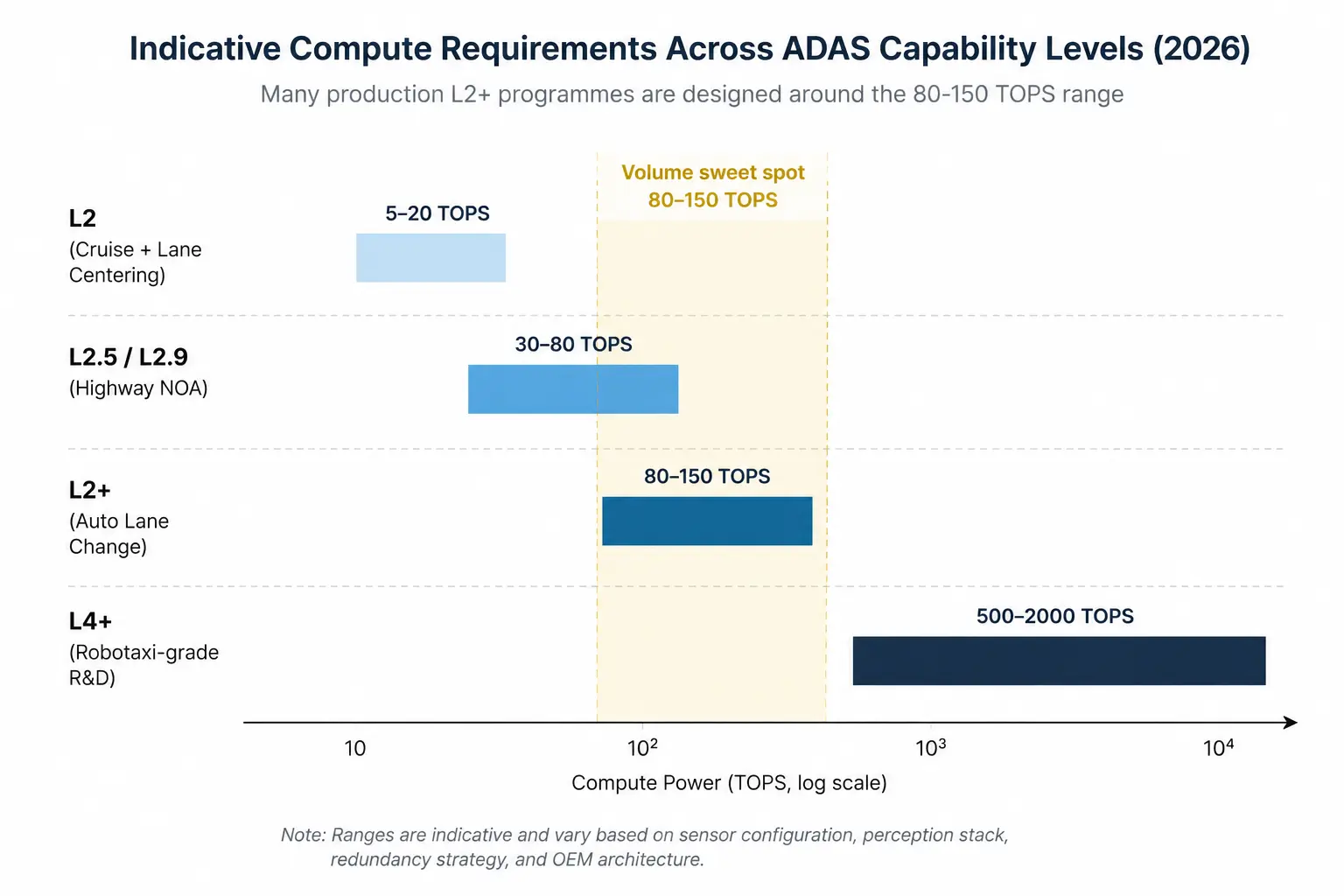
For most Tier-1 suppliers, this is where competitive advantage is built. Success comes from delivering production-ready ADAS platforms that balance capability, scalability, and cost.
Typical Programme Timeline: L2 vs L2+
| Phase | L2 | L2+ |
|---|---|---|
| Sensor Validation | 6-8 weeks | 8-12 weeks |
| Software Development | 12-16 weeks | 16-20 weeks |
| Safety Documentation | Parallel | Parallel |
| System Testing | 8-12 weeks | 12-16 weeks |
| Total | 20-24 weeks | 28-32 weeks |
The most common causes of schedule overruns remain remarkably consistent.
- Delayed sensor validation
- Late functional safety documentation
- Integration issues discovered during final system testing
Every delay introduced during architecture planning becomes significantly more expensive once validation begins.
What’s Different About OEM ADAS in 2026
Success is increasingly determined by execution rather than reputation alone.
OEMs are evaluating suppliers on their ability to:
- Deliver modular software architectures
- Support OTA updates from launch
- Enable scalable integration across multiple vehicle platforms
- Meet functional safety requirements efficiently
- Reduce programme risk through predictable validation and delivery
The shift to software-defined vehicles is changing what suppliers expect.
OEMs are differentiating themselves more and more on software capabilities, not just hardware. They want platforms that enable continuous feature updates, reusable software components and faster deployment across multiple vehicle programmes.
This shift is also driving adoption of frameworks such as AUTOSAR Adaptive and SOAFEE. These technologies are used to build software platforms that can span multiple vehicle generations and reduce long-term maintenance effort.
For tier-1 suppliers, decisions on software architecture made today directly influence future platform reuse, validation effort, and engineering costs.
How Novus Hi-Tech Supports OEM ADAS Integration
OEMs and Tier-1 suppliers do not just need component suppliers. They need engineering partners who understand how software, sensing, compute, and validation come together throughout an ADAS programme.
Novus Hi-Tech supports OEM ADAS development across external perception, in-cabin driver monitoring systems, sensor integration, and software engineering.
Rather than treating hardware and software as separate workstreams, the focus is on building integration-ready ADAS platforms that simplify validation, support OTA evolution, and remain flexible as programme requirements change.
Driver monitoring systems are also becoming increasingly important for many L2+ programmes as regulatory expectations continue to evolve.
If you would like to explore this topic further, read our guide Beyond ADAS: Driver Monitoring in Smart Mobility, which explains how DMS integrates into modern ADAS platforms and why planning it early can reduce downstream engineering complexity
Got an L2/L2+ programme on your desk right now?
Not sure whether your current integration approach can hold up against 2026 OEM expectations? Connect with Novus Hi-Tech’s ADAS team to evaluate your sensor fusion, compute strategy, and software architecture against what OEMs are actually screening for this year.