

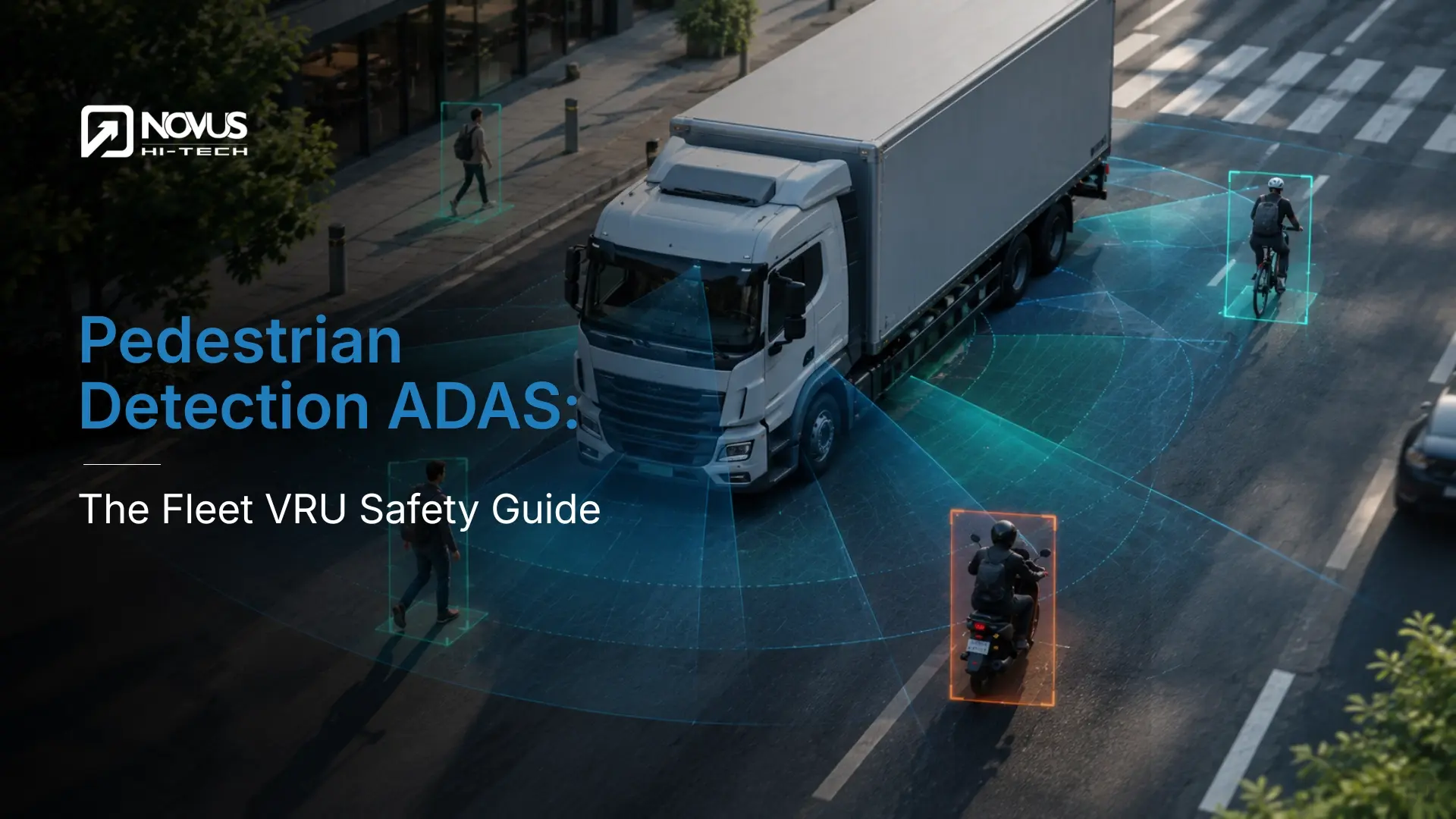
A person on foot or on two wheels gets killed on the world’s roads roughly once every 48 seconds. A human has no protection against a moving vehicle, and until recently, most vehicles had no way to see that human body coming.
Pedestrian detection ADAS exists to fill that void. This guide will explain what it does, what counts as a vulnerable road user in different traffic environments, what regulators around the world now require, and how fleet managers should evaluate a system before buying one.
What Is Pedestrian Detection ADAS?
Pedestrian detection ADAS is an advanced driver assistance function that uses sensors such as cameras and radar to identify pedestrians near a vehicle’s path.
Depending on the system, it can:
- Detect a pedestrian entering or already present in the vehicle’s path
- Alert the driver to a potential collision
- Estimate the movement and position of the road user
- Support automatic emergency braking when a collision becomes imminent
Pedestrian detection is usually a component of a more general vulnerable road user detection capability. This can include cyclists, motorcyclists and other road users with less physical protection than occupants of vehicles.
The technology is not a replacement for the driver. Instead, it offers an additional layer of awareness that can be helpful when a road user appears suddenly or visibility gives the driver little time to react.
Research from the Insurance Institute for Highway Safety found that automatic emergency braking that detects pedestrians was linked with a 27% lower rate of pedestrian crashes and a 30% lower rate of pedestrian injury crashes.
The same research also found that performance differed by conditions, including darkness without street lighting and higher-speed roads.
Why VRU Detection Matters for Fleet Safety
Vulnerable road users account for a large proportion of the global total of road deaths . The World Health Organization’s Global Status Report on Road Safety 2023 found that vulnerable road users such as pedestrians, cyclists and two- and three-wheeler riders account for more than half of all global road traffic fatalities.
The detection challenge also changes with the environment.
A fleet may need to account for:
- Pedestrians crossing roads or walking close to the vehicle
- Cyclists travelling alongside or crossing the vehicle’s path
- Motorcycles and scooters moving through mixed traffic
- E-bikes and other micromobility users in urban areas
- VRUs appearing from behind parked vehicles or other visual obstructions
Novus Hi-Tech’s ADAS features guide for Indian commercial fleets breaks down how forward collision warning, lane departure, and pedestrian detection work together as one system rather than standalone add-ons.
This makes vulnerable road user detection more than a simple object-recognition task. The system needs to identify relevant road users, understand their position and movement, and determine when their path creates a potential collision risk.
How ADAS Regulations Are Evolving
Regulatory requirements are making pedestrian, cyclist and blind-spot detection increasingly relevant to vehicle manufacturers and fleet operators.
- India
India has introduced several ADAS-related Automotive Industry Standards covering different safety functions. ARAI lists AIS-162 for Advanced Emergency Braking Systems, AIS-186 for Blind Spot Information Systems, AIS-187 for Moving Off Information Systems and AIS-188 for Lane Departure Warning Systems.
AIS-186 compliance starts with knowing what the standard actually covers. It’s built specifically around bicycle detection: a blind spot information system that alerts the driver to a possible collision with a bicycle on the vehicle’s near side. The standard applies to N2, N3, M2 and M3 vehicle categories, as set out in MoRTH’s notification GSR 184(E), and it also specifies performance and warning requirements for the system.
India’s ADAS ecosystem is also placing greater emphasis on validation for local traffic conditions. ARAI highlights India-specific traffic and infrastructure data for ADAS validation, including local classes such as motorcycles, auto-rickshaws, and traffic signs.
- European Union
The EU has introduced requirements for advanced safety systems across different vehicle categories. Under the EU General Safety Regulation, M2, M3, N2 and N3 vehicles are required to have advanced systems capable of detecting pedestrians and cyclists close to the front or nearside of the vehicle and providing a warning or avoiding a collision with these vulnerable road users.
- United States
The National Highway Traffic Safety Administration (NHTSA) issued a rule mandating automatic emergency braking, including pedestrian AEB, on new passenger cars and light trucks by September 2029.
The regulatory guidelines vary by market and vehicle category, but the focus is evident: advanced safety systems are growing into a more important part of vehicle design and fleet safety planning.
- Southeast Asia
Southeast Asia’s push runs through ASEAN NCAP. Its 2021-2025 protocol scores AEB City, AEB Inter-Urban, Blind Spot Detection, Pedestrian Protection, and a dedicated Motorcyclist Safety category. The 2026-2030 roadmap adds AEB Motorcycle on top.
For fleets running in Malaysia, Thailand, Indonesia, Vietnam, and the Philippines, this means new vehicles are increasingly rated on their motorcyclist safety score, pedestrian AEB performance, and blind-spot detection – not only crash-test ratings.
Cyclist Detection ADAS and Two-Wheeler Detection in India
This becomes especially relevant for cyclist detection ADAS and two-wheeler detection in India use cases.
For example, a fleet vehicle operating in dense urban traffic may encounter:
- A motorcycle travelling close to the vehicle’s side
- A scooter approaching from an adjacent lane
- A cyclist crossing the vehicle’s projected path
- Multiple two-wheelers travelling close together
- A road user appearing from behind another vehicle
Sensor configuration also matters. Cameras can provide detailed visual information for classification, while radar can contribute information about distance and relative movement. Using multiple sensor inputs can help create a more reliable perception system across different operating conditions.
Fleet operators looking for a broader safety setup can also consider solutions such as Novus Safe Lite, which combines pedestrian and two-wheeler collision warnings with DMS, video telematics, and additional camera support
Fleet operators should also look at how the system performs in the specific environments where their vehicles operate.
This is particularly relevant in India, where ARAI’s ADAS validation work includes India-specific traffic classes such as motorcycles and auto-rickshaws.
What to Evaluate in a VRU Detection Fleet System
Choosing a VRU detection fleet solution requires looking beyond what is offered, such as pedestrian detection as a feature.
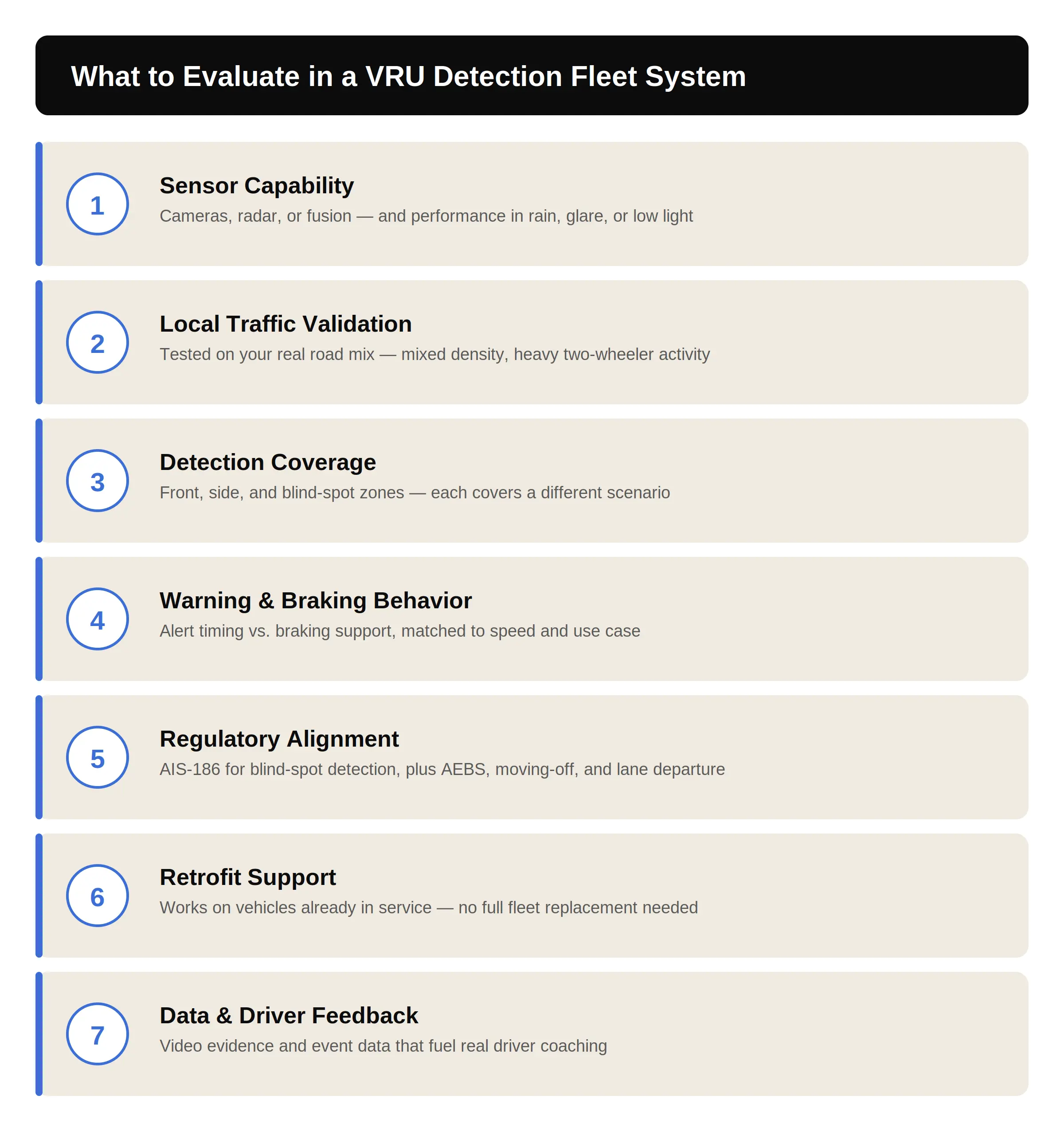
Fleet operators evaluating ADAS should also consider how detection, driver alerts, video evidence, and fleet data work together. For more guidance, read How to Choose the Right Video Telematics for Your Fleet Safety.
Putting Pedestrian Detection Into Practice
Novus Hi-Tech provides ADAS, DMS, and video telematics solutions for commercial vehicles and fleet operators. Its solutions include functions such as Forward Collision Warning, Lane Departure Warning, and Pedestrian Collision Warning.
If you’re exploring pedestrian detection ADAS or broader fleet safety solutions, Novus Hi-Tech can help you find the right fit for your fleet.