
Your ADAS bill of materials says one price. The final invoice says another.
That difference rarely comes from the camera or the radar. It comes from the lines nobody quoted: calibration, software licenses, validation, and integration. Each one shows up after the purchase order and hits your budget.
This is where ADAS projects become money and time losers for commercial vehicle OEMs. Quotes come in a variety of formats. Scope moves from one vendor to another. Comparing them takes guesswork.
This guide closes that gap. It shows what a complete BOM contains, what each line costs, and where missing items hide.
What Goes Into an ADAS Bill of Materials? AIS-184 and Beyond
Start with scope. An ADAS stack is a bundle of separate functions. Each function can sit under its own standard.
Driver drowsiness and attention warning is one function. India’s AIS-184AIS 184 and the EU’s drowsiness rules both cover it. The standards for blind spot detection, when moving off, for lane departure, and for emergency braking are separate.
That split matters for the BOM. We view this from a functional perspective of what is needed from a rule and what is contributed by a supplier.
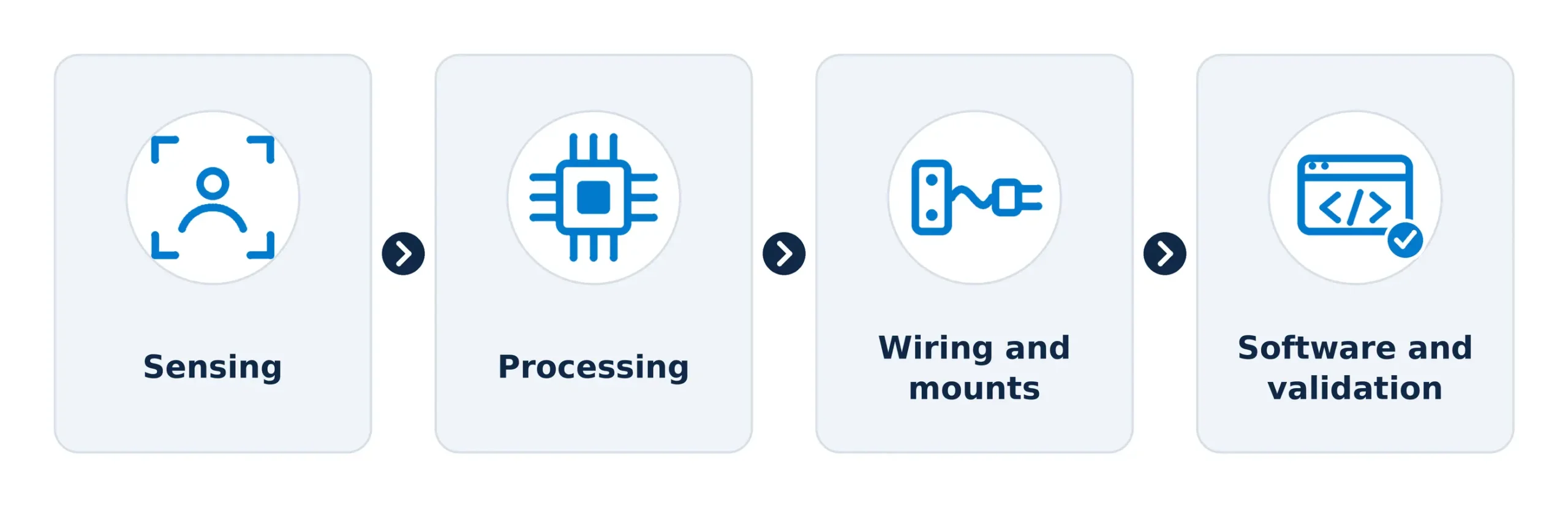
The AIS-184 standard is technology-neutralAIS 184 standard is technology-neutral, so builds differ by design. Common AIS-184 BOM lines:
- Driver-facing camera or other sensing hardware
- Processing unit and vehicle interfaces
- Harness, connectors, and mounts
- Software, calibration, and validation
Do not treat every ADAS component as mandatory. Confirm your vehicle category and target market first. Novus walks through the standard in its AIS- 184 compliance guide.
ADAS BOM Cost Breakdown: Line Items to Request
Every supplier quote must include the following details:
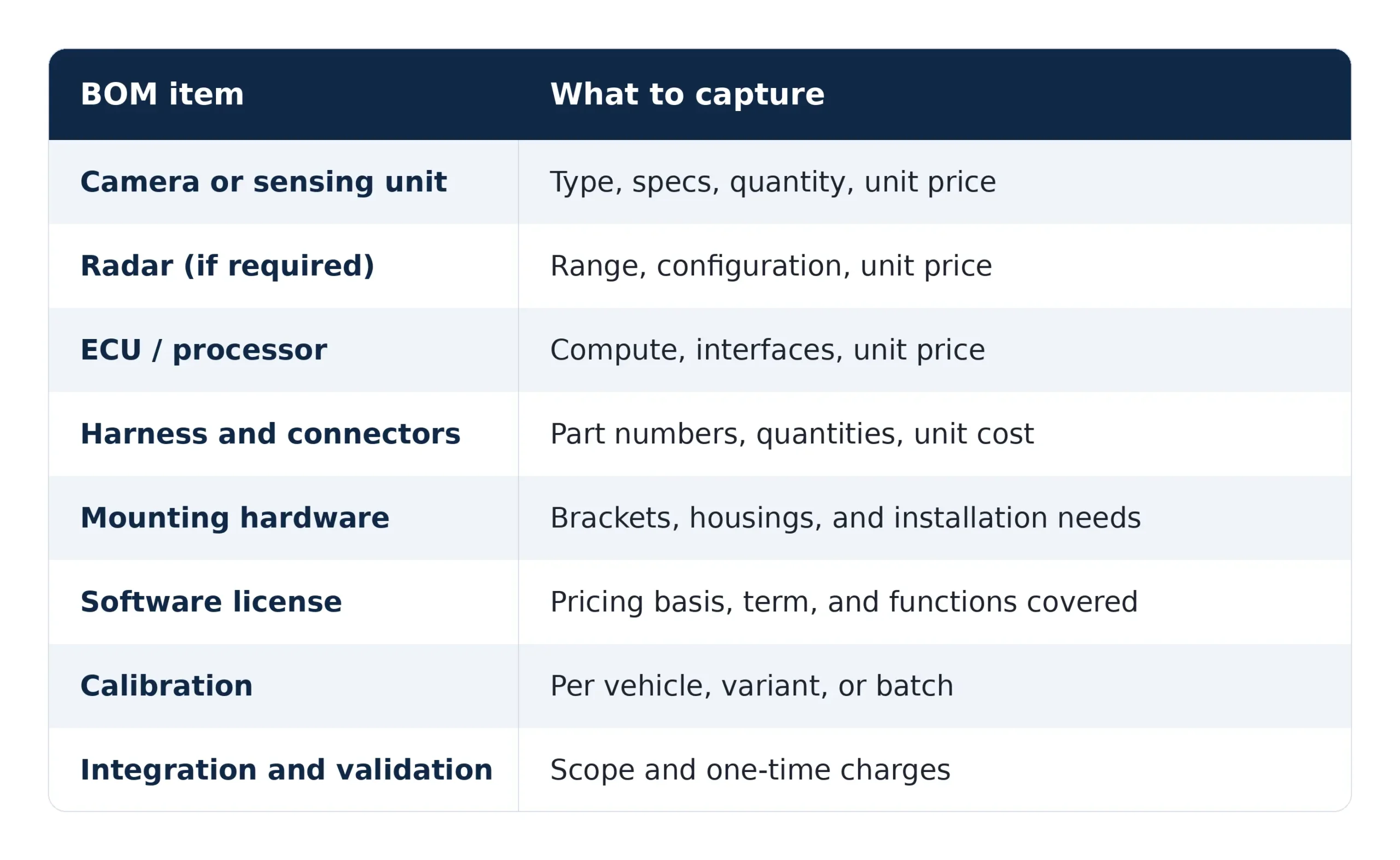
Report hardware, recurring software fees, and one-time engineering separately. Blended totals hide the real comparison.
Which functions need a camera, a radar, or both? Novus breaks down nine truck features in its ADAS features for trucks guide.
The most cost tends to hide in four lines:
- Harness and connectors: Length and routing vary with wheelbase and cab type. One part number rarely fits every variant.
- Software license: Comparing the one-time fee to the annual fee is not the same. Request the pricing basis.
- Calibration: The costs of EoL and workshop calibration vary at different times.
- Validation: The test scope may vary for each variant and each market.
Benchmark Costs: What a Truck ADAS Stack Looks Like on Paper
Public ADAS pricing data is thin. Two research sources give a usable baseline. Both are estimates, not supplier quotes.
A 2024 US DOT study of trucking ADAS estimated costs on a new tractor:
- Automatic emergency braking: $2,800
- Adaptive cruise control: $745
- Lane keeping or centering assist: $2,800
- Onboard safety monitoring with road-facing cameras: $1,757
- Total: $8,102
Two details stand out. About 69% of the monitoring line ($1,207) is driver coaching time, not hardware. And the figures include a 12% US federal excise tax. The study notes that aftermarket installs skip that tax but carry higher installation labor.
The lesson for any market: taxes and soft costs belong in your BOM view.
Europe offers a retrofit angle. A 2025 peer-reviewed study in Sustainability reported these ranges:
- Lane departure warning: €518 to €1,745
- Fatigue warning: €279 to €1,125
- Pedestrian collision warning: €45 to €228
- Combined retrofit units: about €800 on average
Blind spot detection had no suitable cost estimate. Its break-even point sits near €457 per vehicle. In its nine-driver pilot, about half of 281 warnings were false alarms.
One windshield camera can serve several functions. That makes the per-function CV ADAS cost misleading. For a retrofit reference point, review Novus Safe Pro and Novus Safe Lite.
What Pushes ADAS Stack Pricing Up or Down?
Five drivers shape most of the spread:
- Sensors: Type, specification, and quantity form the basis. Radar adds a second sensor, a mount, and more validation.
- ECU: The number of functions a unit can host is defined by processing power and vehicle interfaces.
- Software: What you pay after launch is determined by the license and update terms.
- Calibration and validation: Both repeat for every variant and market.
- Volume and ownership: Supplier agreements and integration responsibility transfer costs between you and the supplier.
Validation deserves a closer look. False alarms wear down driver trust, so tuning takes real engineering hours.
Warning vs. Intervention: Two Tiers With Different BOMs
ADAS functions are classified into two tiers. The tier you pick decides how much of your BOM is hardware and how much is integration.
Warning functions alert the driver. Lane departure, fatigue, and pedestrian and blind spot warnings are here. The hardware stays compact: a sensor or camera, a processing unit, and an alert output.
Intervention functions act on the vehicle. Emergency braking and lane keeping sit here. In the 2024 US DOT estimate, each one costs $2,800 on a new tractor. Both tie into braking and steering, which adds integration and validation lines.
That tie-in has a limit. Vehicle makers restrict outside access to brakes, steering, and throttle, so retrofit systems mostly stay in the warning tier. The tier you need often decides who can supply it.
Novus covers the Tier-1 side of that integration in its OEM ADAS L2/L2+ integration guide.
Conclusion
A line-item BOM enables CV OEMs to compare quotes and budget hardware, software, calibration, and integration in any market.
Explore Novus ADAS for OEMs and contact our team to find out more about your vehicle safety requirements.
Start with a clear ADAS bill of materials to facilitate evaluation of each quote