

The ADAS features for trucks that matter most are forward collision warning, automatic emergency braking, headway monitoring, lane departure warning, blind spot monitoring, pedestrian collision warning, drowsiness detection, distraction alerts, and event video with coaching. Your crash history decides which to fit first.
You already know what one bad second can cost. FMCSA estimates the average large-truck injury crash at $326,810 and a non-injury crash at $49,398. A fatal crash averages around $15.2 million. Those numbers count the full societal cost, not only your insurance bill. They still show how fast one lapse in attention adds up.
ADAS for trucks goes after that lapse. Advanced driver assistance systems use cameras, radar, and other sensors to do three things: warn your driver, step in when the driver cannot, and record what happened.
This guide covers nine ADAS features for trucks, the data behind each, and how to match them to your routes. For a broader primer on how each technology works, see our guide to ADAS features explained.
Let’s see which ones your fleet needs first. Start with the data.
What Fleet Data Says About ADAS Features for Trucks
A 2024 FMCSA-sponsored study from Virginia Tech gives the broadest view. Researchers analyzed 54,250 trucks across 117 fleets and 5.72 billion miles. About 65% of those trucks already ran at least one ADAS feature. Compared with trucks without ADAS:
| ADAS feature | Crash rate vs. trucks without ADAS |
| Forward collision warning + emergency braking | About 40% lower |
| Forward collision warning | About 30% lower |
| Lane departure warning | 21% lower |
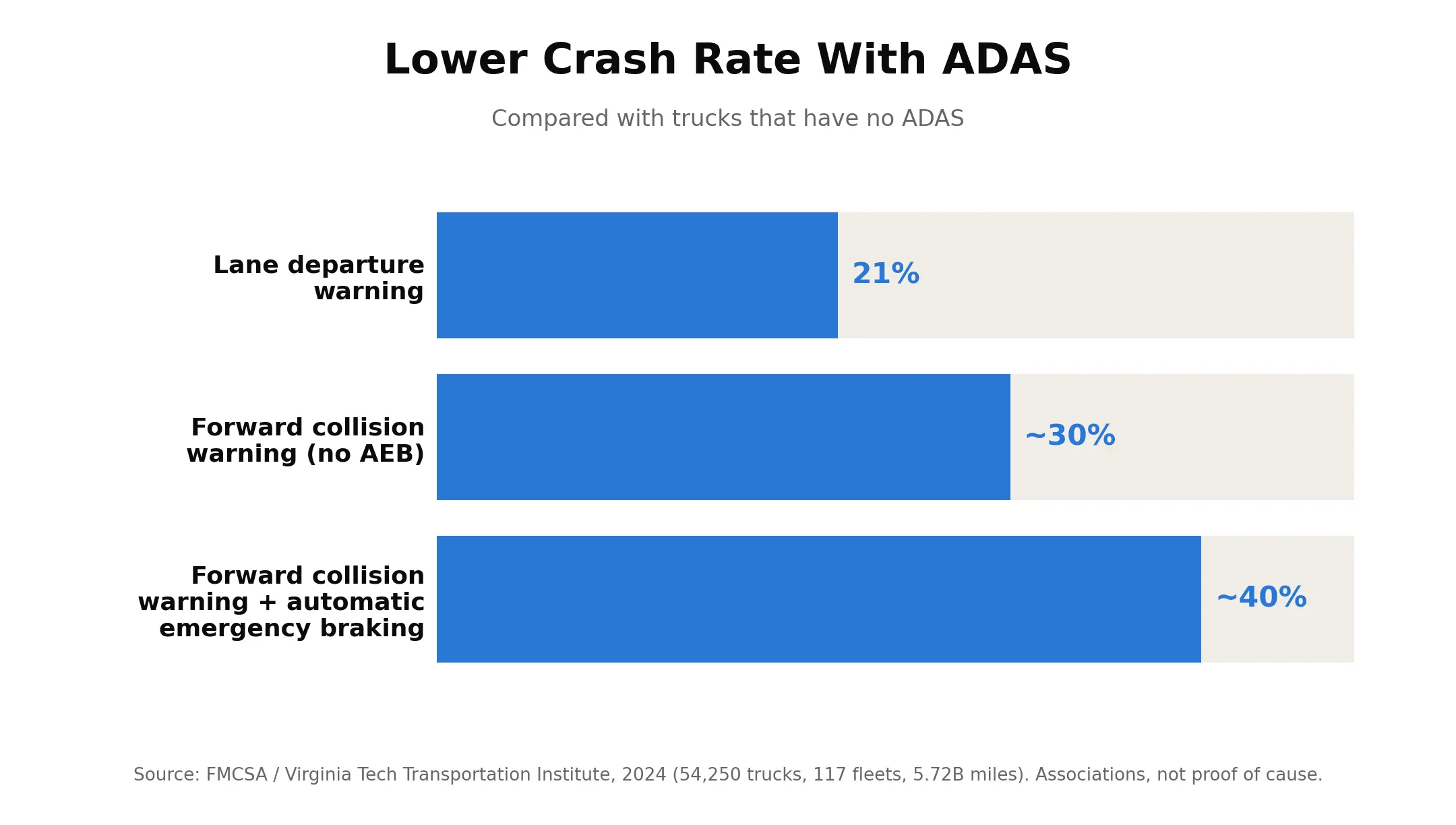
These are correlated; driver habits, routes, and fleet culture all shape results. Still, the pattern holds across a very large sample.
The money side looks just as pointed. ATRI’s 2026 insurance report shows liability premiums climbing 18.6% from 2021 to 2024 to 10.2 cents per mile. Truck crash rates fell 2.6% over the same period, and per-mile liability losses still rose 33.1%.
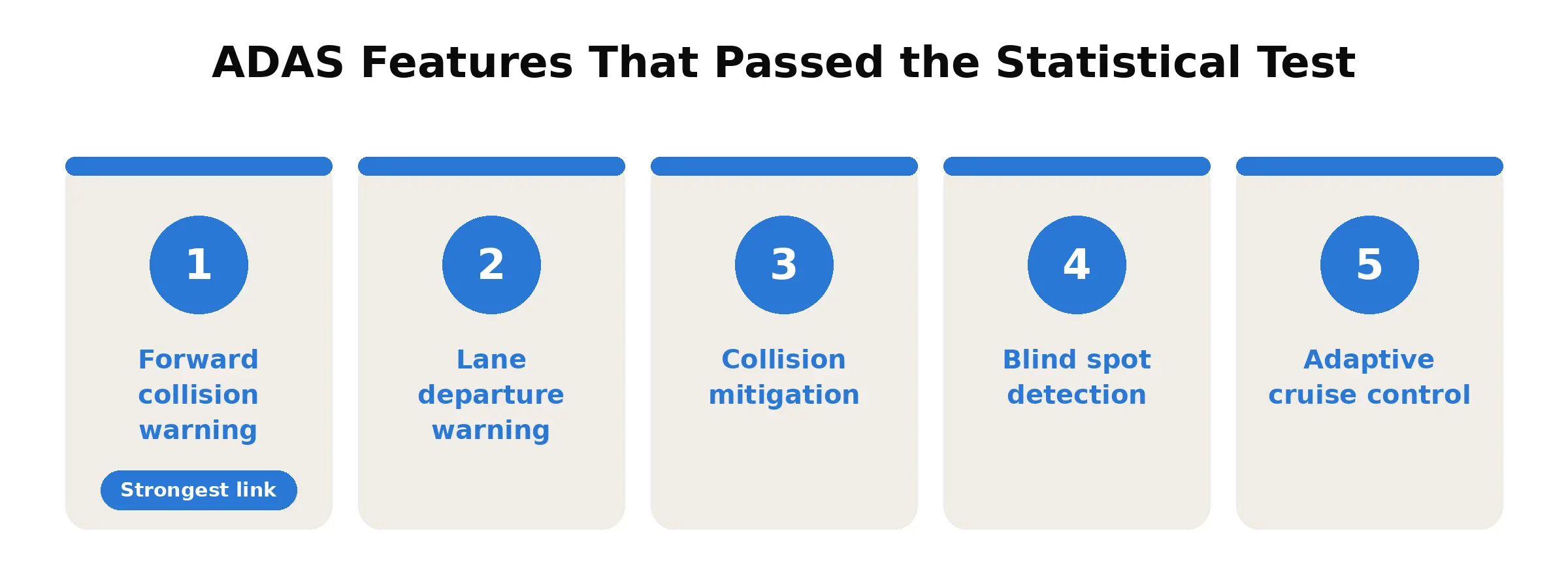
ATRI then tested which technologies tracked with lower per-mile losses. Six passed the statistical test:
- Forward collision warning (the strongest link)
- Lane departure warning
- Collision mitigation
- Blind spot detection
- Adaptive cruise control
- Automated emergency braking
Adoption tells its own story. Forward collision warning deployment increased 24 percentage points from 2021 to 2024, whereas driver-facing cameras grew only 8%. Many fleets guard the front of the truck well and still leave the cab unwatched.
You do not need new trucks to close that gap. Novus Safe Pro and Safe Lite add ADAS and video-based safety to vehicles already in service.
9 ADAS Features for Trucks Worth Prioritizing
-
Forward collision warning system.
A radar, camera or both follow the gap to the vehicle ahead and estimate how fast the gap is closing. When the gap closes too quickly, your driver gets an alert before braking turns into an emergency. A loaded truck needs far more room to stop than a car, so every extra second counts.
ATRI’s researchers also flag failure to stop as one of the most common negligence claims in truck crash litigation. Make sure the system performs in rain, glare, and darkness.
-
Automatic emergency braking system.
A warning only helps if your driver reacts. When a crash looks imminent and the driver has not braked, this feature applies the brakes itself.
Trucks with it plus forward collision warning showed the biggest crash-rate drop in the Virginia Tech data. Look at how the braking threshold is set and whether the system logs each braking event for your review.
-
Headway monitoring.
Forward collision warning reacts to closing speed. Headway monitoring watches the habit behind it: following distance, measured in seconds. If one driver tailgates on every shift, the data shows it. You get a guidance conversation weeks before a near-miss becomes a claim. Check whether thresholds can differ for loaded and empty runs.
-
Lane deviation warning system.
A forward-facing camera detects lane markings and notifies the driver if the truck drifts without a signal. Certain systems can also automatically guide the truck back into the lane to verify the features of the system you are getting.
Drifting could mean the driver is tired or distracted (like looking at a phone) so every alert is potentially a sign of a bigger problem. Long highway hauls need this most. Test it on roads with faded markings, and make sure you can see when a driver switches it off. A disabled system protects no one.
-
Blind spot monitoring system.
Side and rear sensors detect vehicles your mirrors miss, then alert the driver before a lane change, merge or turn. Heavy trucks carry large blind areas on both sides, so a clear mirror does not mean a clear lane. ATRI also linked blind spot detection to lower liability losses. Sensor coverage differs by body and trailer type, so check each vehicle in your mix.
-
Pedestrian collision warning.
Cameras and radar spot people, cyclists, and two-wheelers near the truck’s path. Some systems break automatically. The system sees where the driver cannot, seeing people disappear below the cab line and two-wheelers slipping through gaps at junctions. If your trucks work crowded markets, depots, or loading zones, test low-speed and night performance first.
-
Driver drowsiness detection system.
An in-cab camera reads eye closure, blink rate, and head position. Fatigue builds slowly, so the system alerts your driver at the early signs, before a micro-sleep takes over. Over weeks, the data also shows when fatigue peaks. That tells you whether your schedules, not your drivers, need a second look.
-
Distraction and phone-use alerts.
The same driver monitoring system flags phone use, missed seatbelts, and eyes off the road. Novus’s truck driver monitoring guide explains how its edge AI fires these alerts in seconds, even without a network connection. That matters on routes with patchy signal. Novus also says Safe Pro draws on about 600TB of Indian driving data.
-
Event video and coaching analytics.
Alerts only help when someone acts on them. Video clips add context, so you can see whether a driver caused an event or reacted to one. That protects your good drivers and speeds up claims. Novus reports that its Nayara Energy deployment, which paired monitoring with coaching, delivered the following:
- 46% fewer road behavior violations
- 55% fewer fatigue alerts
- 55-60% fewer distraction events
- Response time down from 24 hours to under 4 seconds
Which ADAS Features Fit Which Crash Pattern
Your own incident history points to the right features:
- Rear-end crashes: forward collision warning plus automatic emergency braking
- Following-distance complaints: headway monitoring
- Lane-change and turn claims: blind spot monitoring
- City and mixed-traffic routes: pedestrian collision warning
- Night and long-haul incidents: drowsiness detection and distraction alerts
Indian routes add their own twists: mixed traffic, uneven surfaces, and night-heavy runs. Ask any vendor what data trained its system.
One caution. ADAS does not replace a trained driver. It gives a good driver more time and gives you better evidence.
Novus’s ADAS in commercial fleets guide lists the metrics worth watching, including near-miss incidents, harsh braking, fatigue alerts, and insurance claim frequency.
Choosing ADAS Features for Your Truck Fleet
Strong fleet safety solutions link alerts, video, and coaching. Commercial vehicle safety systems also work better when drivers understand the “why” before installation day.
Together, these truck safety features cut risk on the road and give you proof when claims arrive.
Want a second opinion on which ADAS features fit your routes and vehicles? Talk to the Novus team.