
AIS 184: A Quick Breakdown
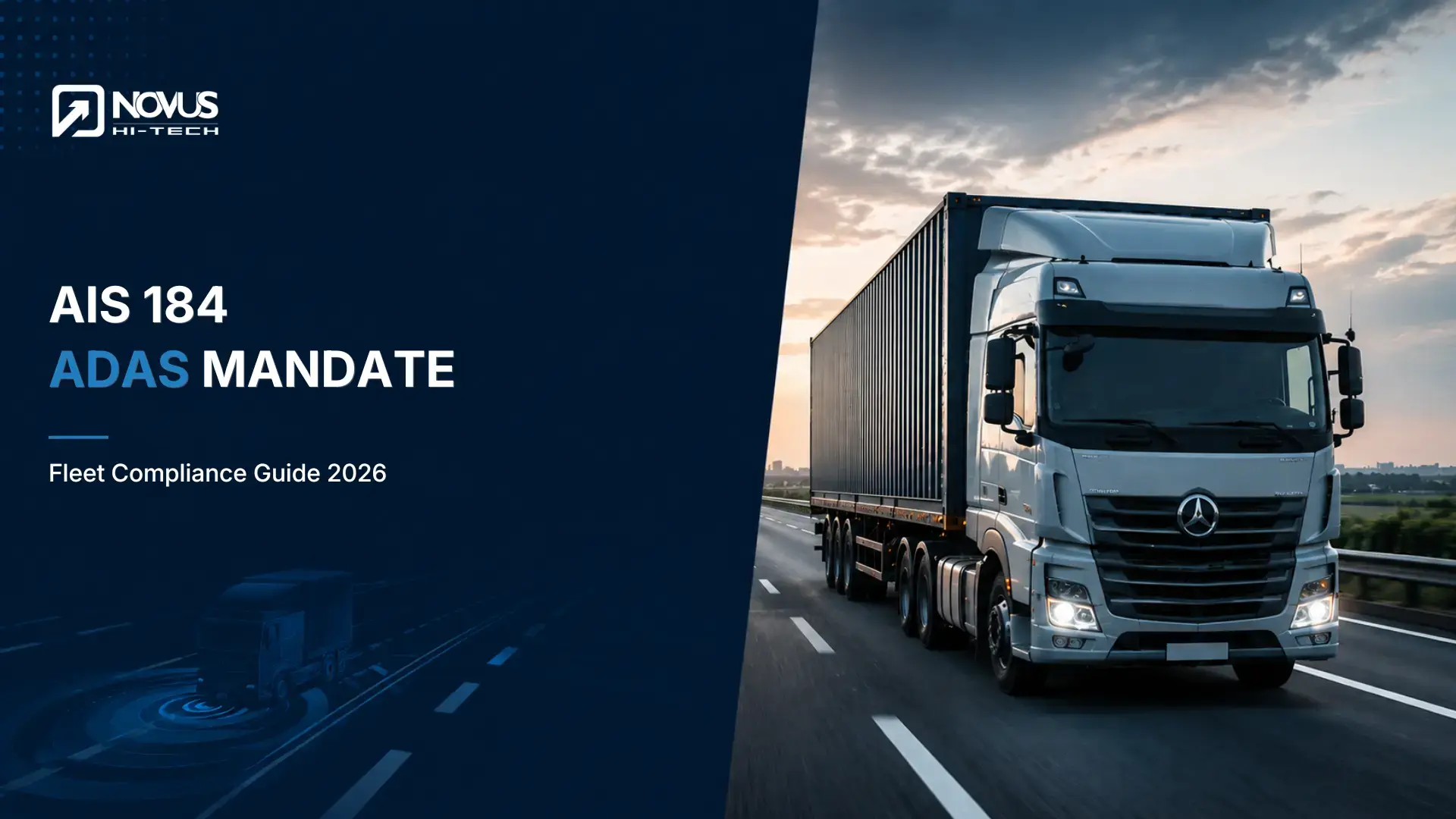
AIS 184 is a mandatory safety standard by the Ministry of Road Transport and Highways (MoRTH) that requires all new commercial vehicles in India to be fitted with Advanced Driver Assistance Systems (ADAS).
The AIS 184 standard, issued under the authority of the Ministry of Road Transport and Highways (MoRTH) establishes a formal, enforceable framework requiring Advanced Driver Assistance Systems (ADAS) across categories of commercial vehicles operating on Indian roads.
This is not a safety recommendation. It is a compliance requirement with defined implementation timelines, technical specifications, and operational consequences for fleets that do not meet it.
This article explains what AIS 184 compliance requires, why the regulation was introduced, and what commercial fleet operators must do to prepare effectively.
Why AIS 184 Exists: The Road Safety Imperative
India accounts for approximately 11% of global road fatalities despite having a significantly smaller share of global vehicle population National Road Safety Campaign.
MoRTH’s data consistently identifies driver error, fatigue-related incidents, and inadequate collision response as primary contributors to heavy vehicle accidents. These are precisely the categories that ADAS technology is designed to address.
The underlying logic is straightforward: if driver behavior cannot be fully controlled through enforcement and training alone, the vehicle itself must carry a baseline layer of protective intelligence. AIS 184 formalizes that baseline.
What AIS 184 Requires: A Technical Overview
AIS 184 is one of five standards issued under the February 2026 MoRTH notification. It specifically governs Driver Drowsiness Detection. Other features such as Electronic Stability Control, Advanced Emergency Braking, Lane Departure Warning, Blind Spot Information System, and Moving Off Information System are governed under separate standards.
- Collision Avoidance
These systems address the most common high-severity accident scenarios on Indian highways. Mandatory requirements include:
- Driver State
Fatigue and inattention are statistically significant contributors to long-haul commercial vehicle accidents. AIS 184 addresses these through:
- Driver Drowsiness Detection (DDD): Real-time monitoring of driver alertness patterns, with escalating alerts when deterioration is detected.
- Data Recording and Regulatory Accountability
AIS 184 also mandates that vehicles carry event data recording capability, enabling post-incident forensic analysis and regulatory audit compliance.
Key compliance note: The mandatory status of individual features depends on vehicle category (N2, N3, M2, M3) and manufacturing date.
AIS 184 ADAS Compliance Framework: Feature- by- Feature Analysis
AIS 184 is focused on a single safety technology: the Driver Drowsiness and Attention Warning System (DDAWS).The purpose of DDAWS is to identify signs of reduced driver alertness caused by drowsiness. Rather than directly measuring fatigue, the system evaluates behavioural indicators such as:
- Steering behaviour
- Driving patterns
- Attention-related driving inputs
AIS 184 remains technology-neutral regarding detection methods. Manufacturers may use camera-based driver monitoring, steering pattern analysis, or a combination of technologies, provided the system meets the required performance standards.
AIS 184 specifies how the system must communicate with the driver when drowsiness is detected. The system must provide at least two warning modes:
- Visual Warning – steady or flashing tell-tale, icon, or message
- Acoustic Warning – an audible alert that is clearly recognisable by the driver
The driver must also be able to deactivate and reactivate the warning function, ensuring usability while preventing excessive nuisance alerts.
The Compliance Gap Most Fleet Operators Are Not Addressing
Awareness of the AIS 184 mandate is growing, but the compliance gap in India’s commercial fleet sector remains significant. The reasons are structural rather than intentional.
Large fleet operators managing mixed-age vehicle populations face a challenge: newer vehicles arriving from OEM production lines increasingly carry ADAS hardware, but a substantial proportion of currently operating commercial vehicles do not meet AIS 184 specifications.
Mid-size and smaller operators often lack the internal compliance infrastructure to track regulatory timelines, validate hardware against specification requirements, or manage fleet-wide deployment programs without external support.
Operational Impact: What Changes When You Deploy ADAS at Scale
ADAS compliance is not purely a hardware procurement exercise. For fleet operators, the deployment of AIS 184 compliant systems across a large vehicle population creates operational changes across several dimensions.
- Driver Training and Behavior Adaptation
ADAS systems change the interface between driver and vehicle. AEB interventions, alert thresholds, and drowsiness detection responses all require structured driver orientation programs.
- Maintenance and System Integrity
ADAS sensors cameras, radar units, and LiDAR where applicable require regular calibration and maintenance protocols that differ from traditional mechanical fleet maintenance.
- Data Management and Audit Readiness
With EDR integration mandated under AIS 184, fleet operators will accumulate event data that becomes relevant in insurance disputes, regulatory audits, and accident investigations.
- Fleet Management System Integration
The operational value of ADAS extends beyond compliance when systems are integrated with central fleet management platforms. Drowsiness events, collision warnings, and lane departure patterns become fleet level data points that can inform route planning.
The Risk of Non-Compliance
Non-compliance with AIS 184 carries consequences across three distinct risk categories. Each operates on a different timeline, but all are consequential for fleet operators managing commercial operations at scale.
Regulatory and Legal Risk
Vehicles that do not meet AIS 184 specifications within mandated timelines may face type approval challenges, registration complications for new additions to the fleet, and potential enforcement exposure during MoRTH compliance inspections.
Insurance and Financial Risk
India’s commercial vehicle insurance sector is actively incorporating safety technology compliance into premium structures. Fleets operating non-ADAS vehicles are likely to face higher premium trajectories as the market reprices risk in light of regulatory standards.
Reputational and Commercial Risk
For logistics operators, transport companies, and fleet service providers whose customers include large corporates or government entities, ADAS compliance is increasingly becoming a procurement criterion.
Non-compliance is not a static risk. As enforcement infrastructure develops and insurance markets mature, the cost of deferred compliance increases over time.
Preparing for AIS 184 Compliance
For fleet operators approaching AIS 184 compliance as a structured program rather than a reactive procurement exercise, a phased approach reduces risk and distributes cost effectively.
Phase 1 – Compliance Baseline Assessment
Map your current fleet against AIS 184 category requirements. Identify vehicles already meeting specification (typically newer OEM production), vehicles requiring retrofit, and vehicles approaching end-of-life where replacement is the more economical path.
Phase 2 – Vendor Qualification and Hardware Selection
Not all ADAS systems available in the Indian market are certified against AIS 184 specifications. Procurement decisions should require documented compliance certification, not vendor self-attestation.
Phase 3 – Phased Deployment with Driver Integration
Deploy ADAS systems in cohorts with structured driver orientation at each stage. Build internal feedback mechanisms to identify system performance issues early. Establish calibration and maintenance schedules before deployment begins.
Phase 4 – Data Governance and Audit Readiness
Implement data management protocols for EDR and fleet ADAS event data before they become operationally necessary. Establish access controls, retention policies, and audit submission procedures in coordination with your legal and compliance teams.
The Future of Regulated Fleet Intelligence in India
AIS 184 is best understood not as an endpoint but as a regulatory floor. The trajectory of global commercial vehicle safety regulation and India’s demonstrated alignment with international standards suggests that ADAS requirements will expand in scope and sophistication over successive revision cycles.
Fleet intelligence the aggregation and application of vehicle, driver, and route data to operational decisions is the emerging capability that distinguishes leading transport operators globally.
Compliance as Competitive Infrastructure
AIS 184 compliance is not a bureaucratic exercise. It is the regulatory expression of a structural shift in how Indian commercial transport is expected to operate with documented, technology-enforced safety baselines that protect drivers, other road users, and the operators who bear liability for fleet operations.
Operators who approach compliance early, systematically, and with an eye toward operational integration will build a durable advantage: lower insurance exposure, stronger regulatory standing, better driver safety outcomes, and the data infrastructure to manage increasingly complex fleet operations intelligently.