

Material movement is the backbone of every factory, warehouse, and distribution center. As industries scale, manual transport becomes slow, unsafe, and increasingly expensive. This has accelerated the adoption of AGVs (Automated Guided Vehicles) and AMRs (Autonomous Mobile Robots) across sectors.
But one question comes up in nearly every automation discussion:
“Should we choose AGVs or AMRs for our facility?”
This guide provides a clear, comprehensive comparison to help you make the right decision.
What Is the Difference Between AGVs and AMRs?
Here is the simplest explanation:
AGVs follow fixed paths.
They move along magnetic tapes, reflectors, wires, QR codes, or painted lines.
If an obstacle appears, they stop and wait.
AMRs navigate intelligently.
They use LiDAR, cameras, and onboard computation to understand the environment.
If the path is blocked, they dynamically reroute.
AGV = Fixed
AMR = Flexible
This is the fundamental distinction.
AGV vs AMR: Complete Comparison Table
| Category | AGV (Automated Guided Vehicle) | AMR (Autonomous Mobile Robot) | Winner |
|---|---|---|---|
| Navigation | Fixed path | Dynamic, AI-based | AMR |
| Flexibility | Low | Very high | AMR |
| Obstacle Handling | Stops and waits | Avoids and reroutes | AMR |
| Setup Time | Weeks (infrastructure required) | Days (no floor infrastructure) | AMR |
| Safety | Basic | 360° sensing | AMR |
| Payload Capacity | Very high (5–50 tons) | Moderate to high | AGV |
| Initial Cost | Lower | Higher | AGV |
| Lifetime Cost | Medium–high (tape/reflector upkeep) | Low–medium | AMR |
| Best Application Fit | Repetitive routes | Dynamic workflows | Tie |
| Scalability | Limited | Excellent | AMR |
| Industry 4.0 Readiness | Moderate | High | AMR |
Understanding AGVs: How They Work and Where They Fit
AGVs are driverless industrial vehicles that move along predefined tracks.
They are extremely reliable when workflows are stable and routes rarely change.
Typical AGV Navigation Methods
- Magnetic tape
- Laser reflectors
- QR codes
- Painted lines
- Embedded wires
Where AGVs Perform Best
- Straight, repetitive movement
- Engine or heavy component transport
- Fixed pallet routes
- Bulk material handling
- Highly predictable processes
Advantages of AGVs
- Lower initial cost
- High load-carrying capacity
- Very stable operations
- Minimal reliance on connectivity
Limitations of AGVs
- Inflexible
- Route changes require physical work
- Stops completely when blocked
- Floor tape or markers need upkeep
AGVs are like automated conveyor belts, perfect for consistent, repetitive workflows.
Understanding AMRs: How They Work and Where They Fit
AMRs are intelligent, self-navigating robots capable of understanding and responding to real-time conditions inside the facility.
Key AMR Technologies
- 2D / 3D LiDAR sensors
- SLAM (Simultaneous Localization & Mapping)
- Depth cameras
- AI-based obstacle avoidance
- Multi-sensor fusion
- Onboard computing and path planning
Where AMRs Perform Best
- Dynamic warehouses
- Facilities with mixed traffic (people + forklifts)
- Multi-SKU, multi-route operations
- Line-side feeding with variable demand
- Modern smart factories
- Layouts changing every 6–12 months
Advantages of AMRs
- Zero infrastructure required
- Higher safety in mixed environments
- Fast deployment
- Adapts to daily workflow changes
- Scalable across shifts or facilities
- Provides real-time visibility and analytics
Limitations of AMRs
- Slightly higher initial cost
- Requires good network connectivity
- More sensors = more sensitive during maintenance
AMRs are essentially intelligent intralogistics assistants, capable of dynamic, safe, and efficient movement.
Discover how the right Autonomous Mobile Robot (AMR) solutions drive business efficiency.
Download our free eBook for expert insights and trends!
Why Choose AGVs? (Use-Case Based Selection)
AGVs are the right choice when:
- Your workflow is repetitive and stable
- Your layout will not change for several years
- You move extremely heavy loads
- You want the lowest upfront cost
- You need dependable route-based automation
Best suited for:
Automotive OEMs, steel plants, heavy manufacturing, chemical plants, bulk movement.
Why Choose AMRs? (Use-Case Based Selection)
AMRs are the ideal choice when:
- You need flexibility
- You operate in dynamic or mixed environments
- People and robots share the same space
- You need rapid deployment
- You want long-term scalability
- You need data visibility and traceability
- SKU counts and route patterns frequently change
Best suited for:
Warehousing, FMCG, pharma, electronics, EV, 3PL, consumer goods, and any Industry 4.0-oriented operation.
When to Deploy AGVs vs AMRs
A practical time-based interpretation:
Choose AGVs when:
- Processes are predictable and unchanging
- Transport is linear or loop-based
- Payloads exceed standard AMR limits
- ROI is primarily CAPEX-driven
- Environment is controlled
Choose AMRs when:
- Operations evolve every few months
- People and equipment mix closely
- SKUs and part flows vary
- You operate two or three shifts
- Visibility, safety, and flexibility matter
- You plan to scale quickly
Who Should Use AGVs vs AMRs?
AGVs fit organizations like:
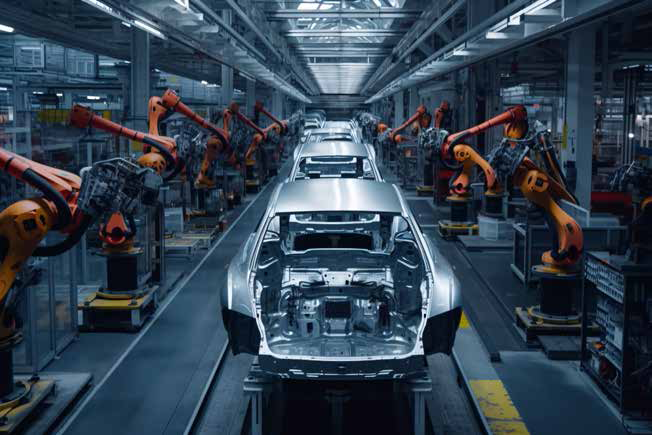
- Automotive assembly
- Steel mills
- Chemical processing
- Cement / bulk material operations
- High-volume rigid processes
AMRs fit organizations like:
- Multi-SKU warehouses
- FMCG & food manufacturing
- Pharmaceutical plants
- EV battery lines
- Electronics manufacturing
- 3PL distribution
- Factories with evolving layouts
A Simple Decision Framework
Ask these 5 questions:
- Will your routes remain unchanged for 3+ years?
If yes → AGV - Do you move extremely heavy loads?
If yes → AGV - Is your environment mixed with people, trolleys, and forklifts?
If yes → AMR - Do you need fast deployment (2–6 weeks)?
If yes → AMR - Is long-term scalability important?
If yes → AMR
A Straightforward Comparison Answer
Many readers look for a simple explanation to the question: What is the difference between AGV and AMR?
Here’s a clear, concise version:
AGVs follow fixed, predefined paths using tapes, reflectors, or wires. AMRs use LiDAR, cameras, and AI to navigate dynamically, avoid obstacles, change routes on the fly, and adapt to layout changes.
Conclusion
Both AGVs and AMRs play essential roles in modern intralogistics.
AGVs excel in repetitive, high-load, fixed-path operations, while AMRs offer adaptability, safety, and scalability for dynamic environments.
Today, many advanced factories deploy hybrid fleets—AGVs for backbone routes and AMRs for flexible workflows—to achieve the best of both worlds.
About Novus Hi-Tech
Novus Hi-Tech is a global pioneer in AI-driven robotics and autonomous mobile solutions, engineered indigenously in India. With 150+ patents, 1,200+ mobile robots deployed, 8M+ km autonomous travel, and 100+ enterprise customers, Novus enables factories and warehouses to transition from manual movement to intelligent, safe, and scalable automation.
Organizations exploring AGVs or AMRs can engage Novus Hi-Tech for workflow evaluation, ROI modeling, and end-to-end automation consulting.
Ready to Automate Your Material Movement?
If your team is evaluating AGVs, AMRs, or a hybrid fleet, our experts can help you assess workflows, build the right solution architecture, and estimate ROI tailored to your operations.
Let’s build the future of smart intralogistics — together.