Ask an AMR vendor if their robot works with other manufacturers’ hardware, and the answer is almost always yes. Ask what that means on the floor, and the answer gets unclear fast.
Here’s the honest version. Without a shared protocol, two robots can occupy the same warehouse, but they can’t share an intersection, a fleet manager, or even an agreed definition of “stop.” That difference doesn’t show up in a demo. It shows up the first week a second vendor’s robots touch the floor, when someone on the integration team realizes the existing fleet manager can’t see the new fleet at all.
One standard has become the default fix for that difference: VDA 5050.
Here’s what the VDA 5050 standard is, how it works, what changed with VDA 5050 3.0, and where the standard continues to leave gaps you have to plan for yourself. Let’s get into it.
What Is VDA 5050?
VDA 5050 is an open communication standard for autonomous mobile robots (AMRs) and AGVs. It gives an AMR fleet management system one common “language” to talk to robots from different manufacturers. Consider it similar to USB-C for robots: one cable, any device. It’s published jointly by Germany’s VDA and VDMA associations, with technical work led by the Institute of Materials Handling and Logistics (IFL) at the Karlsruhe Institute of Technology (KIT).
VDA 5050 is an open standard for communication between mobile robots and a fleet control system, developed through the VDA/VDMA working group with contributions from research and industry partners.
What Problem Does It Solve?
Before the VDA 5050 standard existed, every new robot brand meant a custom integration project. That created vendor lock-in, slow scaling, and a fleet manager that could only “see” one brand at a time. VDA 5050 fixes this by standardizing how orders go out and how status comes back, no matter who built the robot.
VDA 5050 vs. AMR Fleet Management
Don’t confuse the two. VDA 5050 is not a fleet management system on its own; it’s the messaging layer underneath one. Your AMR fleet management software decides where robots go and in what order? VDA 5050 just makes sure every robot understands the instructions the same way.
Why Multi-Vendor AMR Fleets Need It
-
Cross-Brand Communication
One fleet controller can now send orders to robots from Vendor A and Vendor B using the same message structure – no custom code per manufacturer.
-
Simpler Integration
Instead of a one-off connector for every robot you buy, your team builds one interface. New robots that support the standard plug-in with far less engineering. That’s a big part of why India’s AMR vendor pool keeps expanding: more brands are shipping VDA 5050-ready robots, and buyers can compare them on merit instead of on integration cost. If you’re weighing options, our own roundup of leading mobile robot manufacturers in India walks through how the local field has grown.
-
Room to Scale
Facilities grow. You add robots, swap vendors, expand to new sites. A multi-vendor AMR setup means automation can grow without a new integration headache each time.
-
It Doesn’t Erase the Integration Work
VDA 5050 standardizes the messages, not who owns the decisions those messages trigger. A detailed practitioner breakdown of AMR RFPs points out that dispatch logic still has to account for production schedules, work-in-progress, and material call logic that lives in the MES, not in the robot fleet manager.
How Does VDA 5050 Work?
Fleet Control, MQTT Broker, and Robots
The architecture behind MQTT fleet control is simple: a fleet controller decides what needs to happen, messages travel through an MQTT broker, and robots subscribe, receive orders, and publish status back.
Orders and Status, Back and Forth
The fleet sends an “order,” a sequence of waypoints, or nodes, connected by edges. The robot works through it and continuously publishes a state message: position, battery, current step, and any active errors. That loop is what lets one dashboard track a mixed fleet live.
The Official Topics
VDA 5050 defines a fixed set of MQTT topics that every conformant robot and fleet controller publish and subscribe to:
- order: the sequence of nodes and edges the robot should drive, plus any actions to run along the way
- state: the robot’s live position, battery level, current step, and error list
- instantActions: immediate commands outside the current order, like “pause” or an emergency stop
- connection: a simple online/offline heartbeat between the robot and the broker
- visualization: high-frequency position data meant only for drawing a smooth live map, not for control logic
- factsheet: a robot’s specs, load capacity, and supported actions, so the fleet manager knows what it’s talking to
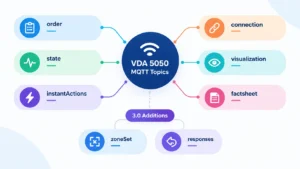
Version 3.0 adds two more, optional ones: zoneSet, which shares zone definitions between the fleet controller and freely navigating robots, and responses, a dedicated channel for acknowledging instant actions.
One detail worth knowing early: the connection topic is a network check, not a health check. It tells you whether the link to a robot is up. It says nothing about a robot that’s still connected but stuck, faulted, or off course. For that, your fleet manager needs to watch the errors, operatingMode, and safetyState fields inside the state message instead.
The VDA 5050 specification defines standardized MQTT message structures and topics, including order, state, instantActions, connection, visualization, and factsheet, enabling fleet controllers and mobile robots to exchange commands, status, and configuration data.
VDA 5050 and MQTT: How They Work Together
What Is MQTT?
MQTT is a lightweight publish-subscribe messaging protocol built for low-bandwidth, spotty-connection environments, exactly what a robot faces when it loses signal behind a shelf. Robots report changes as they happen instead of waiting to be polled, which keeps traffic manageable even as the fleet grows into the hundreds.
Why VDA 5050 Uses It
MQTT is efficient, reliable, and scales easily to hundreds of devices publishing and subscribing at once. That’s why it’s the backbone of modern MQTT fleet control.
VDA 5050 vs. MQTT vs. Sparkplug B
MQTT is the pipe. VDA 5050 is what flows through it. Two robots could both use MQTT and still not understand each other, since MQTT says nothing about what’s inside a message. VDA 5050 supplies the shared message format that makes the conversation work. If your plant already runs Sparkplug B on the same broker for general equipment telemetry, know that it solves a different problem: Sparkplug standardizes reporting from any device, while VDA 5050 standardizes a command-and-report contract specifically for mobile robots. The two can coexist on the same broker.
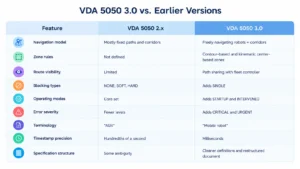
What’s New in VDA 5050 3.0?
VDA 5050 3.0 was released on March 19, 2026, following a public GitHub comment period that ran into early February 2026 and generated substantial community feedback that the core team folded into the final version, according to the joint VDA/VDMA press release.
- Freely navigating robots: better support for robots that plan their own routes, not just fixed paths.
- Zone concept: two zone types now exist. Contour-based zones cover things like blocked areas and speed limits, while kinematic center-based zones handle priority and directional rules. A blocked zone, for example, forces a robot to stop and raise a critical error if it ends up inside one it shouldn’t enter. Robots must request permission before entering certain zones, and a conflict matrix helps the fleet controller sort out overlapping zone claims.
- Path sharing: freely navigating robots share their planned and intermediate routes back with the fleet controller, so nobody loses visibility just because a robot is choosing its own path.
- Backward-compatible corridors: the older corridor and predefined-trajectory model for line-guided vehicles hasn’t gone away. Version 3.0 keeps it alongside the new zone concept specifically so one interface can still cover both simple AGVs and highly autonomous AMRs in the same fleet.
VDA 5050 Version 3.0 expands the standard with support for freely navigating mobile robots, zone-based coordination, path sharing, and updated operating and blocking concepts while maintaining compatibility with established trajectory-based approaches.
How VDA 5050 Improves AMR Fleet Management
Centralized Coordination
Every robot speaking the same protocol means one dashboard for your entire fleet, regardless of brand.
Task and Traffic Management
Standardized order and state data lets your fleet manager assign tasks efficiently and keep robots from colliding at intersections, and the new zone concept in 3.0 gives it a formal way to enforce right-of-way and restricted areas instead of relying on ad hoc geofencing.
Supporting Mixed Fleets
Forklifts from one vendor, tuggers from another, and pallet movers from a third all run under one controller. Some manufacturers have made this a selling point directly. We covered that shift in more depth in our piece on software-defined robotics, if you want the bigger picture.
Scaling Across Facilities
Once your AMR fleet management system speaks VDA 5050, rolling the same setup out to a second site is far faster, since your integration work carries over. That efficiency compounds fast: it’s one of the reasons AMRs cut warehouse labor costs and operating expenses as deployments scale.
What VDA 5050 Won’t Do For You
- It doesn’t make every robot automatically compatible; the interface still has to be built, and porting from 2.x to 3.0 means real engineering work, not a config toggle.
- Robot capabilities still vary by vendor. The VDA 5050 standard fixes communication, not performance.
- Your fleet controller still has to be good. Great MQTT fleet control under a weak fleet manager is still a weak system.
- It doesn’t assign liability or safety responsibility across vendors. That’s a separate conversation your contracts need to have, and one the VDMA has only recently started publishing formal guidance on.
- Safety systems, cybersecurity, and WMS/ERP integration remain separate work; the standard explicitly excludes all three from its scope.
Where AMR Fleets Go From Here
VDA 5050 turns “which robot brand am I locked into” into “which robot fits this job best.” With VDA 5050 3.0 live and more manufacturers shipping compliant adapters every quarter, that’s quickly becoming the baseline for multi-vendor AMR fleets, not a nice-to-have. What it still leaves to you: the LIF layout handoff, the liability conversation across vendors, and a real migration plan if you’re moving off 2.x.
A mixed AMR/AGV fleet needs an AMR fleet management system built around the VDA 5050 standard from day one. Novus builds its autonomous mobile robots to work this way, and our warehouse automation solutions are designed around exactly this kind of vendor-neutral, VDA 5050-ready fleet management.
That’s VDA 5050: the quiet standard doing a lot of heavy lifting in 2026.
If you’re planning a mixed AMR/AGV deployment and want to talk through what a VDA 5050-ready setup would look like on your floor, Novus is happy to walk through it with you.