
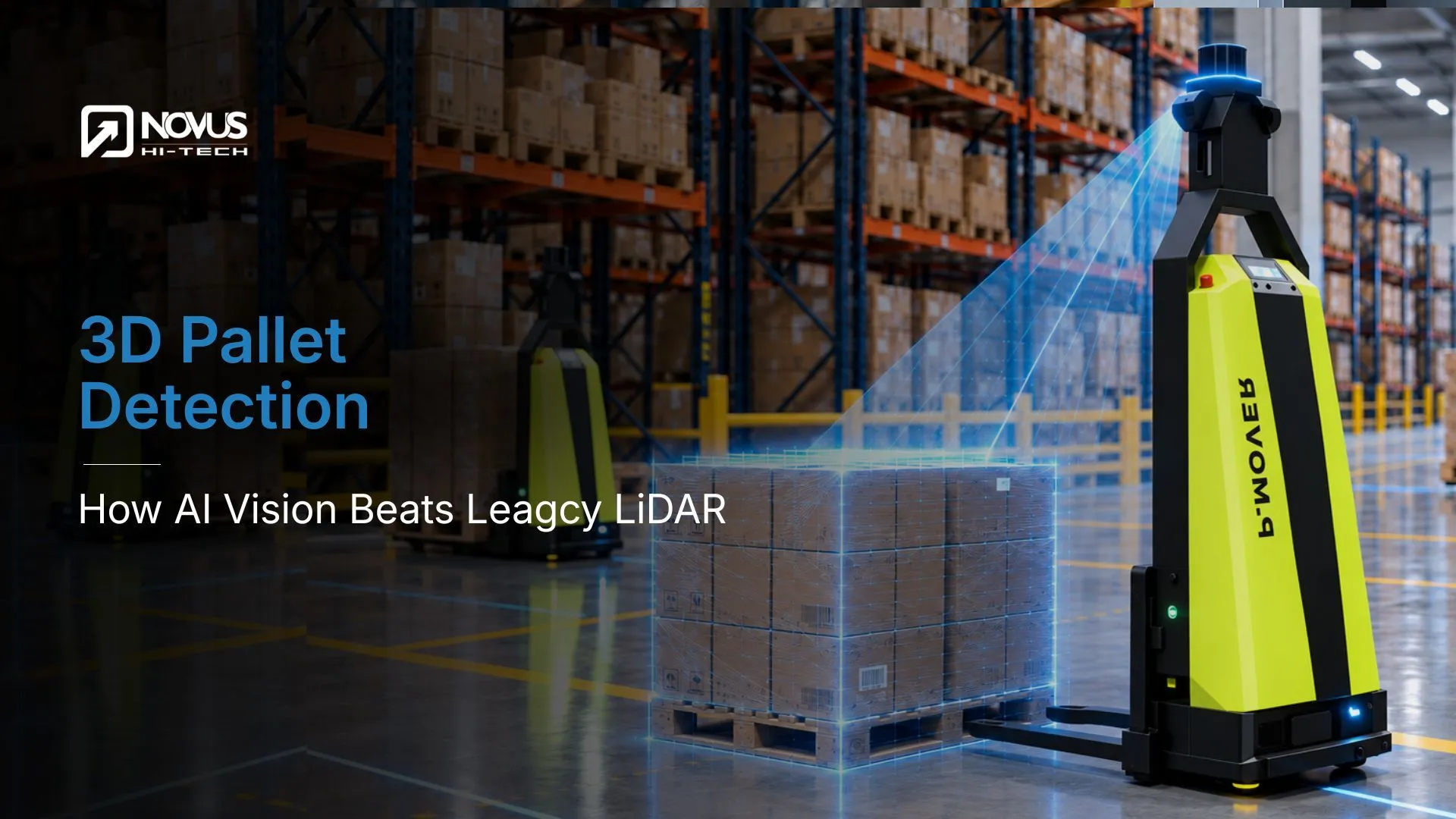
A pallet can be directly in front of an autonomous forklift and yet be difficult for a robot to pick.
The pallet may be wrapped in plastic. Its stringer may be damaged. Another pallet may be sitting a few inches away. The load may be slightly rotated or extending over the pallet edges.
A basic sensor can signal the robot that something is there. The bigger question is, is that the right pallet? Where exactly is it, and can the robot approach it correctly?
This is the point where 3D pallet detection becomes vital.
Modern AI vision is capable of combining image data, depth, 3D geometry, and learned pallet features to give an autonomous forklift more information about what it is seeing.
For pallet handling, that extra context can matter just as much as navigation.
Why 3D pallet detection is gaining attention
3D pallet detection is moving from research into commercial warehouse robotics. Recent product launches in the autonomous material-handling market have demonstrated the importance of perception in automated pallet movement, with AI-based pallet detection and 3D vision now available on commercial pallet-handling platforms.
The change is important because pallet handling is more than just object detection. The autonomous vehicle should be able to detect the target pallet, determine its position and orientation, and use this information to approach and manipulate it accurately.
For a broader explanation of how LiDAR, cameras, SLAM, and other sensing technologies fit into autonomous mobile robots, see Novus’ AGV and AMR Systems: Smart Factory Guide.
Why pallet detection gets difficult in a real warehouse
A warehouse rarely gives a robot a perfectly positioned pallet every time.
Real operating conditions introduce variation:
- Plastic-wrapped pallets
- Cracked or damaged stringers
- Mixed pallet types
- Partially blocked pallet faces
- Closely positioned pallets
- Uneven pallet placement
- Rotated pallets
- Loads extending beyond pallet edges
- Bright or low-light areas
- Dust, reflections, and visual clutter
A perception system that works only with clean, standardized pallets can struggle when those conditions change.
That is why AI pallet perception needs to go beyond detecting a rectangular object. The robot needs to identify the pallet, estimate its position and orientation, and connect that information to the forklift’s approach and fork alignment.
What 3D vision gives an autonomous forklift
A range sensor can provide information about distance and surface geometry. AI vision can add another layer:
What is this object?
Where does the pallet begin and end?
Which pallet is the target?
What is its orientation?
Where should the forks approach?
That is the role of 3D vision forklift technology.
A perception system can combine:
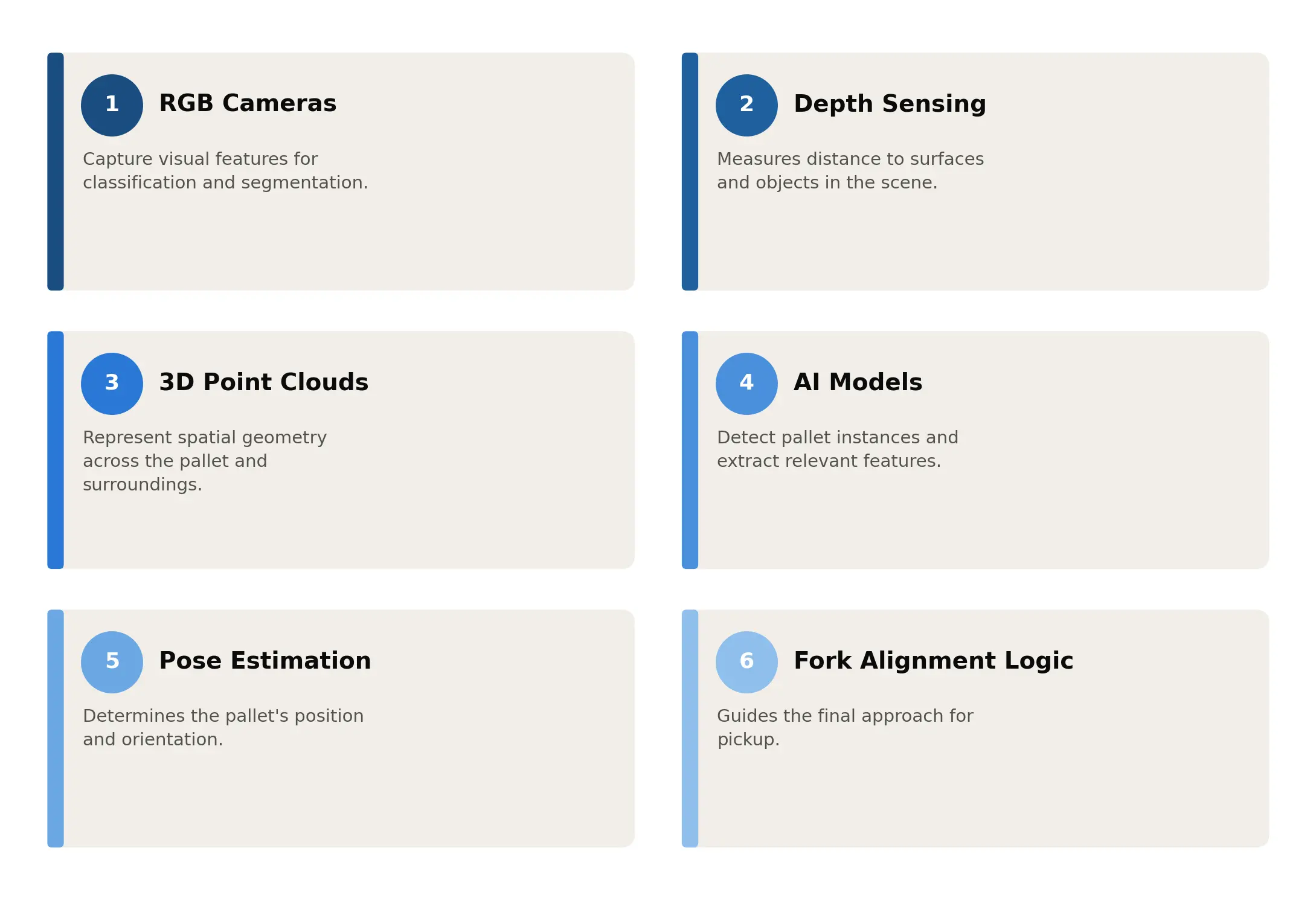
The result is a spatial representation that can support pallet localization, approach planning, and fork alignment.
Why AI vision changes pallet recognition
LiDAR has an important purpose in autonomous robotics. It can support mapping, localization, obstacle detection, and environmental awareness.
The challenge comes when the robot needs to detect what it is seeing.
A point cloud can describe surfaces and distances. AI vision can use learned visual features to classify and segment objects.
This is where pallet recognition AI can add value.
For example, two pallets can have similar geometry but different positions, orientations, or visual conditions. The perception system needs to separate those pallet instances and determine which one is relevant to the current mission.
This does not mean LiDAR becomes irrelevant. A practical perception architecture can use sensor fusion, with different technologies contributing different information:
LiDAR: navigation and spatial awareness
Vision: object understanding
Depth and 3D processing: pallet geometry and pose
Control system: approach and pickup
The goal is to give the autonomous forklift better information at the point where accurate pallet interaction matters.
Novus’ Forklift AMRs and Autonomous Pallet Trucks guide explains how 3D vision cameras, LiDAR, AI algorithms, and fork-alignment systems can work together for pallet handling.
What recent research tells us about pallet detection
The technology is moving from basic object detection toward combined perception, localization, and pose estimation.
A 2024 Sensors study combined RGB and depth images, deep-learning segmentation, keypoint extraction, and 3D point-cloud data to identify and localize target pallets in an unmanned forklift scenario. Under the study’s test conditions, pallet-positioning error was below 20 mm, while rotation-angle error was below 0.37°.
Another study on pallet detection and localization from synthetic data reported 0.995 mAP50 for single-pallet detection on a real-world dataset. It also reported average position accuracy below 4.2 cm and an average rotation accuracy of 8.2° for pallets within 5 meters in the tested head-on configuration.
These results should not be treated as direct performance comparisons because the studies use different sensors, datasets, environments, and evaluation methods.
The useful takeaway is that pallet perception can be measured using concrete metrics rather than vague claims about “smart vision.”
Why synthetic data can help
Training a pallet perception model on real warehouse footage alone can be expensive. A useful dataset needs enough variation to represent the conditions a robot may encounter.
It should include:
- Different pallet designs and loads
- Wrapped or damaged pallets
- Partial occlusion and multiple pallets
- Different lighting, distances, and camera angles
Synthetic data can help generate some of these conditions at scale.
A 2025 survey in Engineering Applications of Artificial Intelligence manually screened 1,570 papers and identified 50 studies that explicitly detailed computer-vision implementations in warehouse automation. The review covered object detection, classification, segmentation, navigation, AI accelerators, and robotic platforms.
The researchers also highlighted the need for standardized benchmarking, photorealistic synthetic datasets, and better deployment of vision systems on edge AI hardware.
Synthetic data can help with training, but it cannot replace deployment testing. A model still needs to face the warehouse conditions where it will operate.
Why real-world pallet conditions matter
Perfectly positioned pallets make perception look simple.
Real warehouses are different.
A cracked stringer can change the expected pallet geometry. Shrink wrap can hide visual features. A mixed stack can place several pallet instances close together. A rotated pallet can change the expected fork-entry angle. Partial occlusion can hide part of the pallet from the camera.
These conditions create a perception problem, not just a detection problem. For autonomous pallet identification, the system needs to differentiate the target pallet from surrounding objects and estimate enough information to support the next stage of the robot’s movement.
The important consideration is not if a model can identify a pallet, but whether that identification is effective when the pallet differs from the training examples. Analyzing real warehouse footage can assess the system’s ability to recognize the correct pallet and determine an appropriate pickup position under less-than-ideal conditions.
The technical stack behind 3D pallet detection
A 3D pallet detection system brings several technologies together; the process looks like this:
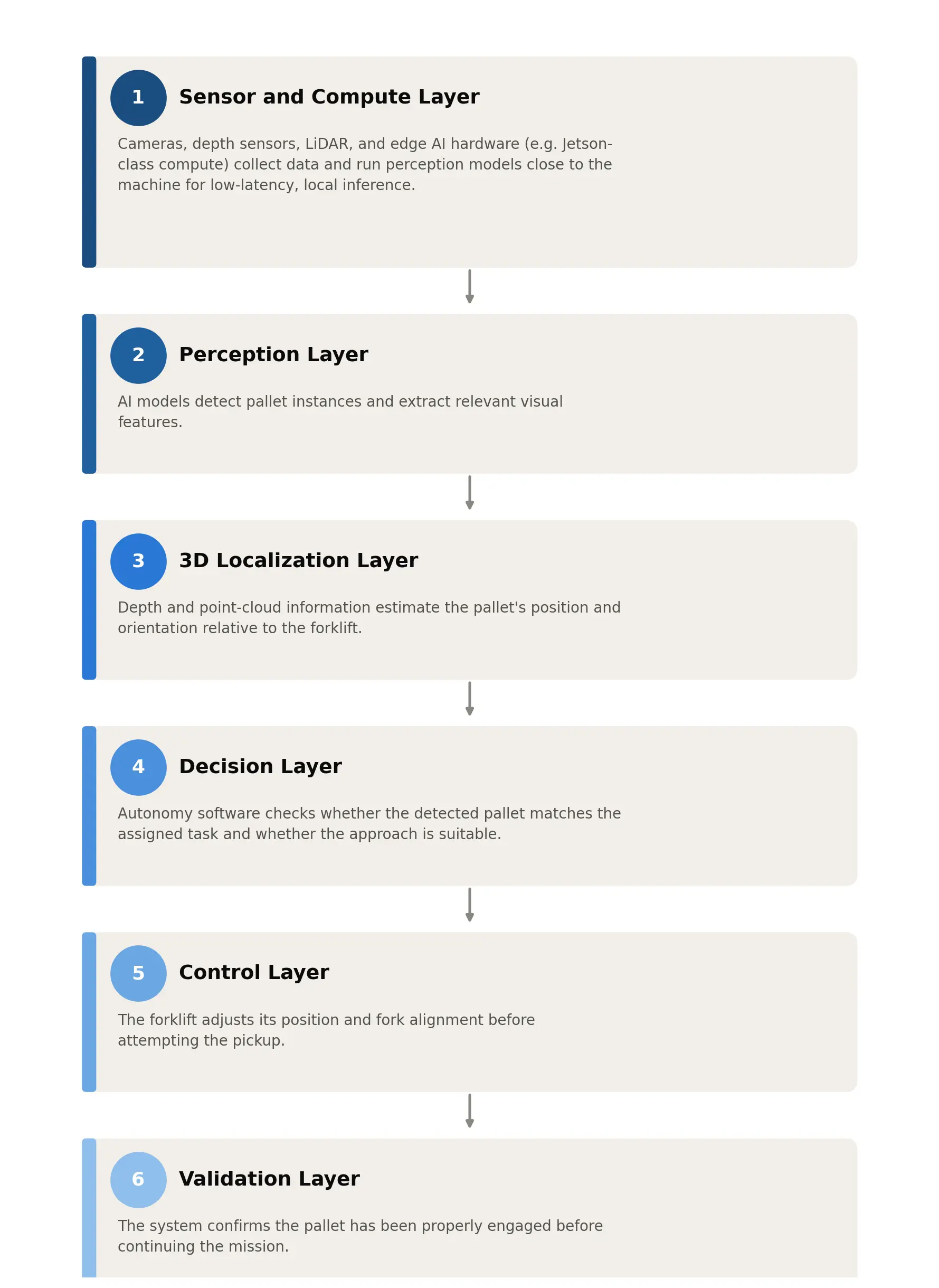
The important point is that these layers work together.
Perception has to provide useful information to navigation and control for the complete pickup process to work reliably.
How 3D pallet perception fits into P-Mover
For an autonomous pallet truck such as the Novus P-Mover, pallet perception is part of a broader autonomy stack. P-Mover combines laser SLAM and vision-based navigation to support autonomous movement of pallets and bins across warehouse and manufacturing environments.
Navigation helps the vehicle understand where it is and how to move through its surroundings, and pallet perception provides information about the object it needs to approach and handle.
In a pallet pickup scenario, these capabilities need to work together so the vehicle can locate the target pallet, approach it, and align for the task.
Learn more about the Novus P-Mover and its autonomous pallet-handling capabilities.
How this connects to autonomous forklift design
Pallet perception does not operate separately from the rest of the robot.
An autonomous forklift has to understand its position, navigate to the target area, identify the correct pallet, estimate its position and orientation, align the forks, and validate the pickup.
This is why navigation and perception need to be considered together.
Novus’ How AMRs Use SLAM in Robotics explains how SLAM helps mobile robots map their surroundings and determine their position while moving through dynamic warehouse environments.
Pallet detection sits one layer above that navigation problem.
SLAM helps answer “Where am I?”
3D pallet perception helps answer “What am I looking at, and where is it relative to me?”
The control system then needs to answer, “How should I approach it?”
That distinction is important when understanding how perception fits into an autonomous forklift.
Conclusion: From seeing pallets to understanding them
A pallet represents more than just a rectangle captured in a camera feed.
For an autonomous forklift, it is a physical target with a location, orientation, geometry, and pickup path.
That is why 3D pallet detection is growing into an important part of autonomous material handling.
AI vision can provide the semantic layer needed to recognize pallet instances. Depth and 3D data provide essential spatial information for accurate positioning and fork alignment.
If you’re exploring autonomous pallet movement or AI-driven forklift perception for your warehouse, contact our team to walk through your specific application, operating conditions, and material-handling requirements.