
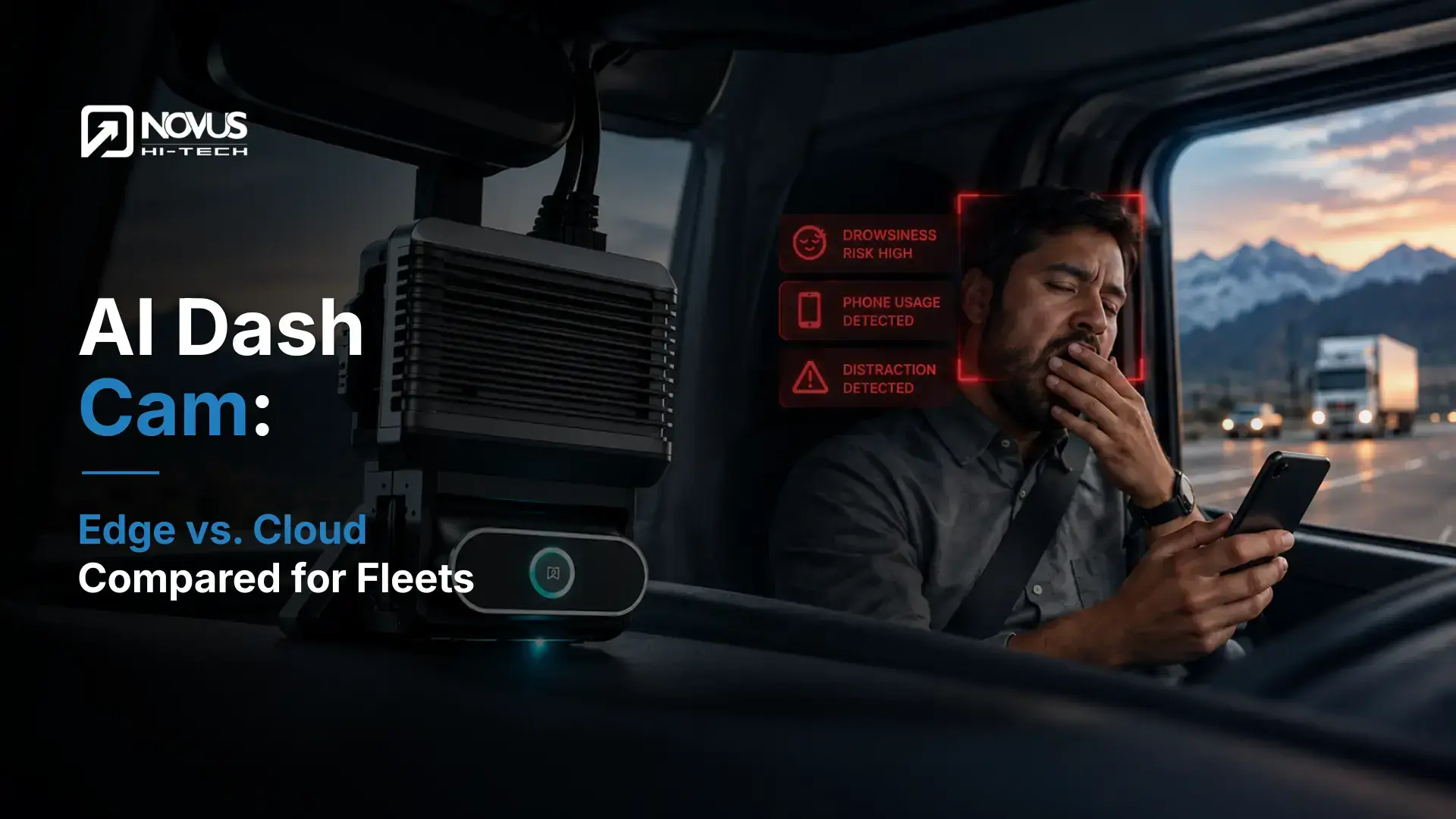
Commercial fleets everywhere are betting on the same idea: an AI dash cam that catches a risky moment before it becomes a claim. But the camera only helps if it can think fast enough to matter, and that depends entirely on where it processes what it sees.
This piece compares the two architectures that decide how fast your dash cam reacts: edge AI dashcam systems that process video on the device and cloud-connected dashcam systems that send footage to a server first. If you want to start with the basics, see our guide on what a dashcam is and its role in accident prevention.
Every AI Dash Cam Makes One Core Decision: Where It Thinks
Every AI dash cam sold today claims artificial intelligence somewhere in its spec sheet. That claim tells you almost nothing on its own.
For a broader look at how AI turns camera footage into actionable fleet-safety insights, check out our guide to AI video telematics
What matters is where the thinking happens:
- On the camera itself – this is edge AI dashcam or on-device AI dashcam territory
- On a remote server – this is the cloud-connected dashcam model
- A blend of both, where the device handles urgent decisions and the cloud handles storage and reporting
That single architectural choice decides how your fleet camera performs on a highway, in a tunnel, or on a rural stretch with no tower in sight.
Edge AI Dashcam or Cloud-Connected Dashcam: The Real Difference
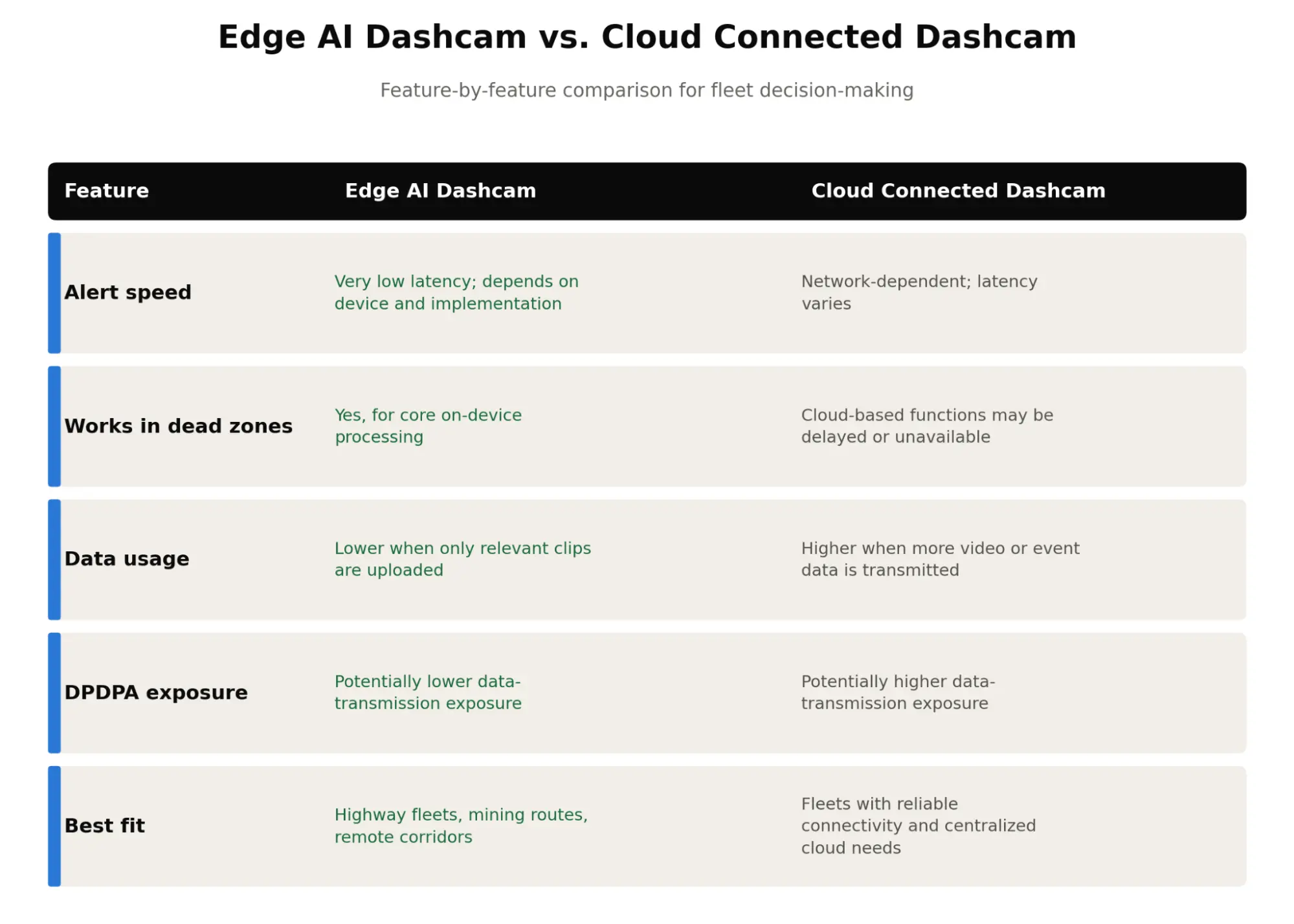
An edge AI dashcam carries its own processor and runs trained models directly on the device. It doesn’t wait for permission from anywhere else to flag a risk.
A cloud-connected dashcam can send video or event data to remote servers for storage, analysis, or both
What an edge AI dashcam does:
- Processes video and sensor data on the device itself
- Flags harsh braking, drowsiness, or a collision risk within milliseconds
- Uploads only the relevant clips, not continuous raw footage
What a cloud-connected dashcam does:
- Captures footage, then uploads it for server-side analysis
- Needs a stable, live connection to generate any real-time result
- Consumes more mobile data and cloud storage over time
- Cloud-dependent real-time alerts may be delayed or unavailable when connectivity drops.
Fleets running dense city routes with strong 4G rarely notice the gap. Fleets running national highways and rural corridors notice it on the very first dead zone.
Dashcam Latency: The Seconds That Decide an Outcome
A truck moving at 80 km/h covers roughly 22 meters every second. Run the math on a typical cloud round-trip.
Even a few seconds of network and processing delay can translate into tens of meters of travel at highway speeds. Dashcam latency at that scale turns a warning into a record of what already happened.
Local processing can substantially reduce network-dependent alert latency, giving the driver more time to respond.
Inside an On-Device AI Dashcam: How In-Vehicle AI Processing Works
In-vehicle AI processing runs on a compact chip built into the camera, trained on patterns that matter for safety: eyes closing for too long, a phone lifted toward the driver’s ear, and a vehicle drifting out of its lane.
The chip doesn’t consult anything outside the vehicle to recognize these patterns. It already knows what to look for.
That design gives an on-device AI dashcam a specific set of advantages for commercial fleets:
- It can keep analyzing through patchy or zero connectivity
- It can reduce mobile data usage, because only relevant clips need to leave the vehicle
- It can reduce cloud storage needs, since raw footage can remain local until needed
- Its core processing does not depend on a network round-trip, although detection performance can vary with visibility and sensor quality
Chipmakers have pushed this further too. Newer automotive-grade processors now run vision models and driver-coaching logic entirely on the camera, without any cloud dependency for the core safety function.
Highway Dead Zones Are a Global Fleet Problem
No highway network fully escapes mobile coverage gaps. Governments on multiple continents are actively working to close them right now, which tells you how real the problem still is.
Southeast Asia is dealing with it in real time. Malaysia formed a joint highway telecom task force in 2025 after finding roughly 50 km of highway, including sections of the PLUS Expressway, with zero mobile coverage. Vietnam’s telecom ministry, in a plan confirmed in July 2024, set a target to reach full mobile broadband coverage on all national highways and expressways, an admission that full coverage didn’t exist at the time.
The same pattern shows up well beyond the region. In the US, Verizon, AT&T, and T-Mobile agreed in 2026 to launch a satellite-based joint venture to close rural dead zones along long interstate stretches. Australia’s Mobile Black Spot Program still lists national highway sections, including the Princes Highway and Kings Highway, as active blackspots in its February 2026 target list. India’s National Highways Authority flagged 424 locations covering roughly 1,750 km of highway with critically poor or missing coverage in a January 2026 report.
Picture a cloud-connected dashcam entering any of these zones, wherever the fleet operates. Live alerts stop. Uploads queue up and wait. The camera keeps recording to local storage, but the fleet manager gets nothing until the signal returns, sometimes tens of kilometers later.
An edge AI dashcam doesn’t need the tower, anywhere in the world. It has already evaluated the event, alerted the driver, and logged the record. The cloud sync happens whenever the network allows it, not before the driver needed the warning.
For any fleet running a Southeast Asian highway corridor, a US interstate, an Australian regional route, or an Indian national highway, this single fact should decide the architecture, not the brochure.
Data Rules Are Tightening Across Asia, Not Just in One Country
Fleet telematics data faces a growing compliance problem, and the direction is the same across the region: more consent requirements, more restrictions on where footage can sit.
India’s Digital Personal Data Protection Act, 2023, along with the DPDP Rules that followed, places real obligations on any business collecting driver and vehicle data. Legal analysts covering the transport and logistics sector note that fleet operators are generally the data fiduciaries when they determine why and how driver and vehicle personal data is processed, while telematics providers may act as data processors depending on the arrangement, since they routinely collect location data, driving behavior patterns, and in some cases facial data from drivers. That status comes with responsibilities including consent, breach notification, and cross-border data transfer.
Indonesia’s Personal Data Protection Law took a similar path. Enacted in 2022, its two-year transition period ended in October 2024, so any business collecting personal data from Indonesian citizens, fleet and logistics operators included, is now expected to be fully compliant or face fines of up to 2% of annual revenue.
A cloud-first dashcam uploads every clip, every trip, every driver’s face to a server before anyone gets to decide if that data needs to leave the vehicle at all, and some of those servers sit outside the country where the data was collected.
An edge-first architecture changes that equation. Most of the processing, and the decision about what’s worth keeping, happens on the device. Only flagged, relevant clips move to the cloud. Less raw personal data in transit means a smaller compliance surface under any of these laws.
What the Data Shows About Edge AI in Indian Fleets
A few independently verified numbers give a clearer picture than any vendor claim.
- 55% reduction in drowsiness alerts per 1,000 km and a 46% annual reduction in road-behavior violations, reported in an AWS case study on Novus Hi-Tech covering one of its largest dangerous-goods logistics deployments.
- 41% drop in bus accidents for Nagpur’s Aapli city bus fleet after ADAS deployment, alongside a 30% reduction in monthly driver risk scores, tracked by the IIIT-Hyderabad-backed iRASTE road safety initiative between January and August 2023.
- The global automotive computer vision AI market, valued at $1.9 billion in 2025, is projected to reach $8.9 billion by 2035 at a 16.7% CAGR, with Global Market Insights specifically citing the shift toward edge computing as the response to latency, reliability, and privacy concerns in vehicle safety systems.
- National Highways alone accounted for 31% of all road accidents and 36.6% of fatalities in India during 2024, per the Ministry of Road Transport and Highways, underscoring why highway-grade reliability matters more than city-grade convenience for fleet safety tech.
Data like these show what happens after the camera is installed, not just what the camera claims to do.
Matching the AI Dash Cam to Your Route, Not the Spec Sheet
Skip the feature checklist and start with your actual operating map. The right architecture depends on where your trucks drive, not which camera has the longest spec sheet.
- Map your routes against known coverage gaps. For remote and rural highway stretches, prioritize in-vehicle AI processing over cloud dependency.
- Decide how fast you need to know. A delay acceptable for routine monitoring can become critical when you need a safety alert.
- Get a straight answer on data storage. Ask where footage lives, for how long, and whether it ever leaves India, especially with DPDPA obligations in play.
- Calculate your real data cost. On-device filtering can cut monthly SIM and cloud storage spend by a wide margin compared to continuous cloud upload.
- Run a pilot on your worst-connectivity route first. A camera that performs well in a depot yard tells you little about how it performs on a remote highway stretch.
Choosing an AI Dash Cam Built for Indian Roads
The right AI dashcam architecture depends on how your fleet operates. For unreliable-connectivity routes, edge processing keeps core safety functions available while cloud connectivity supports synchronization and storage.
Novus Hi-Tech’s video telematics platform uses an edge-first approach for Indian commercial fleets. Want to see what fits your fleet? Talk to the Novus team.