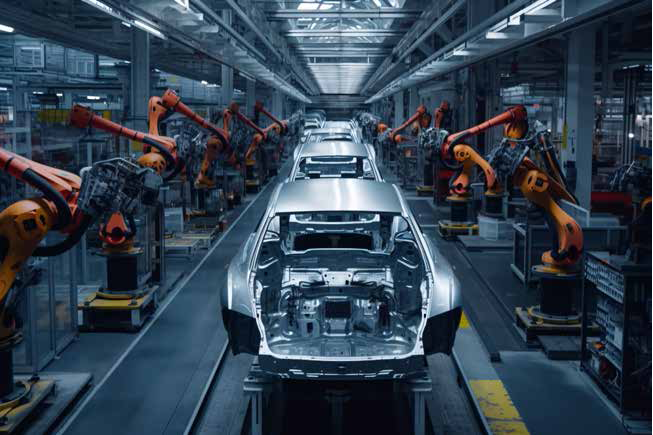

Moving a component across the factory floor is one job, while delivering it to a workstation, feeding it into a production line, and then moving on to the next task is another. When such jobs take place all day, the time spent handling materials can become very substantial.
Autonomous mobile robots (AMRs) help companies to carry out these movements more efficiently since they move about a facility and carry materials from one fixed location to another, which reduces the need for multiple manual rounds.
A mobile manipulator robot uses mobile navigation with robotic arm capabilities to handle tasks across different workstations. Proper planning is still essential if AMRs are to work effectively on a busy factory floor, as product movement, crowded working areas, and changes in production requirements can all lead to operational problems.
What is a mobile manipulator robot?
A mobile manipulator robot combines an autonomous mobile base with a robotic arm. The base drives to the station. The arm then picks a part, loads a machine, or places a component. You will also hear it called a mobile manipulation robot, a mobile cobot, a cobot on an AMR, or a robotic arm on a mobile base.
It solves a problem that each machine has on its own:
- A fixed arm stays inside its cell.
- A standalone AMR moves materials, but a person or a machine still has to load and unload it.
- A mobile manipulator drives between stations, handles its own loading, and moves on to the next task.
It also fits into facilities that are already running, which means you can reassign it to a new station without rebuilding the layout.
Two limits to keep in mind:
- Payload: The arm sets the lifting limit. Heavy pallets still belong on a dedicated AMR.
- Stability: The base must stay steady while the arm moves and stop in the same spot at every station.
What makes an autonomous mobile robot different?
An autonomous mobile robot (AMR) is designed to transport materials from one place to another and navigate its environment. Unlike machinery that follows a fixed path, an AMR can move around obstacles and react to changes in its surroundings by using sensors and navigation technology.
To get a sense of their environment, these systems may use cameras, LiDAR, and technologies like simultaneous localization and mapping (SLAM). For each job, the AMR either carries materials directly or takes on an attachment, such as a lift, a roller top, or a tugger hitch, that fits the handling task.
If you want to know more, read Novus’s guide on how autonomous mobile robots work.
Top 5 use cases for mobile manipulator robots and AMRs
Five industrial applications are worth considering.
1. Moving materials between workstations
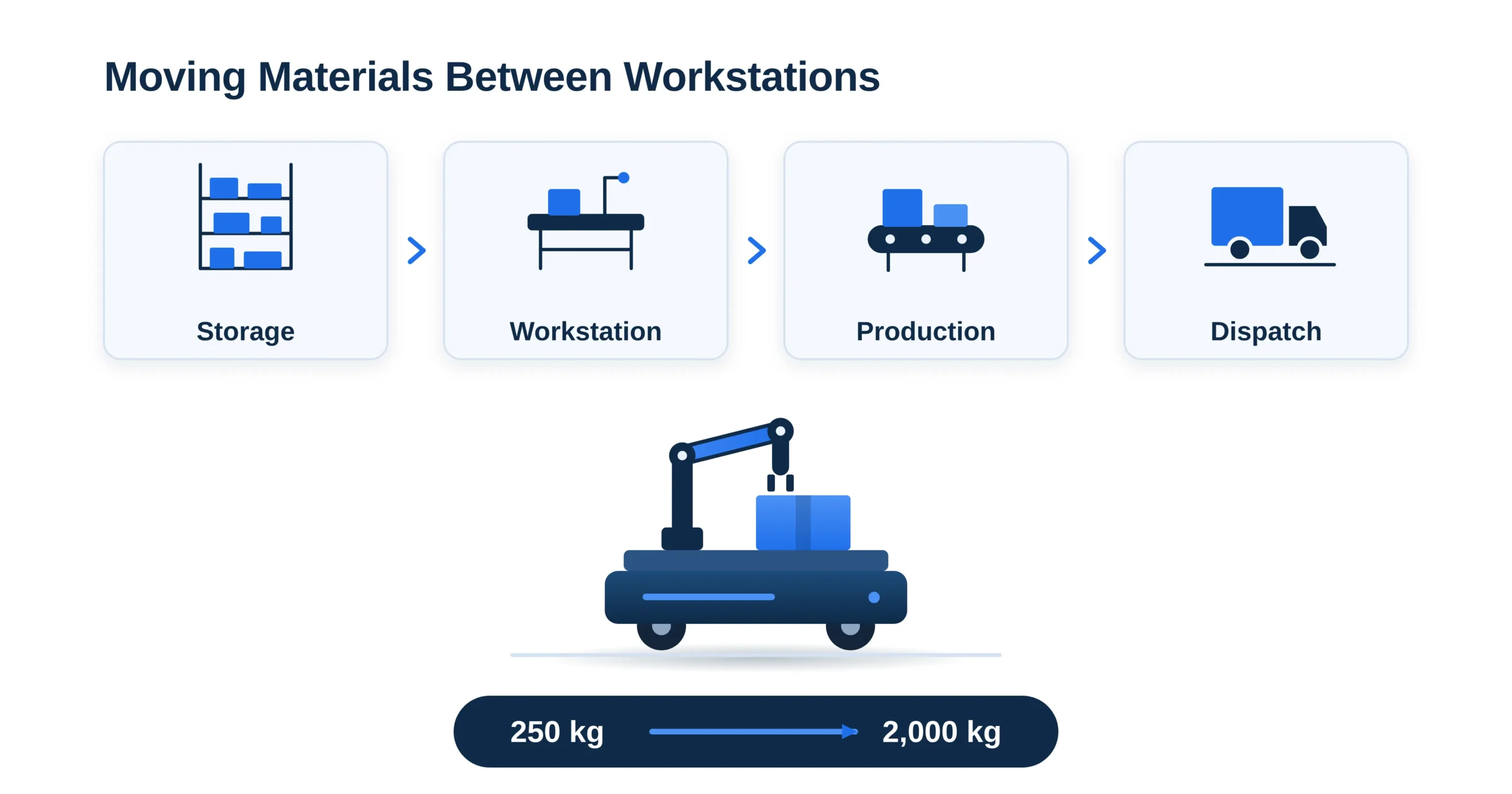
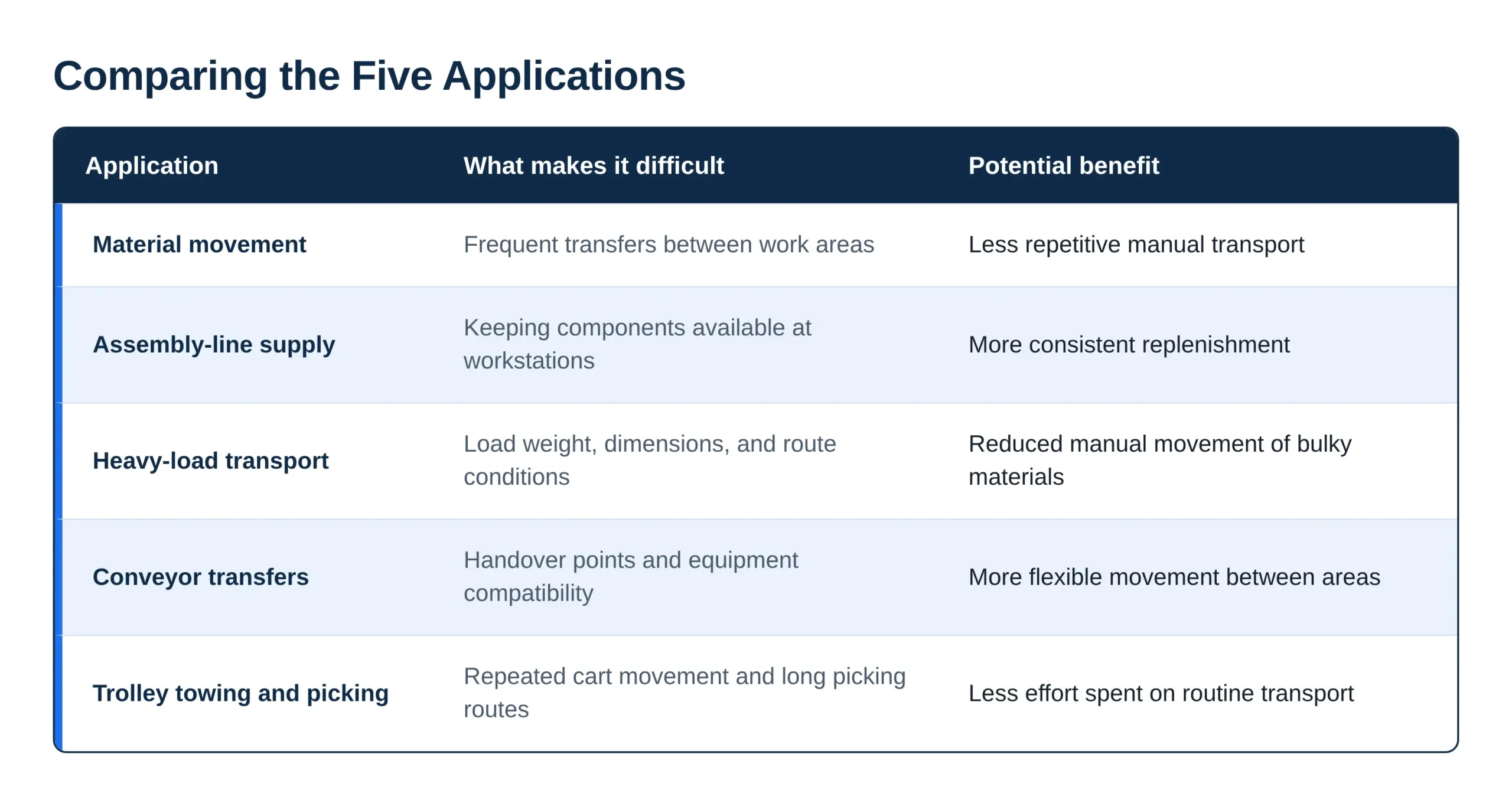
Automated material handlers move materials from one storage area to another, from one workstation to another, from one production area to another, and from one dispatch point to another. Once a delivery is finished, the robot takes up its next assigned task, which cuts the time employees spend on routine transportation.
A robotic arm on a mobile base can also handle components at different workstations. Companies can evaluate various options in accordance with their material-handling needs, and the load decides most of the choices. Size the payload to the heaviest load the robot carries regularly, not the average one. A robot that moves 30 kg totes between two cells needs a very different base from one that hauls 1,000 kg pallets across the plant. Narrow aisles and shared walkways also set the robot’s footprint and speed.
2. Providing the assembly lines with components
The assembly line requires the correct components to be available at the right time; if a workstation runs short of parts, then production may have to slow down until another person organizes a replenishment run.
AMRs are capable of delivering components, parts kits, and other supplies to specific production areas and can also transfer work-in-progress materials between different stages, thus assisting companies in managing the flow of materials as production requirements change.
A cobot on an AMR can combine material transportation with collaborative robotic tasks at assembly stations. For example, the robot can bring a kit to a station, place the parts into a fixture, and move on to the next station on its route. Scheduling deliveries to the line’s pace instead of waiting for a call keeps stations from running dry.
The Novus guide explains how autonomous mobile robots can support various industrial workflows.
3. The transportation of pallets and heavy loads
To move heavy materials across a factory or a warehouse, it is necessary to have the right kind of equipment and to arrange things carefully. If such movements take place frequently, they can also cause a backlog of materials around the storage areas and the production routes.
AMRs built for heavier loads transport compatible pallets, frames, and other industrial cargo from one specified location to another. In different situations, a robot can move materials from the receiving area to storage, deliver supplies to the production area, or transfer finished goods to a different area.
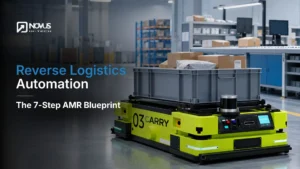
The payload capacity of the Novus CARRY can reach 2,000 kg, which is enough for heavily loaded pallets. Four details settle the setup: the size and weight of the load, the condition of the floor (joints, ramps, and slopes affect speed and stability), the width of the route, and how the load is picked up and handed over at each end
4. The transfer of materials between conveyors and production areas
Conveyors are useful for transporting materials along fixed routes, but in a facility not all transfers take place along a straight line since materials might have to be moved between different conveyor sections, production cells, or work areas which have different layouts.
AMRs fitted with the right attachments are able to carry out these transfers by moving loads between the designated handover points. According to their setup, they can assist in moving compatible pallets and frames between conveyor systems and other production areas.
A mobile cobot adds robotic handling to these transfers, such as lifting a part off a conveyor and placing it into a fixture. For heavier parts, some teams look at UR20 AMR integration. The UR20 is a collaborative arm rated for 20 kg with a 1,750 mm reach, and the arm alone weighs 64 kg. The AMR underneath therefore needs a base rated for that weight that stays stable when the arm extends
5. The use of trolleys and the support of picking operations
It is not necessary in all material-handling positions for a robot to carry a load directly on its platform; in some facilities the materials are already on trolleys, which have to be moved between workstations, storage, and dispatch.
A tugger AMR tows compatible carts along set routes, which automates repeated trolley movements.
Tugger AMRs are useful in two cases:
- Where several loads need to be transported together.
- When employees regularly move carts between the same locations.
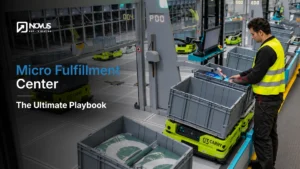
AMRs can also be used for picking and kitting. For instance, a robot providing pick assistance can carry the items that have been collected while an employee is selecting the products or components, so the worker no longer has to push a fully loaded trolley over long distances.
The extent of the benefit will vary according to how frequently the task takes place, the distance covered, and the amount of manual effort required.
What decides whether an investment is worthwhile?
The cost of purchasing a robot doesn’t end with the price of the machine itself; businesses also have to take into account the expenses associated with integration, continuous maintenance, safety requirements, and the time required to deal with operational problems.
Begin by examining the specific task:
- How frequently does it occur?
- How much time do the employees spend on it?
- Is there consistency in the loads and routes?
- What level of manual effort is involved in each movement?
Let’s look at a system that costs $120,000 and yields annual net savings of $60,000; in this case, the simple payback period would be two years. However, this is only an example and not a typical outcome in the industry.
Your actual payback period is set by the system’s total cost, its level of utilization, the operating expenses, and the savings the facility realizes. Utilization carries a lot of weight: a robot that runs two shifts spreads the same purchase price over twice the working hours.
Before deciding to make an investment, businesses should evaluate their current material-handling costs and compare these with the costs that are expected from an AMR deployment.
The Novus Return on Robotics calculator can be used to estimate possible labor savings and the break-even timeline by using information about the facility and the staffing.
Ending note
Autonomous mobile robots handle a range of material-handling tasks that keep factories and warehouses going, such as supplying assembly lines, transporting heavy loads, and towing trolleys. Their value comes from how well they match the existing workflow and how much repetitive movement they cut down.
Improve material movement in your facility with the Novus team, talk over your operational needs, and find out how our autonomous mobile robot solutions can help with your operations.