
A logistics company runs 400 commercial vehicles. Most still have four to six years of useful life ahead. Accident rates are climbing. Safety targets have tightened. Management wants driver assistance deployed across the fleet within months, not procurement cycles.
The question is not whether to deploy ADAS, as that decision has already been made now the question is how. Retrofit the existing fleet now, or specify OEM-fit ADAS on new vehicle acquisitions going forward?
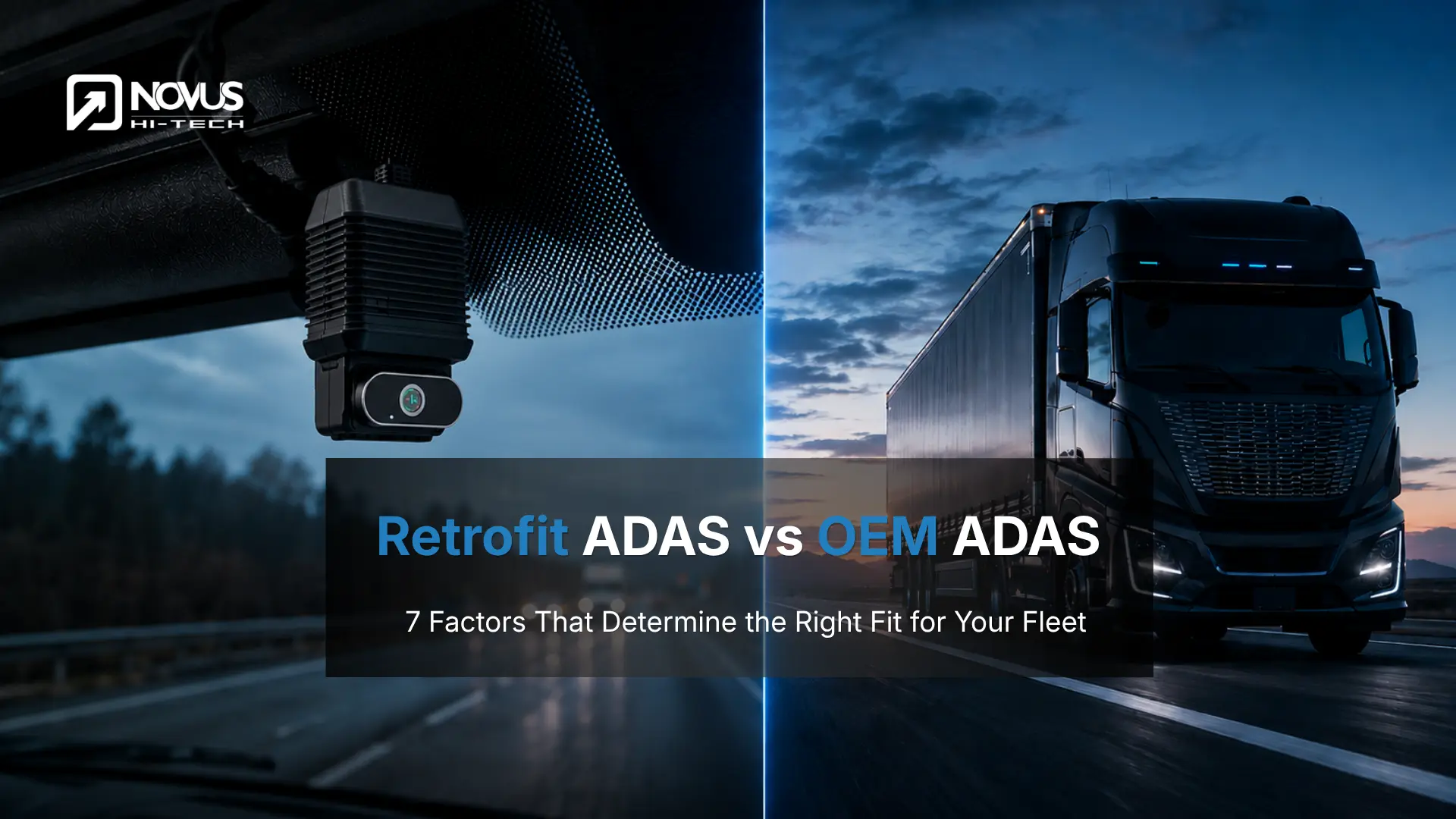
This is the retrofit ADAS vs OEM ADAS decision that fleet safety managers and operations directors across commercial transport are actively working through. The stakes are significant. According to India’s Ministry of Road Transport and Highways, road accidents in India reached 480,583 in 2023, claiming 172,890 lives, an all-time high, with over speeding accounting for 68% of fatalities. Globally, the commercial vehicle ADAS market is valued at USD 13.78 billion in 2025 and is projected to reach USD 29.10 billion by 2030, growing at a CAGR of 16.13%, a direct reflection of how urgently fleet operators are prioritising safety technology investment. In India specifically, ADAS adoption reached 8.3% across new vehicles in H1 2025, with Level 2 systems growing 70.8% year-on-year, and commercial vehicle adoption is accelerating alongside passenger segments.
Who Is This Article For?
This guide is for fleet managers, transport operations heads and procurement decision-makers evaluating ADAS deployment across their vehicle base. After going through this article you will come away with a structured decision framework, a head-to-head comparison of both approaches, and clarity on when a hybrid strategy makes the most practical sense. ADAS has moved from being a premium feature to a baseline safety requirement, driven by rising accident costs, compliance pressure, insurer scrutiny and the shift toward data-driven fleet operations.
Understanding the Two Paths to ADAS Deployment
Path 1: Retrofit ADAS
Retrofit ADAS, also called aftermarket ADAS, is installed on vehicles already in service. The system runs independently of the vehicle’s factory architecture, using externally mounted cameras, on-board AI processing hardware, and real-time alerts delivered directly to the driver.
Installation is completed within hours per vehicle. There is no dependency on vehicle manufacturer lead times or procurement schedules. The entire existing fleet can be covered before a single new vehicle enters service.
Path 2: OEM-Fit ADAS
OEM-fit ADAS is factory-installed during vehicle manufacture. The system integrates natively with the vehicle’s electronic control unit, embedded sensors, and communication architecture. Calibration is completed at the factory. The safety system and the vehicle operate as a unified system from day one.
For fleet operators making new vehicle acquisitions, this is typically the most technically complete ADAS deployment available, with tighter integration and standardised configuration across all new vehicles in the order.
Retrofit ADAS vs OEM-Fit ADAS: 7 Decision Factors That Determine the Right Choice
Fleet operators often frame this as a binary choice. In practice, the right approach depends on operational variables specific to each fleet which might also relate to their fleet safety solutions. The following seven factors provide a structured way to work through the evaluation.
Decision Factor 1: How Quickly Do You Need Safety Coverage?
When accident rates are climbing and compliance targets have moved, waiting 18 to 36 months for a vehicle replacement cycle is not an acceptable safety plan. Retrofit ADAS can be deployed across an existing fleet in weeks. Every month without driver assistance on a high-utilization vehicle carries continued safety and liability exposure.
Decision Factor 2: What Does Your Fleet Age Profile Look Like?
If most of your fleet was acquired in the last four to six years, those vehicles carry substantial remaining asset value. Retiring them to gain factory ADAS is difficult to justify economically. Retrofit keeps productive assets in service while closing the safety gap. The older the fleet, the stronger the case for retrofit.
Decision Factor 3: How Much Capital Are You Prepared to Commit?
Full fleet replacement to gain OEM ADAS capability is not simply a technology decision, it is a capital allocation decision. Vehicle acquisition, financing, insurance, registration, and disposal of existing assets combine to make it an order of magnitude more expensive than deploying a retrofit system on a fleet that still has productive years ahead. For organisations operating under defined safety or technology budgets, retrofit delivers measurable safety improvement within existing capex or opex envelopes, without triggering a replacement cycle.
The ROI case reinforces this. An IIHS study of 62 carriers found that trucks equipped with forward collision warning had 22% fewer crashes overall and a 44% reduction in rear-end crashes specifically. Accident cost reduction, lower insurance premiums, and compliance savings typically allow fleet operators to recover a retrofit ADAS investment well within the vehicle’s remaining lifespan.
Decision Factor 4: How Important Is Deep Vehicle Integration?
OEM-fit ADAS communicates directly with the vehicle’s ECU, accessing brake response, steering input, and powertrain data in real time. That integration depth enables more precise safety interventions. For operations where active intervention capability matters as much as alerting, OEM-fit is the stronger technical choice. For fleet operators evaluating driver behaviour monitoring as a standalone priority, see how Driver Monitoring Systems work independently of OEM integration.
Decision Factor 5: Are You Managing a Mixed Fleet?
Factory-fit ADAS systems are manufacturer-specific. Standardising safety coverage across a multi-brand fleet through OEM procurement alone is not operationally feasible. Retrofit ADAS is vehicle-agnostic, the same system runs across trucks, buses, tankers, and light commercial vehicles regardless of manufacturer.
Decision Factor 6: What Is Your Long-Term Fleet Strategy?
For organisations with structured procurement programs and long vehicle ownership cycles, OEM-fit ADAS supports safety standardisation at scale. Every new vehicle enters service with the same architecture and calibration baseline. If long-term standardisation is a priority and procurement timelines allow for it, OEM-fit builds a more consistent foundation over time.
Decision Factor 7: What Delivers Fleet-Wide Safety Fastest?
Safety coverage reaching 100% of the fleet this year is operationally more valuable than 100% coverage five years from now. Retrofit covers the entire existing fleet immediately. OEM-fit enters one vehicle procurement at a time. For fleet-wide rollout speed as the primary objective, the hybrid approach delivers the fastest path to complete coverage.
Decision Matrix: Which Option Wins Under Each Condition?
| Decision Factor | Retrofit ADAS | OEM-Fit ADAS | Winner |
| Deployment Speed | High | Moderate | Retrofit ADAS |
| Existing Fleet Coverage | Excellent | Limited | Retrofit ADAS |
| New Vehicle Programs | Moderate | Excellent | OEM ADAS |
| Capital Efficiency | High | Moderate | Retrofit ADAS |
| Deep Vehicle Integration | Moderate | Excellent | OEM ADAS |
| Mixed Fleet Compatibility | Excellent | Moderate | Retrofit ADAS |
| Long-Term Standardisation | Moderate | Excellent | OEM ADAS |
| Fleet-Wide Safety Rollout Speed | Excellent | Moderate | Retrofit ADAS |
| Future Procurement Alignment | Moderate | Excellent | OEM ADAS |
When Retrofit ADAS Is a Stronger Choice?
Scenario 1: Your Fleet Has Years of Useful Life Remaining
Retiring functional vehicles to gain factory safety features is rarely economically defensible. If the asset is productive and the lifecycle is intact, retrofitting preserves that investment while closing the safety gap.
Scenario 2: Safety Improvements Are Needed Now
Accident reduction targets, compliance obligations, and insurer requirements operate on their own timelines. The NHTSA estimates that driver-assistance technologies could prevent or mitigate hundreds of thousands of crashes annually, but only when deployed. Retrofit gets there without waiting for procurement cycles.
Scenario 3: Budget Constraints Make Fleet Replacement Impractical
Vehicle acquisition, financing, insurance, registration, and disposal costs are substantially higher than a retrofit deployment program. When capital is constrained, retrofit delivers safety ROI faster.
Scenario 4: Your Fleet Includes Multiple Vehicle Types and Brands
A retrofit system like Novus Safe Pro runs across different vehicle types without manufacturer-specific configuration. The same unit covers trucks, buses, and commercial vans, mixed-fleet compatibility is built in.
Retrofit ADAS Wins When:
- Deployment speed matters more than integration depth
- Existing assets must remain productive
- Fleet-wide coverage is the immediate priority
- Capital expenditure is constrained
- Safety upgrades cannot wait for procurement cycles
Factory-fit systems are manufacturer-specific. A retrofit system runs across trucks, buses, and commercial vans from different OEMs without requiring separate configurations. Novus Hi-Tech’s Novus Safe Pro is a 4-camera retrofit solution, combining DMS, telematics, ADAS, and surround visibility, built for mid-to-large mixed commercial fleets. The Novus Safe Lite offers a compact dual-camera option for fleets requiring essential ADAS and DMS coverage without the full 4-channel configuration.
When OEM-Fit ADAS Is the Stronger Choice
Scenario 1: New Vehicle Acquisition Is Already Underway
When new vehicles are already budgeted and on order, specifying OEM-fit ADAS adds safety capability without a separate deployment project. The vehicle arrives with the safety system already calibrated and integrated.
Scenario 2: Fleet Standardisation Is a Priority
Organisations managing large, homogeneous fleets on long ownership cycles benefit from every vehicle entering service with identical safety architecture. Maintenance, calibration, and data management are simpler at scale when the system is uniform across the entire new-vehicle base.
Scenario 3: Deep Vehicle Integration Is Required
Some high-risk cargo operations and safety compliance frameworks require direct ECU-level communication, where active braking or speed intervention capability is mandated, not just alerting. OEM-fit is the appropriate architecture for those requirements.
Scenario 4: Long-Term Technology Planning Drives Procurement
As fleets plan for connected vehicle architectures and future autonomous capabilities, OEM-fit ADAS creates a more structured foundation. The system is already embedded in the vehicle’s digital infrastructure.
OEM-Fit ADAS Wins When:
- New vehicle acquisition is already underway
- Fleet standardisation across a large asset base matters
- Native vehicle integration is a technical requirement
- Long-term ownership cycles justify the upfront investment
- Procurement timelines align with technology upgrade plans
Why Many Fleets End Up Running Both
The retrofit vs OEM framing assumes a fleet is either all-new or all-old. Most commercial fleets are neither. They operate a mix of vehicles at different lifecycle stages, with ongoing procurement running alongside an existing base that still has productive years ahead.
This is the operational reality that makes the hybrid strategy the most practical path for mid-to-large fleet operators.
A Typical Hybrid Deployment Model
| Fleet Segment | Recommended Approach |
| Existing trucks (in-service) | Retrofit ADAS |
| Existing buses / LCV (in-service) | Retrofit ADAS |
| New vehicle purchases (current cycle) | OEM-Fit ADAS |
| Future procurement (planned) | OEM-Fit ADAS |
The hybrid approach closes the safety gap on the current fleet immediately, while building a standardised OEM-fit architecture into all future acquisitions. Fleet-wide coverage is reached faster than either approach alone could achieve.
Novus Safe Pro: Field Performance
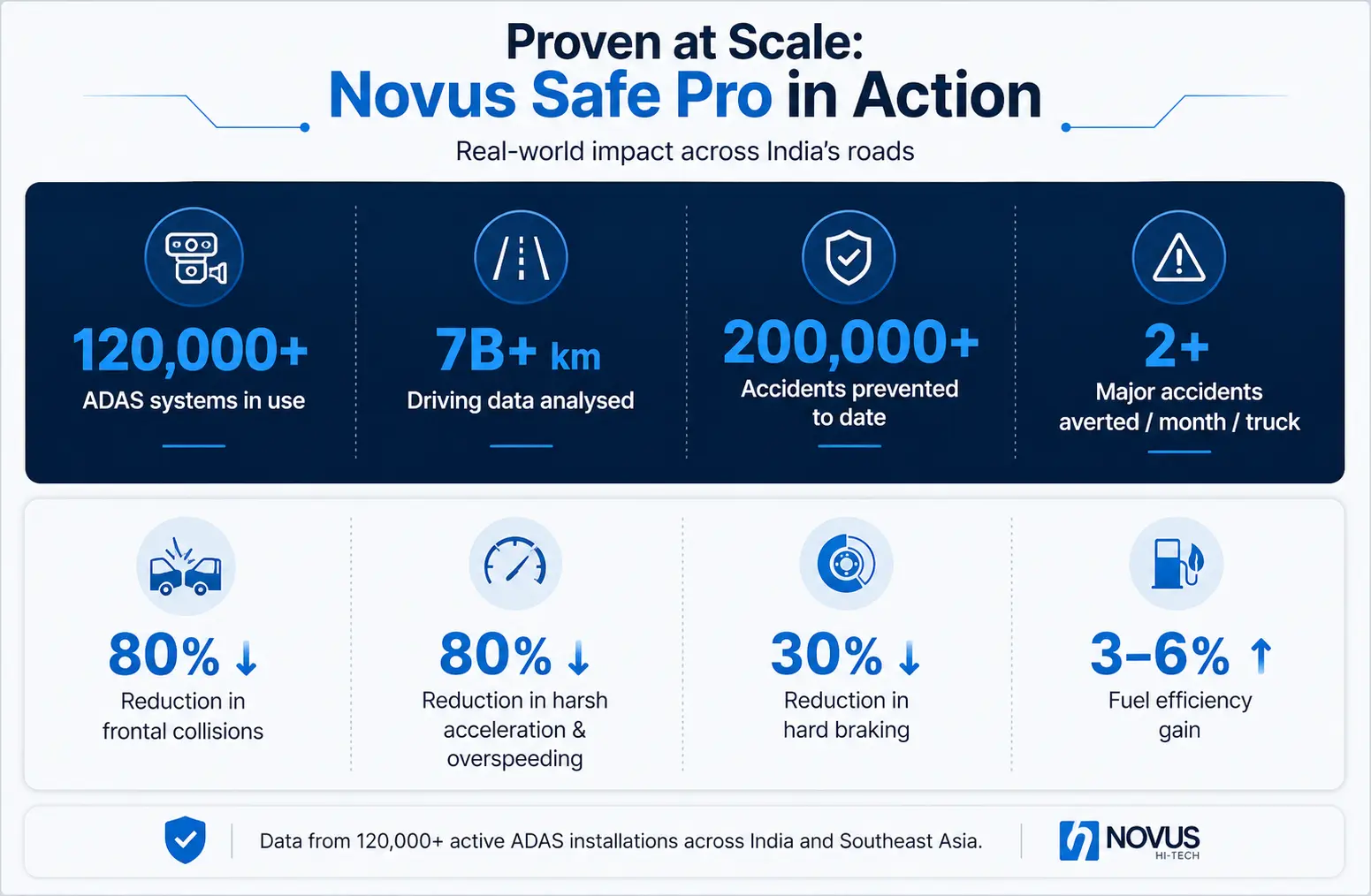
Source: Novus Hi-Tech deployment data across 120,000+ active ADAS installations. Accident prevention metrics are modelled estimates based on incident rate reduction data validated across fleet deployments in India and Southeast Asia.
Fleet ADAS Buying Decision Checklist
Before committing to either deployment path, these questions should be answered with current operational data rather than assumptions.
Fleet Assessment
- What is the average age of your vehicles?
- How many years of useful life remain across the fleet?
- What is the total fleet size, distributed by vehicle type?
- What are your current vehicle replacement cycles?
Operational Assessment
- What do accident trends look like over the last 12 to 24 months?
- Are driver fatigue incidents or near-miss events increasing?
- Have safety compliance requirements tightened in your operating environment?
- Are customers or insurers applying pressure for higher safety standards?
Financial Assessment
- Is fleet replacement financially viable within the current budget cycle?
- What is the available capital or opex budget for safety technology?
- What ROI timeline is acceptable to justify the investment?
The Best ADAS Strategy Depends on Your Fleet, Not the Technology
The retrofit vs OEM question is a fleet strategy question. Both deployment models deliver real safety improvement. The variable is which path fits your fleet’s age, asset economics, deployment timeline, and operational structure.
Retrofit ADAS wins on speed, flexibility, and coverage of the existing fleet. OEM-fit wins on integration depth and long-term standardisation. For most commercial fleets, with mixed vehicle ages, active procurement, and immediate safety pressure, the hybrid approach delivers the highest total safety impact in the shortest time.
What matters is that coverage reaches your drivers now, not after the next procurement cycle completes. The cost of waiting is measurable. The cost of deploying is not.
Ready to Evaluate Your Fleet’s ADAS Strategy?
Not sure which ADAS deployment model fits your fleet? Connect with Novus Hi-Tech’s fleet safety team to evaluate your vehicle mix, operational requirements, and safety goals, and identify the approach that delivers the highest impact for your investment.