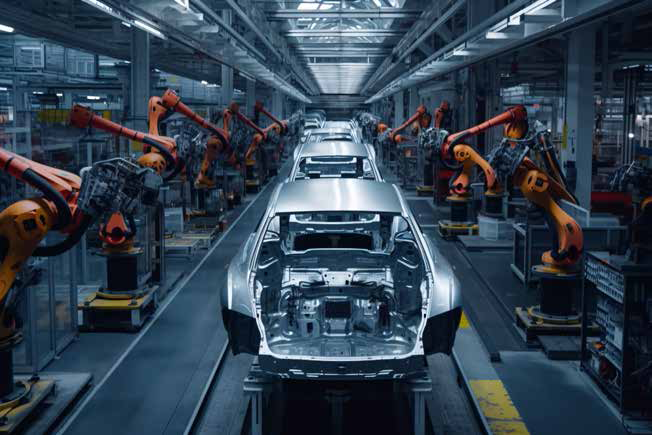


The global robotics industry is revolutionising modern manufacturing, and as we move toward 2026, factories—along with warehouses and automotive industries—are relying on robots more than ever before. The industry is now at a clear inflection point, where automation is no longer a future ambition but a present-day operational priority.
According to MarketsandMarkets, the industrial robotics market is projected to grow to USD 29.43 billion by 2029, a strong indicator of accelerating adoption across global manufacturing and logistics ecosystems.
The resurgence of manufacturing in large economies and the explosion of the global eCommerce market are examples of how quickly today’s world of industrial and warehouse environments are changing. The introduction of smart technologies, advanced sensors, and highly integrated systems, adds to this volume of change, allowing robots to become integrated into the daily operations of businesses in a manner that is far easier than it used to be.
There are many examples of companies from India that are making a name for themselves as leaders in automation for the fastest-growing segments of the economy, such as Novus Hi-Tech.
Global Robotics Market Outlook to 2026
According to the International Federation of Robotics (IFR), industrial and logistics robots are expected to account for nearly 60–65% of total market growth between 2025 and 2026, making factory automation the undisputed epicentre of the robotics revolution.
What makes this growth cycle different from previous ones is where it’s coming from. Two segments: industrial robotics and warehouse robotics — are not just growing; they are redefining the baseline for what modern operations look like.
Whether it’s a Tier 1 automotive supplier running 24/7 robotic welding lines, a mid-sized FMCG manufacturer deploying cobots for packaging, or a large e-commerce fulfilment centre routing orders with autonomous mobile robots (AMRs) and the shift towards automation is happening at every scale and in every geography.
Why Factory Robots Are Dominating Growth
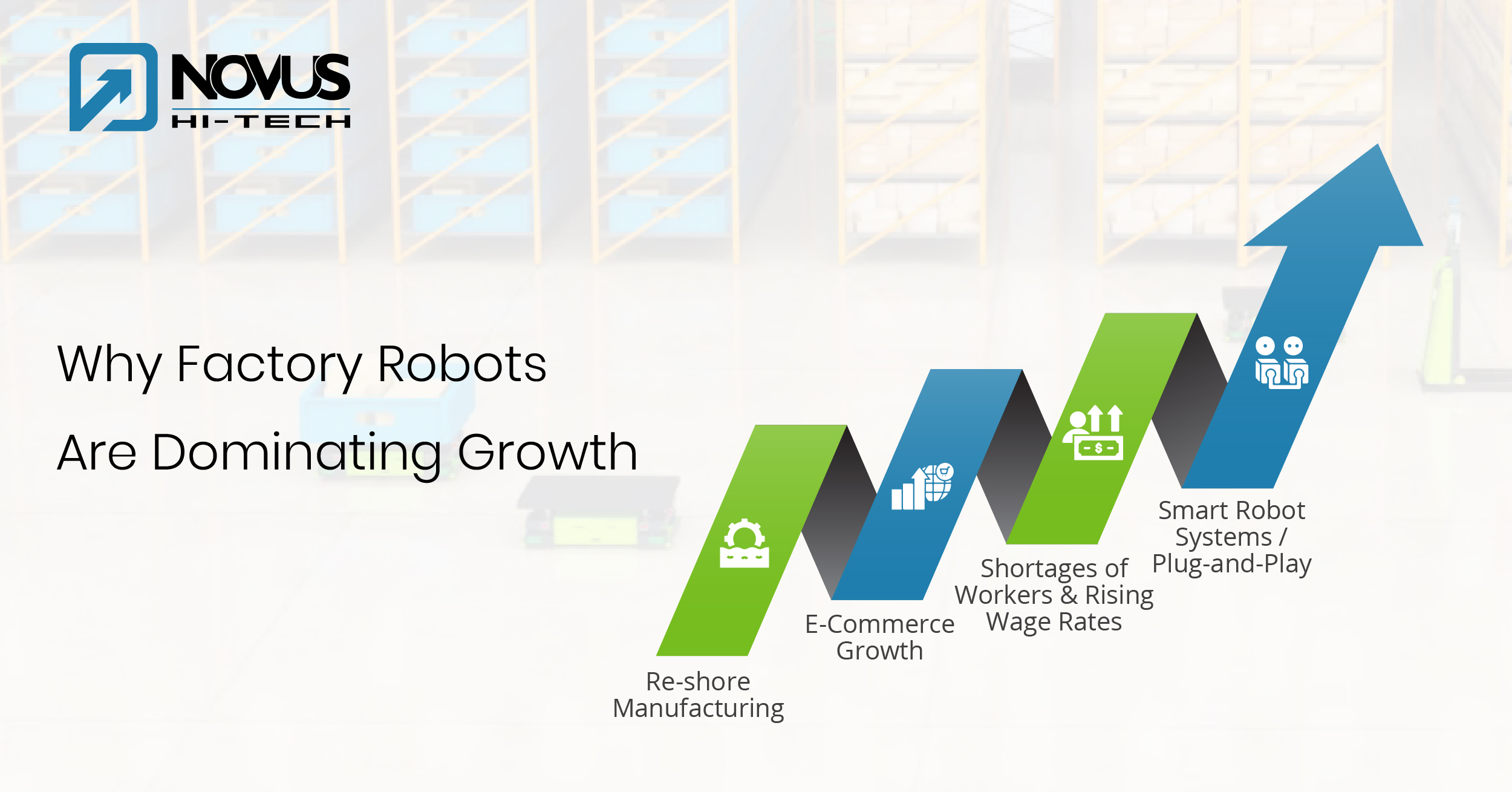
Four macro trends are creating a near-perfect storm of demand for industrial and factory robots in 2026. Understanding them is key to understanding where the market is headed.
1. Re-shore Manufacturing
Geopolitical uncertainty and the supply chain disruptions of the last half-decade have pushed governments and corporations to bring production closer to home. The Deloitte re-shoring report notes a consistent rise in domestic manufacturing investment across the US, Europe, and parts of Asia.
The fastest and most cost-effective way to scale newly re-shored factories? Automation. Re-shoring and robotics are, increasingly, two sides of the same coin.
2. E-Commerce Growth
As more consumers use e-commerce to shop online, there is also an associated increase in the number of orders being shipped, leading to the growth of the warehouse robotics market. Due to the growing popularity of same-day or next-day delivery services, robotic sortation systems ( robots ) and Industrial Robot ( IR ) manipulators are now considered to be essential operating tools for all warehouses.
3. Shortages of Workers & Rising Wage Rates
Finding qualified workers is now a major global issue and the solution to this issue is through increased Automation use by companies. Automation does not replace workers, it fills the gaps that cannot be filled by workers and assists companies to complete monotonous, dangerous, or detail-oriented activities that require a rapid response time.
4. Smart Robot Systems / Plug-and-Play
There are many new technologies available for robots today that will allow a manufacturer to implement a new robotic system without good design of a robotic cell. In addition, internal navigation systems and AI-powered perception enable the installation of robots in as little as one week and can lower the overall cost of installing a robotic system.
Key Segments Driving the 2026 Surge
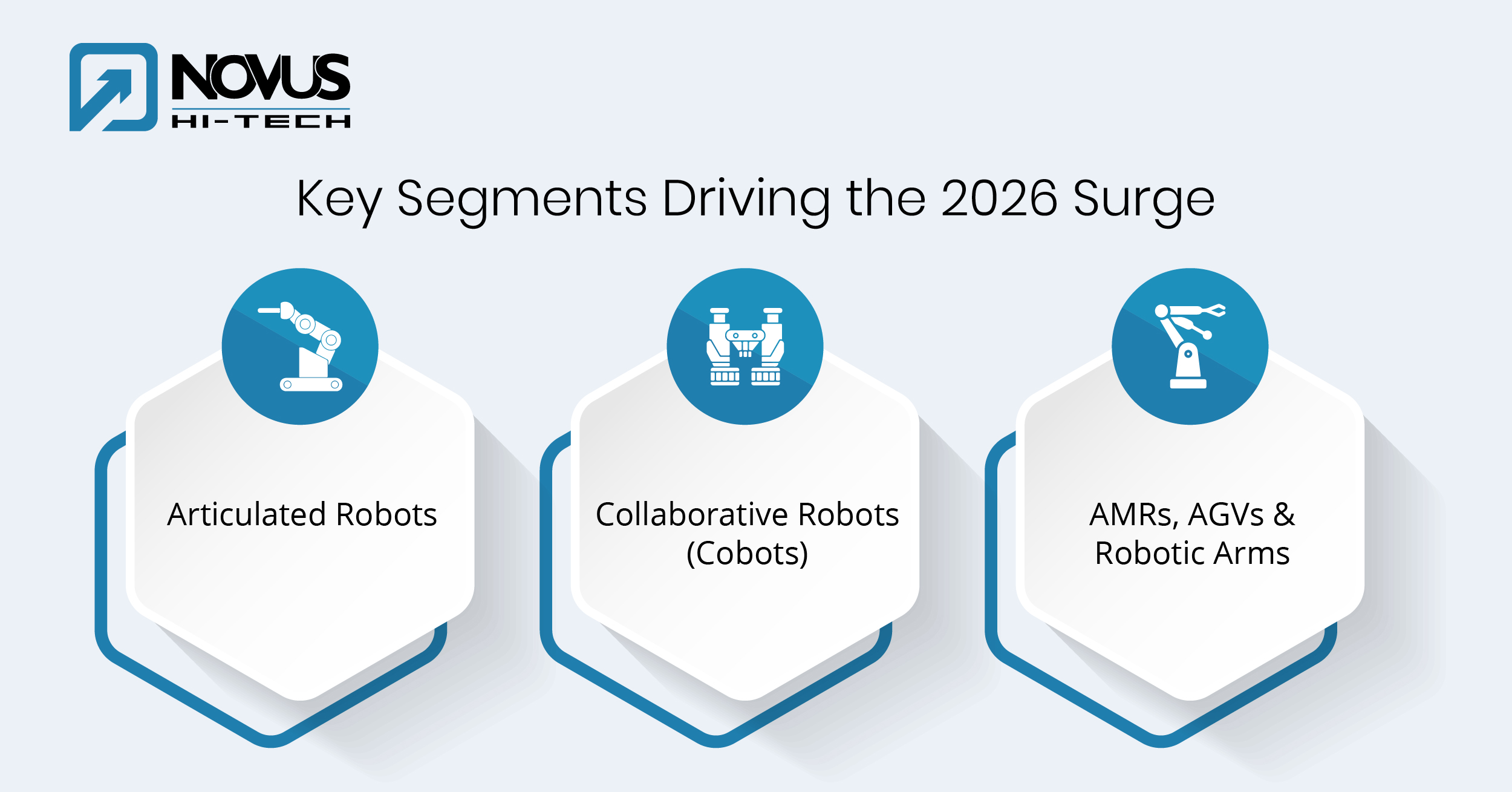
Several categories inside the industrial robotics market and automotive robotics market are growing at record speed. Here are the standouts:
1. Articulated Robots
The workhorse of heavy industry, articulated robots remain dominant in automotive, electronics, and metal processing. Their multi-axis flexibility makes them ideal for welding, assembly, polishing, and material handling. These tasks require precision repeatability at high throughput.
The articulated robot segment is expected to maintain its position as the largest sub-category of the industrial robotics market through 2026, backed by continued automotive investment in Asia-Pacific and Europe.
2. Collaborative Robots (Cobots)
Cobots have become the entry point for SME automation globally and their adoption is accelerating fastest in markets like India. Unlike traditional industrial robots, cobots:
- They don’t need fenced-off areas
- They work alongside humans safely
- They can be deployed quickly with minimal programming
3. AMRs, AGVs & Robotic Arms
Autonomous Mobile Robots (AMRs) and Automated Guided Vehicles (AGVs) are the fastest-growing segment within the warehouse robotics market. Unlike traditional conveyor-based systems, AMRs navigate dynamically using onboard sensors and AI, making them far easier to integrate into existing facilities without infrastructure overhauls.
| Robot Type | Best For | Key Advantage |
|---|---|---|
| Articulated Robot | Welding, assembly, machining | High precision, multi-axis range |
| Cobot | Light assembly, inspection, packaging | Safe human collaboration, fast setup |
| AMR | Goods-to-person picking, internal logistics | Dynamic navigation, no infrastructure change |
| AGV | Fixed-path pallet movement | High payload, proven reliability |
| Robotic Arm | Piece picking, palletising, sorting | Flexible end-effector options |
Regional Leaders in Factory Robotics Adoption
The global rise of factory robots is not evenly spread—some regions are setting the pace faster than others.
Asia-Pacific Leads the Race
China remains the world’s biggest adopter, followed by South Korea and Japan. India is rising fast, backed by:
- Government incentives
- PLI (Production-Linked Incentive) schemes
- The ‘Make in India’ manufacturing push
Europe & North America Stay Dominant
Germany remains a powerhouse in the industrial robotics market, and the USA leads adoption in automotive, warehousing, and high-tech sectors.
India’s Rapid Rise
India is becoming a serious contender, not just as a buyer but also as an automation innovator. Backed by the Government of India’s Production-Linked Incentive (PLI) schemes across 14 sectors including electronics, pharmaceuticals, and auto components and the broader ‘Make in India’ manufacturing push, the Indian factories are embracing AMRs, robotic arms, and cobots at an accelerating pace.
India’s robot installations have grown significantly year-on-year, and with a manufacturing sector increasingly competing for global supply chain contracts, the business case for automation has never been stronger.
Novus Hi-Tech’s Role in the Factory Robotics Revolution
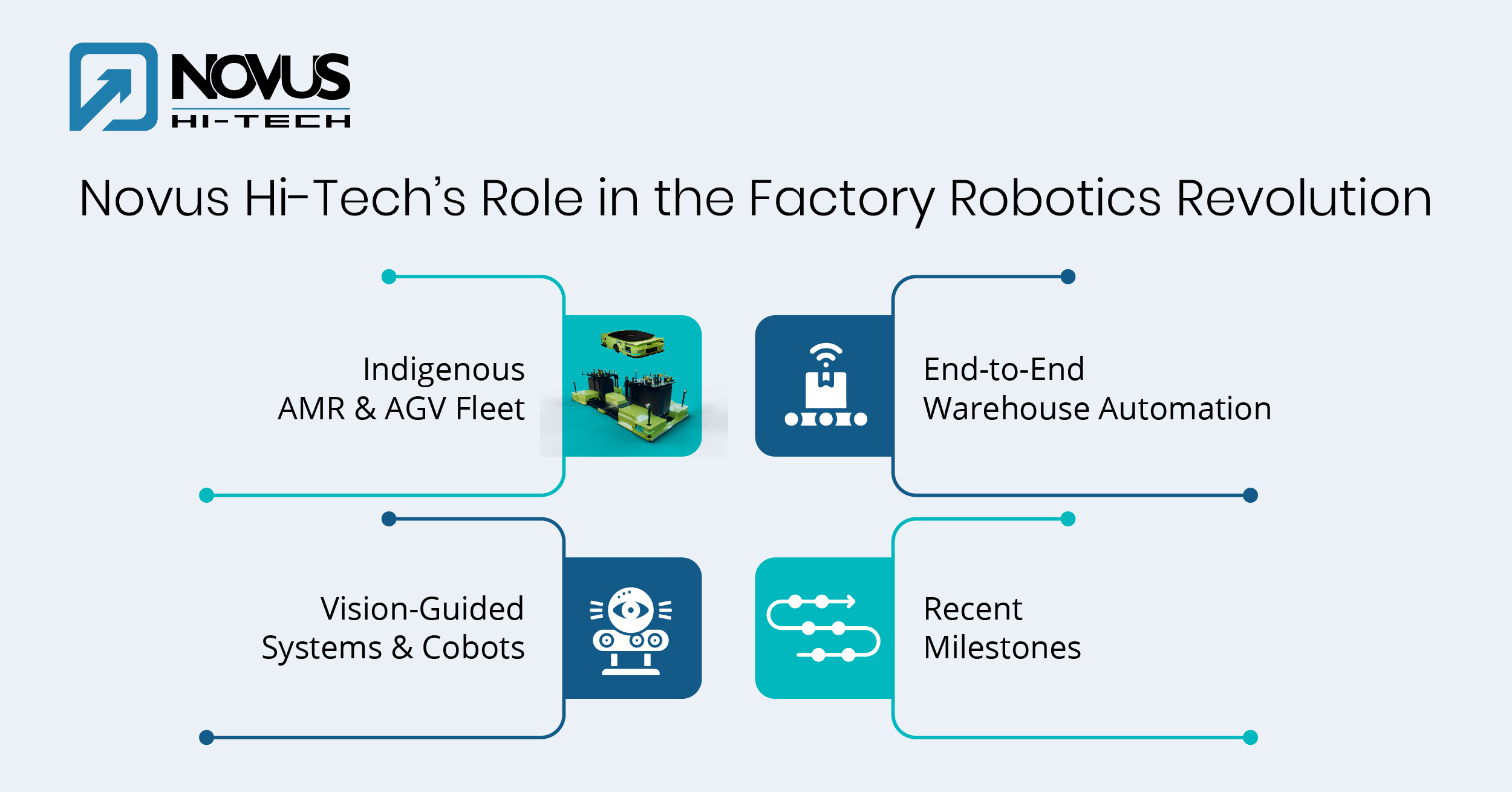
As India’s manufacturing landscape evolves, Novus Hi-Tech is emerging as a major catalyst for change. With a strong focus on R&D and real-world deployment experience, the company is steadily carving its space in both the industrial robotics market and the automotive robotics market.
1. Indigenous AMR & AGV Fleet
Novus Hi-Tech has developed a robust portfolio of Autonomous Mobile Robots and Automated Guided Vehicles that are already being deployed across:
- Automotive plants
- E-commerce fulfilment centres
- Consumer goods facilities
These robots deliver high throughput with 99.99% uptime and consistently low error rates.
2. End-to-End Warehouse Automation
From inbound to dispatch, Novus designs warehouse systems that operate with precision, intelligence, and minimal manual touchpoints.
3. Vision-Guided Systems & Cobots
Their cobots and AI-powered systems can manage tasks like vision picking, quality inspection, and assembly even in dynamic Indian factory environments.
4. Recent Milestones
Some of their notable achievements include:
- Large-scale AMR deployments in automotive hubs
- Partnerships with global logistics giants
- Rapid expansions into electronics and FMCG sectors
Future Outlook Beyond 2026
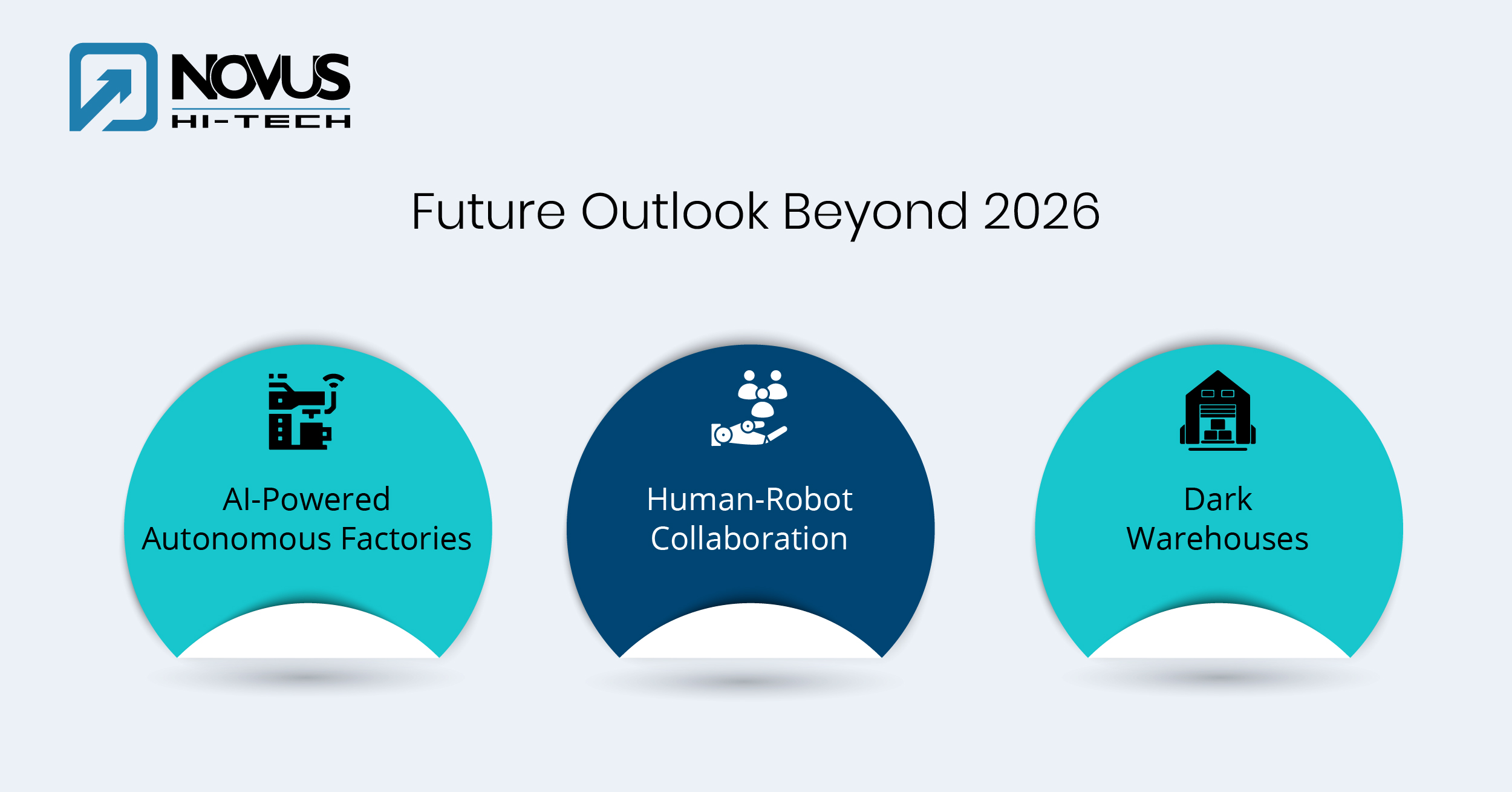
While 2026 is set to mark a defining moment for the global robotics market, the story doesn’t end there. A far more intelligent, autonomous future lies ahead.
AI-Powered Autonomous Factories
By 2030, factories will be capable of running end-to-end operations with minimal human intervention.
Human-Robot Collaboration
Cobots will move beyond assistance—they’ll truly collaborate. They’ll understand context, anticipate issues, and adapt just like human co-workers.
Dark Warehouses
These 24/7, zero-light facilities will become a norm as businesses chase maximum efficiency and minimum operational costs.
Conclusion
In 2026, the Key contributors are planning to reshape the worldwide automation market with Industrial robotics market, warehouse robotics market, and automotive robotics market. Global companies are taking quick steps to implement modernisation through agile, innovative and cost-efficient partnerships. Novus Hi-Tech sets itself apart in this area.
Novus provides the technology, experience and dependability for your robot-first era, from production expansion and material handling automation to implementing the next generation of fulfillment operations.
Are you ready to implement automation at your facility?
Contact the Novus Hi-Tech team to set up a custom online demonstration.