
India is in the middle of the most ambitious energy infrastructure expansion in its history. With the Ministry of New and Renewable Energy (MNRE) targeting 500 GW of renewable energy capacity by 2030 and solar at the core of that mission, the country has moved decisively to build domestic solar manufacturing capability at scale.
Solar PV manufacturing in India has crossed a critical threshold. India’s installed solar capacity crossed 100 GW in January 2025 and has since reached 132.85 GW as of November 2025, a 41% year-on-year increase, placing the country third globally in solar power installed capacity (MNRE, 2025). The Production Linked Incentive (PLI) scheme has catalysed gigawatt-scale factory investments across Gujarat, Rajasthan, and Tamil Nadu, drawing long-term capital into domestic module production for the first time.
But building capacity and operating it reliably are two different challenges. As India’s solar factories scale from hundreds of megawatts to multiple gigawatts, the limits of manual production are becoming clear. This guide maps exactly where factory automation creates the greatest value across the solar PV production line and where Indian manufacturers should invest first.
Why Solar Panel Manufacturing in India Is at an Inflection Point
Solar panel manufacturing in India has undergone a structural transformation since 2022. Before the PLI scheme, the country sourced the majority of its modules from imports, leaving the domestic industry exposed to global supply chain disruptions and volatile pricing.
The PLI scheme for High Efficiency Solar PV Modules changed this. Phase 1 of the scheme incentivised approximately 10 GW of new domestic manufacturing capacity, bringing major investment from solar PV modules manufacturers in India including Waaree Energies, Adani Solar, Vikram Solar, and Goldi Solar. With Phase 2 extending this further, India is now building a manufacturing base designed to serve both domestic demand and export markets.
The pace of factory commissioning is accelerating. Yet the rapid shift from import dependence to domestic scale production has exposed a production quality challenge that capacity announcements alone do not resolve. At gigafactory volumes, manual-led operations cannot deliver the throughput consistency that PLI output targets demand.
The inflection point is here. The question facing Indian solar manufacturers is no longer whether to automate, but where to start.
The Solar PV Manufacturing Process: From Silicon to Finished Module
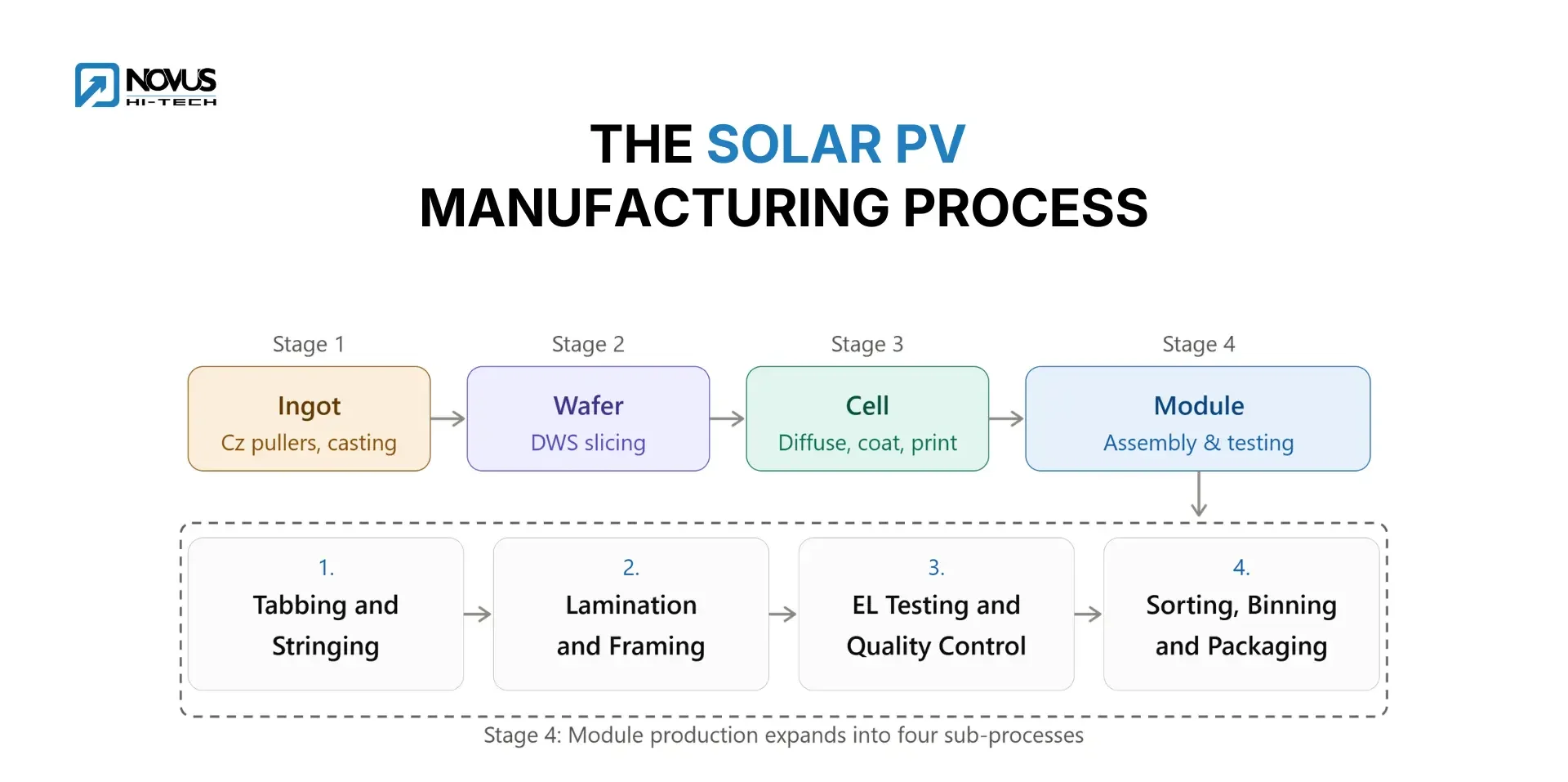
Understanding where automation fits in solar PV manufacturing begins with mapping the full production process. A solar module moves through four primary stages, from raw polysilicon to a finished, dispatch-ready product.
Stage 1: Ingot Production
Polysilicon is melted and cast into monocrystalline or multicrystalline ingots using Czochralski (Cz) pullers or directional solidification furnaces. This is the foundational step where raw material quality here determines the efficiency ceiling of every component downstream. Handling stress during ingot transfer is a primary source of structural damage before wafer slicing begins.
Stage 2: Wafer Production
Ingots are cropped, squared, and ground before being sliced into wafers at thicknesses of 160 to 180 microns using diamond wire saws (DWS). Wafers are then cleaned, inspected, and sorted. Vibration and inconsistent carrier handling during inter-station transfer are the primary sources of micro-crack introduction at this stage.
Stage 3: Cell Production
Wafers undergo a multi-step fabrication process like texturing, diffusion, tunnel oxide and poly-Si deposition, anti-reflection coating, and metal contact printing to become photovoltaic cells. For TOPCon cells, this includes additional ALD, SiNx deposition, and LECO sorting steps. Precision requirements here are extremely high; any contamination or handling error directly reduces cell conversion efficiency.
Stage 4: Module Production
This is the most process-intensive stage, encompassing several sub-processes that convert individual cells into a finished, tested module:
- Tabbing and Stringing: Cells are soldered into strings using copper ribbons. Handling inconsistency here directly affects long-term module efficiency and structural integrity.
- Lamination and Framing: Cell strings are layered between glass, EVA film, and backsheet, then laminated under heat and pressure. An aluminium frame completes the module.
- EL Testing and Quality Control: Each module undergoes electroluminescence (EL) imaging to detect internal micro-cracks and IV curve testing to classify modules by power output bin. This is where all upstream handling damage becomes visible — after significant production value has already been added.
- Sorting, Binning, and Packaging: Modules are sorted by wattage tolerance, labelled, palletised, and prepared for dispatch.
Manual operations remain most prevalent at wafer carrier transfer points, cell cassette movement between fabrication stations, and the intralogistics connecting all four stages. These are the highest-risk points for quality variation and throughput loss at scale.
Manufacturing Challenges Driving Automation Adoption
Scaling solar PV manufacturing in India is as much a quality and consistency challenge as it is a capacity one.
At gigafactory volumes, even a small defect rate translates to a significant number of rejected modules each week. Manual handling at fragile-material stages particularly wafer transfer and cell cassette movement introduces micro-crack risks that only surface during EL testing, after significant production value has already been added to the product.
Shift-to-shift handling inconsistency and workforce availability create throughput variance that manual supervision cannot fully resolve. Indian manufacturers operating under PLI output commitments need production systems that deliver predictable throughput independently of daily workforce variables.
Rising skilled technician wages across the solar manufacturing sector are also narrowing the labour cost advantage that has traditionally slowed the automation investment case in India. The economics are shifting, and factory automation investment is responding.
Talk to Novus Hi-Tech’s solar automation team about your factory requirements →
5 Automation Use Cases Transforming Solar Module Manufacturing
Solar module manufacturing does not require full-line automation to deliver significant results. The following five use cases represent the highest-impact touchpoints for Indian solar factories, covering Novus Hi-Tech’s deployed application areas from wafer to dispatch.
1. Wafer Carrier Handling: Protecting the Most Fragile Stage
Silicon wafers at 160 to 180 microns thick are the most fragile component on the production line. Manual carrier movement between fabrication stations introduces vibration and contact risks that generate micro-cracks before cell fabrication even begins.
AMRs designed for wafer carrier transport navigate factory floors with controlled, smooth movement profiles, eliminating the inconsistency of manual transfer. This reduces pre-cell micro-crack incidence and stabilises input quality into the cell fabrication stage where consistency has a direct impact on final module efficiency ratings.
2. Cell Cassette Handling: Keeping Cell-to-Module Flow Uninterrupted
After cell fabrication, solar cells move between furnaces, testing, and tabbing stations in cassettes. Delays in cassette transfer create thermal queue issues and disrupt stringing line throughput. Shift changes and workforce gaps are the most common causes of this disruption.
Automated cassette handling maintains a consistent inter-station cadence regardless of workforce variables. The result is a more stable stringing line and a measurable reduction in WIP queue buildup between production stages.
3. Intra-Factory Material Handling: The Bottleneck Most Plants Overlook
In a 1 GW facility, the volume of WIP, consumables, and finished goods moving across the production floor each shift is substantial. Fixed conveyor systems lock in layout constraints and require costly retrofitting when production sequences change.
AMRs handle inter-zone transport flexibly, adapting to floor layout adjustments without civil work. Novus Hi-Tech deployments in solar manufacturing environments have recorded up to 30% reduction in material movement costs and up to 30% improvement in overall productivity.
4. Pallet Handling: Moving Finished Modules to Dispatch Without Damage
A finished solar module weighs between 20 and 25 kg. At the dispatch end of the line, manual forklift handling introduces corner-chip damage and inconsistent stacking pressure that can compromise modules after quality testing has been completed and passed.
Automated pallet handling systems such as the Novus P-Mover maintain consistent stacking force and eliminate the product damage risk associated with manual handling at the highest-value point in the production cycle.
5. Automated Trolley and Conveyor Transfer Systems
Between lamination, framing, and testing, trolley-mounted WIP buffers accumulate during shift transitions in Indian solar plants. Manual trolley movement in high-traffic floor zones is a documented source of safety incidents.
Automated trolley transfer systems keep mid-line buffers moving regardless of shift patterns, removing manual operators from hazardous floor areas. Novus Hi-Tech solar factory deployments report 100% improvement in floor safety compliance following the implementation of automated trolley transfer.
India’s Solar Gigafactory Build-Out: Why Automation Is Now Infrastructure
India’s solar gigafactory pipeline has crossed the scale threshold at which automation is no longer an efficiency upgrade. It is a foundational production infrastructure.
PLI scheme output commitments are financial obligations tied to incentive disbursement. Missing production milestones carries direct financial consequences for participating manufacturers. Production systems that depend on workforce consistency and manual handling quality cannot reliably meet those commitments at gigafactory scale.
Indian solar manufacturers are building at a pace and scale that manual production systems were not designed to sustain. The companies that will meet their PLI commitments are the ones that have built automation into their factory design from day one, not retrofitted it after the line is already running.
– Sachin Lendghar, Novus Hi-Tech
The solar gigafactory India is building today will define the country’s renewable energy cost competitiveness for the next decade. Getting the production model right at the build-out stage is significantly less costly than correcting it at operational scale, when every hour of downtime has a PLI milestone attached to it.
Solar Manufacturing Automation: The ROI Case for Indian Plants
The most common objection to solar manufacturing automation in India is the relative cost advantage of manual labour compared to Western markets. This framing misidentifies where the actual return on investment is generated.
For Indian solar manufacturers, automation ROI comes from three primary sources. First, quality consistency: reducing module rejection rates and rework costs associated with defects introduced at manual handling stages. Second, throughput predictability: maintaining output targets through shift transitions, absenteeism, and workforce scaling challenges. Third, safety compliance: reducing incident risk and associated liability in high-volume, fragile-material handling environments.
Targeted automation at logistics and material handling touchpoints the highest-ROI and lowest-risk starting point typically achieves payback within 24 to 36 months in Indian manufacturing environments. Full-line automation timelines depend on production volume maturity and plant configuration.
As skilled technician wages in the solar sector continue to rise with sector growth, the ROI case for automation strengthens with each successive PLI cycle.
What Every Solar PV Module Manufacturer in India Should Automate First
For any solar PV module manufacturer in India evaluating a first automation investment, sequencing matters as much as technology selection.
Phase 1 Start with logistics:
Intra-factory material handling, wafer carrier transport, and cell cassette handling deliver measurable ROI with minimal production line disruption and no requirement for permanent civil work. These are the lowest-risk, highest-return starting points.
Phase 2 Add dispatch-end automation:
Pallet handling and trolley transfer systems scale directly with production throughput. Implement these as output volumes grow and dispatch-end handling becomes a daily bottleneck.
Phase 3 Integrate with production systems:
Connect the AMR fleet management layer with existing MES and SCADA systems for full floor visibility. Lock in navigation lane planning before factory civil work is finalised, retrofitting navigation infrastructure after construction is significantly more expensive.
Conclusion
Solar PV manufacturing in India is entering its most consequential decade. The manufacturers that will lead the sector in 2030 are not simply the ones investing in capacity. They are the ones building production systems capable of delivering that capacity reliably, consistently, and competitively under PLI timelines.
Automation, deployed strategically across the solar module manufacturing line, is how Indian solar manufacturers bridge the gap between committed output and delivered performance.
Novus Hi-Tech’s solar factory automation solutions span wafer carrier handling, cell cassette transfer, intra-factory logistics, pallet handling, and trolley transfer deployed across live solar manufacturing environments in India, with over 1,200 deployments and 8 million kilometres of autonomous operation across industries.
Transform Your Solar Gigafactory with Smart Automation
Discover how automation technologies can streamline material movement, improve efficiency, and support scalable solar PV production.
Connect with Our Automation Experts