
India’s production plants and logistics centers are running out of hands, not out of demand. E-commerce order volumes keep climbing, industrial output is expanding under the PLI push, and skilled operators are harder to hire and retain in almost every industrial cluster. Mobile robots in India, specifically AMRs and AGVs, have become one of the fastest ways to close that gap without redesigning an entire plant floor.
This guide was compiled after reviewing leading mobile robot manufacturers in India across their product portfolios, deployment capabilities, public customer references, patents, and industry use cases. It’s intended to help manufacturers, warehouse operators, and system integrators compare vendors on technical capability rather than marketing claims.
What Are Mobile Robots (AMRs and AGVs) in India, and What Types Exist
Mobile robots move materials, pallets, carts, and finished goods across a site without a human driver. Two broad categories cover most rollouts in India today. Automated Guided Vehicles (AGVs) follow fixed paths, usually magnetic tape, wires, or floor markers, making them reliable and cost-effective for stable, repetitive routes. Autonomous Mobile Robots (AMRs) use sensors, LiDAR, and SLAM-based navigation to move dynamically. They reroute around obstacles, work alongside people, and adapt when a layout changes, which is why most operations adding automation in phases now default to AMRs over AGVs.
Types of Mobile Robots by Function
Within AMRs and AGVs, manufacturers typically build toward one or more functional categories:
| Robot Type | Function | Common Use Case |
| Tugger/tow robot | Pulls trolleys or carts along a route | Line-side parts delivery in automotive plants |
| Unit-load carrier | Carries a single pallet or large load on its deck | Pallet movement between dock and storage |
| Autonomous forklift | Lifts and stacks palletized loads | Warehouse putaway and retrieval |
| Pallet jack/mover | Moves palletized goods at floor level | Short-distance intralogistics |
| Sortation robot | Sorts parcels or totes into bins or racks | E-commerce and quick-commerce fulfilment |
| Dock-and-convey robot | Interfaces with conveyors or AS/RS | Automated handoff between systems |
Best Mobile Robot Companies in India (2026) at a Glance
| Mobile Robot Manufacturers | Core Specialization | Best For |
| Novus Hi-Tech | AMR, AGV, autonomous forklifts, ADAS/DMS | Cross-sector deployments, automotive, India + SEA expansion |
| Addverb Technologies | AMR, AS/RS, sortation | Large-scale warehousing and e-commerce |
| GreyOrange | Goods-to-person AMRs, orchestration software | Retail and 3PL fulfilment |
| Ati Motors (Ati Robotics) | Heavy-payload tuggers and pallet movers | Automotive and appliance manufacturing |
| ANSCER Robotics | AMR for internal logistics | Manufacturing material movement |
| Unbox Robotics | Vertical sortation AMRs | Quick commerce and parcel sorting |
| Hachidori Robotics | AMR with indoor-positioning navigation | Multi-sector intralogistics |
| Simplex Robotics | Intralogistics AMR/AGV | Warehousing and distribution |
| DiFACTO Robotics and Automation | Robotic arms and AMR | Broader factory automation |
| Goat Robotics | Pallet truck and tow truck AMRs | Mid-size industrial facilities |
How to Evaluate a Mobile Robot Manufacturer
Before comparing brands, it helps to know what separates a strong manufacturer from a reseller repackaging someone else’s hardware. Run any shortlist through this checklist:
- Navigation technology – Proprietary SLAM/vision stack vs. licensed third-party software
- Payload range – Does it match your heaviest and lightest loads?
- Fleet management system – Can it coordinate multiple robots and integrate with your WMS/ERP?
- Local service network – Spare parts, uptime SLAs, and response time in your region
- Compliance and safety certification – Relevant industrial safety standards for your sector
- Track record – Verified installations in your industry, not just case studies
- Total cost of ownership – RaaS vs. outright purchase over 3 to 5 years
A manufacturer that builds its own navigation stack and hardware, rather than white-labeling, generally offers better long-term support and faster fixes when something goes wrong on the floor.
How Much Does a Mobile Robot Cost in India?
Pricing varies widely by robot type, payload, and navigation technology. As a general reference point, AMRs in India typically run from roughly ₹25 lakh to ₹70 lakh per unit, with forklift AMRs sitting at the higher end due to their sensor load and lifting hardware. AGVs are usually cheaper per unit upfront but often carry added infrastructure costs for tape, wiring, or reflector installation across a site.
A Robotics-as-a-Service (RaaS) model is worth considering if you want to avoid a large upfront outlay, since it spreads cost into a subscription and shifts maintenance onto the vendor. For a fuller breakdown of unit costs, integration spend, and payback timelines, see this detailed AMR cost and ROI guide.
Top 10 Mobile Robot Manufacturers in India (2026)
Here’s a closer look at ten established and emerging mobile robot companies in India shaping the market. This list isn’t exhaustive, and it’s worth requesting a live demo and reference checks from any vendor before committing.
1. Novus Hi-Tech
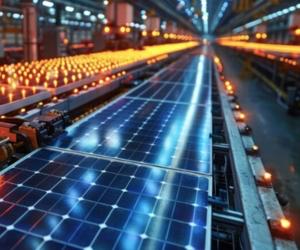
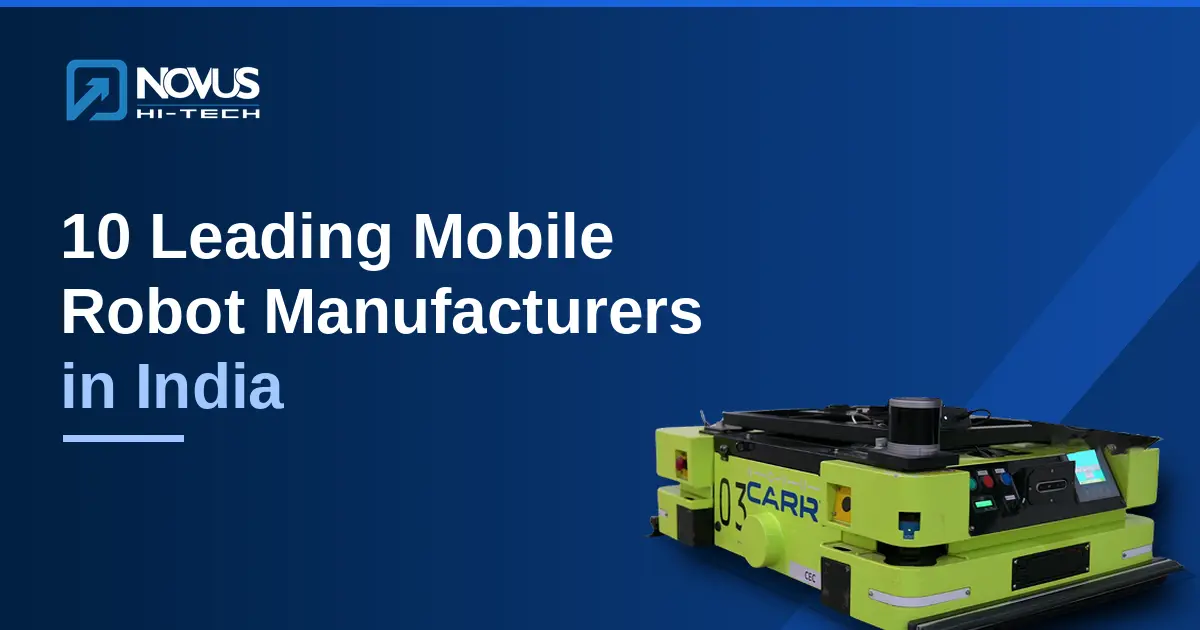
Novus Hi-Tech is one of India’s leading mobile robot manufacturers, delivering mobile robots including autonomous mobile robots (AMRs), AGVs, autonomous forklifts, and intelligent intralogistics solutions through its P-Mover platform and Carry series robots. The company also develops ADAS, DMS, and fleet safety solutions, along with automation systems for solar PV manufacturing.
With a growing global footprint spanning India, Southeast Asia (SEA), the Middle East, and North America, Novus Hi-Tech works with manufacturers, warehouses, logistics operators, and system integrators to accelerate industrial automation and smart mobility initiatives worldwide. Backed by 1,400+ mobile robots deployed, 150+ patents, and over 10 million kilometers of autonomous navigation across industrial and commercial environments, the company has earned the trust of leading brands such as Vinfast, Mondelez, Daikin, Volvo Eicher, Daimler, Asian Paints, and John Deere.
2. Addverb Technologies
Addverb operates one of India’s largest robotics production capacities. Its portfolio spans AMRs, AS/RS, and sortation robots, built for high-throughput e-commerce and large-format distribution centers.
3. GreyOrange
One of India’s original deep-tech robotics companies, GreyOrange is known for its goods-to-person robot fleets paired with fulfilment-orchestration software. It has since expanded into a multinational operation serving retail, e-commerce, and 3PL clients globally.
4. Ati Motors (Ati Robotics)
Incubated at the Indian Institute of Science and founded in 2017, Ati Motors, now operating as Ati Robotics, builds the Sherpa line of AMRs, including heavy-duty tuggers and pallet movers used across automotive, appliance, and electronics manufacturing.
5. ANSCER Robotics
A newer entrant focused specifically on AMRs, ANSCER has built a patented mobile robot platform aimed at internal logistics and repetitive material movement tasks in manufacturing environments.
6. Unbox Robotics
Unbox Robotics builds AI-powered vertical sortation systems, including its UnboxSort platform, using swarm-intelligence-based AMRs suited to high-volume parcel sorting for e-commerce and logistics operators.
7. Hachidori Robotics
Hachidori Robotics manufactures AMRs for unit-load transport, tugging, pallet movement, and dock-and-convey applications, with patented indoor-positioning navigation aimed at reducing infrastructure changes during rollout.
8. Simplex Robotics
Simplex Robotics builds intralogistics-focused AMRs and AGVs for distribution and production environments across India.
9. DiFACTO Robotics and Automation
DiFACTO offers a growing AMR line alongside robotic arms, positioned within India’s wider factory automation ecosystem.
10. Goat Robotics
Goat Robotics offers pallet truck and outdoor tow truck AMRs, with a focus on simplifying rollout for mid-size industrial operations.
Industry Use Cases Driving Mobile Robot Adoption in India
Mobile robots aren’t limited to one type of site. Demand in India spans several sectors, largely centered on material handling automation and broader intralogistics needs:
- E-commerce and quick commerce: order picking, sortation, and last-mile staging in dark stores and fulfilment hubs
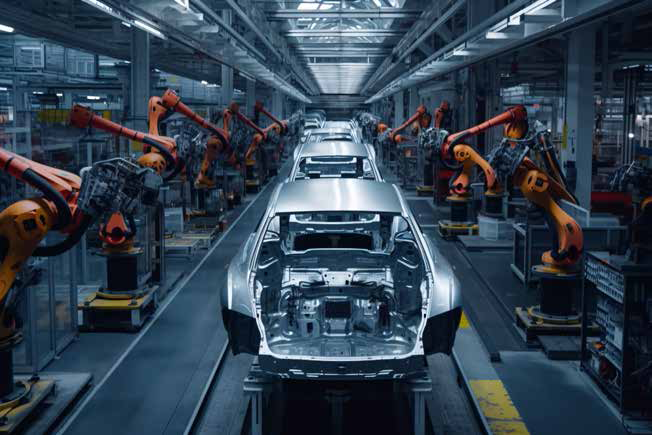
- Automotive and heavy industry: line-side material delivery, kitting, and finished-goods movement
- Pharma production: contamination-sensitive material transport with auditable movement logs
- Data centers: predictable, repeatable transport of equipment and components in controlled environments
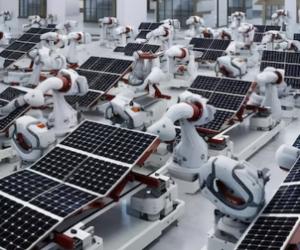
- Solar and electronics production: precision material handling in cleanroom-adjacent environments
Why Indian Manufacturers Are Becoming Global Players
India’s push into mobile robotics isn’t happening in isolation from its broader industrial policy. India ranks seventh worldwide for annual industrial robot installations, according to the International Federation of Robotics’ World Robotics 2024 report. Government programs are a direct driver of this: the Production Linked Incentive scheme, launched in 2020 with a $24 billion budget across 14 sectors, has pushed sustained investment into electronics, automation, and precision engineering, the same building blocks that go into AMR and AGV hardware.
The India-specific autonomous mobile robots market reflects this momentum. It reached roughly USD 153 million in 2025 and is projected to grow at a CAGR of around 15% through 2034, a pace consistent with rising labor costs, e-commerce expansion, and warehouse automation adoption across the country. As global manufacturers diversify supply chains beyond a single country of origin, Indian mobile robot companies are increasingly positioned to supply not just the domestic market but neighboring regions such as Southeast Asia and the Middle East, where automation adoption is following a similar curve a few years behind.
How to Choose the Right Mobile Robot Manufacturer for Your Facility
There’s no single best mobile robot manufacturer for every use case. The right fit depends on:
- Facility layout stability: Frequently changing layouts favor AMRs over AGVs.
- Payload and throughput needs: Match robot capacity to your heaviest regular load, not your average one.
- Integration requirements: Confirm the fleet software connects cleanly with your existing WMS or ERP.
- Local support footprint: Ask how quickly a technician can be on-site if a robot goes down.
- Commercial model: RaaS suits facilities wanting to avoid upfront CapEx; outright purchase can be cheaper over a 5-year horizon at scale.
- Proof of deployment: Ask for reference sites in your specific industry, not just a general case study.
Where India’s Mobile Robotics Market Is Headed
India’s mobile robotics market is shifting from single-robot pilots toward fleet-level rollouts coordinated through what the industry increasingly calls a physical AI or embodied intelligence stack, where perception, navigation, and fleet orchestration work together across multiple robot types on one floor. Manufacturers that can support mixed fleets, integrate with existing plant systems, and provide dependable local service are likely to pull ahead of vendors offering hardware alone.
Indian mobile robot companies are also starting to look outward. Alongside domestic demand, players like Novus Hi-Tech are building a presence in Southeast Asia, where producers and system integrators face similar labor and throughput pressures but are earlier in their automation adoption curve.
Final Takeaway
Choosing a mobile robot manufacturer in India in 2026 is less about picking the biggest name and more about matching a vendor’s navigation technology, fleet management capability, and local service network to your specific operation. Shortlist two or three companies whose track record matches your industry, request live reference checks, and evaluate total cost of ownership over at least a 3 to 5-year window before signing on. Explore smart factory solutions and manufacturing automation approaches that fit your specific production environment before making a final call.