
As warehouses become more automated, the software stack behind them becomes more complicated. A WMS handles inventory and orders. WES coordinates work across people and machines. A WCS runs conveyors, sorters, and other automated equipment. Each system has a place, but it is the point between one and another that is the complication.
But there’s a new question: what if people, forklifts, and robots all have to make decisions in the same physical space, at the same time?
This is where the traditional WMS vs WES vs WCS conversation begins to evolve.
According to Grand View Research, the global warehouse execution system market was valued at USD 1.6 billion in 2024 and is projected to reach USD 4.3 billion by 2030.
This guide breaks down what each system does, how the three layers work together, and where physical AI orchestration fits into the modern warehouse software stack.
Why WMS vs WES vs WCS Confuses Everyone
Ten years ago, most warehouses operated on one system and a lot of manual labor. Today’s floor is conveyors, sortation, AMRs, pick-to-light, and a workforce that’s harder to staff every quarter.
India’s warehouse automation market is also gaining momentum. JLL projects India to be among the top six users of warehouse automation systems globally by 2026, with the market expected to reach $2 billion annually.
Each piece of that operation requires software written to do a particular job.
WMS, WES, and WCS are not three different versions of the same product. They are three levels of the same stack. The levels solve the problem that the one above cannot solve.
Skip a layer the floor really needs, or buy one that overlaps what’s already running, and the cracks show up fast: stalled totes, idle robots, and a floor team that stops trusting the dashboard.
What is Warehouse Management Software (WMS)?
A WMS is the top layer. It runs the warehouse from a planning standpoint.
A warehouse management software system owns:
- Inventory tracking: what’s on hand and exactly where it’s sitting
- Order processing: turning a sales order into a pick, pack, and ship job
- Labor management: assigning work to the team
- Receiving and putaway: logging inbound freight and slotting it
- Reporting: the numbers ops leadership pulls every week
A WMS decides what needs to get done. It doesn’t route a conveyor or dispatch a robot. That’s not its layer.
If a floor runs mostly manually, with scanners and forklifts and no serious automation, a strong WMS can carry the whole operation on its own.
The global WMS market was valued at $4.57 billion in 2025 and is projected to reach $10.04 billion by 2030, growing at a 17.1% CAGR, according to MarketsandMarkets.
What Is a WES (Warehouse Execution System)?
A warehouse execution system sits one layer below the WMS. Its entire purpose is real-time coordination.
A WES takes the plan from the WMS and figures out the fastest path to execute it, across people and machines together. It:
- Sequences tasks so labor and automation aren’t competing for the same work
- Balances load across pickers, robots, and conveyor lines
- Reacts instantly to a rush order, a jam, or a callout
- Gives floor managers live visibility into what’s happening right now
Simple way to remember the split: WMS plans the day. WES runs the next five minutes.
Warehouses added a WES layer because most floors now mix manual labor with automation. Something has to keep both moving in sync, and that job doesn’t belong to the WMS or the equipment itself.
AMRs are a good example of this in practice, and Novus Hi-Tech has a closer look at how they plug into warehouse systems for real-time material movement.
What Is a WCS (Warehouse Control System)?
A warehouse control system is the layer closest to the hardware.
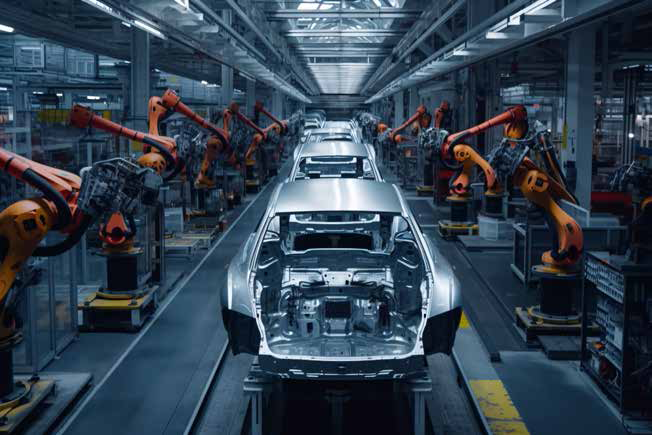
A WCS talks straight to the equipment: conveyors, sorters, carousels, AS/RS units, and robotic arms. It handles:
- Routing totes and pallets through physical equipment
- Triggering motors, sensors, and diverters at the right split second
- Containing a jam on one line so it doesn’t take down the whole floor
- Feeding equipment status back up to the WES and WMS
Any warehouse running serious automation needs a WCS. Without it, that equipment has no traffic controller, and every conveyor decision falls back on guesswork.
When robots and people share the same physical space, a physical AI orchestration layer can complement the WES and WCS by managing dynamic movement and real-time decisions.
The Next Layer: Physical AI Orchestration
Today’s floor may include AMRs, autonomous forklifts, pickers, and conveyors operating at the same time. A WES can coordinate tasks and resources, while a WCS can control fixed automation. But mobile robots and people also need to navigate changing conditions, avoid conflicts, and adjust their movements in real time.
That’s where Novus Brain fits as a physical AI orchestration layer alongside WES and WCS.
Where a WES coordinates task execution and a WCS controls fixed equipment, Novus Brain focuses on the physical layer itself: coordinating AMRs, forklifts, and floor workers as they move through shared spaces. It enables real-time decisions around routing, safety, and priority as conditions on the floor change.
It’s the physical intelligence layer that links task-level orchestration with what’s happening in the physical environment of the warehouse
For a deeper look at how physical AI enables robots to adapt to changing warehouse conditions, see Novus Hi-Tech’s What Is Physical AI? How It’s Transforming Operations explains how autonomous systems can navigate dynamically, reprioritize tasks, and coordinate material flow.
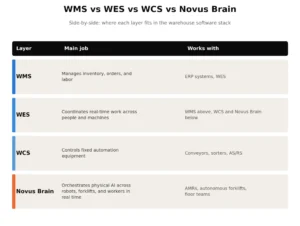
That’s what the modern warehouse software stack looks like in practice: WMS takes care of planning and management, WES takes care of coordination of execution, WCS takes care of control of fixed automation, and physical AI orchestration takes care of dynamic movement across the physical floor.
These layers combine to form a connected path from what needs to happen to how it is actually done in the real world
How Warehouse Orchestration Ties It All Together
This same hierarchy holds from the hardware side too: the WMS runs operations at the global level, the WES orchestrates daily activity across the automated facility, and the WCS sends direct commands to the equipment. That top-to-bottom flow is exactly where Novus Brain enters, at the physical layer beneath the WES.
Trace one order through the stack:
- The WMS creates the pick task and releases it.
- The WES decides who handles it, a person, a robot, or both, and in what order.
- The WCS routes it through any fixed conveyor or sortation equipment.
Novus Brain controls the live physical movement of any AMRs or forklifts, avoiding collisions and changing paths as the floor changes.
That’s how warehouse orchestration ought to work. Each layer does its job, and the handoffs happen without a human being involved.
Do you need a WMS, WES, or WCS?
Here is a quick way to fix it.
A WMS is probably enough if:
- The team picks orders manually or with basic scanners
- There’s little to no conveyor or robotic automation
- The biggest gap is inventory accuracy, not equipment coordination
A WES on top of the WMS is worth it if:
- Manual labor and automation are mixed on the same floor
- Order volume swings hard, and real-time task balancing is needed
- The WMS and the automation aren’t talking to each other
A WCS is needed if:
- Conveyors, sorters, AS/RS, or fixed robotic material handling are in use
- Equipment routing decisions happen faster than any person can manage
- Live equipment status matters more than finding out something broke an hour later
Summary on WMS vs WES vs WCS
Here’s the short version:
- A WMS manages inventory, orders, and labor.
- A WES coordinates real-time work between people and machines.
- A WCS controls fixed automation equipment.
- Novus Brain orchestrates the physical layer: robots, forklifts, and workers moving through the same space in real time.
The WMS vs WES vs WCS decision comes down to one question: where is the operation actually breaking down today? Start there, then build up the stack, layer by layer, until every part of the floor, human and robot, is moving in sync.
Running or planning a mixed fleet of AMRs, forklifts, and floor workers? Running or planning a mixed fleet of AMRs, forklifts, and floor workers? Talk to the Novus Hi-Tech team about integrating physical AI orchestration into your existing WMS and WES setup.