
Your AMR battery charging strategy can affect how long robots stay available during a shift.
A robot on a charger is not moving pallets. So what are the different ways AMRs can be charged, and what should you know before choosing between them?
The answer depends on factors including shift patterns, fleet size, battery chemistry, operating conditions, battery capacity, and charging infrastructure.
This guide will explore the key AMR battery charging processes, how they differ, what a battery cycle means, and the factors that can influence battery performance and fleet availability.
AMR Battery Charging: The Two Key Approaches
There are two standard approaches to charging AMRs: opportunity charging and full-cycle charging.
Opportunity charging means topping up the battery in shorter charging sessions during periods when the robot is not busy.
Full-cycle charging uses longer operating periods followed by a dedicated charging window, typically when the robot can remain offline for an extended period.
Opportunity Charging vs. Full-Cycle Charging: Side-by-Side Comparison
The table below compares both AMR charging approaches across the factors that most affect fleet planning.
| Factor | Opportunity Charging | Full-Cycle Charging |
|---|---|---|
| How it works | Short top-ups during idle windows between tasks | One long charging session after an extended run |
| Best for | Two-shift, three-shift, and 24/7 operations | Single-shift sites with an overnight break |
| Robot availability during shifts | Higher, since robots rarely go offline for long | Lower, since robots need a long offline window |
| Charging points needed | More, spread across the facility | Fewer, often grouped in one area |
| Battery capacity required | Can be smaller, as energy is replenished through the shift | Must cover a full operating period |
| Fleet software dependency | High: needs coordinated charge triggers and staggering | Low: a fixed schedule usually works |
| Charger traffic risk | Congestion if many robots dock at once | Minimal during operations |
| Battery cycle impact | Many partial charges; cycles count cumulatively | Fewer, deeper charge sessions |
| Chemistry fit | Well suited to LFP, which tolerates frequent cycling | Works with LFP or NMC |
| Planning complexity | Higher | Lower |
These are not two different ways of plugging in an AMR. They affect the planning of charging times, the battery capacity, the availability of chargers, and the utilization of robots during a shift.
How you do this will depend on the way your fleet is run.
For a broader look at how AMRs handle charging, navigation, and fleet coordination, see Novus Hi-Tech’s AGV and AMR Systems Guide.
Opportunity Charging AMR Setups
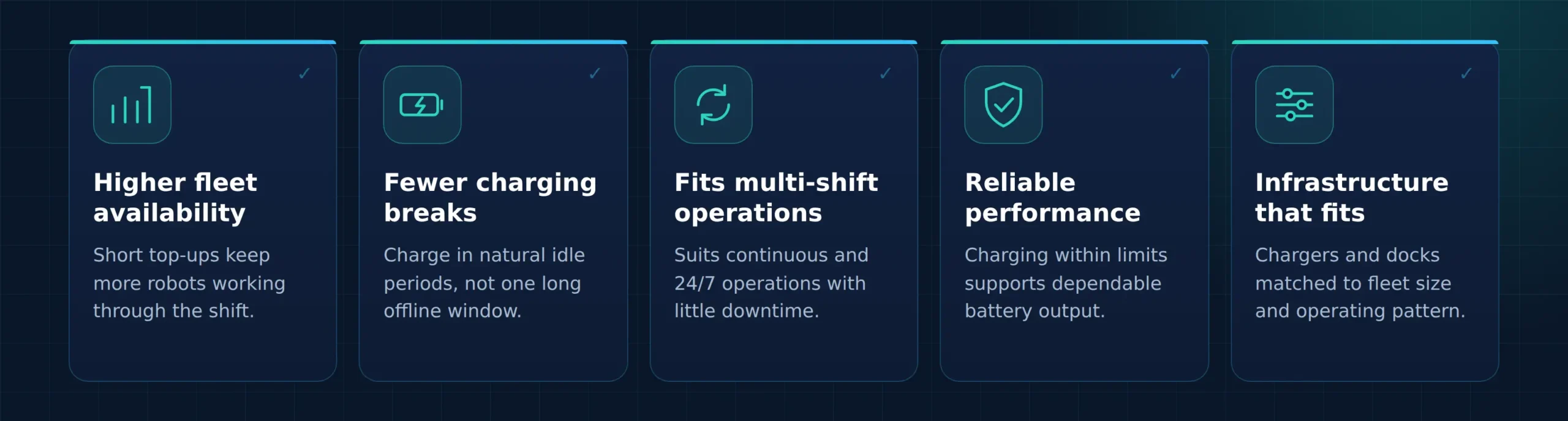
Opportunity charging allows AMRs to receive smaller top-ups during natural idle periods.
For example, an AMR may complete a task, return to a charging station during an available window, receive a partial charge, and then return to operation when another task is assigned.
This approach can be useful for fleets that operate for long hours or across multiple shifts.
Some features include:
- Keeps robots available for longer periods during operations
- Reduces the need for long charging breaks
- Can require more charging points
- Works well for continuous or multi-shift operations
- Requires charging locations and fleet movement to be coordinated
Opportunity charging does not mean every idle period needs to become a charging period. The fleet management system, battery state of charge, workload, and charger availability all influence when a robot should charge.
Full-Cycle Charging
Full-cycle charging gives robots a longer charging window after a period of operation.
It can be easier to manage when there is a clear break between operating periods, like overnight in a single-shift facility.
Common features include:
- Simple charging pattern
- Fewer charging points may be needed
- Robots spend longer periods offline for charging
- Can suit single-shift operations with an overnight charging window
One important distinction is that a full charging session is not always the same thing as one full battery cycle.
A battery cycle is typically defined by the total energy discharged and recharged in relation to the battery’s usable capacity. For example, using approximately 50% of a battery’s usable capacity twice can represent roughly one full equivalent cycle, rather than two complete cycles.
This distinction matters when evaluating battery cycle life. A robot receiving frequent partial charges through opportunity charging is not necessarily completing a full battery cycle every time it connects to a charger.
LFP vs. NMC AMR Batteries
Battery chemistry is another important part of the charging discussion.
Two commonly discussed lithium-ion chemistries are LFP (lithium iron phosphate) and NMC (nickel manganese cobalt).
LFP
LFP batteries are known for their lower material cost and strong cycle-life characteristics.
The IEA’s Global EV Outlook 2026 battery analysis notes that LFP batteries generally have lower energy density than NMC, while their lower cost has contributed to wider adoption across battery applications.
Some features include:
- Lower cost per kWh
- Lower energy density than NMC
- Suitable for applications where weight and space are less restrictive
- Well suited to applications where frequent cycling is important.
NMC
NMC batteries offer higher energy density, which can be useful when battery size and weight are important.
Some features include:
- Higher energy density
- More energy within a smaller and lighter pack
- Useful where weight or available battery space is a constraint
- Different thermal and operating considerations compared with LFP.
What Goes Into AMR Charging Infrastructure?
The AMR charging infrastructure is more than the charging station.
An AMR fleet may also need to account for:
- Charging station availability
- Dock placement
- Docking accuracy
- Electrical capacity
- Network connectivity
- Fleet traffic around charging areas
- Backup arrangements
Charging infrastructure also needs to work alongside the rest of the warehouse environment.
If multiple robots need to charge around the same time, charging locations can become an important part of overall fleet movement. A fleet may have enough total charging capacity on paper but still experience delays if several robots arrive at chargers at the same time.
This is why charger quantity should be considered alongside battery capacity, charging power, robot utilization, operating hours, and the expected timing of charging demand.
Novus’s AMR Cost & ROI Guide breaks down what goes into the full cost of an AMR deployment, including engineering, integration, and ongoing maintenance costs that sit beyond the robot price. Charging infrastructure belongs in that same budget conversation.
AMR Battery Management: The Settings Behind Each Charge
AMR battery management covers when a robot charges, how far it charges, and how battery health is tracked.
Common practices include:
- A charge trigger: the state-of-charge level at which a robot heads to a charger
- A charge limit: how far each top-up goes before the robot returns to work
- Staggered charging: so robots do not all dock at the same moment
- Temperature monitoring: heat and cold both affect battery performance
- State-of-health tracking: to spot aging packs before they interrupt a shift
Charge limits matter more for some chemistries than others. A 2024 study in the Journal of the Electrochemical Society found that repeatedly cycling LFP cells near the top of charge (75 to 100 percent) can speed up wear and that a lower average state of charge can extend battery life. InsideEVs summarizes the findings.
Fleet management software can coordinate these settings with task assignments. Novus’s How Do Autonomous Mobile Robots (AMRs) Work? explains how fleet management handles charging schedules alongside task assignment and traffic control.
Why Charging Matters in 24/7 AMR Operations
Charging becomes a bigger consideration when AMRs operate across multiple shifts.
In a single-shift facility, robots may have a longer overnight window for charging.
In a two-shift facility, that charging window becomes shorter.
For 24/7 AMR operations, there may be very little time when a robot can remain offline for an extended charging session.
However, opportunity charging does not by itself guarantee continuous robot availability.
The result also depends on battery capacity, charger power, charger availability, workload, docking reliability, and how effectively the fleet management system coordinates charging with task assignments.
Battery swapping is another approach used in some high-intensity operations. Novus includes battery swap systems among the charging approaches used for 24/7, high-intensity operations.
The important point is that charging requirements change with the operating model.
For a broader look at planning an AMR deployment around charging, fleet management, and multi-shift operations, see Novus’s How to Implement AGVs & AMRs in Your Facility.
A strategy that works for a single-shift facility may not work in the same way for a three-shift operation.
Common AMR Battery Charging Challenges
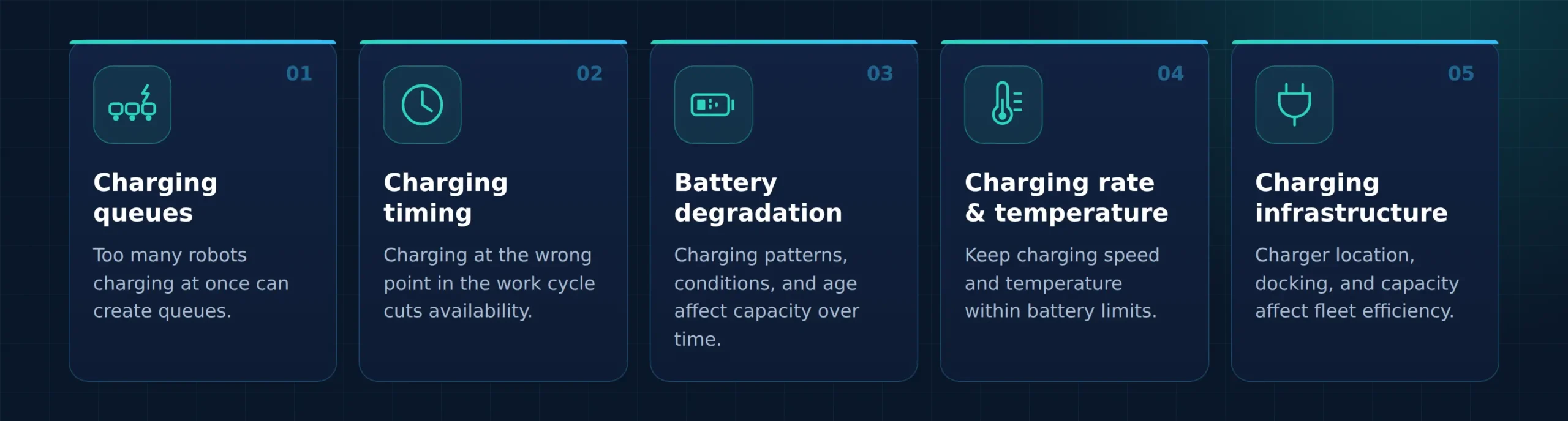
Even when the charging approach looks straightforward, several factors can affect fleet performance.
Final Thoughts
Charging an AMR battery is not like plugging a robot into a charger.
There are two approaches to charging AMRs: opportunity charging and full-cycle charging.
For a single-shift facility with a regular overnight break, a longer dedicated charging window might be possible. If your facility has high utilization or multiple shifts, opportunity charging AMR strategies can help to spread out charging during the operating period.
The best solution depends, in the end, on the energy used by the robots, when they are allowed to go off duty, how quickly they can recharge, and how charging is managed within the fleet.
Are you building your own AMR battery charging strategy for your fleet? Our team is happy to talk through the options if it’s helpful.
FAQs