
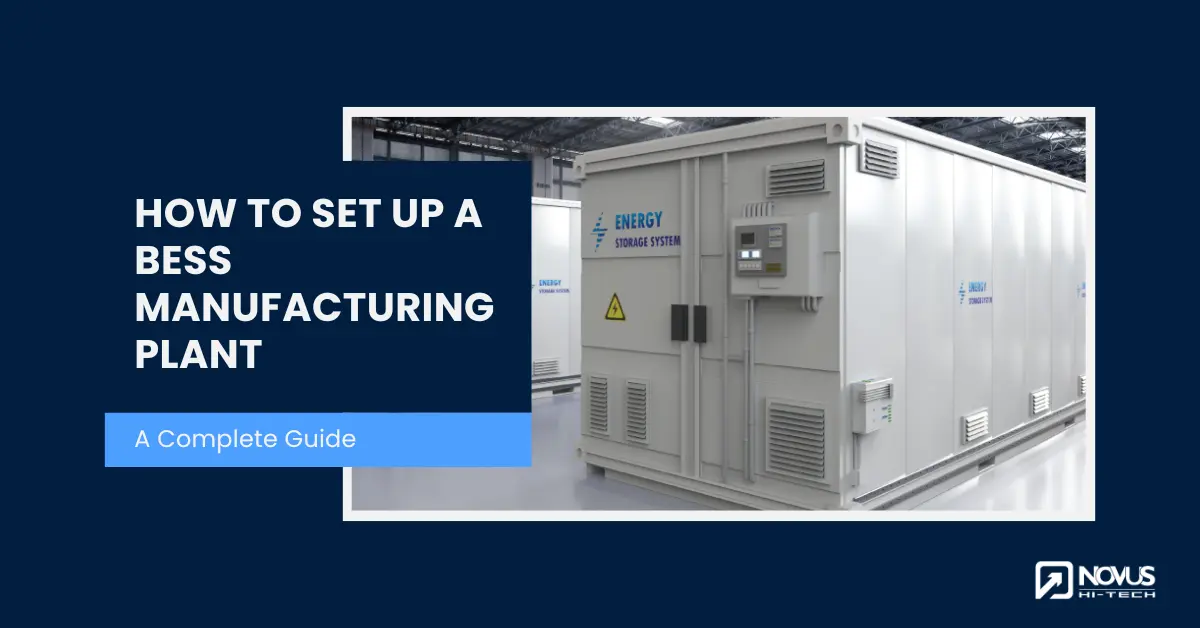
Battery energy storage system manufacturing is moving from a niche opportunity to a core industrial category in India. Grid-scale tenders, C&I storage demand, and the ACC battery storage PLI scheme have pushed established battery makers and new entrants to evaluate dedicated BESS production capacity. This guide covers the complete BESS manufacturing plant setup process: plant requirements, machinery list, factory layout, certifications, capex planning, and the automation decisions that determine whether your production line scales profitably.
If you are a battery manufacturer planning to move up the value chain from cells or packs into containerized grid-scale energy storage, this is the operational roadmap.
What a BESS Manufacturing Plant Actually Produces
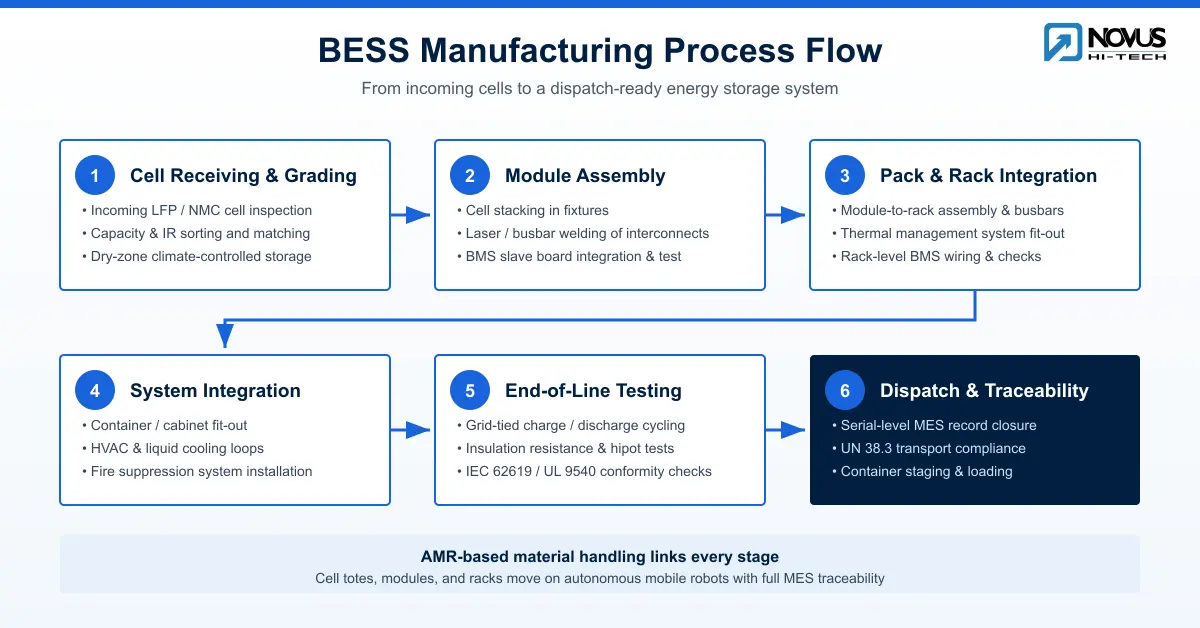
A BESS plant does not manufacture cells. It integrates them. The plant receives lithium-ion cells (typically LFP for stationary storage, occasionally NMC for space-constrained applications) and converts them into deployable energy storage systems through four value-addition stages:
- Battery module assembly: cells are sorted, stacked, and joined through laser welding or busbar welding into modules with integrated sensing.
- Pack and rack integration: modules are assembled into battery packs and mounted in battery enclosure and racking systems with a thermal management system (liquid-cooled or forced-air).
- BMS integration: the battery management system is wired, configured, and validated at module, rack, and system level.
- Energy storage container fabrication and system integration: racks, power conversion interfaces, HVAC, and a fire suppression system for BESS are integrated into a containerized or cabinet-based product, followed by end-of-line (EOL) testing.
Your BESS plant setup requirements flow directly from which of these stages you bring in-house versus outsource. A pack-and-integrate plant needs a fraction of the capex of a facility that also fabricates containers and thermal systems.
BESS Manufacturing Plant Setup: 7 Steps from Planning to Production
The seven steps below cover the full BESS manufacturing plant setup sequence, from product definition to traceability systems. Each builds on decisions made in the previous one.
Step 1: Define Product Scope and Capacity
Before land, machinery, or licensing, lock three decisions:
Cell chemistry and sourcing strategy. Battery cell sourcing (LFP vs NMC) shapes everything downstream. LFP dominates grid-scale energy storage because of cycle life, thermal stability, and cost. Decide whether you will import cells, buy from domestic ACC PLI beneficiaries, or eventually backward-integrate.
Product formats. Utility-scale containers (typically 20-foot units in the multi-MWh class), C&I cabinet systems, or both. Each format changes your BESS factory layout, crane requirements, and EOL testing bays.
Annual capacity target. Plants are typically planned in GWh of annual integration capacity. Capacity determines line count, dry room sizing, and whether semi-automated or fully automated assembly is viable.
Step 2: BESS Plant Setup Requirements: Land, Building, and Utilities
Space. How much space is required for a BESS assembly plant depends on capacity and vertical scope. As an indicative planning range, a 1 GWh per year integration facility generally needs several acres once you account for production halls, warehousing, container staging yards, and statutory setbacks for lithium battery storage. Ceiling height matters: container integration bays need overhead cranes and 8 to 10 metre clearance.
Environmental control. Cell handling and module assembly zones require dry room requirements far stricter than general industrial space, with dew point control to prevent moisture ingress during cell prep. Full cleanroom classification is usually unnecessary for integration plants, but controlled-humidity zones are non-negotiable.
Power and safety infrastructure. EOL testing of multi-MWh systems demands substantial grid connection capacity, often with regenerative cyclers that return discharge energy to the grid. Fire safety design must follow lithium-specific norms, including segregated cell storage, thermal runaway detection, and suppression systems rated for battery fires.
Step 3: BESS Plant Machinery List
The machinery required for BESS manufacturing falls into five groups:
Module assembly line
- Cell sorting and grading systems (capacity and internal resistance matching)
- Cell stacking and fixture stations
- Laser welding or busbar welding systems for cell interconnects
- Module-level BMS slave board integration and testing rigs
Pack and rack assembly
- Torque-controlled fastening systems
- Busbar forming and insulation equipment
- Thermal interface material dispensing
- Rack assembly fixtures and lifting aids
System integration
- Overhead cranes for rack and container handling
- Energy storage container fabrication or fit-out stations (if in scope)
- HVAC and liquid cooling loop installation and pressure-testing rigs
- Fire suppression system installation and verification tooling
Testing and quality
- Module and rack cyclers
- End-of-line (EOL) testing bays with grid-tied bidirectional power supplies
- Insulation resistance and hipot testers
- Environmental chambers for sample validation against IEC 62619 and UL 9540 test conditions
Material handling and logistics
- AMR and AGV material handling in battery plants for cell totes, modules, and WIP movement
- Automated storage for incoming cells with FIFO enforcement
- Conveyors linking assembly stations
Step 4: BESS Factory Layout and Production Line Setup
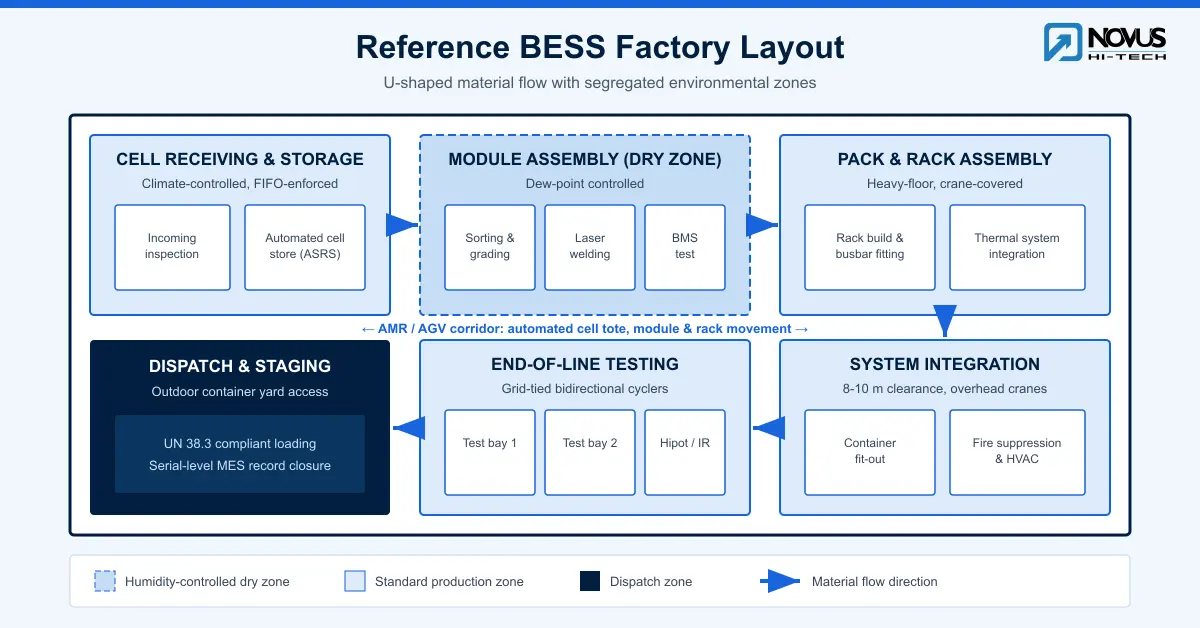
An efficient BESS production line setup follows a linear or U-shaped material flow: cell receiving and climate-controlled storage, module assembly in the dry zone, pack and rack assembly, system integration, EOL testing, and dispatch staging.
Three layout principles separate high-throughput plants from struggling ones:
Segregate by environmental requirements. Keep the dry zone compact. Every square metre of humidity-controlled space carries a permanent operating cost, so only cell prep and module assembly belong inside it.
Design for weight from day one. Modules weigh tens of kilograms; racks weigh hundreds; containers weigh tens of tonnes. Floor loading, aisle widths, and crane coverage must be planned before civil work, not retrofitted.
Automate material movement early. Manual movement of cell totes and modules is the most common bottleneck in gigafactory-style facilities. BESS assembly line automation using autonomous mobile robots keeps task time stable as volumes ramp, removes forklift traffic from zones with sensitive electronics, and creates the traceability backbone quality teams need. Novus Hi-Tech’s P-Mover class AMRs, proven across 1,500+ deployments and 10M+ km of autonomous navigation, are engineered for exactly this class of heavy, high-mix intralogistics.
Step 5: Certifications and Compliance
What certifications are needed for BESS manufacturing depends on target markets, but the core stack is consistent:
Product certifications
- IEC 62619: safety requirements for industrial lithium cells and batteries; the baseline for most international and Indian tenders.
- UL 9540 and UL 9540A: system-level energy storage safety and thermal runaway fire propagation testing; increasingly demanded by global EPCs and insurers.
- BIS certification for lithium batteries: mandatory registration under CRS for applicable battery categories sold in India.
- UN 38.3: transport testing for lithium batteries, required before any shipment.
Plant and business licensing (India)
- Factory license and fire NOC with lithium-specific provisions
- Pollution control board consents (CTE and CTO)
- Battery Waste Management Rules, 2022 registration and EPR obligations
- CEIG approval for high-capacity electrical test infrastructure
Budget 9 to 15 months for the full certification cycle on a new system design, and sequence it in parallel with plant commissioning rather than after.
Step 6: Investment and Capex Planning
How much does it cost to set up a BESS manufacturing plant in India? There is no single number, because BESS manufacturing plant investment scales with vertical integration depth. Structure your capex model around these heads instead of a headline figure:
| Capex Head | Key Drivers |
| Land and building | Capacity target, container staging area, dry room footprint |
| Module and pack lines | Automation level, welding technology, line count |
| Testing infrastructure | EOL bay count, cycler capacity, grid connection |
| Material handling automation | AMR/AGV fleet size, ASRS scope |
| Certification and compliance | Number of product variants, target markets |
| Working capital | Cell inventory is the dominant component |
Two factors shape BESS manufacturing returns. First, battery cells make up most of the product cost, making working capital management as important as plant capex. Second, India’s ACC Battery Storage PLI scheme and VGF program favor domestic value addition, with a minimum 20% local content requirement (including indigenous EMS software) and a ₹5,400 crore expansion approved in May 2026 to support 30 GWh of new capacity. Even if you’re not a direct PLI beneficiary, sourcing from domestic manufacturers can strengthen tender eligibility.
Is BESS manufacturing profitable in India? The businesses that sustain margins share three traits: high plant utilization, disciplined quality that keeps warranty reserves low, and automation that holds labour cost per kWh flat as volumes grow. Integration is a throughput and quality business, and both are engineering decisions made during plant setup.
Step 7: Quality, Traceability, and Digital Systems
Grid-scale buyers and insurers now expect battery plant quality control and traceability down to individual cell serial numbers. That requires:
- MES for battery manufacturing: a manufacturing execution system that records cell grading data, torque values, weld parameters, and test results against each module and rack serial.
- Automated data capture: manual logging fails at scale. Scanners, weld monitors, and cycler outputs should write directly to the MES.
- Closed-loop material tracking: AMR-based material movement integrates natively with MES and WMS layers, so every cell tote and module carries a verified digital location history from receiving to dispatch.
This traceability stack is also your defense in warranty disputes and thermal incident investigations, which makes it a commercial asset, not an overhead.
BESS Plant Setup Timeline: How Long Does It Take?
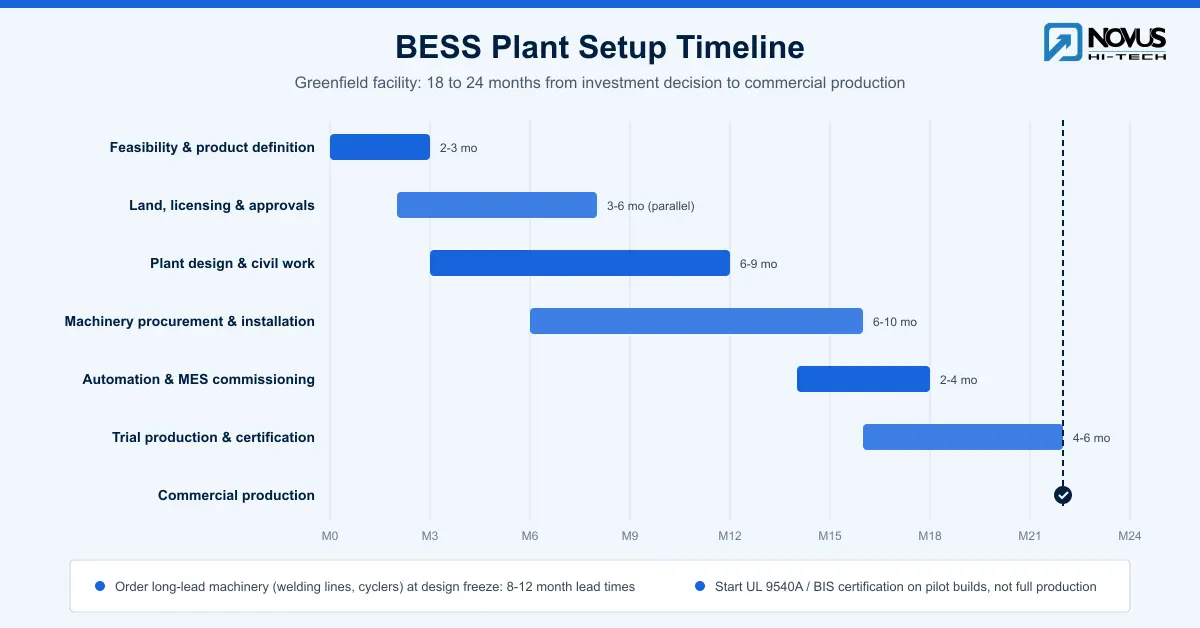
For a greenfield pack-and-integrate facility, plan for 18 to 24 months from investment decision to commercial production. Brownfield conversions of existing industrial buildings can compress this to 12 to 15 months. The phases below overlap deliberately; running them in strict sequence adds six months or more.
| Phase | Indicative Duration | Key Activities |
| Feasibility and product definition | 2 to 3 months | Capacity planning, cell sourcing strategy, capex model, PLI and incentive mapping |
| Land, licensing, and approvals | 3 to 6 months | Factory license, fire NOC, pollution consents, CEIG application (runs parallel with design) |
| Plant design and civil work | 6 to 9 months | Dry room construction, heavy flooring, crane installation, grid connection |
| Machinery procurement and installation | 6 to 10 months | Welding lines, cyclers, and EOL bays are long-lead items; order at design freeze |
| Automation and MES commissioning | 2 to 4 months | AMR fleet deployment, MES and WMS integration, traceability validation |
| Trial production and certification | 4 to 6 months | Pilot builds, IEC 62619 and UL 9540A testing, BIS registration, customer audits |
Two scheduling rules protect the critical path. First, order long-lead equipment (laser welding systems, grid-tied cyclers) at design freeze, not after civil completion; these items routinely carry 8 to 12 month lead times. Second, start certification on pilot-build units rather than waiting for full production, since UL 9540A and BIS cycles run months and can otherwise delay first revenue on a finished plant.
Common Mistakes to Avoid
- Undersizing EOL testing. Test bays, not assembly stations, are the usual throughput constraint in BESS plants.
- Treating fire safety as a compliance checkbox. Insurers increasingly audit against UL 9540A data; design for it upfront.
- Deferring automation to “phase two.” Retrofitting AMR and conveyor systems into a live plant costs more and disrupts production. Fix the automation architecture during layout design.
- Ignoring reverse logistics. Battery Waste Management Rules impose EPR obligations from day one of sales.
How Novus Hi-Tech Supports BESS Plant Setup
Novus Hi-Tech builds the material handling automation layer for battery and energy manufacturing plants. With 150+ patents and deployments across manufacturers including Asian Paints, ACG, and John Deere, our AMR fleets handle cell tote movement, module transfer, and heavy rack logistics with full MES and WMS integration. The Novus P-Mover platform is deployed in solar PV manufacturing lines with directly transferable workflows for BESS module and pack logistics.
Planning a BESS production line? Talk to our automation team about a layout and fleet-sizing study before you freeze your civil design.