

Factories and warehouses today are under pressure to move materials faster, safer, and with higher consistency. Labor shortages, increasing SKUs, tighter takt times, and digital transformation goals have accelerated automation across industries.
This is where Automated Guided Vehicles (AGVs) and Autonomous Mobile Robots (AMRs) have emerged as foundational building blocks of modern intralogistics.
While AGVs excel in stable, repetitive, fixed-path workflows, AMRs shine in dynamic, fast-changing environments. Together, they power some of the world’s most efficient factories and warehouses.
This guide explores how different industries use AGVs and AMRs, where each technology fits best, and why material-handling automation has become a competitive advantage.
Where Are AGVs & AMRs Used?
Industries deploying AGVs and AMRs include:
- Automotive & Auto Components
- FMCG & Consumer Goods
- Warehousing & 3PL
- Pharmaceuticals & Healthcare
- Electronics & Semiconductor
- EV & Battery Manufacturing
- Food & Beverage
- Heavy Engineering & General Manufacturing
- E-commerce Fulfillment
- Aerospace
- Campus Logistics (inter-building material movement)
Each sector has its own movement patterns, payload types, and operational constraints — and that’s why both AGVs and AMRs find strong relevance.
Discover how the right Autonomous Mobile Robot (AMR) solutions drive business efficiency.
Download our free eBook for expert insights and trends!
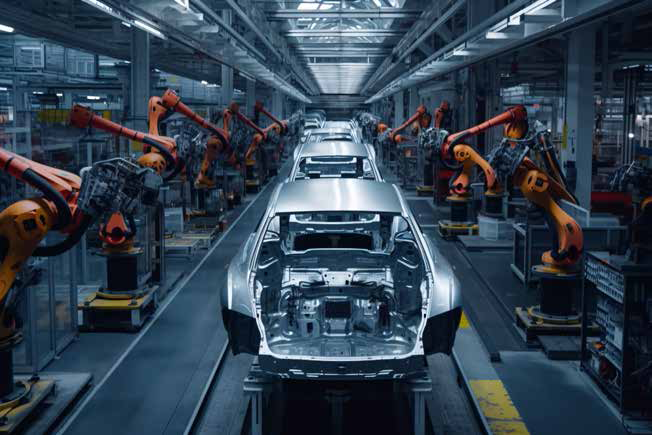
Automotive & Auto Components
Few industries depend on predictable material flow as critically as automotive manufacturing. Every workstation must receive the right material at the right time to maintain takt.
Key Applications
- Line-side material delivery
- Kitting and sequencing
- Powertrain and BIW movement
- WIP transfer between stations
- Tugger routes for assembly supply
- Inter-building transfers across campuses
Where AMRs Fit Best
- Mixed traffic conditions
- Line feeding with dynamic demand
- Layouts that change with new models
- Multi-station milk-run operations
Where AGVs Fit Best
- Long, repetitive loop routes
- Engine block and assembly transfers
- Heavy, predictable pallet cycles
- Fixed conveyor-replacement paths
The automotive shop floor commonly uses hybrid fleets — AGVs for stable backbones and AMRs for flexible last-mile movement.
FMCG & Consumer Goods
FMCG operations involve high-speed material flow, narrow aisles, and continuous pallet movement between processing, packaging, and warehouse zones.
Key Applications
- Raw material movement
- Packaging material supply
- Finished goods pallet transfer
- Production-to-warehouse movement
- Inbound replenishment
AMR Highlights
- 24×7 operation
- Fast deployment
- High safety in congested zones
- Smooth, damage-free movement
AGV Highlights
- Reliable pallet shuttling on fixed routes
- Good fit for predictable conveyor-replacement cycles
FMCG plants often run two or three shifts, making automation ROI extremely strong.
Warehousing & 3PL
Modern warehouses face SKU complexity, peak season spikes, and the need for high picking throughput. AGVs and AMRs modernize internal logistics without major infrastructure changes.
Key Applications
- Goods-to-person order picking
- Putaway and replenishment
- Sorting and routing
- Zone-to-zone transfer
- Batch picking workflows
- Cross-docking
AMR Highlights
- Perfect for dynamic pallets and totes
- Ideal for operations that frequently reconfigure racks
- Precise movement in shared human–robot zones
AGV Highlights
- Efficient for fixed point-to-point pallet cycles
- Useful for predictable dock-to-storage movement
Warehouses benefit from flexible workflows, making AMRs dominant — but AGVs still play a role in fixed heavy pallet routes.
Pharmaceuticals & Healthcare
The pharma sector requires precision, sterility, and traceability. AMRs and AGVs reduce human error and improve compliance.
Key Applications
- Batch movement
- Cleanroom material handling
- Packaging line supply
- API and WIP transfer
- Cold chain logistics
AMR Highlights
- ISO-compatible cleanroom variants
- Zero human contamination
- Full traceability for audits
AGV Highlights
- Reliable movement between controlled zones
- Fixed routing reduces contamination risks
Pharma sites often prefer AMRs for flexibility, while AGVs handle repeatable routes.
Electronics & Semiconductor
These industries require high precision and contamination control, making automated movement essential.
Key Applications
- PCB and component transfer
- WIP movement between stations
- Cleanroom logistics
- Tooling and tray handling
- Sensitive asset transport
AMR Highlights
- Millimeter-level docking accuracy
- ESD-safe payload variants
- Excellent for compact spaces
AGV Highlights
- Useful for repetitive long-distance cleanroom loops
Electronics lines change frequently, so AMRs dominate — but AGVs still support fixed repetitive high-volume movements.
EV & Battery Manufacturing
EV plants are material-intensive and fast-growing. Battery modules, trays, and packs require safe, consistent, vibration-free movement.
Key Applications
- Cell-to-module transport
- Module-to-pack transfer
- Line-side delivery
- Inter-building transport
- Heavy-duty tray movement
AMR Highlights
- High stability
- Safe movement of sensitive components
- Smooth navigation across people, robots, and equipment
AGV Highlights
- Strong fit for fixed pallet or tray cycles
- Good for linear conveyor-replacement paths
Battery and pack assembly benefits from hybrid fleets, with AMRs handling dynamic zones and AGVs supporting repetitive flows.
Food & Beverage
Food production often includes cold storage, hygiene zones, and repetitive high-speed pallet motion.
Key Applications
- Ingredient movement
- Packaging supply
- Finished goods transfer
- Cold-room logistics
- Hygienic zone distribution
AMR Highlights
- Stainless steel variants available
- Excellent performance in chilled environments
- Reduced contamination risk
AGV Highlights
- Reliable in repetitive or loop-based paths (e.g., warehouse-to-chiller cycles)
General Manufacturing & Heavy Engineering
Industrial plants operate with large assemblies, heavy WIP, and cross-departmental movement.
Key Applications
- Material feeding
- Assembly line WIP movement
- Tooling and fixtures transport
- Finished goods pallet handling
AMR Highlights
- Versatile for changing layouts
- High safety in shared spaces
- Good for mixed SKUs and irregular movement patterns
AGV Highlights
- Strong candidate for fixed loops between machining, inspection, and storage
- Highly predictable movement patterns
Discover how the right Autonomous Mobile Robot (AMR) solutions drive business efficiency.
Download our free eBook for expert insights and trends!
E-commerce & Fulfillment Centers
High order velocity and SKU variety make fulfillment centers ideal for AMRs and AGVs.
Key Applications
- Goods-to-person picking
- RFID-based sorting
- Putaway and replenishment
- Returns management
AMR Highlights
- Fast, flexible, scalable
- Ideal for SKU-dense operations
- Supports seasonal workforce stability
AGV Highlights
- Suitable for repetitive dock-to-storage pallet cycles
Aerospace & Precision Manufacturing
Aerospace operations require controlled, safe, and precise handling — ideal for mobile automation.
Key Applications
- Tooling transfer
- WIP movement
- Large assembly transport
- Component movement between bays
Both AGVs and AMRs find use depending on whether the route is repetitive or dynamic.
Campus Logistics (Multi-Building Movement)
Large industrial parks and multi-facility campuses require long-distance movement across buildings.
Key Applications
- Inter-building movement
- Outdoor transfers
- Yard logistics
AMR Highlights
- GPS + LiDAR outdoor capabilities
- Smooth movement across roads, ramps, and entry points
AGV Highlights
- Strong fit for repetitive campus runs between fixed stations
Conclusion
Different industries adopt AGVs and AMRs for different reasons:
- Automotive needs precision takt-time supply
- Warehousing needs speed & picking accuracy
- Pharma needs traceability & sterility
- Electronics needs precision & cleanroom compatibility
- EV & Battery needs safe, stable movement
- FMCG needs speed & productivity
- Food & Beverage needs hygiene & cold-room reliability
- Heavy engineering needs predictable, safe internal logistics
Across industries, the common goals are the same:
Higher throughput, safer movement, predictable flow, and scalable operations.
Both AGVs and AMRs help organizations achieve these outcomes — often working together in hybrid fleets.
How Novus Hi-Tech Supports Industry Automation
Novus Hi-Tech is a global pioneer in AI-driven robotics, AGV/AMR systems, and intelligent intralogistics — engineered indigenously in India.
With:
- 150+ patents
- 1,200+ mobile robots deployed
- 8M+ km autonomous robot travel
- 100+ enterprise customers
Novus helps industries evaluate workflows, design automation roadmaps, and deploy end-to-end material movement systems tuned to their environments.
📩 To explore AGV or AMR use cases for your industry:
marketing@novushitech.com
Let’s build the next generation of intelligent factories and warehouses — together.