
So what happens when order volumes continue to grow but there aren’t enough laborers willing to do the work?
Ask a warehouse manager in India, and you’ll probably get a tired laugh before an answer. Every festive season brings the same scramble – orders surge, floors get chaotic, and there aren’t enough hands to pick, move, sort, pack, and dispatch it all in time. That’s no longer a once-a-year headache. It’s the warehouse labor shortage operators now plan their whole year around.
The numbers give some context. Some sectors aim to recruit 500,000 blue-collar workers every month in India but can meet only 80% of that demand. A report based on about 4.8 lakh blue-collar job postings in 2025 noted that gig hiring increased 92% year-on-year in 2024
In parallel to this, customers are getting used to faster delivery.
So warehouse operators are facing three challenges at once:
More orders. Fewer available workers. Less time to do the task.
That’s when warehouse automation starts to look less like a sci-fi notion and more like a workable fix.
When Are Robots Really Helpful?
“Warehouse automation” can sound like replacing an entire workforce with machines.
In fact, it often begins with something a lot smaller.
Say it’s a worker who spends a large part of each shift walking between storage racks and a picking station. Or someone pushing totes from one side of the warehouse to the other. Over and over again.
The task itself is not very complicated. It just has to be done again and again. And that is a real frustration.
That is exactly the kind of work robots can take on.
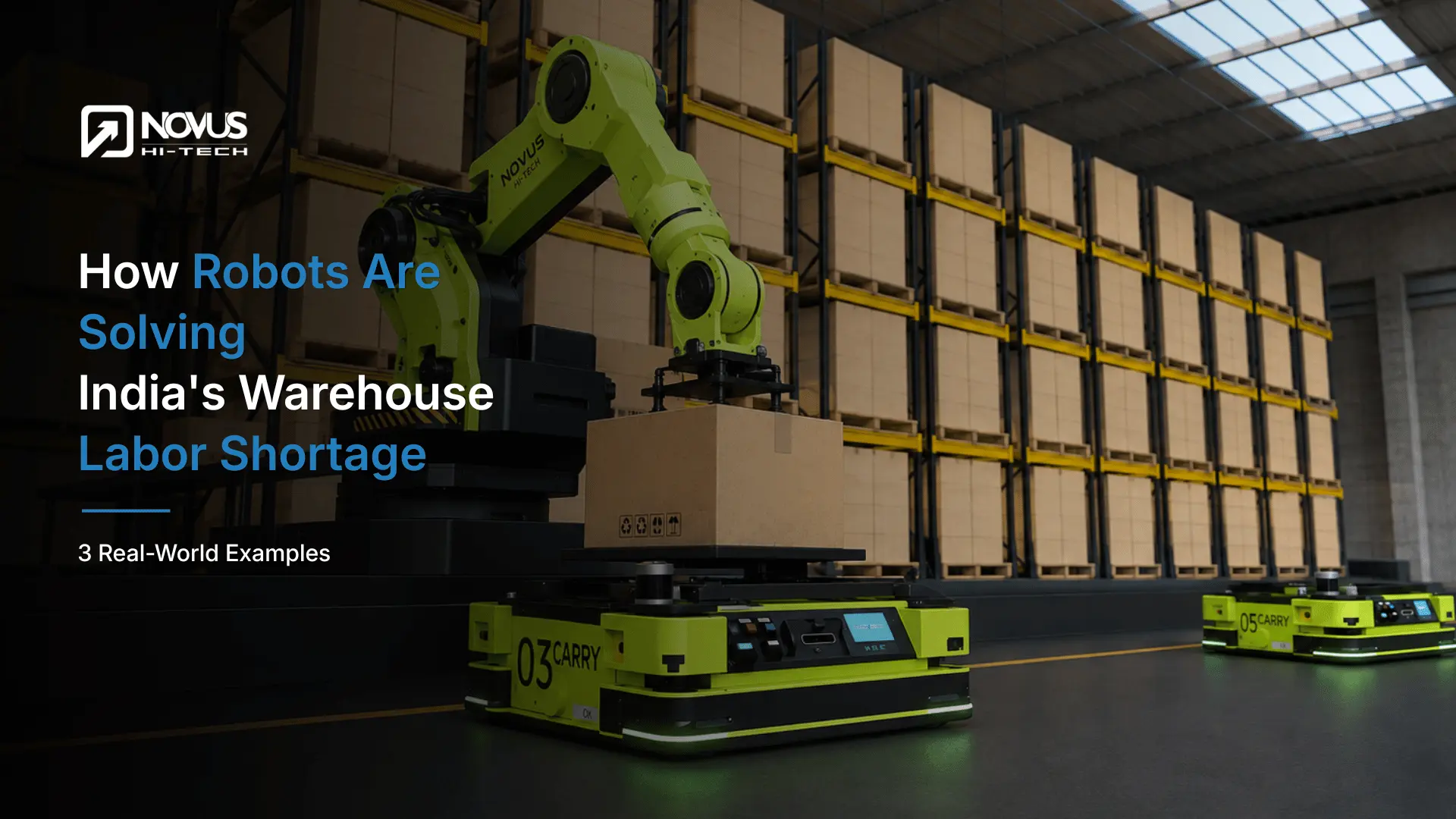
Autonomous mobile robots, or AMRs, are designed to move goods around a facility without requiring a fixed physical track. They use technologies such as LiDAR, cameras, and SLAM to understand their surroundings and adjust their route when something gets in the way.
That flexibility is one of the main differences between an AMR and a traditional AGV.
But putting a robot on the floor is not enough.
An AMR in warehouse operations needs to work with the systems already running the facility. That can include the warehouse management system, fleet management software, conveyors, sortation equipment, and picking stations.
If those systems cannot communicate properly, the robot may move perfectly well and still fail to improve the operation.
Robots pay off once the physical equipment and software actually work together. That combination, hardware plus software, is what material handling automation looks like at an operational level.
A few Indian companies are already showing what that looks like.
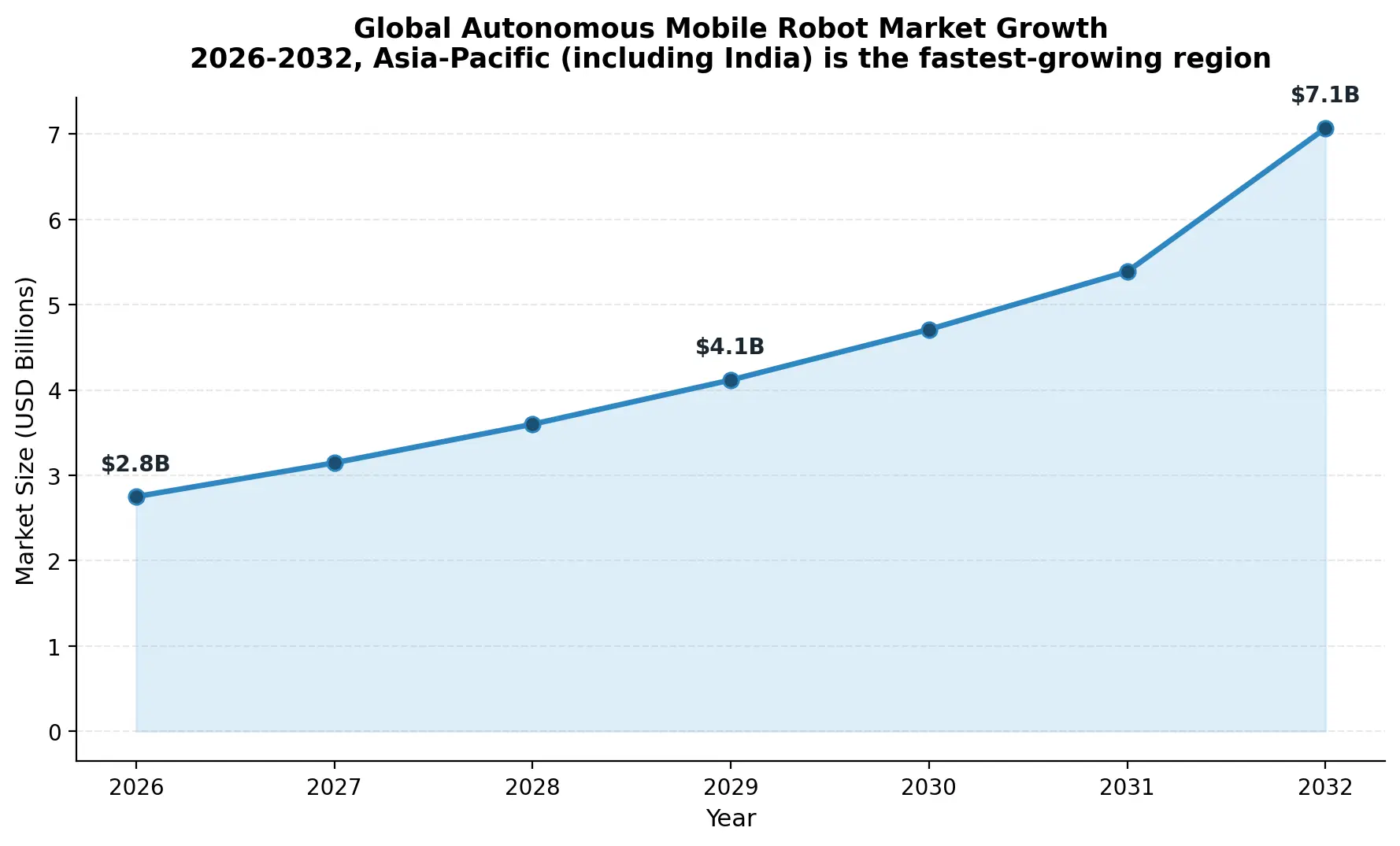
3 Real Examples of Warehouse Automation in India Right Now
1. Flipkart: Getting More Packages Through the Door
Flipkart’s problem was straightforward: Its delivery network had to manage a huge number of packages without any more manual sorting work.
Flipkart deployed 100 robots at one of its delivery hubs in Bengaluru to automate package sorting. The robots were said to process roughly 4,500 packages an hour vs. roughly 450 packages an hour through the manual process.
That is about a tenfold difference.
The system also had another advantage. If more capacity was required, additional robots could be added without having to make a proportional increase in infrastructure.
That matters during periods when volumes are difficult to predict.
Flipkart’s broader automation efforts have also been associated with shipping-time reductions of up to 80% in reporting on its warehouse and supply chain operations.
The bigger point is not simply that a robot can move a package faster.
It is that repetitive movement and sorting do not necessarily need to consume the same amount of human time.
A worker who previously spent a significant part of the shift moving or sorting goods can instead spend more time on activities where human involvement actually adds value.
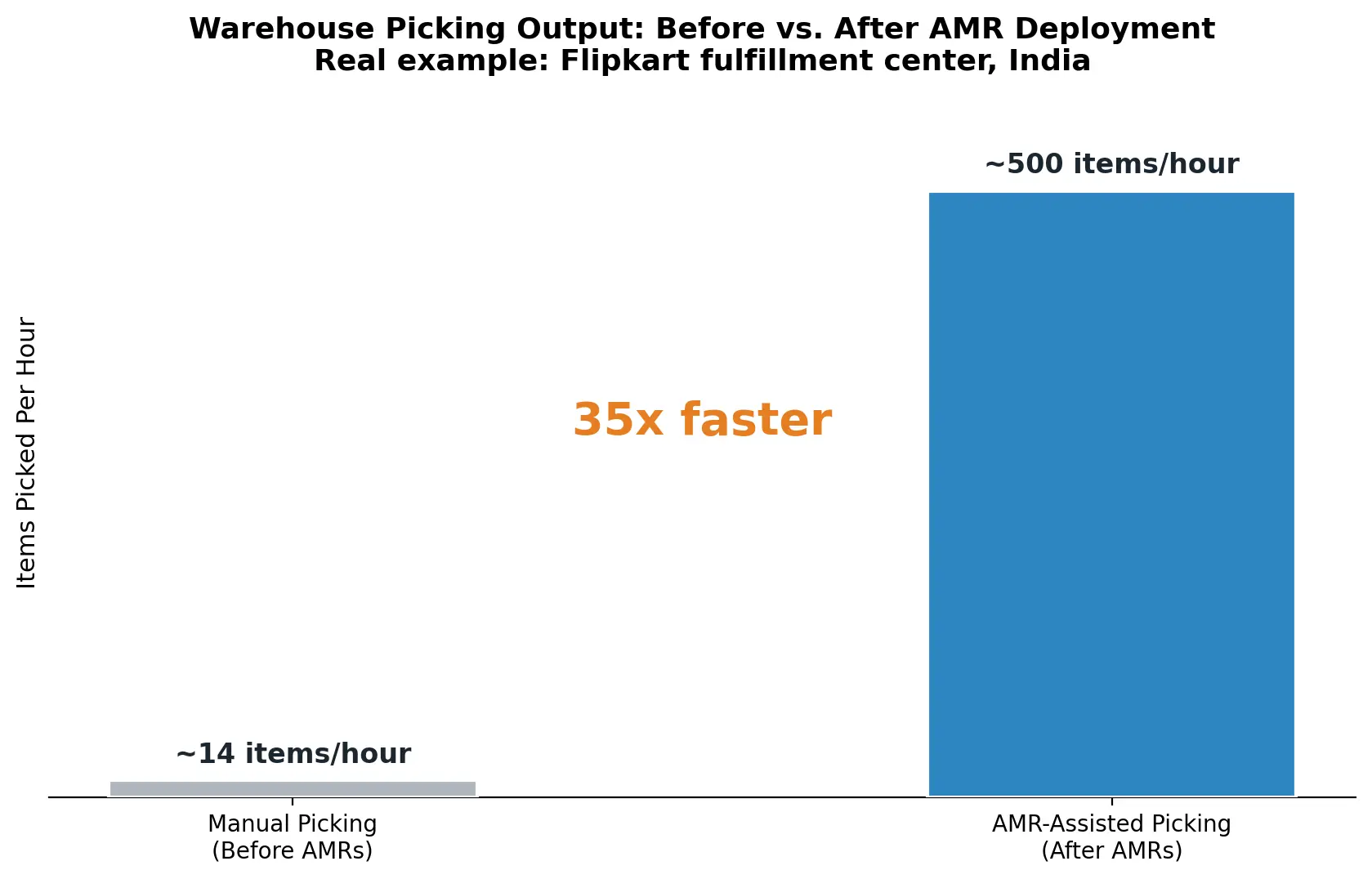
What this shows: robotics can increase throughput without requiring a warehouse to increase manual movement at the same rate.
2. Reliance Fashion & Lifestyle: When One Automated Process Isn’t Enough
Reliance had a different problem.
Its omnichannel operation needed to handle a large volume of inventory while serving different types of orders. But if you automate one little piece and then the next step becomes a bottleneck, you haven’t gained much.
Its distribution center in Sultanpur is about 200,000 sq ft and has a capacity of about 1.5 crore units.
The facility features a suite of technologies, including an AS/RS, shuttle systems, vertical lifts, smart conveyors, and goods-to-person stations. These systems are managed by a warehouse execution system that guides the flow of goods through the facility.
Warehouse performance is rarely determined by one activity. Suppose picking becomes twice as fast. If packing cannot keep up, the warehouse has not really become twice as productive.
The same problem can happen between receiving, storage, picking, and dispatch.
Reliance’s setup is an example of what happens when automation is designed around the entire flow rather than around one isolated task.
What this shows: as warehouse operations become larger and more complex, integrating different automation systems can matter just as much as the individual machines.
3. PepsiCo: More Output Without Building a Bigger Facility
PepsiCo’s problem was different again.
The company needed to move large quantities of material, but the facility involved was only around 36,000 square feet.
Instead of relying entirely on manual material movement, the plant introduced crane-based AS/RS, mother-child shuttles, and pick-by-light technology.
The resulting system reportedly achieved throughput of around 300 pallets per hour.
It’s a useful example, because warehouse automation is often associated with enormous fulfillment centers. You don’t always need one. Sometimes the constraint is simply space.
If there is not enough room to keep adding storage, aisles, and workers, increasing storage density and automating movement can provide another way to increase capacity.
In that situation, automation is solving two problems at once: how to move more material and how to make better use of the available space.
What this shows: automation can be a response to space and throughput constraints, not just a response to labor shortages.
What These Examples Tell Us About India’s Warehouse Labor Shortage
Flipkart wanted to move and sort more packages. Reliance needed to coordinate a large omnichannel operation. PepsiCo needed high material-handling throughput inside a relatively compact facility – three different technologies, deployed for three different reasons.
In each case, the company started with a warehouse problem, not a robot. That distinction matters for anyone evaluating automation today. It’s tempting to start by asking, “Which robot should we buy?” A better question is, “Where are we losing the most time or capacity?”
Where Should a Warehouse Start?
Your team does not need to automate an entire warehouse to find out whether automation can help.
Start with one process.
Look at where labor spends the most time walking. Check which tasks are repeated hundreds of times a day. Look at what happens during peak periods. And, most importantly, find something that can be measured.
Effective numbers might include:
- Cost per pick
- Orders processed per hour
- Picking accuracy
- Labor hours per order
- Dock-to-stock time
- Travel time per worker
- Peak-period throughput
This baseline is easy to overlook.
McKinsey has also highlighted the value of nailing down operational requirements and KPIs before scaling warehouse automation. Its research also discusses usage-based models such as pay-per-pick, which can reduce the upfront capital burden. In the examples it examined, these models reduced project capital costs by 60% to 80%.
That changes the conversation quite a bit.
Instead of asking:
“Can we afford 50 robots?”
A warehouse operator can ask the following:
“Can five robots solve this particular problem?”
If the answer is yes, and the numbers bear it out, then scaling is an easy call.
As supply chains continue to move larger volumes, automation is becoming one way companies can reduce their dependence on repetitive manual movement.
If your warehouse is facing similar capacity or labor challenges, the Novus Hi-Tech team can help assess how AMRs and other material-handling automation technologies could fit into the existing operation, starting with processes where automation can have the clearest, most measurable impact.