
Safety technology improves truck driver retention when fleets use it to protect drivers, not police them. ADAS and driver monitoring systems (DMS) cut fatigue and crash risk, give drivers video proof in disputes, and build trust through transparent data. Paired with fair pay and predictable schedules, they give drivers a reason to stay.
Keeping drivers is now as hard as finding them. The IRU counts about 2.9 million unfilled truck driver jobs across 18 markets, and India alone is short of roughly 2.2 million drivers. Every driver who quits is costly to lose and slow to replace.
Most fleets reach for higher pay first. It helps, but the IRU’s own research shows wages alone no longer keep drivers. What does? A job that feels safer and fairer.
This guide covers the scale of the shortage, what churn really costs, and five ways safety tech helps you keep your drivers.
What the Numbers Say: The Global Driver Shortage
Wherever freight moves, fleet managers are short of drivers.
- Global: The International Road Transport Union reports about 2.9 million truck driver positions that remain vacant across 18 markets. That’s 11% of the workforce. Europe runs at 13%, and roughly 20% of European drivers expect to retire within five years.
- India: Business Standard, citing a World Bank report, puts India’s shortfall at about 2.2 million drivers in 2025.
- Southeast Asia: Mordor Intelligence says driver shortages are squeezing road freight in Thailand and Malaysia. They also report that new license issuance fell by nearly 10% in 2024.
The driver talent pool is shrinking across Asia, Europe, and plenty of places in between. Keeping the drivers you already have is now the real job.
What Driver Churn Costs a Commercial Fleet
High fleet driver turnover costs more than the recruiting bill. Look at what piles up:
- Recruiting and onboarding time
- Training money spent on people who leave within months
- Idle trucks and delayed deliveries
- Newer drivers with less road time, which raises crash risk
- Lower morale for the people who stay
How big can it get? Covenant Logistics, a U.S. carrier, says in its FY2025 annual filing that it’s common for individual carriers’ driver turnover to exceed 100% in a year. In other words, some fleets replace their whole driver team every year.
Why Drivers Walk Away
Pay matters. But IRU’s report describes a “wage wall”: higher wages alone no longer attract or keep drivers.
What pushes individuals out besides money?
- Long hours nobody can plan around
- Tired, stressful driving
- Monitoring that feels like surveillance instead of support
In India, wages add to the pull. Truck drivers earn roughly ₹20,000 to ₹25,000 a month, while city cab drivers can earn up to ₹30,000 for easier work, according to the same Business Standard report.
You might not bridge that divide, but you can enhance the perception of safety and fairness in the job, which is where safety technology plays a significant role.
5 Ways Safety Tech Improves Truck Driver Retention
One rule runs through all five: protect, don’t police. Drivers stay when the tech in their cab is clearly on their side.
1. Monitor Fatigue Early and Protect Your Drivers
Start here, because it decides how drivers see everything else. A camera in the cab can feel like a boss watching over your shoulder. Handled well, it feels like a co-driver.
Before installation, explain what the system records, who sees it, and how long you keep it. Let drivers see their own scores. Drivers who understand the purpose tend to accept the tech. Drivers who find out later tend to resent it.
See what a well-run setup looks like in this overview of truck driver monitoring systems.
2. Spot Fatigue Early and Protect Your Drivers
Experienced drivers know how dangerous tired driving is. They’ve felt it.
A driver monitoring system watches for fatigue and distraction in real time and alerts the driver before a lapse can turn into a crash. When the system nudges a tired driver to take a break, it reads as care, not control.
3. Replace Blame With Proof
Few things sour a driver faster than being blamed for something they didn’t cause. Video settles it. A car cuts in or a pedestrian steps out, and the footage backs your driver up.
The result: fewer disputes, fewer unfair deductions, and more trust.
Weighing ADAS against video telematics? This guide on how to choose the right video telematics for fleet safety covers the options.
4. Make the Cab a Safer Place to Work
Blind spots on a big truck wear drivers down every day. Blind spot detection, forward collision warning, and moving-off alerts take some of that weight off.
A job that feels less risky is a job people stay in.
City routes add pedestrians and two-wheelers to the mix. This pedestrian detection ADAS guide shows how fleets handle that risk.
5. Cut False Alerts So Drivers Keep the System On
A system that beeps all day gets ignored or switched off.
When you evaluate ADAS, ask vendors for their false alert rate. Novus recommends keeping it below 2% in its guide to top ADAS features for Indian commercial fleets, since noisy alerts push drivers to tune out. Accurate alerts build trust, and trust keeps the system running.
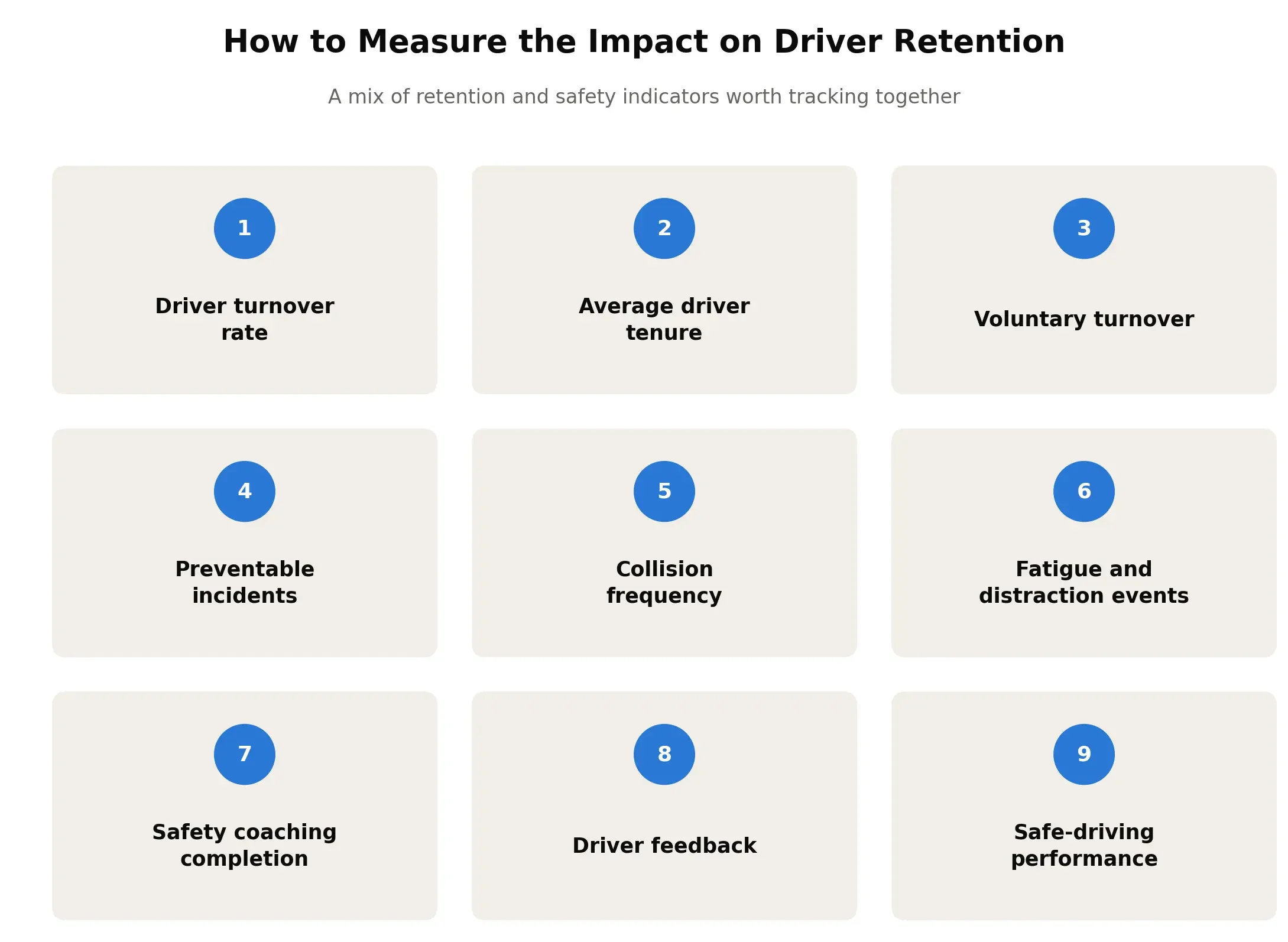
Driver Retention by Region: India, Southeast Asia, GCC, and Europe
The retention problem is global. Rules and road conditions change by region.
- India: Mixed traffic, unmarked rural highways, and night-heavy duty cycles make fatigue and blind spots a daily risk. Systems need calibration for local roads.
- Southeast Asia: An ageing driver base and shrinking license intake in markets like Thailand and Malaysia make every experienced driver worth keeping.
- MEA and GCC: Long desert and highway hauls raise fatigue risk. Novus’s analysis of driver monitoring in smart mobility notes that safety rules around fleet monitoring are tightening across India, the EU, and GCC markets.
- Europe: The EU’s General Safety Regulation pushes driver alertness and distraction warnings into new vehicles. Novus launched GSR-compliant ADAS solutions at InCabin Barcelona in 2024.
Different regions, same pattern. Fleets that treat driver safety as part of the job offer, not an add-on, give drivers a reason to stay.
Conclusion
The driver shortage won’t ease soon. IRU data, World Bank estimates for India, and Southeast Asian market analysis all point the same way.
Safety tech won’t replace fair pay or sensible schedules. But used to protect drivers, it makes the job safer, the disputes fairer, and the data transparent, which are the things that keep good drivers in the cab.
Want to see how this could work for your fleet? Talk to Novus Hi-Tech about ADAS and driver monitoring built for India, Southeast Asia, and the GCC.