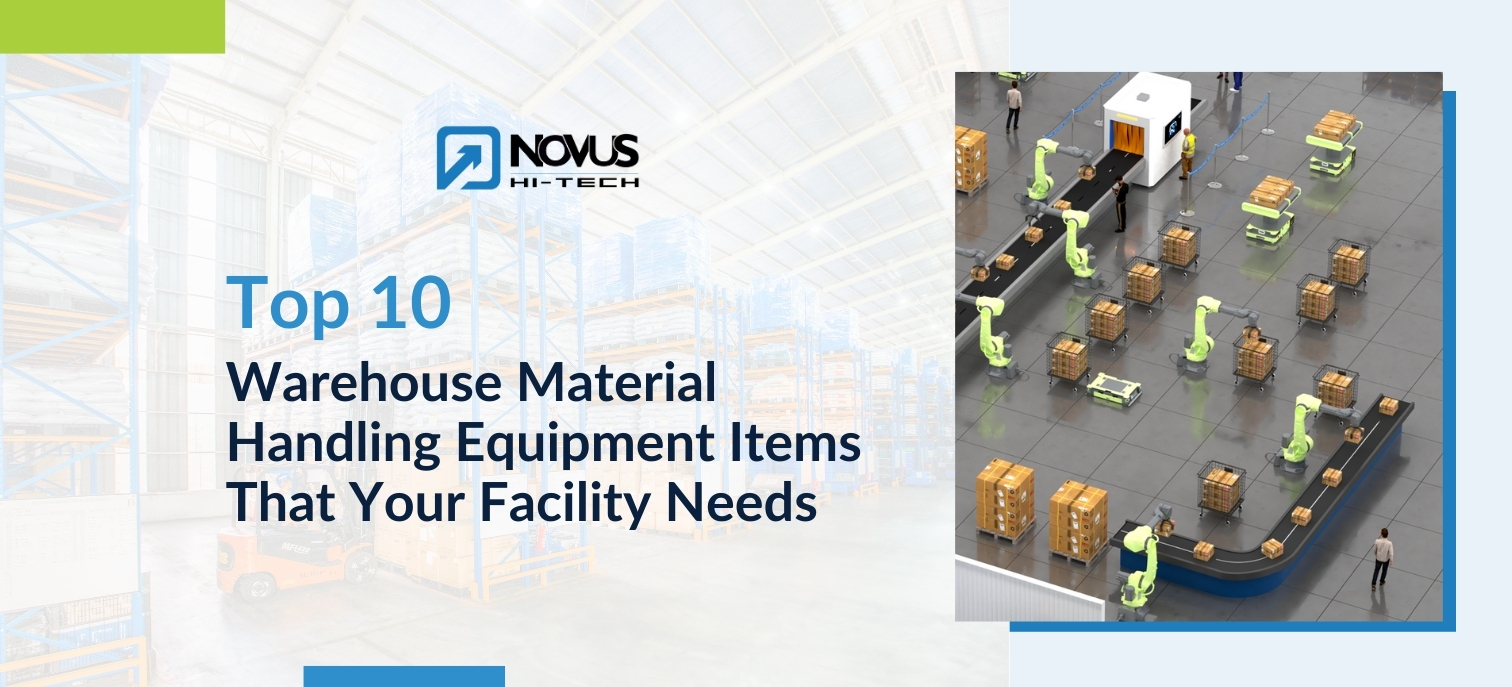
Material handling equipment is any tool, vehicle, or system a warehouse uses to move, lift, store, load, or retrieve goods. The main types are manual trucks, powered vehicles like forklifts, conveyors, loading equipment, storage systems, and automated equipment such as autonomous mobile robots. Most warehouses need a mix of several types.
Choosing the right mix lowers handling cost per pallet, speeds up order cycles, and keeps people away from risky manual lifting. This guide covers 10 essential types, what each is used for, and the benefits it brings.
Material handling equipment list at a glance
| # | Equipment | Category | Typical load | Main use |
|---|---|---|---|---|
| 1 | Hand and platform trucks | Manual | Up to 1,000 kg | Cartons and bulky items, short moves |
| 2 | Pallet trucks (manual and electric) | Manual / powered | 1,500 to 3,000 kg | Moving single pallets at floor level |
| 3 | Pallet stackers | Powered | 1,000 to 2,000 kg | Lifting pallets to low and medium racks |
| 4 | Counterbalance forklifts | Powered | 1,500 to 5,000 kg | Truck loading and general pallet work |
| 5 | Reach trucks and order pickers | Powered | 500 to 2,500 kg | High-bay storage and picking at height |
| 6 | Conveyor systems | Fixed | Carton or tote level | Continuous flow between fixed points |
| 7 | Dock levellers and loading equipment | Loading | Rated to truck traffic | Loading and unloading trucks |
| 8 | Pallet racking and shelving | Storage | Rated per beam level | Storing goods between moves |
| 9 | AMRs and AGVs | Automated | 250 to 20,000 kg | Driverless transport between zones |
| 10 | Autonomous forklifts | Automated | Pallet level | Driverless pallet transport and stacking |
Load ranges are typical industry ranges. Always check the rated capacity of the specific model.
Top Warehouse Material Handling Equipment
1. Hand trucks and platform trucks
A hand truck is a two-wheeled upright trolley the operator tilts back and pushes. A platform truck is a flat deck on four casters for larger or awkward loads. Both are the simplest and cheapest equipment on any material handling equipment list.
Uses: moving stacked cartons, drums, gas cylinders, mixed items, and maintenance stores over short distances.
Benefits:
- Very low purchase and running cost, with no charging or fuel.
- No operator licence or special training needed.
- Reduces carrying by hand, which cuts strain injuries on small, frequent moves.
2. Pallet trucks (manual and electric)
A pallet truck, also called a pallet jack, slides its forks under a pallet and raises it just off the floor. A manual truck uses a hydraulic pump handle and the operator pulls it. An electric truck uses a battery to drive and lift, so the operator only steers.
Uses: moving pallets between the dock, staging areas, storage, and production lines.
Benefits:
- The standard, low-cost way to move a single pallet.
- Electric models cover longer runs and more pallets per shift without operator fatigue.
- Compact enough for tight aisles and truck beds.
3. Pallet stackers
A pallet stacker lifts pallets off the floor and into low or medium-height racking. It is smaller and cheaper than a forklift and works in narrower aisles.
Uses: putting pallets away in small warehouses, back-of-store rooms, and production stores.
Benefits:
- Adds vertical storage without the cost of a full forklift.
- Smaller footprint suits tight sites.
- Lower running cost and simpler operator training.
4. Counterbalance forklifts
The counterbalance forklift is the most widely used forklift. A weight at the rear balances the load on the front forks, so it needs no support legs. Electric models suit indoor work, while diesel and LPG models suit yards and heavy-duty outdoor work.
Uses: truck loading and unloading, yard moves, and general pallet handling.
Benefits:
- Handles heavy loads indoors and outdoors.
- Very versatile, so one machine covers many tasks.
- Fast at the dock, where most pallet traffic happens.
Watch for: it needs wide aisles to turn, and forklift and pedestrian traffic is a common source of warehouse incidents.
5. Reach trucks and order pickers
A reach truck extends its forks forward to place pallets deep into high racking, and turns in narrow aisles. An order picker raises the operator with the platform so they can pick individual cases from upper levels.
Uses: high-bay pallet storage (reach truck) and case or piece picking at height (order picker), common in e-commerce and spare-parts warehouses.
Benefits:
- More storage in the same floor area through taller racks and narrower aisles.
- Removes ladders from picking at height.
- Shorter travel between pick faces.
6. Conveyor systems
A conveyor moves goods continuously along a fixed path. Roller and belt conveyors handle cartons and totes. Telescopic conveyors extend into trucks and containers for unloading. In bulk industries, conveyors, stackers, and bucket elevators move loose material such as grain, coal, or sand.
Uses: sorting, packing lines, linking production to dispatch, and unloading floor-loaded containers.
Benefits:
- High, steady throughput between fixed points.
- Cuts walking and carrying for workers.
- Less product damage than repeated manual handling.
Watch for: conveyors are fixed. They work best when the flow and layout will not change for years.
7. Dock levellers and loading equipment
A dock leveller is a hinged steel plate built into the loading dock. It bridges the height gap between the dock floor and the truck bed, so pallet trucks and forklifts can drive straight in. Dock ramps and dock boards do the same job where a fixed leveller is not installed.
Uses: loading and unloading trucks of different heights.
Benefits:
- Faster, smoother loading and unloading.
- Safer crossings for vehicles and people at the dock edge.
- Less damage to goods and equipment from bumps and drops.
8. Pallet racking and shelving (storage equipment)
Storage and handling equipment holds goods between moves. Pallet racking stores full pallets in rows and levels. Shelving and bins hold cartons and small parts. Automated storage and retrieval systems (AS/RS) store and fetch loads automatically in high-volume sites.
Uses: bulk pallet storage, pick faces, small-parts stores, and buffer stock.
Benefits:
- Uses vertical space, so the site stores more per square metre.
- Organised locations make stock counts and picking faster.
- Protects goods from floor stacking damage.
Racking choice also decides which vehicles you need. High racks need reach trucks, while narrow aisles rule out counterbalance forklifts.
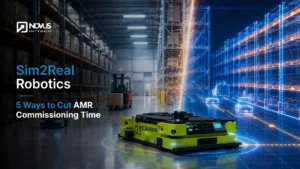
9. Autonomous mobile robots (AMRs) and automated guided vehicles (AGVs)
Both move goods without a driver, but they navigate differently. An autonomous mobile robot maps the site and plans its own route around people and obstacles, so routes change in software. An AGV follows a fixed path set by tape, magnets, or reflectors, which suits stable, repetitive routes. See our guide to types of AGVs.
Uses: line-side supply, trolley towing, and transport between storage, production, and dispatch.
Benefits:
- Runs across shifts without fatigue.
- Frees operators from repetitive transport for higher-value work.
- Fewer forklifts in pedestrian areas, which lowers collision risk.
- Consistent, trackable delivery times.
Novus Hi-Tech builds both. Novus Carry is the AMR range: Carry for general transport, Carry Slim for sliding under carts and racks, Carry HD for heavy loads, and Carry Omni for moving in any direction. Swappable top modules (lifter, conveyor, roller top, hitch) let the same robot do different jobs. Novus Line covers assembly, heavy-duty, and rail-guided AGVs, and Novus Tow tuggers handle line-side milk runs. The range runs in plants and warehouses across India, the Middle East, and Southeast Asia.
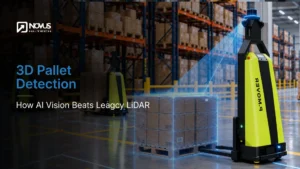
10. Autonomous forklifts
An autonomous forklift does the work of a pallet truck or stacker with no operator. It finds the pallet, picks it, moves it, and drops it at the target location. 3D pallet detection lets it handle pallets that are slightly out of position, which is normal on real warehouse floors.
Uses: repetitive pallet moves from dock to storage, storage to production, and end-of-line to dispatch.
Benefits:
- Removes a driver from the most repetitive pallet runs.
- Steady output across all shifts, including nights.
- Fewer forklift incidents and less product damage.
- Easy to start small with one route and add more.
Novus Fork is Novus Hi-Tech’s range of pallet robots, in jack, stacker, and forklift versions, covering everything from floor-level pallet moves to stacking into racks. For sites that already own forklifts, Novus Drive autonomy kits can retrofit existing machines from other makers to run without a driver.
Material Handling Equipment vs Material Handling Systems
Material handling equipment means the individual tools and vehicles above. A material handling system is how they work together: the storage layout, the equipment fleet, the routes between zones, and the software that directs them.
Material handling equipment is usually grouped into four categories:
- Storage and handling equipment: racking, shelving, bins.
- Bulk material handling equipment: conveyors, stackers, bucket elevators.
- Industrial trucks: pallet trucks, stackers, forklifts, order pickers.
- Engineered and automated systems: AS/RS, AMRs, AGVs, autonomous forklifts.
Planning the system, not just buying single machines, is what turns equipment into throughput.
How to Choose The Right Material Handling Equipment
- What do you move? Cartons, pallets, long items, or bulk material.
- How far, and how often? Short, occasional moves suit manual equipment. Long, repeated moves suit powered or automated equipment.
- How high do you store? Floor storage needs pallet trucks. High racks need reach trucks.
- How wide are your aisles? Counterbalance forklifts need the most space.
- Where is your labour risk? Multi-shift sites with high attrition or forklift near-misses gain most from automation.
When to automate
Automation pays back fastest where the same pallet or trolley move repeats many times per shift across several shifts. Dock to storage and storage to line are common first routes. Novus Hi-Tech has deployed 1,400+ robots, backed by 150+ patents and 10M+ km of autonomous navigation, for customers including Asian Paints, Nestlé, and Volvo Eicher.
Talk to our team to find the route in your facility that will pay back first.