What happens when your quickest robot encounters an unforeseen obstacle? In many warehouses, the result is a halt, a pause, and a blockage forming precisely where speed is most critical.
The difference between a robot’s performance on a pristine demo floor and its effectiveness in a real-world setting is where numerous automation investments fall short. While cycle time and pick rate may appear impressive on paper, they lose significance when forklifts, personnel, and other robots begin to navigate the same aisle simultaneously. This is exactly why warehouse robot navigation now gets scrutinized as closely as raw speed.
What Exactly Is a Mixed Traffic Robot?
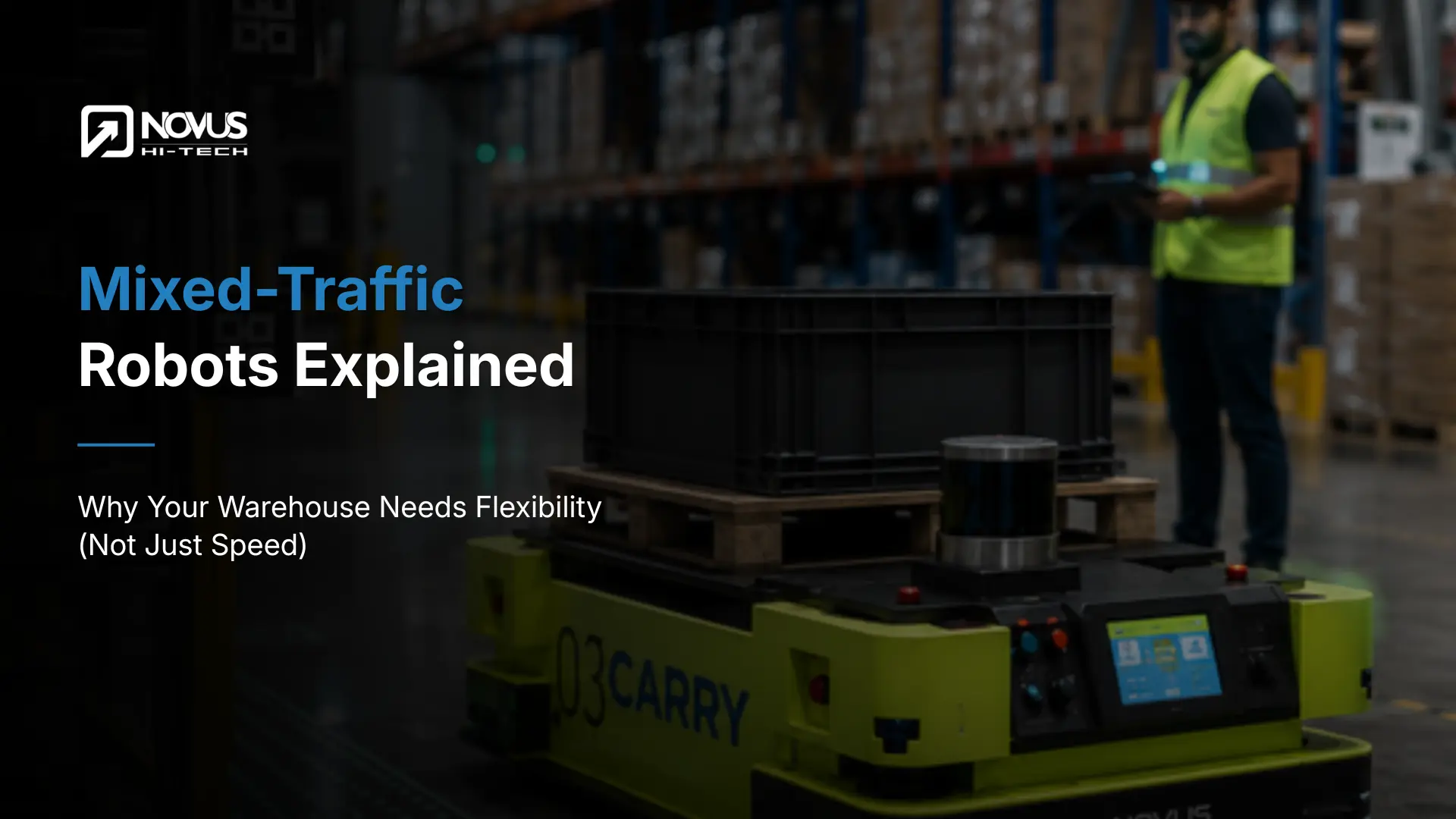
A mixed-traffic robot is a robot that is operating in a space that it does not fully control. People, forklifts, carts, and other robots all share the same floor, often all at the same time, with no dedicated lane to keep them apart.
That’s a completely different problem than a robot sitting inside a fenced cell where nothing weird ever wanders in. Night and day, really.
For a robot to handle that kind of chaos, a few things need to be happening simultaneously:
- It has to sense what’s actually near it right this second, not what a floor plan claimed an hour ago
- It needs a solid fix on exactly where it is on the map, constantly
- And it has to take both of those and make a call on where to go next, then be ready to scrap that call the instant something shifts
Basically, it’s a robot watching, deciding, and adjusting over and over. Older automation only ever worked because the room around it stayed predictable.
AMR vs AGV – Is the Question What It Used to Be?
For a long time, the AMR vs AGV conversation basically boiled down to price and how twisty your routes were.
An AGV sticks to a fixed path. Wire buried in the floor, tape on the ground, fixed beacons – whatever the setup, it doesn’t stray from it. Reliable, sure, but only as long as nothing on that path changes.
An AMR does its own thing. It maps the space using onboard sensors and figures out a route as it goes, adjusting on the fly.
Fair enough, that split still exists. But there’s a wrinkle now: regulators expect both categories to hit roughly the same detection and stopping benchmarks. Which means the label on the machine matters less than it used to.
For a deeper look at how AMRs handle unexpected obstacles, see Novus Hi-Tech’s guide to AMR navigation in warehouses.
One more data point worth chewing on. Industry projects show AGV revenue dropping from around a third of total mobile robot revenue in 2024 to roughly a fifth by 2030, as budgets keep tilting toward AMR-style flexibility. That’s the shift powering flexible warehouse automation across the industry.
Regulators Are Finally Catching Up to the Hardware
Good news: the rulebook is catching up to the tech, and that’s actually great timing for anyone shopping for these systems right now.
ISO 3691-4:2023 is the international standard covering safety requirements and verification for driverless industrial trucks and their systems, including AGVs and AMRs. It sets a clear, high bar, requiring the robot to stop before any contact happens, so buyers finally have a solid benchmark to hold vendors to.
In the U.S., ANSI/RIA R15.08 provides safety requirements for industrial mobile robots and is commonly considered alongside ISO 3691-4 when evaluating mobile-robot safety. Together, the two give buyers a genuinely reliable way to compare vendors apples to apples.
That’s a real win for you. When a vendor can clearly walk you through how their dynamic obstacle avoidance meets these standards, it’s a strong sign they’ve engineered for messy, shared floors from the ground up.
Fleets Are Where Coordination Gets Tested
One robot on its own? Rarely causes problems. The headaches start once you go from a handful of units to an actual fleet.
A couple of robots hit the same junction at the same second. Or three of them are all racing toward one pickup station.
That’s the challenge that multi-robot coordination is meant to solve. And it’s not getting less relevant anytime soon. An industry expert expects the global installed base of mobile robots to blow past 4.2 million units by 2030. With that many machines on the floor, a coordination failure gets a lot more expensive than it used to.
Good warehouse robot navigation goes further than just dodging whatever’s directly in front of it. It’s trying to predict where the rest of the fleet will be half a minute from now and steering around a jam before it even forms.
Where Does That Leave You?
Speed still counts for something, don’t get me wrong. But a fast robot that freezes the second a forklift crosses its path isn’t fixing your bottleneck. It’s just moving it somewhere else.
Ask the vendor the following questions:
- Can they walk you through real documentation for ISO 3691-4 and ANSI/RIA R15.08 compliance, not just a claim on a spec sheet?
- What happens when three robots want the same aisle at the same time?
- Does scaling up mean adding units, or does it mean redoing your entire layout?
Novus Hi-Tech’s forklift AMRs and autonomous pallet trucks show how that flexibility-first thinking plays out on an actual warehouse floor, not just on paper. That’s what flexible warehouse automation is ultimately about.
Wondering what mixed-traffic robots could realistically do for your operation? Meet our team that’s built for shared, unpredictable floors, not just a straight line and a stopwatch.