Most fleet buyers treat a five-star safety rating as a settled fact. It isn’t. It’s a snapshot, and snapshots go stale.
Case in point: in March 2026, ASEAN NCAP withdrew the Proton X90’s 5-star rating after its 2026 facelift quietly dropped autonomous emergency braking, lane keep assist, and blind-spot detection, the exact tech that earned it the rating. No new crash. No new test. Just less safety equipment on the same nameplate.
For fleet operators, that’s the real risk: assuming a rating travels with the name when it actually belongs to a specific variant at a specific point in time.
Why the Rating System Is Changing
For some time, ASEAN NCAP has been rating vehicles, primarily based on crash tests, to assess how well a car protects occupants in the event of an accident.
The 2026-2030 protocol retains the same four-pillar structure (adult occupant protection, child occupant protection, safety assist and motorcyclist safety) but rebuilds what is under it:
- Expanded test criteria under the same category weightings make safety assist and motorcyclist safety scoring more granular
- New AEB test scenarios are built specifically around collisions between cars and motorcycles
- Motorcyclist safety, in particular, gets sharper focus given how disproportionately two-wheelers feature in regional traffic
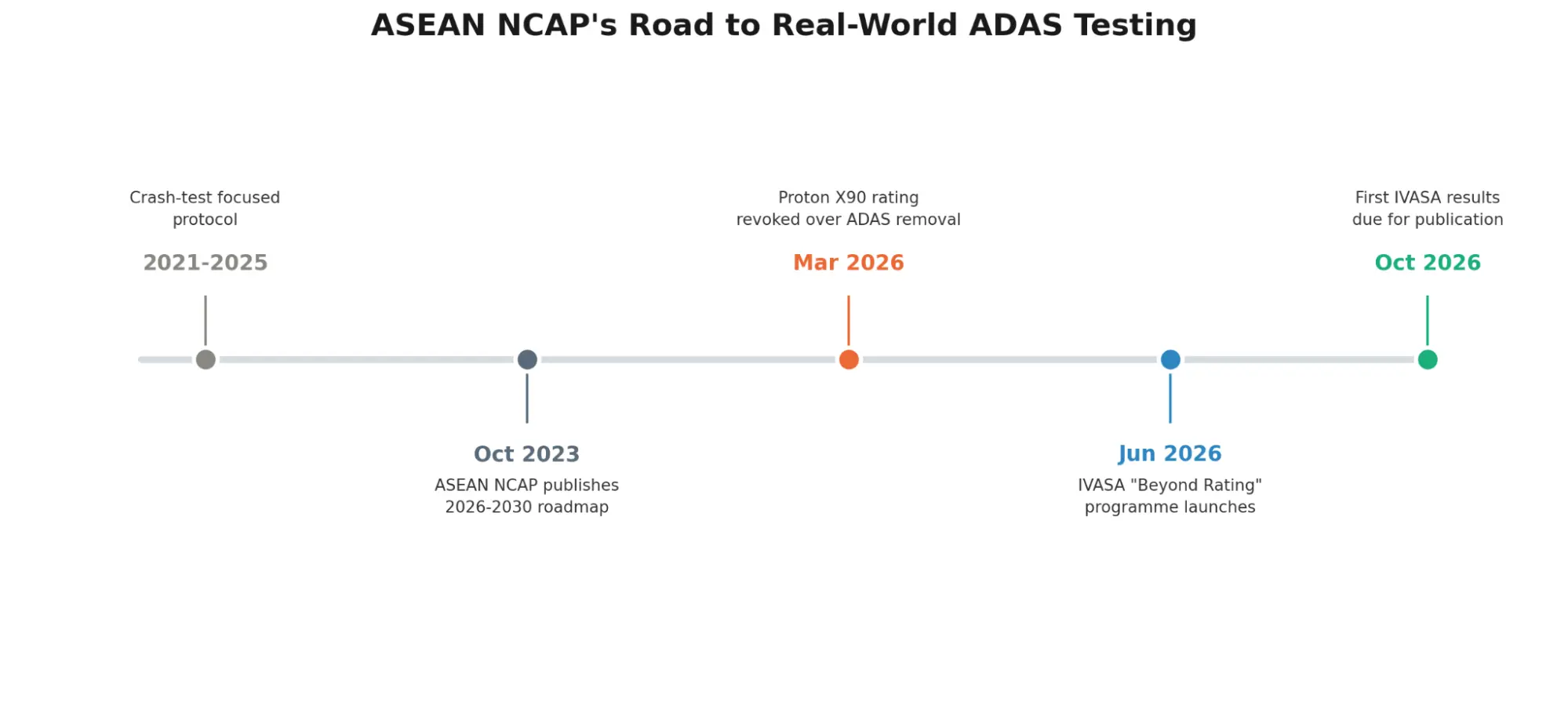
The bigger change lies outside the star-rating system. In June 2026, IVASA ASEAN NCAP launched, the Intelligent Vehicle Advanced Safety Assessment, nicknamed “Beyond Rating.” It’s the first programme in the region dedicated to real ADAS testing Southeast Asia has ever had.
The new ASEAN NCAP ADAS rating covers three areas:
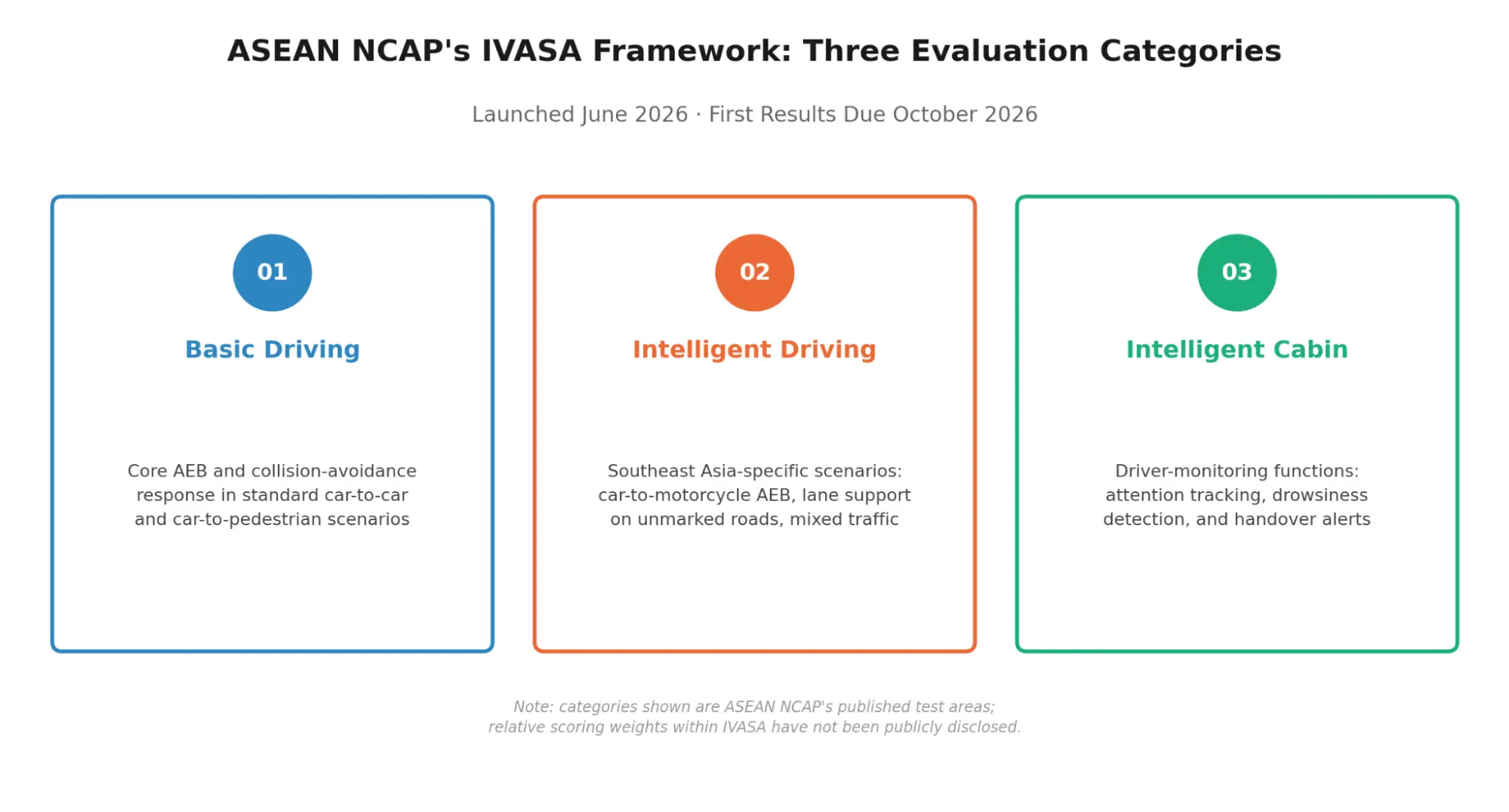
For now, the programme focuses on vehicles with SAE Level 2 automation, and automakers volunteer their vehicles for testing; not every model is assessed automatically.
How IVASA Typically Tests ADAS
- Scope: Applies to SAE Level 2 vehicles, systems that provide both steering and acceleration/braking support (e.g., adaptive cruise control + lane centering) but still require an attentive driver.
- Basic Driving: Tests fundamental AEB and collision avoidance in typical car-to-car and car-to-pedestrian situations.
- Intelligent Driving: Includes Southeast Asia-specific scenarios like car-to-motorcycle AEB, lane support on painted/unmarked roads, and system behavior in mixed traffic.
- Intelligent Cabin: Driver monitoring features: attention monitoring, drowsiness detection, and how well the system alerts or takes back control. This is the same discipline covered in our piece on driver monitoring’s role in smart mobility, where DMS picks up exactly where standard ADAS assumptions run out.
- Participation: Testing is currently voluntary. OEMs submit vehicles rather than having every model assessed automatically, so the absence of a rating doesn’t necessarily mean a vehicle underperforms, only that it hasn’t been tested yet. This voluntary, evolving structure is exactly why this intelligent driving systems rating matters for procurement decisions going forward.
What This Means for Fleet Operators
A five-star crash rating used to be the finish line for buyers. Now it’s just the starting point.
IVASA testing looks closely at:
- AEB performance against motorcycles
- Lane support systems
- Blind-spot detection
The takeaway for fleet buyers: a star rating earned years ago doesn’t guarantee the same safety tech sits in this year’s model. Checking what ADAS features a vehicle actually has, not just trusting an old rating, is now part of doing your homework, and part of staying ahead of fleet safety compliance SEA expectations. Our guide on implementing ADAS across commercial fleets covers exactly this gap between owning the technology and operationalizing it.
Southeast Asia’s mixed traffic is exactly why this matters here more. Motorcycles filter between lanes, drift for visibility, and cut in without warning. Fleet vehicles need AEB and lane support tuned for that reality, not systems designed around clean European lane markings and predictable following distances.
The shift for fleets: stop just picking individually “safe” vehicles. Start building a fleet where every unit’s ADAS behavior is understood, verified, and monitored, not assumed.
Why a Good Rating Still Isn’t the Whole Story
There’s a real gap between having ADAS and using it well. Driver behavior, road conditions, and system limits all sit between a rated feature and a prevented accident.
This is where fleet safety operators need to think beyond the rating and toward the whole system:
- ADAS tells you what the vehicle can do
- Driver monitoring tells you what the driver is actually doing: distraction, drowsiness, disengagement
- Fleet data ties both together across every vehicle, route, and shift
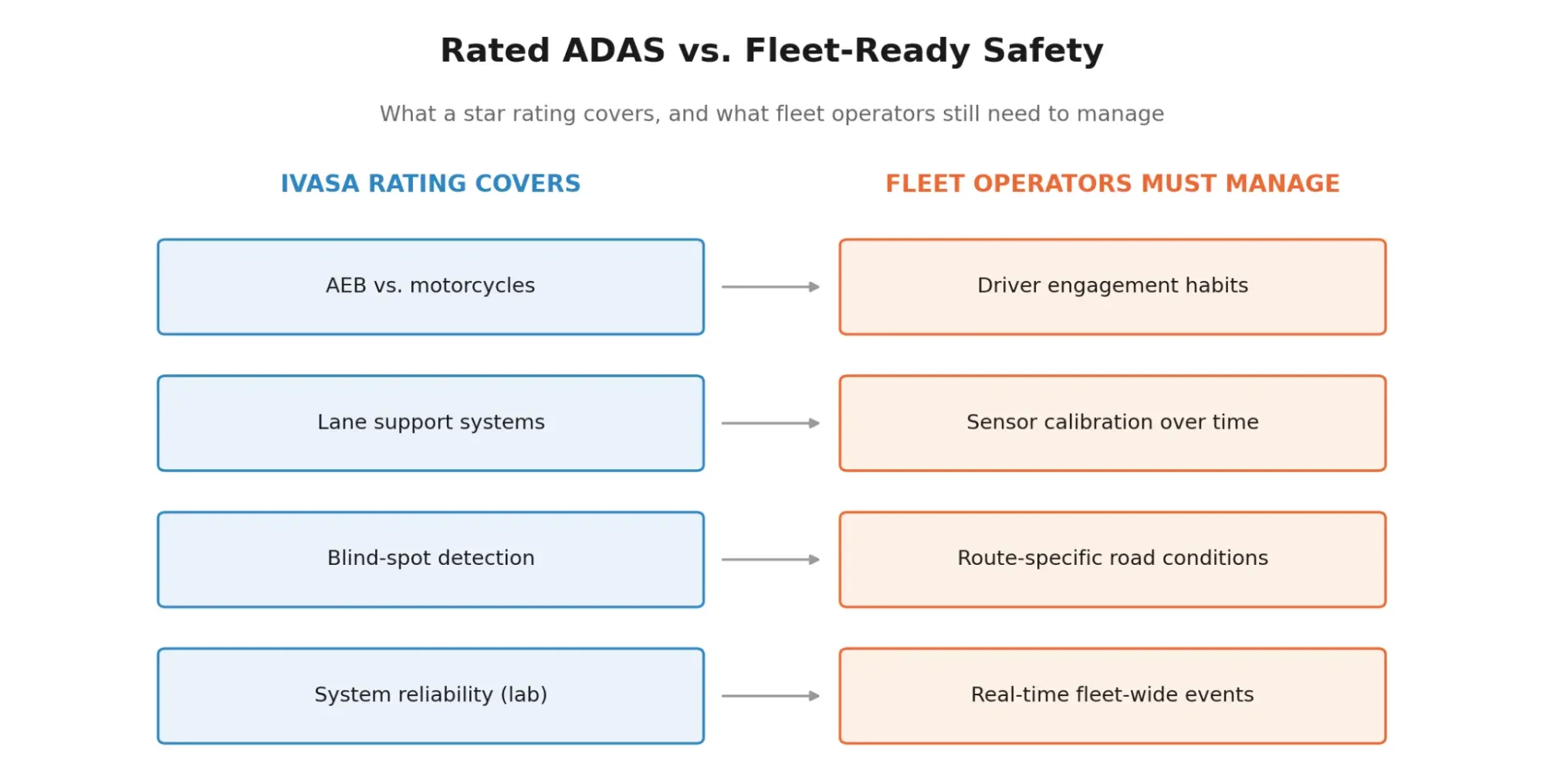
Together, these turn a one-time safety rating into an ongoing risk-management practice, and a foundation for real fleet safety compliance in Southeast Asia operators can rely on.
How Novus Helps Fleet Operators Put ADAS Into Action
Novus develops ADAS for OEMs built for real-time road-risk detection, engineered around the traffic patterns and road conditions common across India and Southeast Asia, not adapted from systems designed elsewhere.
Alongside that, Novus’s driver monitoring systems watch for distraction and drowsiness, the two failure modes that even a well-rated ADAS system can’t fix on its own.
And fleet-level visibility ties it all together. Novus is the first to aggregate safety events across the entire fleet, rather than keeping ADAS and driver-monitoring data siloed within each vehicle, enabling operators to recognize patterns, not just isolated incidents. AI-powered insights turn that raw data into actionable information – showing which routes, drivers, or vehicles are most at risk, before that risk becomes an accident.
If you run a commercial fleet on ASEAN routes, speak to our team about how ADAS-plus-DMS looks for your OEM or fleet program.
Ending Note
ASEAN NCAP’s evolving approach to ADAS gives fleet operators a stronger reason to closely examine vehicle safety technology, and IVASA’s real-world testing framework is a genuine step forward for the region.
But the rating itself is only half the picture. The real opportunity lies in connecting ADAS with driver monitoring and fleet intelligence, turning a vehicle-level safety score into fleet-wide, proactive risk management and a stronger fleet safety compliance SEA posture overall.