
In brief: Mobile robots in data centers handle autonomous inspection, rack transport, parts delivery, and continuous environmental monitoring in hyperscale facilities. This guide covers where AMRs deliver value first, how they navigate live server halls safely, and what operators should evaluate before deployment.
A single hyperscale campus can span hundreds of thousands of square feet, house tens of thousands of servers, and demand round-the-clock inspection and asset movement. Walking rounds that once covered a facility now cover a fraction of it, and the technicians available to do them are increasingly hard to hire.
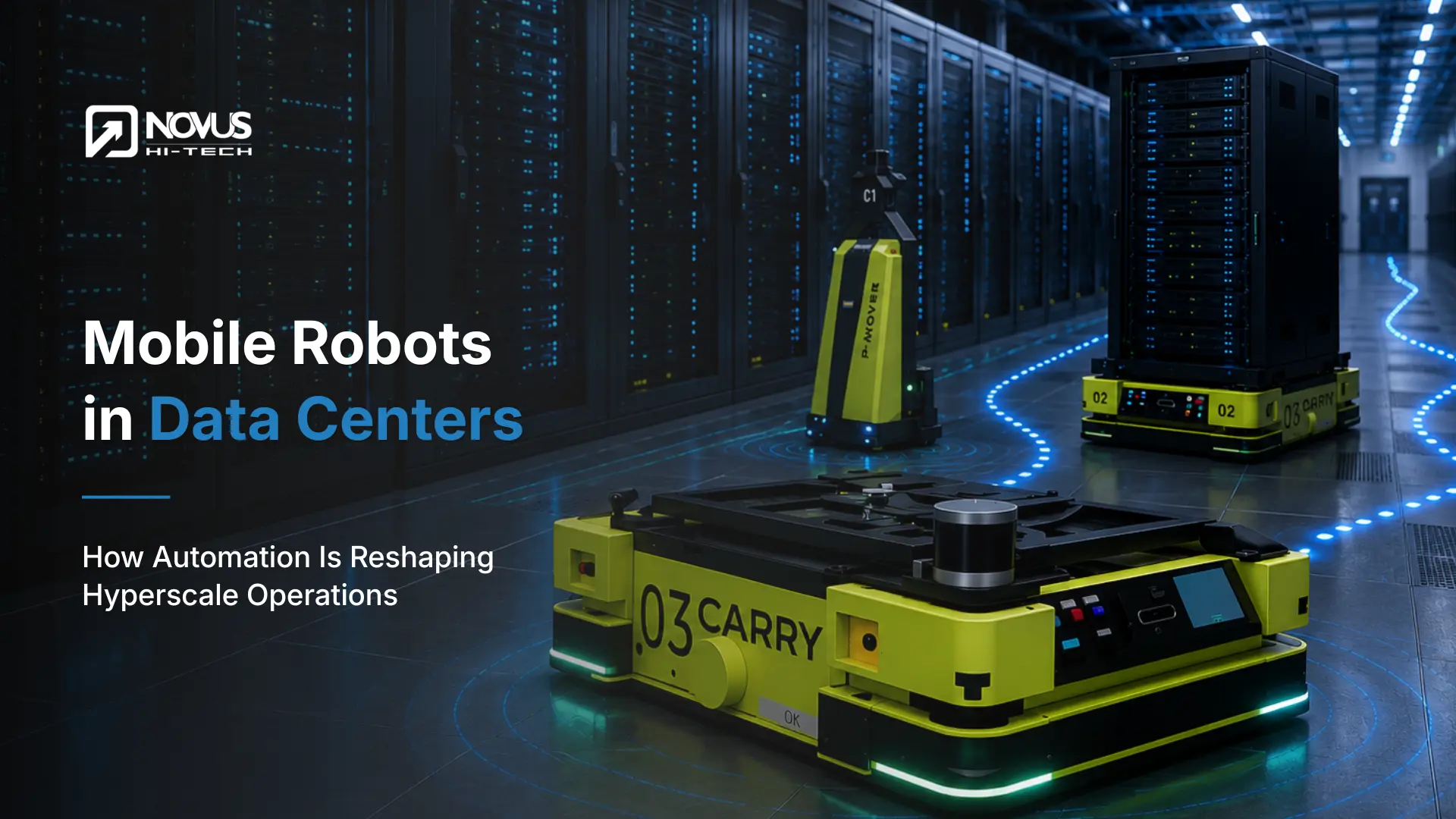
Mobile robots in data centers are closing this gap. AMRs patrol server halls on fixed schedules, move racks weighing several hundred kilograms, and capture rack-level thermal data continuously, without fatigue and without interrupting live infrastructure. For hyperscale operators, the question has shifted from whether to automate to which tasks to automate first.
What Are Mobile Robots in Data Centers?
Mobile robots in data centers are autonomous machines that navigate server halls and support areas independently, using LiDAR, cameras, and SLAM-based mapping to perform physical and monitoring tasks without fixed infrastructure such as rails or magnetic tape. They form one layer of broader data center automation with robotics, which also spans fixed and software-driven systems.
Unlike stationary automation, mobile robots move to work. The two main categories are:
- Autonomous Mobile Robots (AMRs): Navigate dynamically around people, carts, and obstacles. Suited for inspection rounds, spare parts delivery, and rack transport in live facilities.
- Automated Guided Vehicles (AGVs): Follow defined routes for repeatable, high-volume movement, such as shuttling equipment between staging areas and deployment zones.
Both operate alongside human technicians, which matters in data centers where uptime rules out disruptive retrofits.
Also read about 5 Key Differences between AGVs and AMRs
Why Are Hyperscale Data Centers Adopting Mobile Robots?
Hyperscale facilities face a specific set of pressures that make mobile robotics a practical answer rather than an experiment.
Scale Has Outgrown Manual Coverage
A hyperscale hall with thousands of racks cannot be inspected thoroughly by walking rounds. Mobile robots complete patrol circuits on fixed schedules, capturing thermal readings, airflow data, and visual checks at every rack position, every cycle.
Data Center Technician Shortage
Staffing remains a structural constraint for the industry. According to the Uptime Institute Global Data Center Survey 2025, nearly two-thirds of operators report difficulty finding qualified candidates, retaining staff, or both. Offloading repetitive inspection and transport tasks to robots lets scarce technical staff focus on diagnostics, upgrades, and capacity work.
Uptime Penalties Are Severe
Missed early warnings become outages. Continuous robotic monitoring detects hotspots, coolant anomalies, and equipment drift before they escalate, supporting the predictive maintenance models hyperscale operators are moving toward.
Physical Work Carries Injury Risk
Server racks, batteries, and cooling components are heavy. Robotic transport reduces manual handling injuries and the operational disruption that follows them.
Where Do Mobile Robots Work Inside a Hyperscale Facility?
Mobile robots in data centers typically enter operations through five task areas.
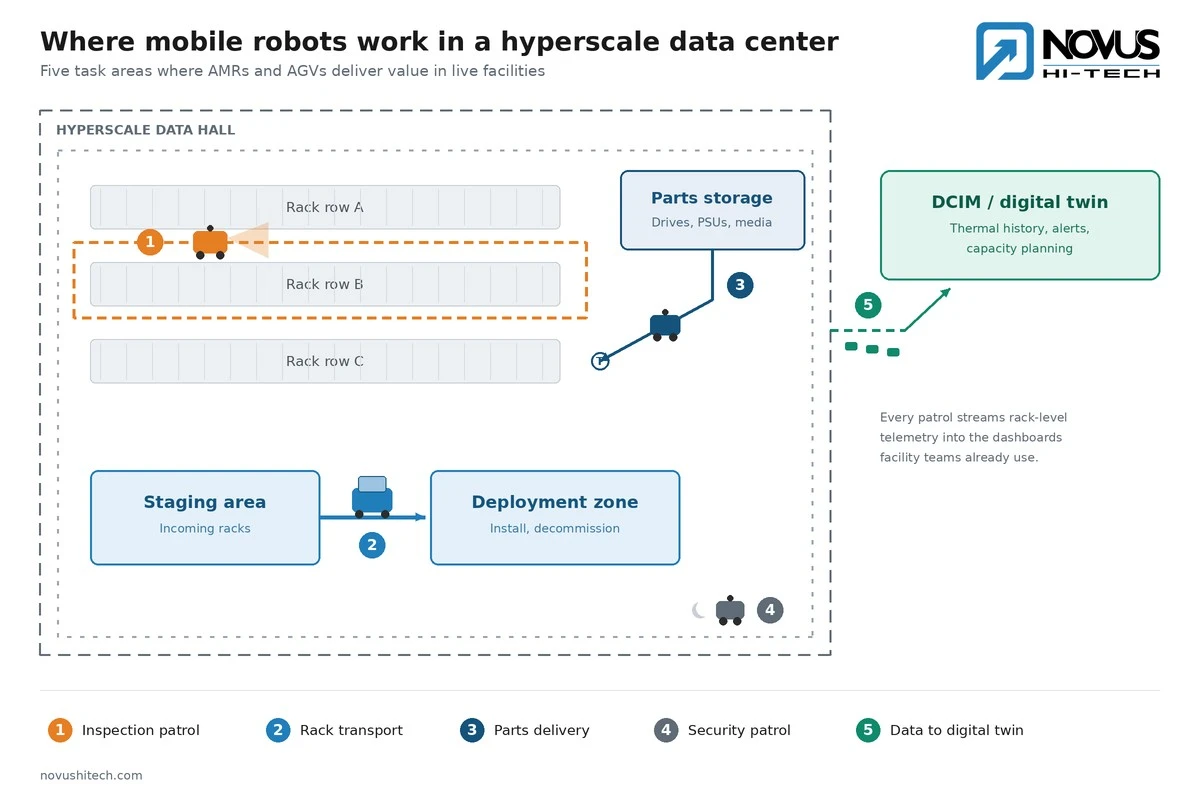
1. Autonomous Inspection Rounds
AMRs equipped with thermal cameras and environmental sensors patrol server halls on scheduled circuits. They log temperature at rack level against thermal envelopes such as the ASHRAE guidelines for data center environments, detect abnormal heat signatures, and flag deviations for technician review. Over time, this creates a rack-by-rack thermal history that manual rounds cannot match.
2. Server and Rack Transport
Populated racks can weigh several hundred kilograms. Mobile robots move racks between staging, installation, and decommissioning zones, reducing manual handling and keeping deployment schedules predictable during capacity expansions.
3. Spare Parts and Media Logistics
Hyperscale campuses run constant replacement cycles for drives, power supplies, and network components. AMRs deliver parts from secure storage directly to the technician at the fault location, cutting travel time inside facilities that can stretch across multiple halls.
4. Environmental and Security Monitoring
Robots patrolling after hours extend monitoring coverage for water leaks, unauthorized access, and door or containment anomalies, complementing fixed sensor grids with mobile verification.
5. Data Collection for Digital Twins
Every patrol generates location-tagged operational data. Fed into a digital twin platform, this data keeps the virtual facility model current, improving airflow simulation, capacity planning, and failure prediction.
Who Benefits from Mobile Robots in Data Centers?
Facility operations leaders gain consistent inspection coverage and cleaner data for uptime reporting and audits.
Data center technicians shed repetitive patrol and transport work, spending more time on skilled diagnostics and installations.
Capacity planners get accurate, continuously refreshed thermal and space utilization data for expansion decisions.
Cloud and colocation customers benefit indirectly through improved reliability and faster fault response inside the facilities hosting their workloads.
Safe navigation in a live facility is the core technical requirement. Modern AMRs combine:
- LiDAR and 3D vision for real-time obstacle detection around technicians, carts, and open floor tiles
- SLAM mapping to localize within halls that look visually repetitive
- Fleet management software to coordinate multiple robots, allocate tasks, and manage charging cycles
- Integration with DCIM systems so robotic findings flow into the same dashboards operators already use
Safety behavior in shared workspaces is governed by standards such as ISO 3691-4, which defines requirements for driverless industrial trucks operating around people. The result is a robot fleet that operates as an extension of the facility team, not a separate system requiring parallel supervision.
When Should a Data Center Deploy Mobile Robots?
Deployment timing depends on operational signals more than facility age. Strong indicators include:
- Capacity expansion is planned.
New halls can be designed robot-ready from day one, with charging bays, network coverage, and floor specifications included. - Inspection backlogs are growing.
If rounds are being shortened or skipped to cover ground, coverage has already degraded. - Technician hiring is falling behind.
Robots absorb the repetitive workload that vacancies leave uncovered. - Predictive maintenance is on the roadmap.
Predictive models need dense, consistent sensor data. Robotic patrols supply it.
Brownfield facilities can be adopted in phases, starting with inspection AMRs that require no structural change, then expanding into transport once workflows are proven.
What Challenges Should Operators Plan For?
Mobile robot deployments succeed when known constraints are addressed upfront rather than discovered mid-pilot.
Network Coverage Gaps
AMRs depend on reliable wireless connectivity for fleet coordination and data upload. Server halls with dense metal racks create dead zones, so a wireless survey should precede deployment, with access points added where patrol routes demand them.
Floor Load and Layout Constraints
Raised floors have load ratings, and a robot carrying a populated rack concentrates significant weight on small contact points. Operators need to verify floor specifications along transport routes and confirm aisle widths, ramp gradients, and door clearances match the robot’s operating envelope.
Change Management with Facility Teams
Technicians who see robots as replacements resist them. Positioning robots as tools that remove patrol drudgery, and involving operations staff in route planning and alert configuration, builds the adoption that pilots need to scale.
Data Ownership and Security
Patrol robots capture imagery and telemetry inside secure facilities. Contracts should define where that data is stored, who can access it, and how it is retained, particularly in colocation environments where multiple customers share halls.
What Should Operators Evaluate Before Deployment?
Four factors separate successful deployments from stalled pilots:
- Integration depth.
The robot fleet should report into existing DCIM and ticketing systems, not a standalone dashboard nobody checks. - Navigation performance in live conditions.
Test AMRs during shift changes and maintenance windows, not empty halls. - Fleet scalability.
A pilot with two robots should run on the same fleet management platform that will later coordinate twenty. - Vendor deployment experience.
Data centers are unforgiving environments. Prioritize partners with proven deployments in mission-critical or industrial facilities.
Novus Hi-Tech brings this deployment depth from more than 1,400 deployments and over 10 million kilometers of autonomous navigation across manufacturing, warehousing, and infrastructure environments, backed by a portfolio of 150+ patents in autonomous systems.
Explore how Novus Hi-Tech is transforming industrial automation with advanced Mobile Robotics, AMRs, AGVs, ADAS, Fleet Safety Systems, and intelligent automation solutions designed for modern manufacturing, warehouse, and logistics environments.
Conclusion
Mobile robots in data centers have moved from pilot projects to operational necessity for hyperscale facilities. As halls grow larger and technician availability tightens, autonomous inspection, transport, and monitoring are becoming the baseline for reliable operations rather than a differentiator.
Operators that deploy early gain something harder to replicate later: months of dense operational data feeding predictive models, and workflows already tuned for human-robot collaboration before the next expansion phase begins.
Looking to evaluate mobile robotics for your facility? The Novus Hi-Tech team can help you select and implement the right AMR and AGV solution based on your operational requirements. Contact us today to discuss your deployment roadmap.