

Autonomous Mobile Robots (AMRs) are transforming modern manufacturing by enabling factories to become smarter, more flexible, and more efficient. Unlike traditional automation systems, AMRs can navigate dynamic environments, adapt to real-time changes, and integrate seamlessly into existing production lines. This makes AMR in manufacturing one of the most important innovations driving Industry 4.0.
What is AMR in Manufacturing?
AMR in manufacturing refers to the use of Autonomous Mobile Robots for tasks such as material handling, logistics, and assembly support. Unlike Automated Guided Vehicles (AGVs), which rely on fixed paths, AMRs use sensors, AI, and mapping technologies to move freely and safely within factory environments.
Key differences between AMRs and AGVs:
- Navigation: AMRs use AI-driven mapping; AGVs follow fixed tracks.
- Flexibility: AMRs adapt to layout changes; AGVs require infrastructure updates.
- Scalability: AMRs integrate easily into existing workflows.
Applications of AMR in Manufacturing
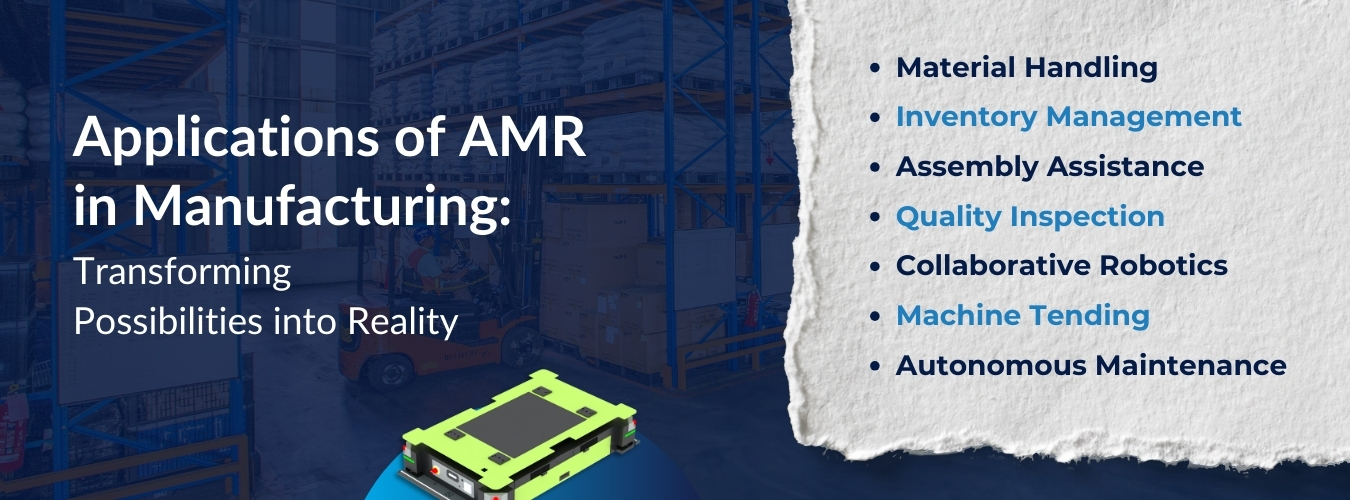
AMRs are being deployed across industries to solve critical challenges:
- Material Handling: AMRs transport raw materials, components, and finished products within manufacturing facilities, optimizing material flow and minimizing manual labor.
- Inventory Management: With their ability to autonomously navigate warehouse aisles, AMRs enable real-time inventory tracking and reduce inventory holding costs.
- Assembly Assistance: AMRs can collaborate with human workers in assembly lines, fetching tools and parts as needed.
- Quality Inspection: Equipped with sensors and cameras, AMRs can perform visual inspections of products, ensuring adherence to quality standards.
- Collaborative Robotics: AMR works alongside human operators, augmenting their capabilities and creating synergistic workflows.
- Machine Tending: AMRs assist in machine tending tasks, such as loading and unloading parts from CNC machines, increasing uptime and productivity.
- Autonomous Maintenance: AMRs can autonomously inspect equipment, detect anomalies, and perform routine maintenance tasks, minimizing downtime and optimizing equipment performance.
Advantages of AMR in Manufacturing

Underneath their sleek exteriors lies a multitude of benefits that AMRs bring to the manufacturing table:
- Enhanced Efficiency: AMRs streamline workflows by automating repetitive tasks, reducing production downtime, and optimizing resource utilization.
- Improved Safety: With their ability to navigate autonomously and avoid collisions, AMRs mitigate the risk of accidents in the workplace.
- Flexibility: Unlike traditional conveyor systems, AMRs can adapt to changing production layouts and scale operations seamlessly.
- Cost Savings: With their ability to operate 24/7 and minimal maintenance requirements, AMRs offer a cost-effective solution for improving manufacturing processes.
- Data-driven Insights: AMR generates valuable data insights that can be leveraged to optimize processes, improve resource allocation, and drive continuous improvement initiatives.
Revolutionizing Manufacturing: The Impact of AMRs
AMRs are not just incremental advancements; they represent a paradigm shift in manufacturing. By introducing flexibility, agility, and intelligence into factory operations, these robots are revolutionizing traditional production models, paving the way for a new era of manufacturing excellence.
The Future of AMRs: A Glimpse into Tomorrow’s Manufacturing Landscape
AI, machine learning, and sensor technologies will push AMR in manufacturing to become smarter with improved decision-making, real-time navigations, and fluid multimodel collaborations. With environmental adaptability being more improved, AMRs will be able to efficiently function under diverse working conditions while ensuring that human robotic interactions lead to safer and more intuitive automations. With scalable, energy-efficient designs, they will redefine efficiency, flexibility, and sustainability in industrial automation.
In a world where manufacturing excellence is paramount, the emergence of Autonomous Mobile Robot Systems heralds a new era of innovation and efficiency.
Ready to embrace this transformative technology? Reach out to Novus Hitech today and embark on your journey towards a human centric, safe, intelligent & more efficient manufacturing future!