

Material handling is one of the most labor-intensive and error-prone functions in any warehouse or manufacturing facility. According to the Material Handling Industry of America (MHI), it accounts for up to 25% of total manufacturing labor costs and nearly 15% of overall production costs — costs that compound with every order surge, labor shortage, and facility expansion.
Warehouse AMRs (Autonomous Mobile Robots) are fundamentally changing that equation.
Unlike legacy conveyor systems bolted to the floor or Automated Guided Vehicles (AGVs) locked to magnetic tracks, AMRs navigate freely, make real-time decisions, and adapt to changing floor conditions. They are already deployed at scale across e-commerce fulfillment centers, automotive plants, pharmaceutical warehouses, and cold-chain facilities — delivering measurable ROI in months rather than years.
This guide covers everything operations and logistics leaders need to know: how warehouse AMRs work, what types exist, what the real-world ROI looks like across industries, how they compare to AGVs and fixed conveyors, and what a practical deployment roadmap looks like.
What Are Autonomous Mobile Robots (AMRs)?
Autonomous Mobile Robots (AMRs) are devices that can navigate on their own to transport materials in unpredictable environments such as factories and warehouses. Unlike traditional Automated Guided Vehicles (AGVs) that have a set path based on fixed paths or systems like QR codes, AMRs are programmed to make real-time decisions based on their surroundings. By using sensors and an algorithm, AMRs can perform a range of tasks as needed, autonomously, with minimal or no input from humans. This allows for flexibility regarding tasks while improving the efficiency of material handling.
How Warehouse AMRs Work
Modern AMRs are not just wheeled carts. They are mobile computing platforms integrating multiple technologies simultaneously.
SLAM (Simultaneous Localization and Mapping):
SLAM allows an AMR to build a map of its environment while simultaneously tracking its own position within that map — all in real time. On startup, the robot navigates its environment to generate a facility map. During operation, it continuously updates that map as conditions change: new pallets placed in an aisle, temporary barriers, or a crowded loading dock.
This is what makes AMRs infrastructure-free. No floor markings. No QR codes. No ceiling beacons.
Lidar Sensors and Cameras:
Novus AMRs combine 360° LiDAR scanning with stereo cameras to perceive their surroundings in three dimensions. LiDAR excels at distance measurement and static obstacle detection; cameras add object recognition — distinguishing a parked forklift from a moving person and responding appropriately to each.
Onboard AI:
The robot’s AI module processes incoming sensor data at high speed, making routing decisions in milliseconds. If a faster path opens up, the AMR takes it. If an obstacle appears, it reroutes automatically rather than stopping and waiting for human intervention — the single most important productivity difference versus AGVs.
Fleet Management System:
Individual AMRs operate within a centrally coordinated fleet management system. This software receives task requests (from warehouse operators, WMS triggers, or ERP events), assigns the optimal available robot, monitors each robot’s status and battery level, manages traffic at intersection points, and provides a live dashboard of your entire automation layer.
Novus Hi-Tech’s fleet management platform supports fleets of any size — from a pilot deployment of 2 robots to enterprise-scale operations with 50+ units.
WMS Integration:
Warehouse AMRs reach their full potential when connected to your existing Warehouse Management System (WMS) or Enterprise Resource Planning (ERP) platform. On receiving a pick instruction from the WMS, the fleet management system dispatches the nearest available AMR to the source location. The robot completes the transfer and confirms task completion back to the WMS — without a single human touch.
Novus AMRs integrate with all major WMS and ERP platforms, including SAP, Oracle, Microsoft Dynamics, and custom systems via open APIs.
Types of Warehouse AMRs
Not all AMRs are the same. The right robot depends on your payload, workflow, and facility layout.
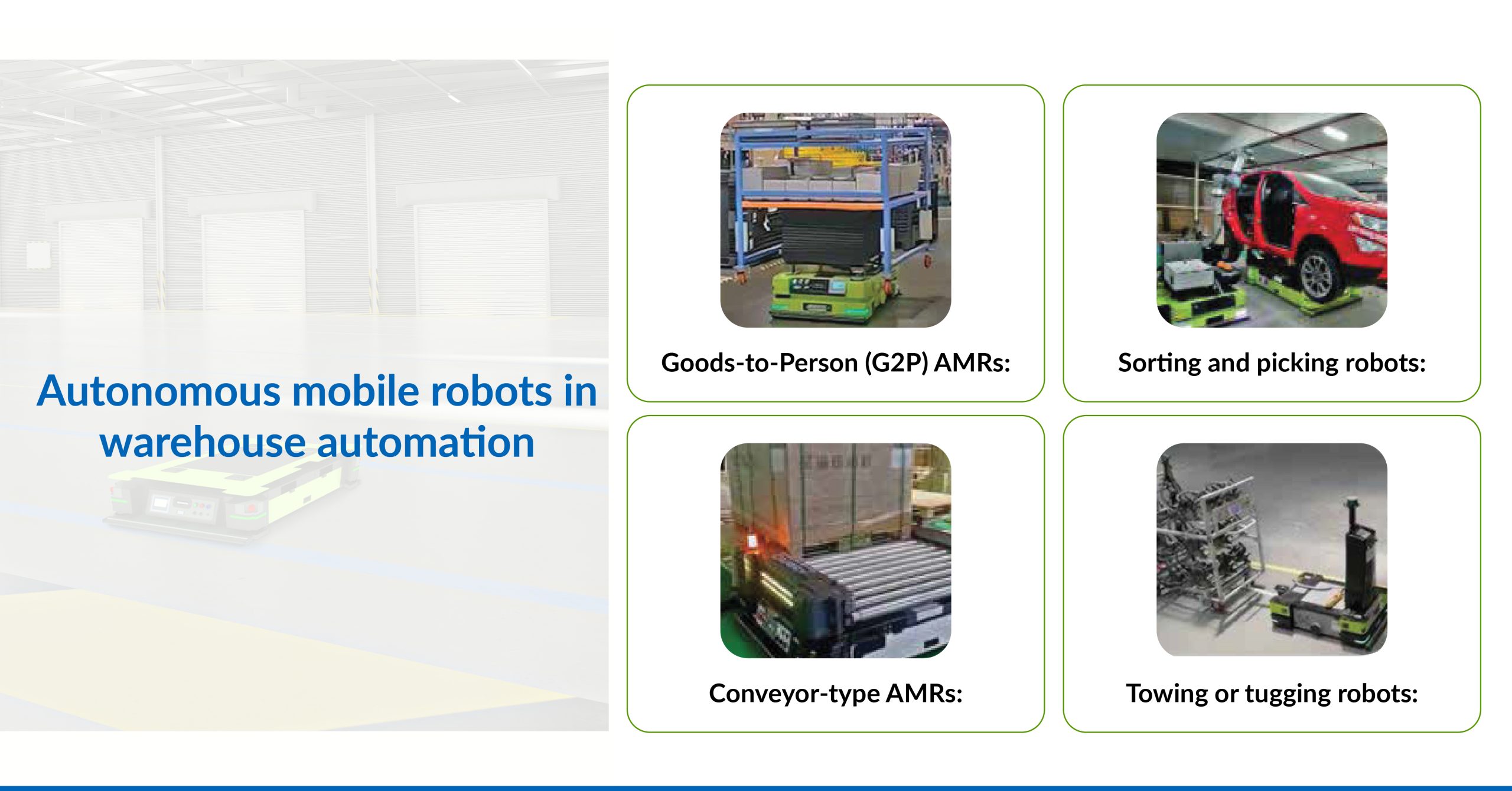
The range of AMRs includes many variations for warehouse automation purposes, including :
1. Goods-to-Person (G2P) AMRs
These robots bring product shelves or bins directly to stationary human pickers, eliminating the need for workers to walk up to 15 km per shift across warehouse aisles. G2P AMRs dramatically reduce pick cycle times and worker fatigue, and are the dominant format in high-SKU e-commerce fulfillment.
Best for: E-commerce, retail distribution, pharmaceutical dispensing
2. Autonomous Pallet Transporters
Heavy-duty AMRs like the Novus P-MOVER move loaded pallets weighing up to 1,500 kg between production lines, staging areas, and dispatch zones. They replace manual pallet trucks and counterbalance forklifts for routine transport tasks — removing the most common cause of warehouse injury.
Best for: Manufacturing, automotive, FMCG, distribution centers
Specs (Novus P-MOVER):
- Payload: up to 1,500 kg
- Navigation: LiDAR + SLAM
- Safety: 360° obstacle avoidance, emergency stop
- Charging: Autonomous opportunity charging
3. Tugger / Towing AMRs
Tugger AMRs pull carts or trailer trains loaded with multiple bins or components across long intra-facility routes. A single robot can replace multiple manual milk-run trips, maintaining a continuous, predictable parts supply to assembly lines.
Best for: Automotive assembly lines, lean manufacturing, line-side delivery
4. Goods-Carrying (Flatbed) AMRs
The Novus CARRY is a platform AMR that transports bins, totes, racks, and custom fixtures. Highly configurable, it adapts to a wide range of payloads and is the most commonly deployed AMR type across industries.
Best for: General warehousing, manufacturing, pharmaceuticals, retail logistics
5. Autonomous Mobile Conveyors
A newer category: AMRs that carry a conveyor surface on their deck, enabling automated transfer of items at fixed induction or discharge points without manual handling. These are particularly effective at connecting static conveyor lines across flexible routing paths.
Best for: Parcel sorting, returns processing, kitting operations
Discover how Material Handling AMRs boost automation efficiency.
Download our free brochure for expert insights and trends!
AMR vs AGV vs Fixed Conveyor: Which Is Right for You?
Choosing between automation technologies is one of the most common questions in warehouse planning. Here is a direct comparison:
| Criteria | AMR | AGV | Fixed Conveyor |
|---|---|---|---|
| Navigation | Free-roaming, AI-based | Fixed path (magnetic/QR) | Fixed infrastructure |
| Infrastructure required | None | Moderate (floor markings) | High (installation, civil works) |
| Obstacle handling | Dynamic rerouting | Stops and waits | N/A |
| Flexibility to change routes | High — software update | Low — physical rework | None |
| Upfront cost | Medium | Medium | High |
| Maintenance cost | Low | Medium | High |
| Scalability | Add units on demand | Add units + reroute tracks | Requires new installation |
| Best for | Dynamic, changing environments | Predictable, stable routes | High-volume fixed flows |
| Typical payback period | 12–24 months | 18–36 months | 3–7 years |
For most modern warehouses — where SKU mix changes, demand peaks shift, and layouts evolve — AMRs offer the most favorable combination of flexibility, ROI speed, and scalability. For a deeper comparison, read our detailed guide: AMR vs AGV vs Forklift: Which One Fits Your Operation in 2026?
Advantages of AMRs in Today’s Warehouse
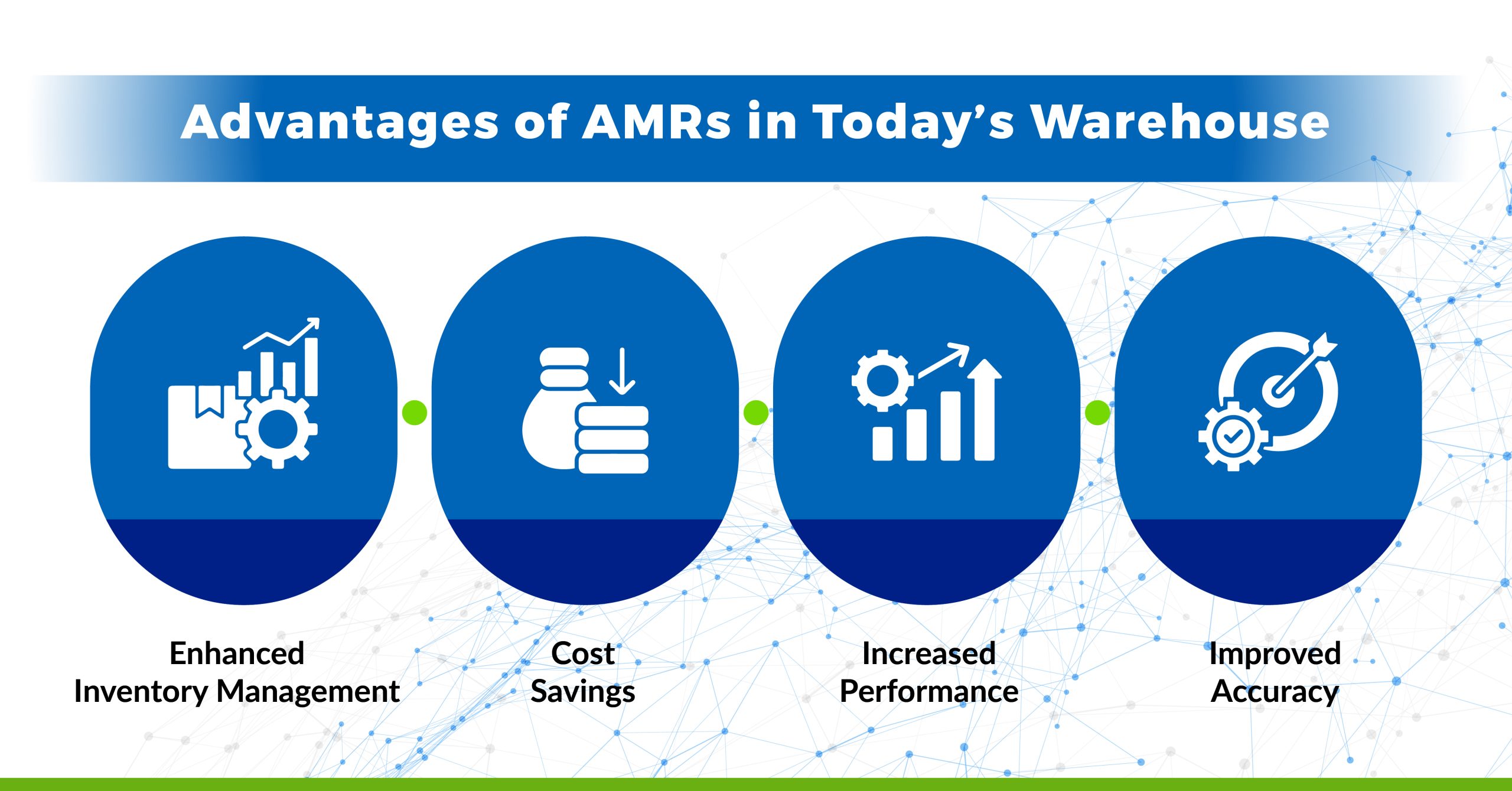
Enhanced Inventory Management
Real-Time Data Updating:
AMRs provide real-time status updates on inventory to maintain accurate stock counts.
Automated Replenishment Alerts:
Alerts can be set to notify stock depletion when items drop below threshold amounts.
Reduced Manual Oversight:
AMRs lessen the impact of human error in managing inventory.
Cost Savings
Labor Force Efficiency:
Automate repetitive tasks, allowing human workers to focus on value-added activities.
Reduced Maintenance Costs:
AMRs have reduced fixed and potential maintenance costs compared to conveyor systems.
Increased Performance
Operating Capacity:
AMRs can operate 24/7 and meet the demand in a high-throughput environment.
Modular Scalability:
AMRs can allow the operator to easily add units during peak seasons or expand the fleet of mobile bots with business increases.
Improved Accuracy
More Accurate Order Fulfillment:
Ensure precise delivery of items, enhancing customer satisfaction.
Error Reduction:
AMRs will reduce picking errors by automating all pick and pack processes.
Real-World Impact: Case Studies
Novus Hi-Tech has deployed AMR solutions in multiple industries resulting in realizable benefits:
E-commerce Fulfillment Centre:
By deploying warehouse AMR solutions like Novus CARRY, a leading e-commerce company improved order processing by 30% and cut labor costs by 25%.
Automotive Manufacturing Plant: By putting Novus P-MOVER robots into operation, it was able to better move heavy components, reduce material handling time by 40% and improve worker safety with lesser manual handling.
The evidence reflects the real potential for AMRs to improve operations and promote business growth.
Challenges to AMR Incorporation and Solutions
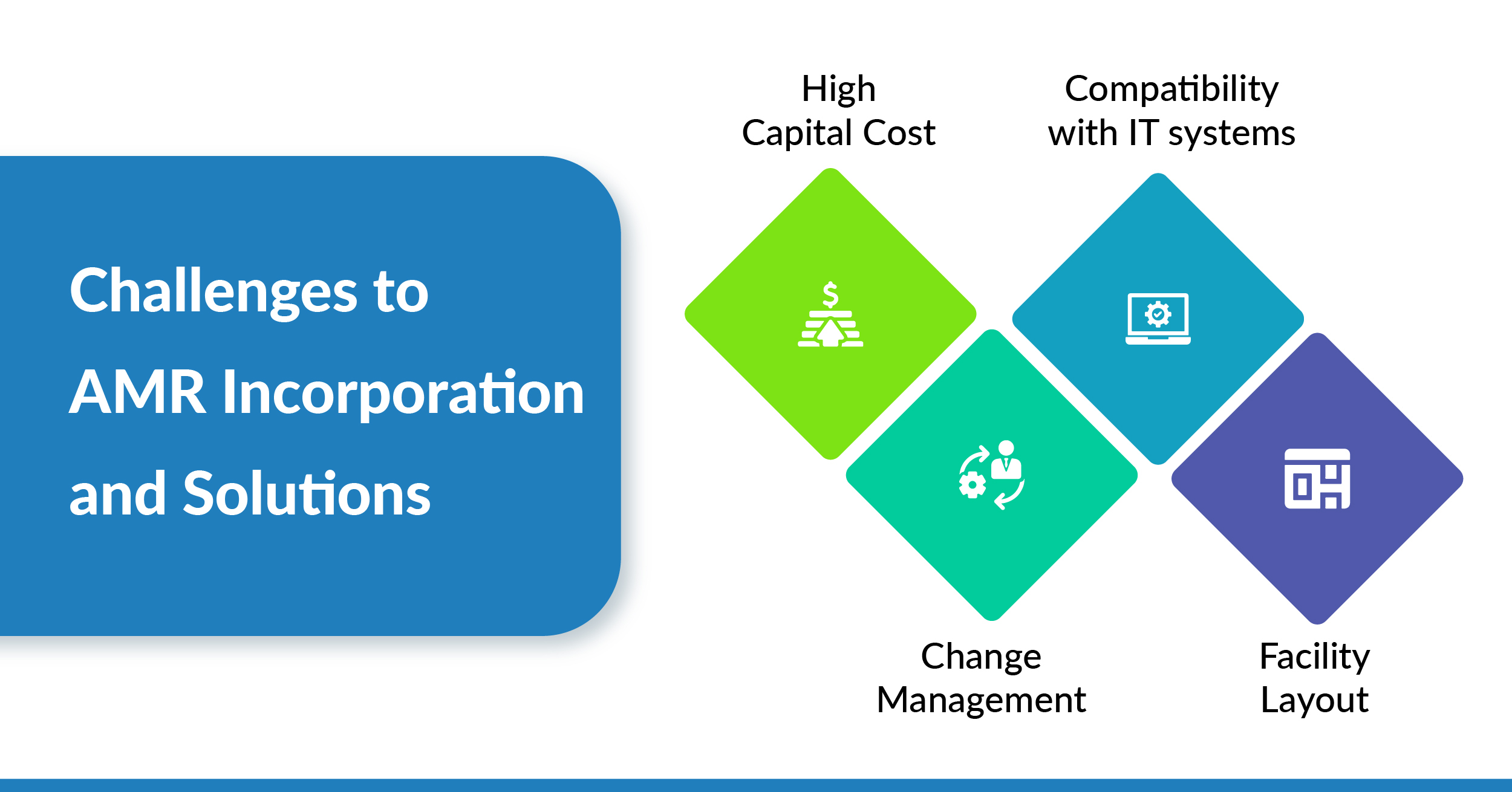
While the ROI is substantial, there can be barriers to incorporating AMRs:
Challenge 1: Upfront Capital Investment
AMRs represent a real capital outlay. However, the total cost of ownership (TCO) over 5 years consistently favors AMRs over fixed automation when infrastructure savings, labor cost reduction, and maintenance costs are properly modeled. For organizations where capital is constrained, Robots-as-a-Service (RaaS) subscription models convert the investment to an operating expense — with full support, maintenance, and software updates included.
Novus Hi-Tech offers flexible deployment models to match your financial structure.
Challenge 2: WMS and ERP Integration Complexity
Legacy systems sometimes lack modern API connectivity. Novus Hi-Tech’s integration team has completed deployments with all major enterprise platforms, including complex custom WMS environments. A dedicated integration assessment prior to deployment maps all connection points and resolves compatibility issues before go-live.
Challenge 3: Change Management and Workforce Transition
Employee concerns about automation are legitimate and deserve honest engagement. The most successful AMR deployments frame automation as role elevation — freeing workers from repetitive transport tasks to quality control, exception handling, and customer-facing functions. Structured onboarding, floor training, and open communication channels drive adoption. In tight labor markets, AMRs have proven to be a hiring and retention advantage — fewer workers want repetitive, physically demanding roles.
Challenge 4: Facility Readiness
AMRs require navigable floor conditions: clear aisle widths (typically 1.2–2.0 m depending on robot type), reasonably level surfaces, and defined pick/drop zones. A Novus Hi-Tech site survey identifies any physical constraints before procurement and provides a facility readiness report with specific recommendations. Most facilities require minimal modification.
Total Cost of Ownership: What to Budget
When evaluating AMR investment, the full cost picture includes:
Capital costs:
- Robot hardware (varies by payload class and quantity)
- Fleet management software license
- WMS integration (typically a one-time professional services engagement)
- Site survey and facility preparation
Operating costs:
- Preventive maintenance (typically low — AMRs have far fewer moving parts than conveyor systems)
- Software updates and support (included in Novus Hi-Tech service agreements)
- Battery replacement (typically after 3–5 years)
- Energy cost (AMRs consume 0.5–2.5 kWh per operating hour depending on payload)
Cost offsets (reduce net TCO):
- Labor cost reduction
- Overtime elimination
- Reduced damage and error costs
- Avoided infrastructure investment (versus conveyor systems)
- Potential energy savings versus older material handling equipment
In Novus Hi-Tech deployments, customers typically see net positive ROI within 12–24 months on a full fleet, with the payback period shortening as fleet size increases.
How Novus Hi-Tech Delivers Warehouse AMR Solutions
Novus Hi-Tech is an India-based autonomous mobile robotics company delivering material handling automation to manufacturing, warehousing, logistics, and retail operations.
Comprehensive AMR Portfolio:
From the versatile Novus CARRY to the heavy-duty P-MOVER pallet trucks, our autonomous mobile robots warehouse lineup fits a broad scope of material handling and transportation needs.
Flexible Fleet Management:
Advanced software ensures optimal task allocation and real-time monitoring of AMR operations.
Full Spectrum Integration:
All Novus AMRs can easily be integrated with most standard warehouse management systems (WMS) and other enterprise resource planning (ERP) systems ensuring seamless integration of AMRs.
Customized Deployment
We collaborate closely with clients to design and implement solutions tailored to specific operational requirements.
Proven Track Record
With success stories from multiple applications of automation technology within logistics, retail and manufacturing, we have showcased improved operational efficiency.
Novus Carry Autonomous Mobile Robots
Our Autonomous Mobile Robots (AMRs) are designed to improve material handling in warehouses and manufacturing facilities. Our AMRs, such as Novus CARRY and Novus P-MOVER, utilize advanced navigation (Lidar + SLAM), real-time task assignment, and intelligent fleet management offer:
- Payload capacity up to 1500 kg
- 360° obstacle avoidance
- Autonomous charging & minimal installation
- Seamless integration with existing WMS/ERP software
From moving pallets to goods to parts—our AMRs are designed to adapt, scale, and deliver operational efficiencies. Explore our AMR product range here.
Adopting AMRs is a strategic leap toward operational excellence. Autonomous mobile robots warehouse automation empowers businesses to improve productivity, accuracy, and scalability. As warehouse demands evolve, AMR adoption will become key to staying competitive. We are paving the way in manufacturing and warehouse automation. Contact us today to join the revolution.