
Eighteen months ago, a PERC-based solar panel production line was considered a safe bet. Today, that same line struggles to sell into markets where buyers now expect TOPCon-grade efficiency as the baseline. The technology moved faster than most manufacturers’ procurement cycles ever did.
That’s the risk hiding in every turnkey decision right now: sign with the wrong partner, and the plant will be outdated before it ever ships its first panel.
Here’s what actually separates a partner worth signing from one that’ll bury you in change orders.
The Real Cost of Getting This Wrong
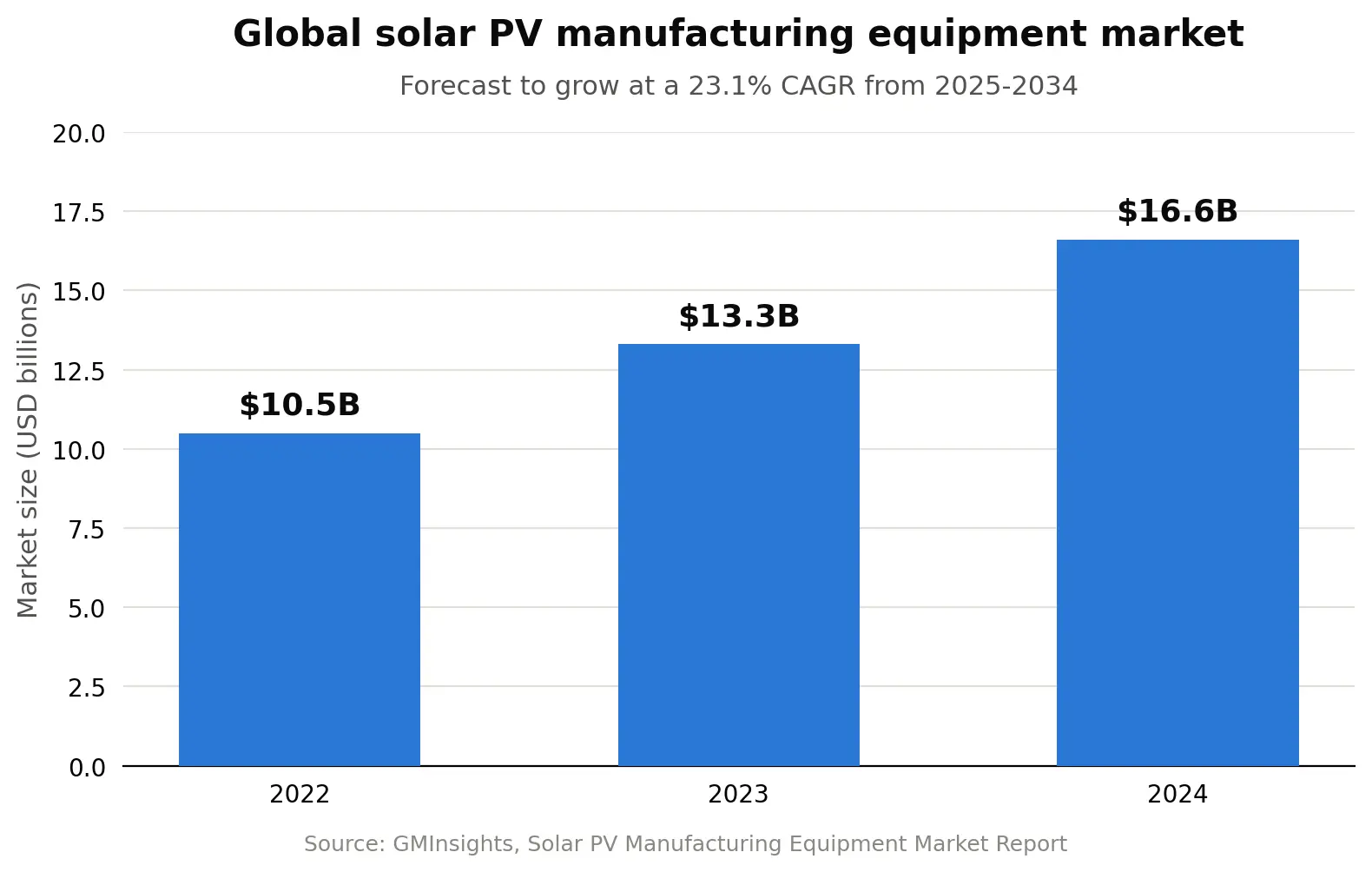
The upside is that the market is already moving fast, and the right partner can shorten your project timeline by 12–18 months. The global solar PV manufacturing equipment market crossed USD 16.6 billion in 2024 and is projected to grow at a CAGR of over 23% through 2034. That growth shows real demand – but it also means your choice of partner matters more, not less, as more players enter the market.
What “Turnkey” Should Specifically Mean
A turnkey solar cell manufacturing plant includes more than just equipment – it delivers the entire value chain.
A true turnkey solution covers machinery, software, training, and continuous support – from the raw wafers to the finished modules. You’re not designing and integrating every part of the plant yourself. You are buying a complete manufacturing solution with clear ownership of the engineering, installation, commissioning, and ramp-up.
The market has grown fast because this model works. Instead of hiring 200 engineers, buying equipment piecemeal, and debugging a solar cell production line for three years, you sign with a partner who’s already done this dozens of times. Technology in this space moves quickly enough that outdated gear becomes obsolete fast – you need a partner tracking those shifts, not one selling year-old blueprints.
TOPCon vs. HJT vs. Bifacial: Which Tech Should Your Line Run?
Here’s where most manufacturers stumble.
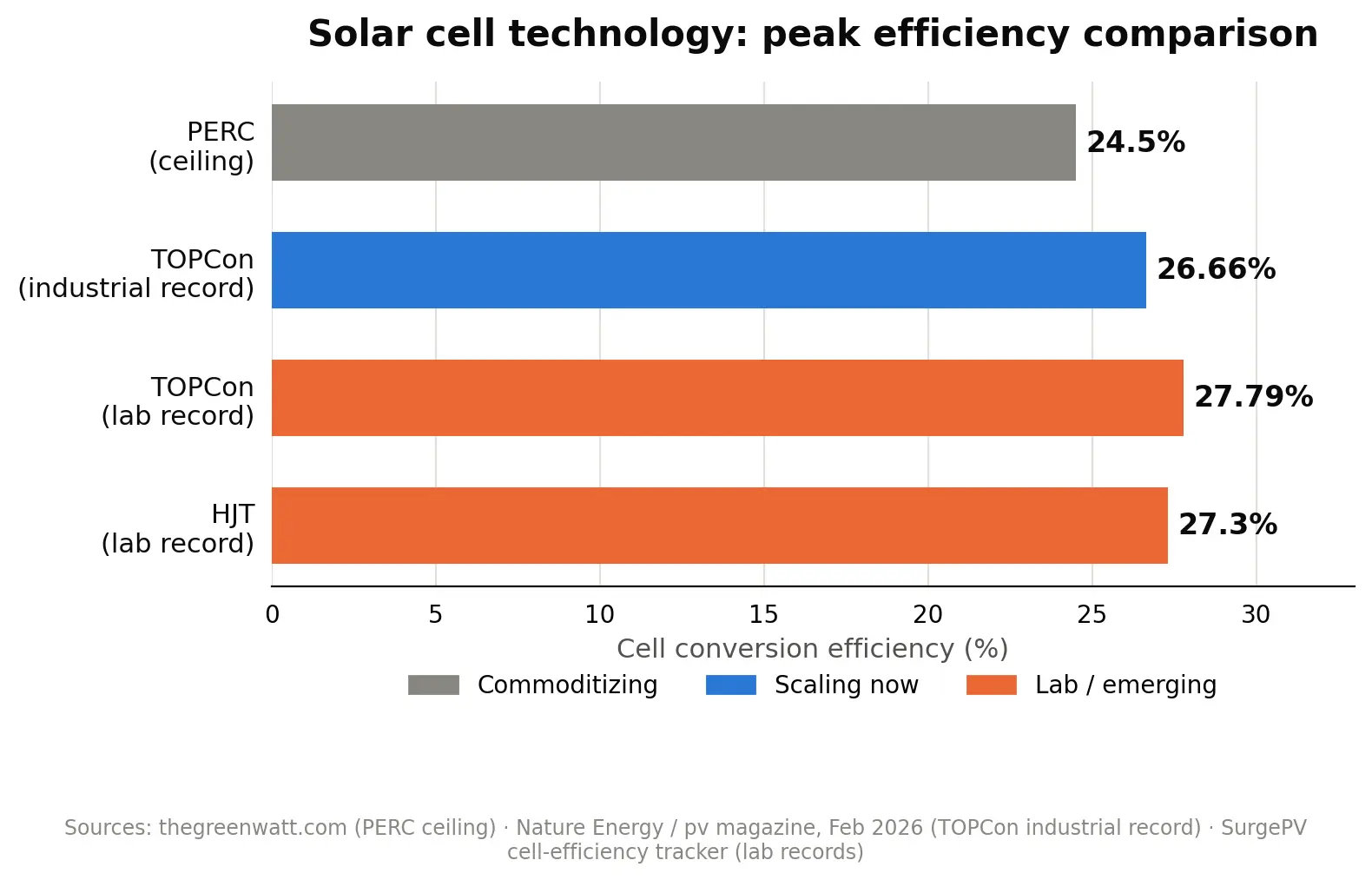
- Tunnel Oxide Passivating Contact, or TOPCon, has become a mainstream technology for high-efficiency cells. In 2026, the development of an industrial-scale TOPCon cell with a certified conversion efficiency of 26.66% was seen, and laboratory TOPCon efficiencies of 27.02% have been reported. The combination of high efficiency, commercial maturity, and scalability makes TOPCon an important technology for manufacturers assessing a new solar panel production line.
- HJT, or heterojunction, offers strong efficiency potential but involves more specialized manufacturing processes and equipment.
- PERC and bifacial panels are commoditizing and proven. And if you’re entering the market in 2026, investing in a mature technology without a clear upgrade path can leave a new production line at a competitive disadvantage.
To select the right technology is also to select a partner with the expertise to reliably deploy, scale, and support it in commercial production. Look for partners that can demonstrate operational TOPCon deployment, commercial production data, and references from similar projects.
Six Checks Before You Select & Sign a Partner
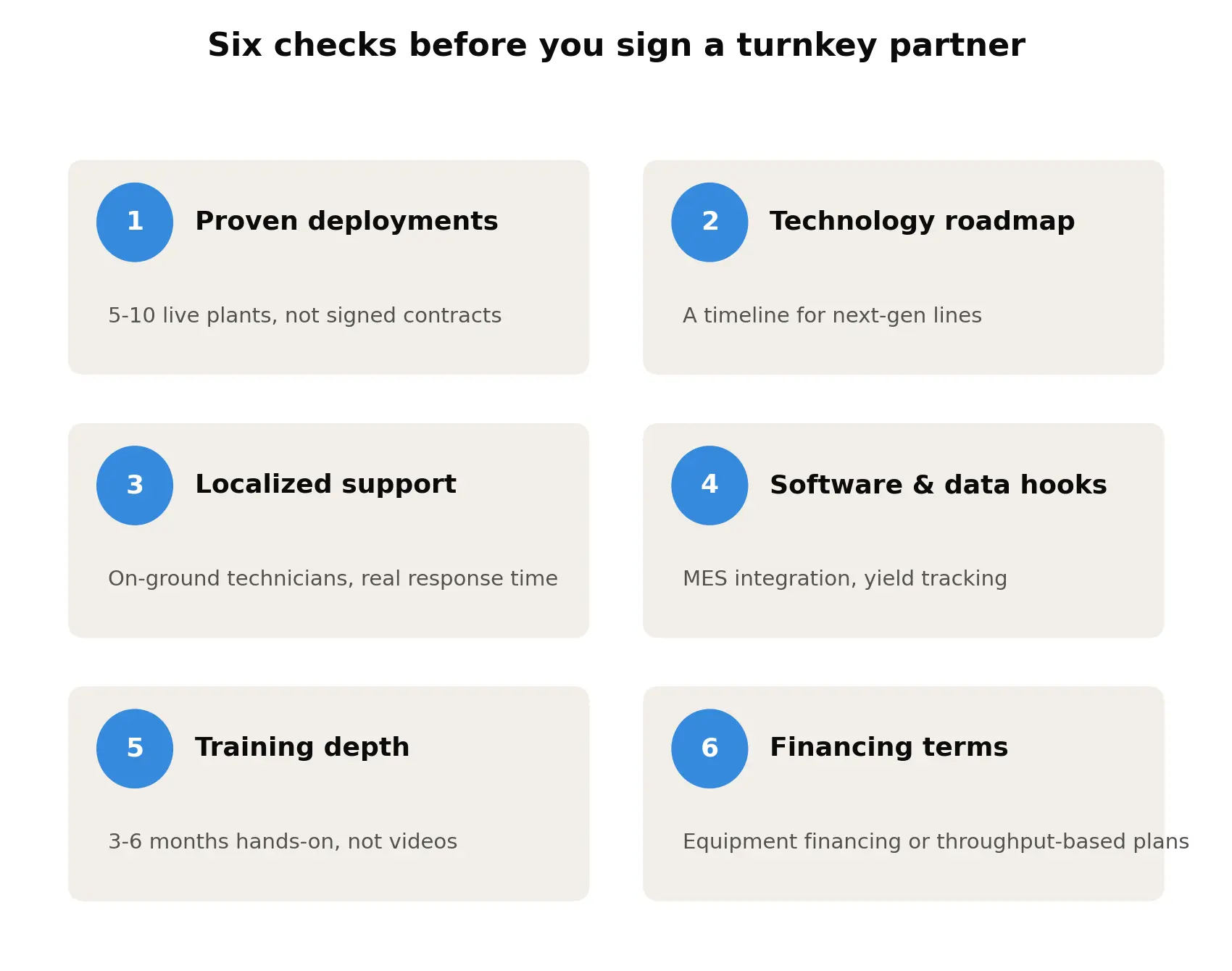
- Proven deployments, not promises. Ask for references. How many live plants are running their solar panel production line? What’s their uptime? Have any failed? You want partners with 5-10 operational plants, not 50 signed contracts.
- Technology roadmap. Where are they investing? TOPCon dominates today, but perovskite-silicon tandem cells are coming. A good partner has a timeline for next-gen lines.
- Localized support. Automation can break down at 3 a.m. on a Sunday. If your partner is 8,000 miles away with a 48-hour response time, your plant stays idle. Look for a partner with on-ground technicians in your region – for example, Novus Hi-Tech maintains local support teams and rapid-response service across the markets it operates in, so a breakdown doesn’t turn into a multi-day shutdown. Ask any prospective partner exactly where their nearest technicians are based and what their actual average response time has been.
- Software and data hooks. A turnkey solar cell manufacturing plant today means real-time yield tracking and predictive maintenance. Don’t accept a partner who can’t integrate with your MES (manufacturing execution system). Data transparency is control.
- Training depth. They hand over a production line. Now you have to run it. Your engineering team needs 3-6 months of hands-on training on the actual solar cell production line they’re inheriting – shadowing commissioning, running the line under supervision, and handling fault scenarios themselves before the partner’s team leaves.
- Financing terms. Capex is massive. Does the partner offer equipment financing, or are you on your own? Some offer annuity-style payments tied to throughput, spreading risk.
Where Automation Changes the Equation
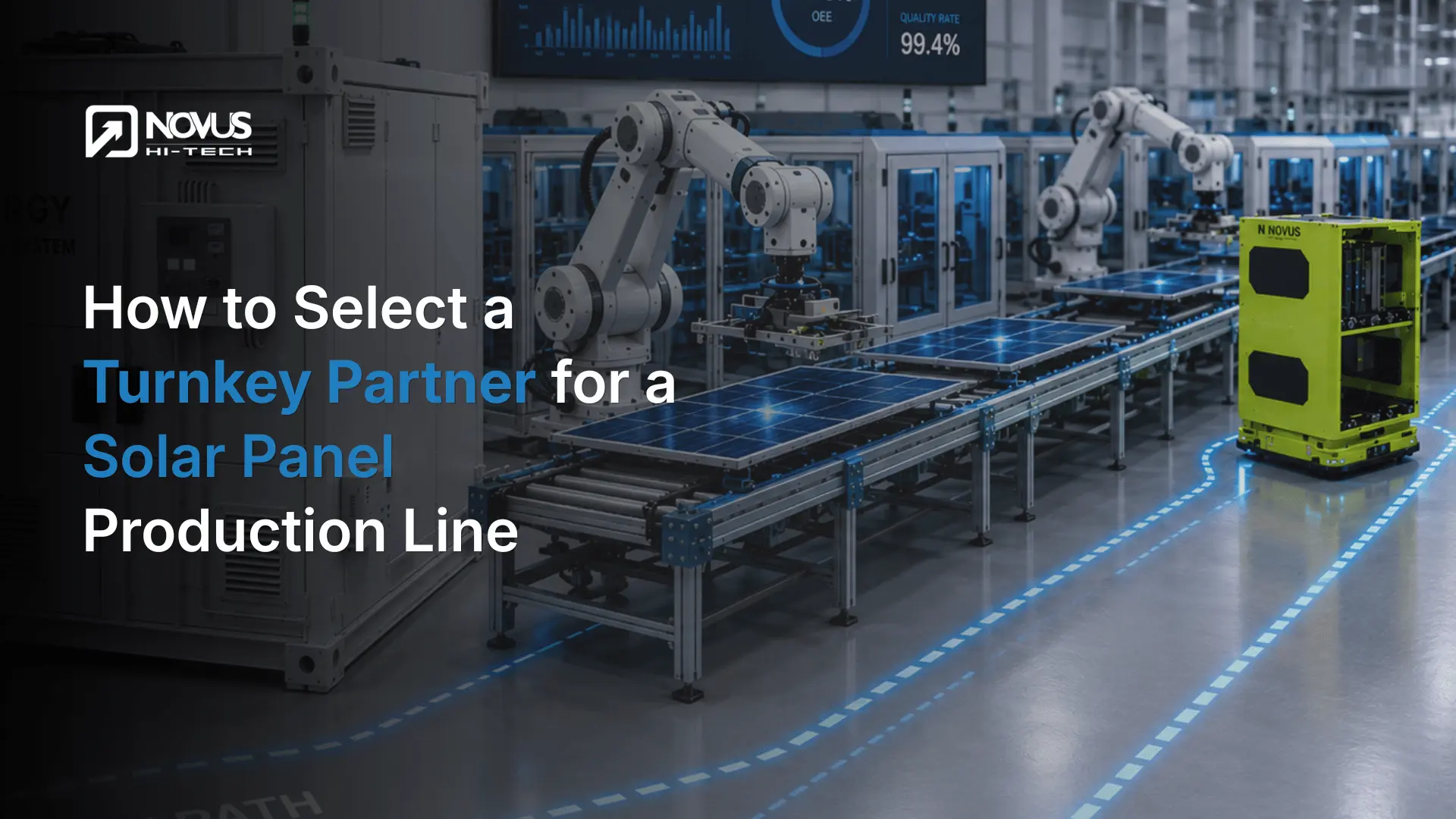
One approach worth understanding: partners like Novus Hi-Tech apply robotics and AI expertise to solar PV manufacturing, including the Novus Carry Solar Cell 500 AMR, designed for solar cell manufacturing applications. Rather than static lines, modern partners are embedding automation across the entire process – from handling wafers to packing modules – reducing labor dependency, shrinking defect rates, and accelerating throughput.
This matters because buyers of solar cell manufacturing plants are increasingly moving away from standardized lines toward equipment that adapts to new regulations, applications, and installation formats. A partner with embedded robotics and AI can pivot your line from standard modules to bifacial or specialized formats without rewiring the entire plant.
Get Your Numbers Straight First
Before you call a partner, know your numbers:
- Capacity target: 5 MW? 500 MW? Scale changes everything.
- Capex budget: Turnkey ranges from $50M (5 MW) to $500M+ (gigawatt-scale).
- Tech preference: TOPCon lines ship faster; perovskite tandem research varies by partner.
- Timeline: 12-18 months from order to first panel off the line.
Your business case should show payback within 5-7 years. If the math doesn’t work, revisit your selling price or efficiency targets.
Talk to People Who’ve Actually Built These Lines
Choosing a turnkey partner for a solar cell manufacturing plant is one of the highest-leverage decisions you’ll make. The right partner ships you a proven, scalable operation. The wrong one leaves you debugging other people’s mistakes while your capex ticks up.
Novus Hi-Tech has skin in this game: our Precision-Flow AMR, Novus Carry, won a 2026 Aegis Graham Bell Award for Manufacturing Innovation. The system is designed to automatically transfer wafers, with special focus on precision and contamination control.
Schedule a call to walk through your capacity targets, technology fit, and timeline, and see a working TOPCon-ready line before you commit to anything.