
Why 2026 Is the Year Warehouse Automation Stops Being Optional
The 5 warehouse automation trends reshaping Indian logistics in 2026 are not on the horizon. They are already operational. India’s logistics costs dropped to 7.97% of GDP in FY 2023-24, per the DPIIT-NCAER Assessment of Logistics Costs in India. Infrastructure reform is working. The next competitive battle, however, is being fought inside the warehouse.
India’s warehouse sector is projected to reach USD 59.34 billion by 2030, growing at nearly 9% annually, according to the India Warehouse Market Report. Within that, warehouse automation is on track to more than double by 2032, per the India Warehouse Robotics and Automation Market report. That is capital being deployed right now, across 3PLs, ecommerce operators, and manufacturers.
A Note on This Article
This article is written for warehouse managers, logistics heads, and infrastructure decision-makers at manufacturing and 3PL businesses in India. No technical background required. Each trend is explained around the operational problem it solves and the business outcome it creates.
What Warehouse Automation Actually Means Today?
Warehouse automation today is not just conveyor belts and barcode scanners. It covers intelligent software that routes orders in real time, autonomous robots that move goods without human direction, and predictive systems that anticipate demand before it arrives.
When these technologies work together, a warehouse stops being a place where goods are stored and becomes a system that manages flow, reduces error, and scales without proportional headcount growth. The five trends below are where that shift is happening right now.
The 5 Trends Reshaping Indian Warehouse Operations Right Now
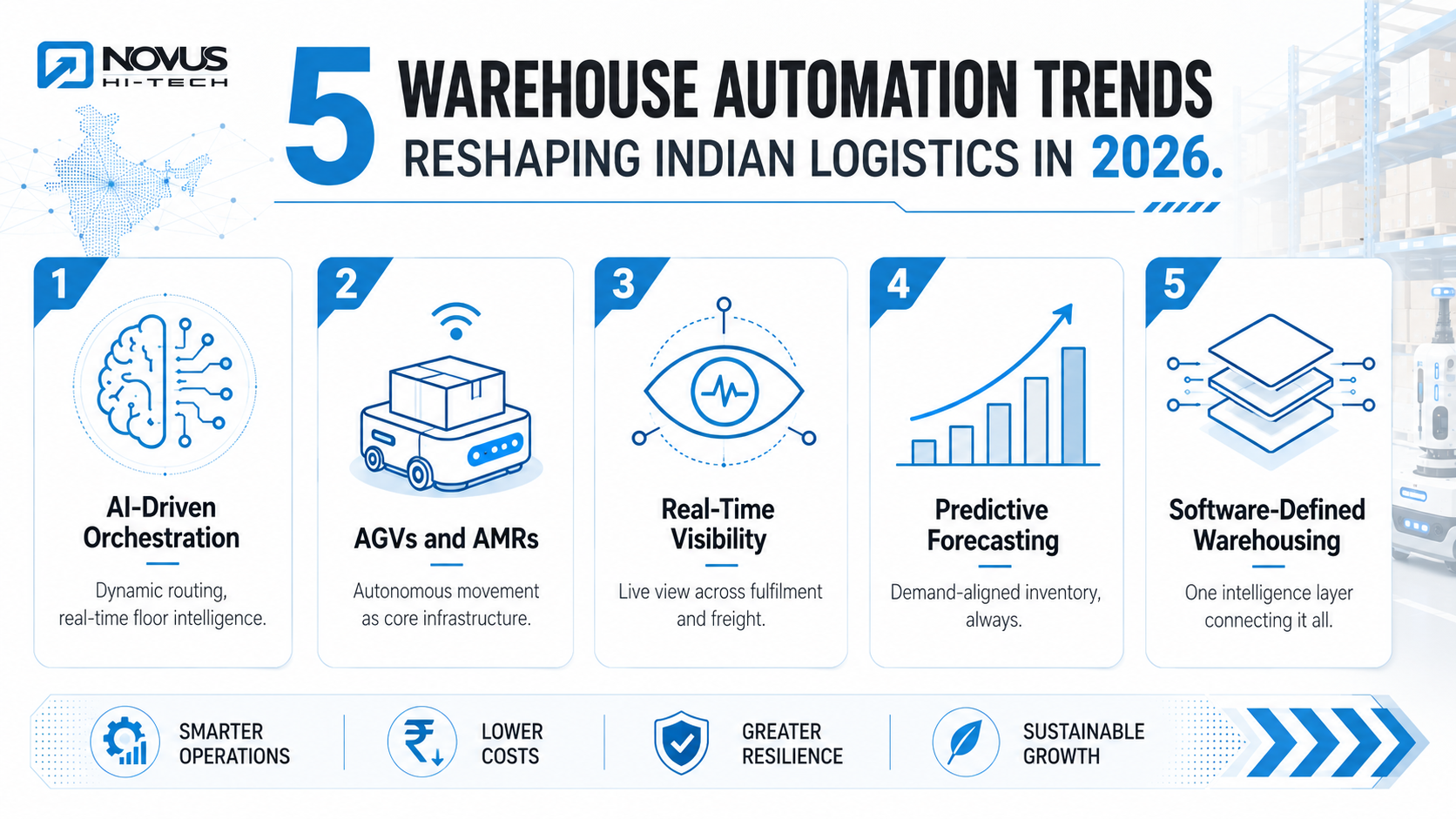
Trend 1: AI-Powered Warehouse Orchestration
Order cycle times keep growing even though the team is working just as hard. SKU counts have increased, demand swings are harder to predict, and the rules your WMS runs on were written for a simpler operation. The system is not broken. It just was not built for this.
AI-driven orchestration replaces static rules with dynamic decision-making. Routing, slotting, and throughput balancing adjust continuously based on what is actually happening on the floor. Congestion is caught before it builds. Replenishment triggers before a shortage occurs.
India’s warehousing stock is forecast to reach 516 million sq ft by 2026, up from 344 million sq ft in 2023, per IBEF. More space without smarter execution just means larger bottlenecks at higher cost.
Operational impact: Faster order cycles, fewer idle movements, stable throughput under demand spikes.
Strategic implication: Warehouse intelligence is becoming more valuable than warehouse size.
Legacy WMS vs AI-Driven Orchestration: Key Differences
| Metric | Legacy WMS | AI-Driven Orchestration |
| Routing Logic | Fixed rules, manually updated | Dynamic, real-time adjustment |
| Response to demand spikes | Congestion builds, SLAs slip | Auto-balances throughput load |
| SKU adaptability | Requires manual reconfiguration | Continuous automated re-slotting |
| Operational visibility | Batch/report-driven | Live operational intelligence |
| Scalability | Proportional cost increase | Scales without proportional headcount growth |
Trend 2: AGVs and AMRs Moving from Pilot Projects to Core Infrastructure
Autonomous robots in Indian warehouses are no longer proof-of-concept projects. Warehouses are now treating autonomous material movement as infrastructure, alongside racking and conveyor systems.
The reason is straightforward. Labour availability tightens at peak, forklift congestion builds in high-throughput zones, and every volume spike demands a headcount response. These constraints show up every quarter.
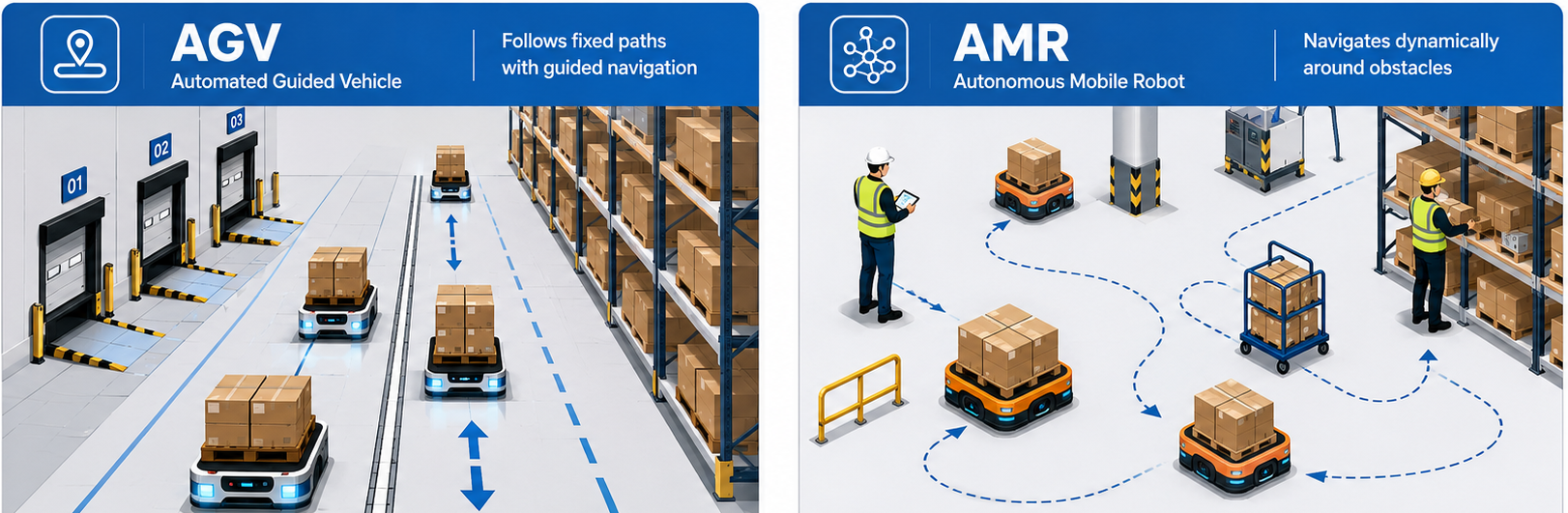
Automated Guided Vehicles (AGVs) handle high-volume, fixed-path tasks such as pallet movement between docks and storage zones. Consistent, repeatable, multi-shift operation without fatigue or error.
Autonomous Mobile Robots (AMRs) navigate dynamically using onboard sensors. Better suited to facilities where floor layouts change or picking paths evolve. They adapt as operations scale, without infrastructure modifications.
The shift: The question is no longer whether to deploy autonomous systems. It is whether your floor layout, power grid, and software are ready to support them.
Trend 3: Real-Time Visibility Across the Entire Supply Chain
A simple test: when a fulfilment exception occurs, do you find out from your own system or from a customer complaint? If the answer is the latter, visibility is costing you SLA compliance.
Ecommerce shipment volumes in India grew 29% in 2024 alone, per Mordor Intelligence. At that growth rate, delayed cargo tracking and fragmented fleet data are active liabilities, not inconveniences.
Modern visibility platforms connect transportation management, fleet tracking, warehouse operations, and fulfilment data into one live view. Exceptions are flagged instantly. ETAs recalculate automatically.
Operational impact: Faster exception handling, better ETA reliability, reduced disruption, stronger customer trust.
Strategic implication: Real-time visibility is a customer experience differentiator, not just an internal efficiency tool.
Trend 4: Predictive Demand Forecasting to Fix the Inventory Imbalance Problem
Overstock on slow-moving SKUs. Stockouts on fast-moving ones. This is almost never a buying problem. It is a forecasting infrastructure problem.
Traditional planning tools run on historical averages and fixed replenishment schedules. They were built for stable demand. Ecommerce and omnichannel fulfillment are not stable. Promotional surges and supply disruptions hit before legacy systems can respond.
India’s supply chain analytics market was USD 385.4 million in 2024 and is forecast to exceed USD 2.3 billion by 2033, per IMARC Group. That growth reflects how fast operators are investing in smarter inventory tools.
Predictive forecasting reads live signals: sales velocity, seasonal patterns, supplier lead times. Replenishment triggers adjust continuously. Inventory stays aligned to actual demand, not last quarter’s assumptions.
Operational impact: Lower carrying costs, fewer stockouts, reduced write-offs, better use of floor space.
Strategic reframe: Inventory management is a data challenge. Warehouses treating it as only a storage challenge will stay perpetually imbalanced.
Trend 5: Software-Defined Warehousing Ties It All Together
The four trends above deliver their full value only when they operate as a single connected system. That is software-defined warehousing.
In most legacy operations, the WMS, robotics, analytics, and ERP run in separate lanes. Data is moved manually. Decisions are made on incomplete information. Scaling means adding systems that do not communicate.
In a software-defined warehouse, every element operates through a shared intelligence layer. New automation is added without rebuilding the foundation. When disruption hits, the system adapts rather than breaks.
Operational impact: Greater adaptability, faster scaling, lower reconfiguration costs, end-to-end execution visibility.
The shift: The warehouse is evolving from a physical facility into an intelligent operational system.
Is Your Warehouse Ready? A 4-Point Check
Knowing which trends matter is the first step. Knowing where your operation stands is what determines the next move.
- Operational Visibility: Can you see inbound freight status, live inventory, and fulfilment exceptions right now without pulling a report? If not, that gap is already costing you.
- Automation Scalability: Before evaluating any robot, check whether your floor layout, power infrastructure, and WMS can support AGV or AMR deployment. Readiness determines feasibility.
- Software Integration: If your WMS, TMS, and ERP require manual data re-entry to stay in sync, every downstream decision carries a delay. A connected software layer is the prerequisite for everything else.
- Throughput Efficiency: If every 20% rise in volume requires a near-equivalent rise in headcount, your operation has no automation leverage. That ratio is the clearest signal that investment is overdue.
Want to understand how automation translates into measurable ROI? Explore Novus Hi-Tech’s guide to scalable warehouse automation and operational growth.
The Divide Is Already Forming
The 5 warehouse automation trends reshaping Indian logistics in 2026 are not isolated technology shifts. They are components of a single structural change in how warehouses are built, run, and scaled. Organisations treating them as separate projects will miss the architecture that connects them. As per IMARC Group 2025, India’s logistics market is projected to reach USD 429 billion by 2034. The operators building intelligent warehouse infrastructure today are positioning for that entire growth curve.
Key Takeaways
- AI-driven orchestration replaces rigid rules with real-time decision-making, cutting cycle times and reducing congestion under demand variability.
- The new core infrastructure now includes AGVs and AMRs. AGVs suit fixed-path, high-volume movement. AMRs suit dynamic environments where layouts evolve.
- Real-time visibility converts exception handling from reactive to proactive, directly improving SLA adherence and customer experience.
- Predictive demand forecasting aligns inventory to live demand signals, reducing stockouts, overstock, and carrying costs.
- Software-defined warehousing connects all four trends into one intelligence layer, enabling scalable operations without rebuilding from scratch.
- The gap between warehouses with this infrastructure and those still on legacy systems will widen significantly through 2026 and beyond.
Talk to Novus Hi-Tech: Warehouse Automation Assessment for Indian Operators
If your warehouse is managing growing SKU complexity, rising fulfilment pressure, or scaling volume, the question is not whether intelligent warehousing is relevant. It is how far along your readiness journey you are.
Novus Hi-Tech works with warehouse operators, logistics companies, and manufacturing enterprises across India to assess infrastructure, identify readiness gaps, and build scalable automation strategies.
Connect with our team for a warehouse architecture and automation readiness discussion.
| Novus Hi-Tech: Novus Hi-Tech is a Physical AI company deploying AGV and AMR systems, AI orchestration platforms, and fleet intelligence solutions across manufacturing, logistics, and 3PL operations in India and across Asia. The insights in this article draw from active deployments and warehouse readiness assessments conducted across the Indian logistics sector. Our team assesses existing warehouse infrastructure, identifies automation readiness gaps, and builds scalable systems integrating AGVs, AMRs, AI-driven WMS, and real-time logistics tracking platforms. The insights in this article draw from active deployments and warehouse readiness assessments conducted across the Indian logistics sector. |