
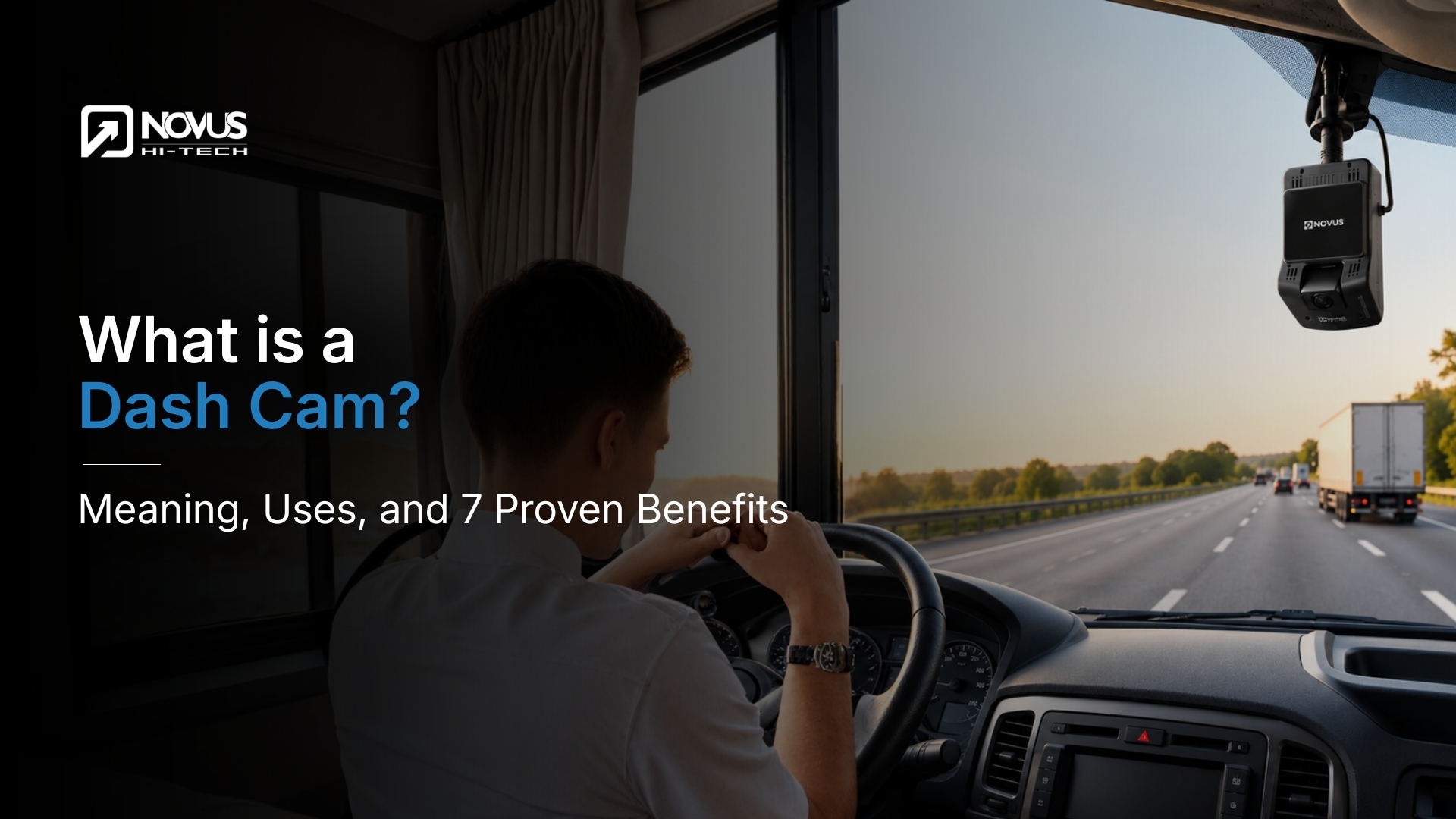
A dash cam is a small camera mounted on a vehicle’s windshield or dashboard that records the road ahead, and in dual models, the driver. Its footage serves as evidence after accidents, and AI dash cams also warn drivers of risks in real time.
Dash cams started as a consumer accessory. Today, commercial fleets in logistics, mining, construction and last-mile delivery treat them as core safety infrastructure, alongside GPS tracking and ADAS.
This guide covers the dash cam meaning, how it works, the main types, what it’s used for, its 7 key benefits, its downsides, and how to choose the right one.
Dash Cam Meaning
“Dash cam” is short for dashboard camera. It is also called a car DVR or in-car camera. The term covers any camera fixed inside a vehicle that records driving footage automatically, from a basic single-lens recorder to an AI system that analyses the road and driver as the vehicle moves.
How Does a Dash Cam Work?
A dash cam powers on with the ignition and starts recording automatically. It saves footage in short clips on a memory card and records over the oldest clips when the card fills up. This is called loop recording.
A built-in G-sensor detects sudden impacts or hard braking and locks that clip so it isn’t overwritten. Many models also have a parking mode, which records when motion or impact is detected while the vehicle is switched off.
AI dash cams add an onboard processor that reads the video in real time. They detect events such as tailgating, lane drift, phone use or drowsiness, sound an in-cab alert, and upload the clip to a fleet dashboard.
Types of Dash Cams
| Type | What it records | Best for |
|---|---|---|
| Front-facing | Road ahead | Personal cars, basic evidence |
| Dual (front and rear) | Road ahead and behind | Rear-end collision evidence |
| Road and cabin (driver-facing) | Road ahead and the driver | Taxis, buses, commercial fleets |
| AI dash cam | Road and driver, with real-time analysis and alerts | Fleets that want to prevent incidents, not just record them |
What Is a Dash Cam Used For?
- Accident evidence: Footage shows who was at fault and protects drivers from false claims.
- Insurance claims: Video speeds up claims and helps settle disputes.
- Fraud prevention: It protects against staged accidents and fake damage claims.
- Driver coaching: Fleets use clips to train drivers on specific unsafe habits.
- Vehicle security: Parking mode records theft attempts and vandalism.
- Real-time safety alerts: AI dash cams warn drivers of collision risk, distracted driving and fatigue.
7 Benefits of Installing a Dash Cam
Apart from these key features/advantages, dash cam installation offers numerous other benefits to people in terms of fleet management or personal safety. Here is a breakdown of the key advantage:
- Efficient Fleet Management: Dash cams are used by fleet operators to monitor the behavior of drivers and comply with all the implemented safety measures. Through video analysis, managers find the most efficient routes, improved fuel economy, and lower cases of dangerous driving practices.
- Enhanced Safety: Dash cams promote safe driving by giving instant feedback and issuing alarms in respect of potential dangers with which the driver might eventually be confronted. In this regard, accidents can be stopped in their tracks.
- Security and Theft Prevention: Many of the dash cams are equipped with motion detection capabilities. This helps capture even when the car has been parked. This is very helpful in case of premeditated theft or vandalism. Any suspicious activity around the car would be recorded and reviewed later.
- Reliable Video Evidence: If an accident occurs, then footage shot by a dash cam forms a great record of events that can help pin the blame and negate the claims. This will reduce disputations in the court and therefore lower insurance rates.
- Safer Driving Moments: The fact that a driver’s actions will be captured causes the driver to maintain safer driving habits. It is very helpful to businesses running large fleets wherein accountability of the drivers is crucial.
- Capturing Unexpected Moments: It is not just for safety and security but also recording unique instances on the road, even when they turn out surprising. Dash cameras record everything from scenic drivers to rare incidents such as meteor sightings that otherwise go unremembered.
Features to Look For in a Dash Cam

This is what you ought to look at when shopping for a dash cam so that you get the best performance based on your needs:
Mounting Options: Versatile mounting options-like suction cups or adhesives, for instance-made available months before installation and repositioning.
Memory Storage and Capacity: Choose a model with ample storage capacity or not that supports expandable memory through SD cards. Higher-resolution footage requires more space, so consider the resolution you’ll be recording at.
Video Quality and Resolution: To capture crucial details like license plates, opt for a dash cam with at least 1080p resolution. Some models even offer 4k for crystal-clear video quality.
Audio Quality and Resolution: Some dash cams can record audio inside the vehicle, which can be useful in understanding the content of an event or accidents.
App connectivity and GPS Tracking: For enhanced convenience, choose a dash cam that connects to your smartphone through an app, allowing you to review footage remotely. GPS tracking can also provide location data, which is particularly helpful for fleet managers.
Cost Considerations: While high-end dash cams come with advanced features, there are also budget-friendly models that offer essential functionality. Balance cost with the features you need to ensure you make the best investment.
Dash Cams vs Video Telematics for Fleets
A standalone dash cam records footage on the vehicle. Video telematics connects that camera to a fleet platform, combining video with GPS, speed, braking and driver behaviour data. Fleet managers see events as they happen, not days later when someone pulls the SD card.
For commercial fleets, this is the real step up. Read more about choosing dash cams for trucks and how aftermarket telematics fits into existing vehicles.

Novus Hi-Tech’s AI Dash Cam Solutions
Novus Safe Pro and Novus Safe Lite combine an AI dash cam, collision avoidance and driver monitoring in one aftermarket system for trucks and buses. Both retrofit into existing vehicles and send alerts and event video to a single fleet dashboard.