
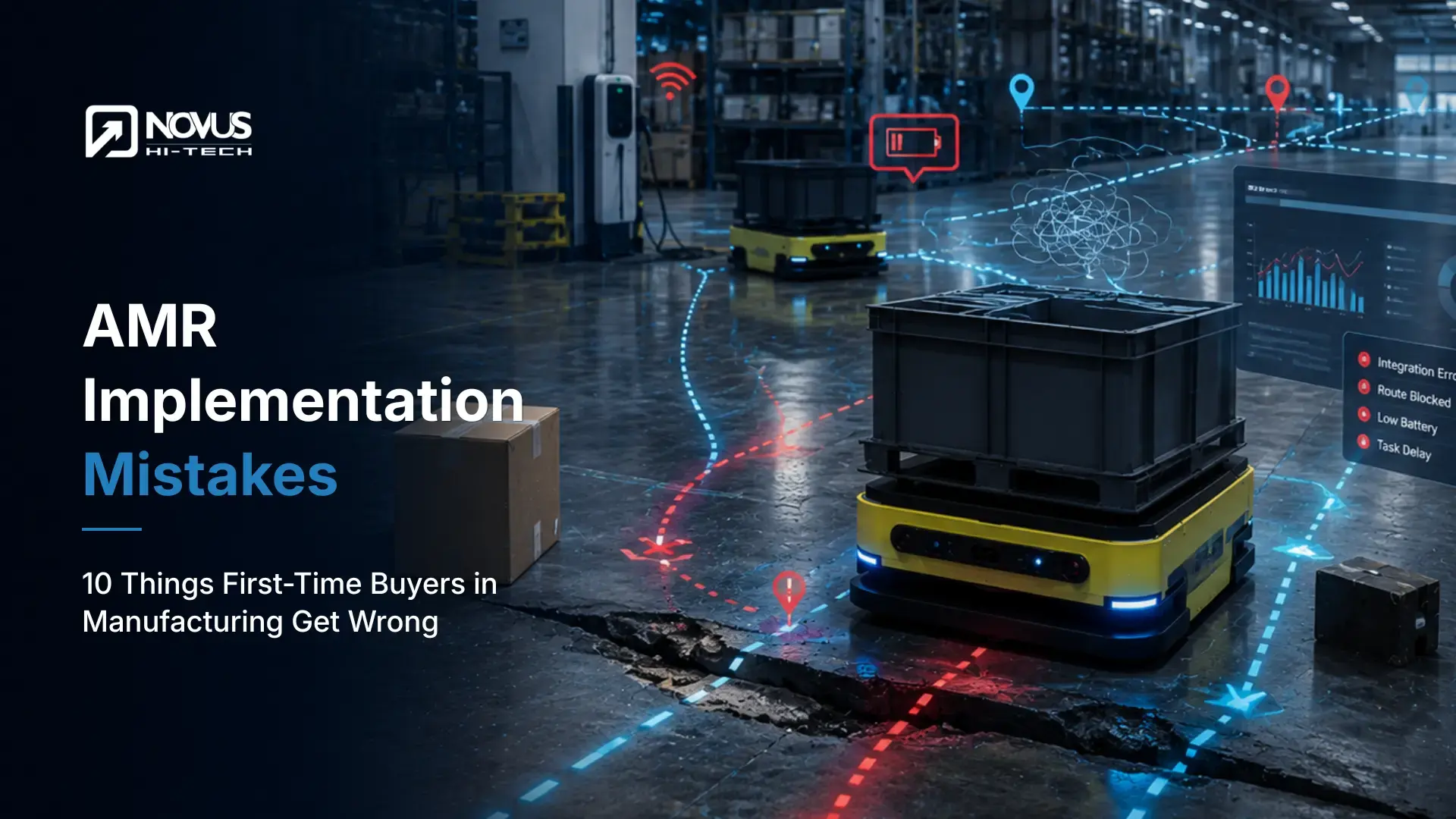
The global AMR market is expected to grow at over 20% annually through 2030, with manufacturing facilities accounting for the largest share of new deployments. Yet for every successful rollout, there are first-time buyers who discover too late that their investment is underperforming.
The reasons rarely come down to the robots themselves. They come down to decisions made before the first unit ever moves across a factory floor.
This guide covers the 10 most common AMR implementation mistakes manufacturers make, drawn from deployment patterns across hundreds of industrial facilities in India, Southeast Asia, and the MEA region. Whether you are evaluating vendors for the first time or finalising a pilot plan, understanding these pitfalls is the difference between an 18-month payback and a two-year course correction.
Why First-Time Buyers Struggle with Autonomous Mobile Robot Implementation
Unlike Automated Guided Vehicles (AGVs), Autonomous Mobile Robots (AMRs) are adaptive, software-driven systems. Their performance depends not just on the hardware, but on how well the deployment is planned, integrated, and managed. Most warehouse automation mistakes do not originate on the shop floor. They originate in the boardroom and procurement process, months before go-live.
Here are the ten mistakes that consistently derail first-time buyers.
The 10 AMR Implementation Mistakes
Mistake 1: Skipping a Formal Site Readiness Assessment
AMRs navigate using LiDAR, cameras, and onboard sensors, all of which are sensitive to floor and environmental conditions. A floor flatness deviation beyond the specified FF/FL tolerance, inconsistent WiFi coverage, or poorly marked pedestrian zones can cause navigation errors and unexpected stops. Skipping this step is one of the most common and expensive early-stage robot integration challenges manufacturers encounter, yet it is rarely included in standard procurement checklists.
Fix: Treat site readiness as a pre-requisite, not a post-contract activity. Most established AMR vendors offer complimentary facility assessments. Make this a qualifying criterion when shortlisting vendors. Ensure the assessment covers floor flatness ratings, WiFi signal mapping across all operational zones, aisle clearance widths, and pedestrian demarcation requirements.
Mistake 2: Sizing AMR Payload Capacity on Current Loads, Not Future Ones
A common AMR deployment challenge is specifying payload capacity based on today’s average load rather than peak and future load scenarios. If your manufacturing output scales by 30% in two years, an undersized fleet compounds the problem quickly. You either add more units than originally budgeted or restrict throughput during scale-up. Neither outcome reflects the ROI projection that was approved at board level.
Fix: Build a demand projection model before writing your AMR specification. Work with your operations and supply chain teams to forecast peak load scenarios, not average ones. Share this model with prospective vendors and ask them to size their recommendation against the Year 3 or Year 5 scenario. A vendor who only quotes against your current baseline is not engineering for your future.
Mistake 3: Treating AMR Fleet Software as an Afterthought
The fleet management software (FMS) is the operational brain of your AMR deployment. Buyers frequently spend weeks comparing hardware specifications while spending minimal time evaluating the FMS. Key questions that often go unasked: Can the FMS handle multi-zone, multi-mission task allocation? Does it support WMS and ERP integration via open APIs? What is the validated maximum fleet size the software can manage in a live production environment? AMR scalability is only as strong as the fleet management software layer managing it.
Fix: Allocate equal evaluation time to the FMS as you do to the hardware. Request a live FMS demonstration that shows multi-robot task management, conflict resolution logic, and WMS API connectivity. Ask specifically for the maximum robot fleet size the software has been validated at in a production environment, not a test lab.
Mistake 4: Underestimating WMS and ERP Integration Complexity
The MHI 2025 Annual Industry Report lists systems integration as one of the most consistently cited barriers to warehouse automation adoption, alongside budget and change management. AMRs do not operate in isolation. They depend on real-time task signals from your warehouse management system. If your WMS runs on a legacy platform or lacks a documented API, significant integration effort is required regardless of which AMR vendor you choose. The complexity scales with the age and architecture of your existing systems.
Fix: Involve your IT team in vendor evaluations from the first meeting, not after contracts are signed. Ask every shortlisted vendor for a WMS integration checklist and request references from customers running the same WMS platform you use. If your WMS is more than 10 years old, budget explicitly for middleware development as a separate line item.
To understand how AMRs fit into broader manufacturing workflows, see how AMRs are transforming manufacturing operations.
Mistake 5: Evaluating AMRs on Unit Price Rather Than Total Cost of Ownership
Industry TCO frameworks consistently show that hardware accounts for roughly 20 to 30 percent of five-year AMR ownership costs. The remaining cost sits in fleet management software licensing, infrastructure modifications such as charging stations and WiFi upgrades, integration development, maintenance contracts, and operator training. Buyers who evaluate AMRs on unit cost alone routinely exceed their original budget by Year 2, often by a significant margin.
Fix: Build a full TCO model before shortlisting vendors. Structure it across five cost categories: hardware, software licensing, infrastructure, integration, and ongoing support. This model also becomes your internal business case document for finance and leadership approval, giving you a more defensible investment proposal than unit price alone ever would. For a full breakdown of what goes into AMR ownership costs, refer to our guide on AMR costs and ROI.
Not sure where to start with your AMR deployment?
Novus Hi-Tech has guided 1,400+ deployments across manufacturing and intralogistics facilities in India and the MEA region. Talk to our deployment team and get a site-specific implementation roadmap – at no cost.
Mistake 6: Piloting in the Most Complex Zone First
It seems logical to stress-test your AMR in the busiest, most dynamic area of your facility. In practice, this produces misleading results. A congested zone with high pedestrian traffic, narrow aisles, and irregular workflows generates performance data that reflects implementation immaturity rather than AMR capability. Running a pilot in a chaotic environment also increases the risk of early operational disruption, which erodes internal confidence in the programme before it has a fair chance to prove its value.
Fix: Start your pilot in a structured, repetitive-flow zone with predictable traffic patterns and consistent shift timing. Prove ROI in a controlled environment first, then expand systematically. Document performance benchmarks at each stage so your expansion business case is evidence-based, not projected from a difficult first phase.
Mistake 7: Ignoring Change Management and Operator Training
Autonomous mobile robot implementation is not just a technology project. It is an operational change. Warehouse staff accustomed to manual trolleys or forklift-dependent workflows need structured training and clear role redefinition, not just a safety briefing. Facilities that skip formal change management plans consistently report slower ramp-up times and higher near-miss incident rates in the first six months post-deployment. The robots are rarely the problem in these cases. The people-process gap is.
Fix: Design a change management plan before go-live. It should include floor staff involvement in the pilot phase, a formal mechanism for operators to report navigation concerns, and clear communication about how roles will shift post-automation. Operators who are involved in the deployment become its strongest advocates rather than its most persistent critics.
Mistake 8: Choosing a Vendor Based on Demo Performance Alone
A polished demo in a controlled warehouse environment tells you very little about how a vendor will perform at your facility over a five-year contract. Industrial AMR selection must go beyond the demo. It should include reference checks with existing deployments in similar manufacturing environments, evaluation of local service and support coverage, software update frequency, and uptime SLA commitments. In India and MEA markets specifically, the proximity and responsiveness of the vendor’s technical support team is a critical operational factor that demo evaluations rarely surface.
Fix: Add a structured reference check to your vendor evaluation process. Contact at least two existing customers in similar facility types and ask specifically about post-deployment support response times, software update quality, and how the vendor handled their most critical downtime incident. Request the vendor’s average time-to-resolution for AMR downtime events as a contractual metric.
Mistake 9: Not Defining ROI Metrics Before Deployment Begins
One of the most overlooked AMR deployment challenges is the absence of a pre-agreed performance baseline. Without baseline data on current cycle times, picking accuracy, labour costs per unit movement, and incident rates, it is impossible to accurately measure AMR ROI in manufacturing after deployment. Many buyers find themselves unable to demonstrate value to leadership even when the AMRs are performing well, simply because there is no pre-deployment benchmark to compare against.
Fix: Conduct a baseline measurement exercise in the 30 to 60 days before go-live. Capture throughput per hour, cost per pallet moved, fleet utilisation rate, and incident frequency across the zones where AMRs will operate. Set these as formal KPI benchmarks and include them in your deployment contract so the vendor is held to measurable outcomes, not just operational readiness.
Mistake 10: Locking Into Proprietary Navigation Technology
Some AMR vendors use proprietary navigation infrastructure such as QR codes, magnetic tape, or closed navigation platforms. This creates long-term vendor lock-in that buyers rarely anticipate at the time of purchase. If the vendor discontinues support, raises licensing fees, or is acquired, your entire operation becomes dependent on their commercial decisions. This is a critical factor in industrial AMR selection that rarely appears in early-stage RFPs.
Fix: Prioritise vendors offering SLAM-based natural navigation with open fleet management APIs. Before signing any contract, confirm that the navigation system does not require proprietary infrastructure installed in your facility. Ask whether the FMS supports third-party robot integration. A vendor confident in their product quality will have no reason to lock you in.
What Successful AMR Deployment Looks Like
Manufacturers who avoid these mistakes share a common pattern. They treat autonomous mobile robot implementation as a structured 12 to 18 month programme rather than a one-time procurement transaction. They begin with a site readiness assessment, build cross-functional project teams that include IT, operations, and finance from day one, and evaluate vendors on long-term support capability rather than unit price or demo performance. With over 8 million kilometres of autonomous travel logged across 100+ enterprise customers, the deployments that consistently outperform their ROI projections are built on rigorous pre-implementation planning, not the specification sheet of the hardware.