
The manufacturing sector has never been more automated, and yet the operational challenges have never been more complex.
Higher SKU counts, shorter product lifecycles, persistent labour shortages, and unpredictable demand patterns are placing pressure on production systems that were never designed for this level of variability. Traditional automation was built for a different operating environment, one where products were standardised, workflows were fixed, and the next step in the sequence was always known in advance.
Deloitte’s Smart Manufacturing and Operations Survey, based on 600 senior manufacturing executives, found that 92% believe smart manufacturing will be the primary driver of competitiveness over the next three years. The same survey highlights that operational risk, workforce gaps, and transformation complexity remain the top barriers to realising that potential. The investment intent exists. The execution environment is getting harder.
This is the context in which the conversation around Physical AI vs Traditional Automation is gaining serious traction, not because traditional automation has failed, but because the problems manufacturers now face require a different kind of capability. The question is no longer whether manufacturers should automate. The question is whether traditional automation alone is sufficient for increasingly dynamic factory environments.
What Have We Covered In This Article?
This article is for operations and technology leaders in manufacturing who want to understand what Physical AI actually means for the factory floor, beyond the terminology. Whether you are early in your automation journey or already running a mature setup, this piece will help you distinguish between two fundamentally different capabilities and why that distinction matters for where the industry is heading.
What is Traditional Automation?
Traditional automation refers to rule-based manufacturing systems that execute pre-programmed instructions in controlled, predictable environments. It includes programmable logic controllers, fixed conveyor systems, industrial robots, and rule-based execution engines that operate within defined parameters without the ability to adapt independently.
Characteristics of Traditional Automation:
- Operates on fixed, pre-programmed workflows
- Requires stable and predictable production environments
- Optimises individual machines or tasks rather than the overall operation
- Needs human intervention to reconfigure when conditions change
- Hardware-centric, meaning changes to the process often require physical modifications
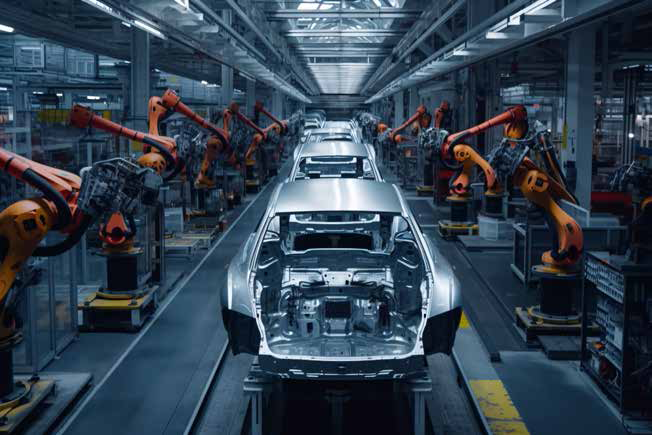
Traditional automation delivered the consistency, throughput, repeatability, and quality control that defined industrial competitiveness for five decades. The IFR’s World Robotics report confirms that 542,000 industrial robots were installed globally in 2024, more than double the figure from a decade ago, with annual installations exceeding 500,000 units for the fourth consecutive year. The total operational stock now stands at over 4.6 million units worldwide. This is not a technology in decline. It is a technology that has become foundational.
But traditional automation carries a fundamental assumption: that the operating environment is predictable. This means fixed layouts and stable workflows, suitable for known sequences. As manufacturing environments grow more complex and harder to staff, the conditions that traditional automation was designed to thrive in are becoming increasingly difficult to maintain. That is not a failure of the technology. It is simply the boundary of what rule-based systems can do.
What is Physical AI?
Physical AI refers to robotic systems that can perceive their environment, reason about what is happening, and take autonomous action in real-world conditions. Unlike traditional automation, which executes fixed instructions, Physical AI interprets context and makes decisions independently.
Characteristics of Physical AI:
- Perceives and responds to its environment in real time
- Makes context-aware decisions without human intervention
- Adapts to variable conditions and unexpected situations
- Coordinates across systems rather than optimising individual tasks
- Operates effectively in dynamic, unstructured environments
The biggest leap from traditional automation to Physical AI is the shift from programmed behavior to learned intelligence. Instead of repeatedly executing predefined rules, Physical AI observes, learns from every interaction, adapts to new situations, and becomes more effective over time.
The World Economic Forum’s 2025 white paper defines Physical AI as robotic systems capable of perception, reasoning, and autonomous action. The WEF identifies three emerging robotics systems that will coexist in the industrial environment: rule-based, training-based, and context-based robotics. Physical AI sits at the intelligent end of this spectrum, characterised by embodied intelligence, the ability to bridge the digital and physical worlds through continuous sensing, reasoning, and action.
The operational distinction matters more than the technical one:
- Traditional automation asks: What is the next step?
- Physical AI asks: What does this situation require?
Where automation executes a fixed instruction, Physical AI interprets context and decides. This is not an incremental upgrade. It is a different approach to the problem of variability, and variability is precisely what manufacturers are dealing with more of, not less.
Physical AI vs Traditional Automation, Key Differences and Five Changes on the Factory Floor
Before examining what changes operationally, it helps to understand where the two approaches fundamentally diverge. The table below maps the core distinctions across dimensions that matter most on the factory floor, including the shift toward adaptive automation and software-defined robotics that separates Physical AI from conventional autonomous vs automated thinking.
| Dimension | Traditional Automation | Physical AI | Why It Matters |
| Decision Logic | Rule-based execution | Context-aware decisions | Handles variability that traditional systems cannot |
| Workflow Type | Fixed, pre-programmed sequences | Dynamic, adaptive workflows | Enables autonomous vs automated operation |
| Response to Change | Requires human reconfiguration | Self-adjusts in real time | Reduces downtime from product or demand shifts |
| Optimisation Scope | Individual machine or task | Entire operation simultaneously | Reduces uncertainty, not just manual effort |
| Hardware Role | Hardware-centric deployment | Software-defined robotics | Change happens at the intelligence layer, not the physical line |
| Environment | Predictable, stable conditions | Variable, real-world environments | Supports adaptive automation across high-mix production |
With these distinctions established, here is what those differences translate to in practice.
| Change | What Shifts | Operational Impact |
| 1. Adaptive Production | Fixed SKU lines → dynamic routing | Handles product variability without line stoppages |
| 2. Edge Decision-Making | Exception escalation → machine-level resolution | Compresses response time, reduces skilled labour dependency |
| 3. Software-Defined Operations | Physical reconfiguration → intelligence layer updates | Reduces changeover cost and time |
| 4. Connected Robotics | Isolated assets → orchestrated systems | Optimises the full operation, not individual stations |
| 5. Operational Resilience | Reactive disruption management → autonomous recovery | Maintains continuity without constant human intervention |
Change 1: Production Becomes Adaptive Instead of Fixed
In a traditional automation environment, producing a different SKU or handling a new product variant typically requires physical reconfiguration. The production system is optimised for what it was built to do. Physical AI introduces dynamic routing and real-time task adjustment. As the WEF white paper describes, this adaptability allows intelligent robotics to handle variability rather than resist it, a shift from production that requires stable conditions to production that functions within changing ones.
Change 2: Decision-Making Moves to the Point of Operation
Traditional automation routes exceptions upward, which means when something falls outside the programmed parameters, a supervisor or engineer intervenes. Physical AI relocates that decision-making to the machine itself. The system identifies an exception, evaluates it against the operational context, and acts. This compresses response time significantly and reduces the demand on human operators for routine operational decisions, a meaningful advantage in environments where skilled labour is already stretched.
Change 3: Software Replaces Hardware as the Primary Lever for Change
When a traditional automated line needs to change, the change is often physical. Tooling, fixtures, conveyor layouts, robot end-effectors. In a software-defined robotics environment, change happens at the intelligence layer. The physical hardware becomes more general-purpose, and the logic governing how it behaves is updated through software. The Deloitte survey identifies automation hardware and connected systems as top investment priorities, but the strategic shift is toward software-driven adaptability, not just more hardware.
Change 4: Machines Become Collaborative Systems Instead of Isolated Assets
Traditional automation optimises individual stations. A robot at a welding cell performs its function. A conveyor moves product. Each asset operates within its defined scope. Physical AI enables coordination across systems. The WEF white paper describes how intelligent robotics orchestrates operations across multiple assets simultaneously, adjusting sequencing, redistributing workload, and responding to upstream and downstream conditions in real time. The IFR’s World Robotics data reflects this directional shift, with growing installations of collaborative and mobile robotic systems alongside traditional fixed-arm robots.
Change 5: Manufacturing Operations Become More Resilient to Disruption
Deloitte’s 2025 survey found that 65% of manufacturing executives rank operational risk as their first or second priority concern. Supply chain volatility, workforce absence, and unpredictable demand shifts make disruption a persistent operational reality rather than an exception. Unlike traditional automation, which depends on human intervention to restore order when something breaks down, Physical AI addresses resilience at the system level.
Distributed intelligence means the operation does not rely on a single point of control, so when one input changes, the system reconfigures around it autonomously. That structural capacity to absorb and respond to disruption is one of the primary reasons Physical AI adoption is accelerating in complex manufacturing environments.
Physical AI vs Traditional Automation Is Not a Replacement Debate
This distinction is worth stating clearly, because the conversation can easily drift in the wrong direction.
Physical AI does not replace traditional automation. The two operate at different layers of the manufacturing system:
- Traditional automation remains the execution layer, performing tasks at speed, at scale, and with consistency.
- Physical AI operates as the intelligence layer above it, interpreting conditions, making decisions, and directing execution.
Rule-based and context-based robotics are complementary systems designed to coexist, each contributing where it is best suited. Manufacturers who treat this as an either/or decision will misallocate resources. The more productive question is: where in the operation are conditions variable enough that intelligence delivers more value than fixed instruction?
Thinking about where intelligent automation fits in your operations? Novus Hi-Tech works with manufacturing teams to map exactly that. Talk to our team to start the conversation.
What Manufacturing Leaders Should Take Away from This Shift
The manufacturers paying closest attention to Physical AI are not doing so because it is a new technology trend. They are doing so because their operating environments are changing faster than rule-based systems can respond.
Deloitte’s survey reports that 78% of manufacturers are already allocating over 20% of their improvement budgets to smart manufacturing initiatives, with 88% expecting those investments to increase or hold steady. The strategic direction is clear. The competitive question is whether those investments are being directed at execution capacity alone or also at operational adaptability.
Manufacturers who embed intelligent industrial robotics as a strategic asset now will lead the next phase of industrial competitiveness. Those who treat it as a future consideration may find the gap harder to close than anticipated.
Operational adaptability, the ability to respond to complexity, variability, and disruption without halting production, is becoming a structural differentiator. That capability does not come from automating more tasks. It comes from making the operation intelligent enough to handle what it has not been pre-programmed for.
The Factory Floor Is Not Changing Because Machines Are Getting Faster
Traditional automation standardised manufacturing. It created the efficiency gains that defined industrial competitiveness for decades. That foundation is not going away.
Physical AI introduces something that traditional automation was never designed to provide: the capacity to respond to change. Not to execute a known task more efficiently, but to interpret an unknown situation and act appropriately.
The factories that outperform over the next decade may not be the ones with the highest density of automation. They may be the ones whose systems can adapt when demand shifts, when a new product enters the line, or when a disruption hits, without waiting for human intervention to restore order.
Physical AI vs Traditional Automation comes down to one difference: fixed logic versus adaptive intelligence. Traditional automation repeats a programmed task. Physical AI senses, decides, and acts in unstructured, changing environments
Explore What Intelligent Automation Looks Like in Your Operations
Understanding the distinction between Physical AI and traditional automation is the first step. The more important question is where your current operations stand to gain from adaptive, intelligent systems.
If you are evaluating your next phase of industrial automation, our team can help you identify where Physical AI creates the most operational leverage for your specific environment. Connect with Novus Hi-Tech to explore how intelligent robotics can work alongside your existing infrastructure.