
Why India Is Mandating ADAS for School Buses
For years, school transportation safety in India has rested on a familiar set of pillars, a trained driver, a compliant bus body, and a checklist of mandatory equipment. That model assumed the driver was the last line of defense. Regulators are now rewriting that assumption.
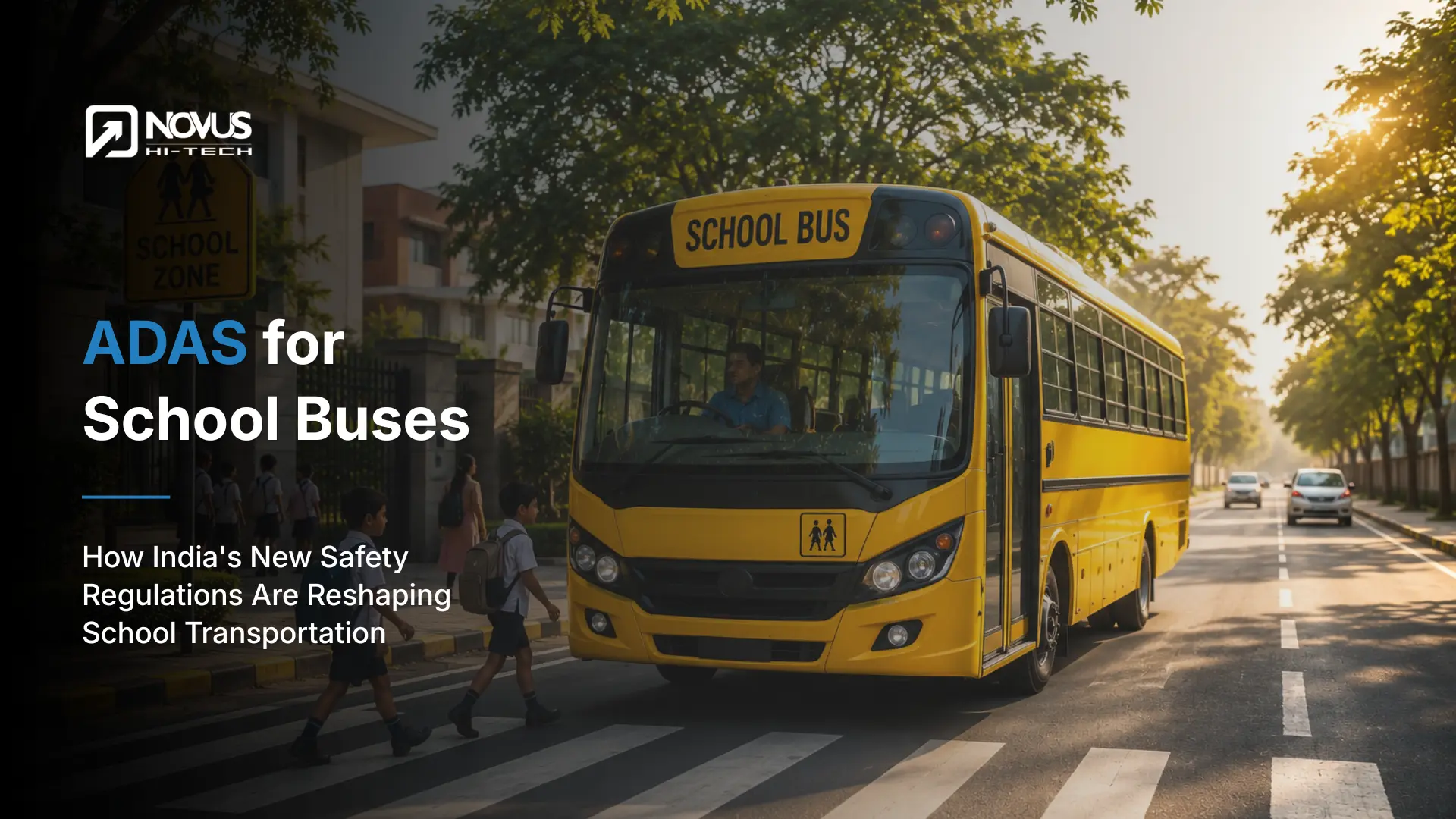
India is moving toward a generation of heavy vehicles, including school buses, that are required to actively assist drivers rather than simply meet static compliance standards. Reports indicate that ADAS for school buses is set to become non-negotiable as part of a broader mandate covering new buses and trucks, with the regulatory timeline pointing toward 2027 as the year several additional active safety systems become standard rather than optional, layered on top of an earlier 2026 rollout already underway.
The UNICEF data shows that road crashes claim the lives of over 42 children and 31 adolescents every single day in India, and a 2022 UNICEF report on child and adolescent road safety in South Asia found that India accounts for roughly 1 percent of the world’s vehicles but 11 percent of all road accident deaths globally. For school administrators and fleet operators, that gap between vehicle share and fatality share is precisely what the new regulatory direction is built to close, and it has direct implications for how buses are procured, retrofitted, and operated in the years ahead.
Why India’s Existing School Bus Safety Standards Are No Longer Enough
School transportation compliance in India has traditionally centered on physical standards, bus body construction under AIS 052, mandatory yellow paint and signage, AIS-140 compliant GPS tracking, speed governors, and driver licensing requirements. These rules govern what a bus must have. They say very little about what happens in the seconds before an accident.
That gap is what the new regulatory direction addresses, and it is unfolding in two distinct phases.
How the ADAS Mandate Is Rolling Out in Phases
The Ministry of Road Transport and Highways has mandated that vehicles in the M2, M3, N2, and N3 categories, which include buses and trucks, carry a defined package of Advanced Driver Assistance Systems, with new models required to comply from April 2026 and existing production models following from October 2026. Each technology in this package, including Advanced Emergency Braking System (AIS-162), Driver Drowsiness and Attention Warning System (AIS-184), and Lane Departure Warning System (AIS-188), is tied to a specific Automotive Industry Standard that defines exactly how it must perform, not just whether it is fitted.
The Union Minister for Road Transport and Highways Nitin Gadkari disclosed in a written reply to the Lok Sabha on February 12, 2026, that a revised braking standard (IS 11852:2019) and Electronic Stability Control under AIS-162 will become mandatory for trucks from October 1, 2027, extending requirements that previously applied only to OEM-manufactured buses. Global NCAP further notes that Blind Spot Information Systems and Moving Off Information Systems, which protect pedestrians and cyclists who remain invisible to drivers of large vehicles, are scheduled to become mandatory from January 1, 2028.
The reasoning behind this layered rollout is grounded in measurable risk, as road crash deaths in India reached an estimated 168,000 in 2022 alone, with up to 461,000 additional injuries recorded in the same period, and trucks and buses account for more than 25 percent of total road accident deaths nationwide despite representing a smaller share of total vehicles on the road. That context reframes ADAS from a technology upgrade into a direct response to a measurable safety gap involving the exact vehicle category schools depend on every day.
For school and fleet operators, this changes the nature of responsibility. Compliance is no longer just about passing an inspection at the time of purchase. It now extends to whether a vehicle can actively detect and respond to risk during operation, which has implications for procurement specifications, retrofit planning for buses already in service, and how accountability is demonstrated if an incident occurs. Fleets that wait until the October 2026 or October 2027 deadlines to act will be retrofitting under time pressure rather than planning on their own schedule.
What ADAS Features Do School Buses Need
The case for ADAS in school transportation becomes clearer when mapped against the operational realities of running a bus fleet, rather than being treated as a feature list.
| Operational Challenge | ADAS Capability |
| Driver fatigue on long or repetitive routes | Driver monitoring and drowsiness alerts |
| Crowded school zones and loading areas | Pedestrian detection |
| Rear-end collision risk in dense traffic | Forward collision warning |
| Lane drifting on highways or poor road markings | Lane departure warning |
| Verifying every child boards and exits at the right stop | In-cabin passenger counting and occupancy monitoring |
Each of these challenges already exists in Indian school transportation operations, and the performance bar regulators are setting is specific. AB Dynamics breakdown of AIS-162 test criteria shows that an Advanced Emergency Braking System must remain active across a speed range from 25 km/h up to a vehicle’s maximum design speed, and must issue a collision warning no later than 0.8 to 1.4 seconds before emergency braking engages, with the system required to prevent impact entirely once braking activates. These are not vague feature claims; they are pass-fail thresholds a system has to meet under test conditions.
Why Passenger Counting Matters More for School Buses Than Any Other Fleet
For most commercial fleets, the cargo cannot walk off the vehicle. School buses are the exception. A camera-based passenger counting system tracks boarding and deboarding at each stop, maintains a live occupancy count, and alerts the driver or transport administrator if a child remains on board after the route ends. Cases of children left inside parked school buses, sometimes with fatal outcomes during summer months, are exactly the category of incident this technology is built to prevent.
Beyond child safety, occupancy data gives school transport administrators verifiable records for parents, supports route optimization by showing which stops are over or under capacity, and helps demonstrate duty of care if an incident is ever questioned. When integrated with the same in-cabin camera hardware that powers driver monitoring, passenger counting extends the DMS investment from watching the driver to accounting for every student on the vehicle.
How Effective Is ADAS at Preventing Bus Accidents
The effectiveness data backs up why regulators are pushing this hard. School Bus Fleet, citing National Safety Council data, reports that ADAS adoption has been linked to a 40 percent drop in large-vehicle front-to-rear collisions. Separately, Global NCAP cites global safety data showing Autonomous Emergency Braking can reduce rear-end collisions by up to 40 percent, a figure consistent across both sources despite covering different markets. School Bus Fleet also notes that Blue Bird made Electronic Stability Control standard on all its air-brake buses back in 2019, alongside backup camera systems, indicating that parts of the school bus industry have already been moving in this direction ahead of regulation.
This is the core distinction fleet operators should internalize. ADAS is not a reactive logging tool that documents what went wrong after an incident. It is a proactive layer that reduces the probability of the incident occurring in the first place, built around driver monitoring systems that track fatigue and distraction alongside the advanced ADAS features that form modern collision avoidance suites.
How Much Does ADAS Cost for School Buses in India
Regulation changes procurement math, and fleet operators should plan for that directly rather than be surprised by it later. Industry estimates reported by Cartoq suggest that adding sensor-heavy ADAS suites could increase the cost of a heavy commercial vehicle by INR 50,000 to INR 1 lakh, depending on the complexity of the system fitted. Some manufacturers are already ahead of the deadline, Tata Motors’ Azura series and Prima range reportedly include collision mitigation systems and lane departure warnings as standard, positioning early adopters ahead of the compliance curve rather than scrambling to retrofit later.
This is also where the retrofit question becomes important for schools running older buses. The October 2026 deadline for existing production models, and the subsequent 2027 and 2028 deadlines for additional systems, mean that buses already in service will need a clear upgrade path, not just new purchases built to the new standard.
What Schools Should Look for Before Investing in ADAS
Not all ADAS offerings are built to the same standard, and the regulatory mandate creates pressure to adopt quickly. That makes a structured evaluation framework more important than a fast decision. Before investing, school and fleet decision-makers should assess whether a solution offers:
- Real-time alerts that reach the driver in time to act, not just data logged after the fact
- Driver monitoring covering fatigue, distraction, and attentiveness
- Pedestrian detection calibrated for crowded, mixed-traffic Indian road conditions
- Video evidence for incident review and driver coaching
- Fleet-level visibility for administrators managing multiple vehicles or routes
- Retrofit compatibility for buses already in service, not only new purchases
- Scalability across a growing or aging fleet
- Service and support availability, since sensor-based systems require calibration and maintenance
- Regulatory readiness aligned with the AIS standards underpinning the mandate
- Passenger counting and occupancy monitoring that confirms every student has boarded and deboarded, with end-of-route child left behind alerts
Novus Hi-Tech’s ADAS and DMS systems, designed in alignment with AIS-162, AIS-184, and AIS-188, are an example of what mandate-ready offerings look like in practice, built for retrofit deployment on existing fleets and calibrated for Indian road and traffic conditions. For operators working through this checklist, that combination of regulatory alignment and retrofit compatibility is what separates a compliant solution from one that simply ticks a box. Drawing on an ADAS implementation guide and broader modern fleet safety strategies built around distracted driving prevention can help narrow the evaluation further.
Preparing School Fleets for the Next Phase of Safety
India’s regulatory direction makes one thing clear, preventive safety technology is moving from optional to expected for the heavy vehicle category that includes school buses. The phased timeline running from April 2026 through January 2028 gives operators a window to prepare, but that window narrows for fleets that wait until enforcement begins to act.
Viewed strategically, ADAS adoption is not a compliance expense to be minimized. It is part of long-term fleet modernization, alongside future fleet technology trends that are already reshaping how commercial and passenger fleets operate across India. Schools and operators who evaluate their fleets now, against a clear framework rather than under regulatory pressure, will be better positioned to protect students and maintain operational resilience as the mandate takes full effect.
If your organization is assessing fleet readiness ahead of these regulatory changes, speak with our team to identify where your fleet stands today and what a phased upgrade path should look like before the 2026 deadline arrives.